

Shipping CIP From Bangladesh: How It Works, Costs and Pitfalls
CIP from Bangladesh splits cost from risk: the seller pays carriage and insurance to the destination, but risk passes at the first-carrier handover. This guide follows the booking, the insurance certificate and the documents, leg by leg.
Short answer
Under CIP (Carriage and Insurance Paid To), the seller contracts and pays for carriage to the named destination and buys insurance for the buyer, while risk passes to the buyer when the goods are handed to the first carrier in Bangladesh. The buyer handles import clearance, duty and onward carriage. Before the handover, check the insurance certificate for Clause (A) cover of at least 110 percent of the contract price.
On this page
Key takeaways
CIP splits cost from risk: the seller pays carriage and insurance to the named destination, while risk passes at handover to the first carrier.
Name both places in the contract: the delivery place where risk passes and the named destination where carriage and cover run to.
Check the certificate before handover: Clause (A) cover, at least 110 percent of the contract price, a direct claim route, and cover to at least the destination.
Budget import clearance, duty, unloading and onward carriage apart from the CIP price; they are for the buyer.
Two CIP quotations for the same order can look alike and still buy different things. One names the handover point as a container terminal in Chattogram, the other names a depot outside Dhaka, and the insurance certificate in the second file arrives two days after the goods have already changed hands. The price is a CIP price. The risk, cover and proof are not the same.
This guide follows a CIP shipment in the order the work happens: booking, insurance, handover, arrival. The CIP duties are the rule's own, under Incoterms 2020, separate from the sea-only rules of CIF.1
Two places, one price: what a CIP quotation actually buys
CIP stands for Carriage and Insurance Paid To. Under Incoterms 2020, the seller delivers the goods by handing them to the carrier it has contracted, and risk passes to the buyer at that handover. Where several carriers handle successive legs, delivery occurs on handover to the first carrier.1 The seller then pays for carriage to the named place of destination, and also buys insurance for the buyer's benefit.1 CIP applies to any mode of transport, including sea, road, rail, air, or a combination of modes.1
A CIP quotation therefore carries two places at once. The first is the delivery place, where the seller hands the goods to the carrier and risk passes. The second is the named place of destination, where the seller-paid carriage and the insurance cover run to. The Incoterms 2020 rules allocate cost, risk and obligations across 11 rules, and CIP is one of two rules that oblige the seller to insure for the buyer, the other being CIF.1 The Incoterms guide for shipments from Bangladesh sets out all 11 rules side by side. The seller completes export formalities, while the buyer handles import formalities, duty and transit customs.1 See the CIP clause guide for the contract wording.
Booking question | CIP answer |
|---|---|
Who contracts the carrier? | The seller |
Who pays carriage to the named destination? | The seller |
Where does risk pass? | Handover to the first carrier |
Who must place insurance? | The seller, for the buyer's benefit |
Who handles import clearance and duty? | The buyer |
Which modes does the rule fit? | Any mode, or a combination |
Booking the movement: the order in which a CIP shipment is put together
First, agree the two places in writing. Name the delivery place with the same precision as the destination: a terminal, depot or cargo warehouse, with a date or delivery window, not only a city. If the delivery place is not agreed, the seller may choose it, so a quotation that says only "CIP Felixstowe" has left the risk point open. Name the first carrier, or the class of carrier, and state who chooses a substitute.
Second, have the seller contract the carriage. The seller books the main carriage to the named destination and confirms the sailing or flight, the transshipment points and the expected arrival in writing. Ask for the booking confirmation itself, and check that the destination on the booking matches the destination in the contract word for word. Third, place the insurance before the handover, as set out in the next section. No handover should happen until the certificate has been seen and checked.
Fourth, complete the export set. The seller completes export clearance and prepares the commercial invoice, packing list and transport document for the mode used. Bangladesh Customs clearance for export requires approval of the Bill of Export, with the export contract or purchase order, commercial invoice, packing list, EXP form and certificate of origin enclosed.2 Fifth, record the handover: the seller must notify the buyer in a timely manner that delivery has occurred. Keep the carrier receipt and the transport document with the notice, because together they prove where and when the handover happened. Sixth, the buyer receives at the destination: import clearance, duty, unloading, onward carriage, and inspection before signing.
The flow below shows the same sequence as a single line, from the factory to the first carrier and on to the destination.
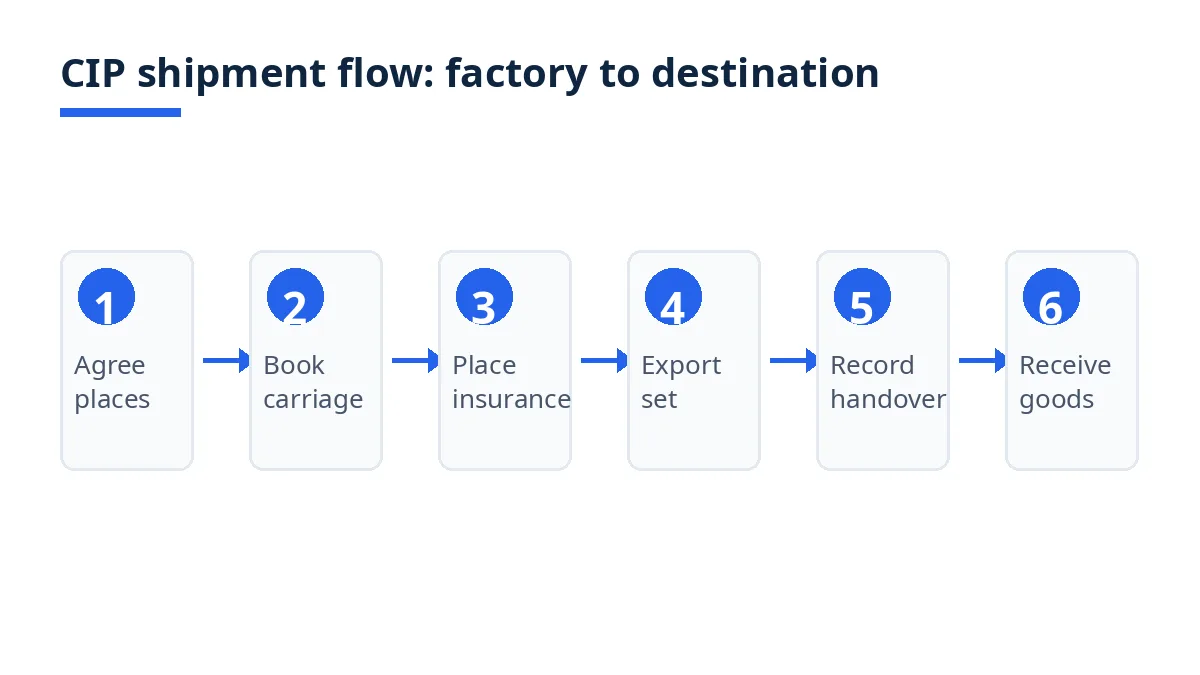
Agree both places. Delivery place, destination, first carrier, delivery window.
Book the carriage. Seller contracts and pays for carriage; booking confirmation checked against the contract.
Place the insurance. Certificate checked before handover.
Complete the export set. Bill of Export, invoice, packing list, EXP form, certificate of origin.2
Record the handover. Delivery notice, carrier receipt and transport document kept together.
Receive at destination. Buyer clears imports, pays duty, inspects.
Placing the insurance: what to see on the certificate before handover
Insurance is what makes CIP different from CPT. Under CPT the seller pays carriage and owes no insurance. Under CIP the seller must obtain cover complying with Institute Cargo Clauses (A), or equivalent cover, for at least 110 percent of the contract price, for the buyer, and must give the buyer the policy or certificate so the buyer can claim directly.1 Cover must run from delivery to at least the named destination. The CPT insurance guide explains the contrast from the CPT side.
Check five rows on the certificate before the handover, and ask the broker to confirm any row that is unclear. The level of cover should state Clause (A), or equivalent cover, as the minimum; the narrower Clause (C) level is the CIF minimum, not the CIP minimum. The insured amount should be at least 110 percent of the contract price, in the contract currency. The beneficiary and claim route should let the buyer claim directly from the insurer. The period of cover should run from delivery to at least the named destination. The goods, marks and order number should match the invoice and the packing list.
Example figures: a contract price of USD 28,000 for jute bags gives a minimum insured amount of USD 30,800 at 110 percent. The example shows the arithmetic only; the premium is a separate figure, agreed with the insurer. Ask the broker in writing which losses sit outside Clause (A) cover, and whether war, strikes or special stow conditions need separate clauses. The CIP quotation comparison guide shows how to test quotations against the same rows.
Costs, timelines and documents: reading a CIP quote line by line
A CIP price is a bundle. Ask for the quotation split into seller-paid and buyer-paid lines, and compare quotations only when both splits use the same delivery place and the same named destination.
Cost line | Paid by | What to check |
|---|---|---|
Inland carriage to the handover point | Seller, within the CIP price unless stated otherwise | Whether the factory-to-terminal leg is inside the price |
Main carriage to the named destination | Seller | Sailing or flight, transshipment, and what the freight price excludes |
Insurance premium | Seller, within the CIP price | Clause (A) level and the insured amount on the certificate |
Export clearance and export documents | Seller | Bill of Export approval and the enclosed document set2 |
Import clearance, duty and taxes | Buyer | Duty basis and the import document set for the destination |
Unloading and onward carriage beyond the named destination | Buyer | Terminal handling and delivery to the final warehouse |
Example figures: main carriage USD 2,400, insurance premium USD 180, and inland carriage to the terminal USD 260 inside a CIP price of USD 30,840 for the jute-bag order above. The figures show structure only, not market rates.
Timelines under CIP are carrier timelines, not rule timelines. The CIP rule sets no transit days, so ask for the sailing or flight date, the transshipment points, and the expected arrival at the named destination, each in writing from the carrier booking. A handover that slips by a week changes the insurance start date and the arrival plan, and both should be re-confirmed in writing when the booking changes.
Before handover, the buyer should hold the contract, the itemised quotation, the invoice and the packing list. At handover, the seller should send the delivery notice, the transport document and the insurance certificate. At the destination, the buyer should hold the import clearance set, the noted delivery receipt and the claim file. Where a letter of credit is used, check the documents against the credit's list and names before booking.
Chattogram, Mongla and Dhaka airport: where the handover sits on each route
The handover point is a place, not a mode, and it often sits inland, before any port gate or airport terminal. Confirm with the forwarder where handover will happen before booking.
On a container movement through Chattogram, the first-carrier handover may happen at the factory gate, at an inland container depot, or at the carrier terminal. Each is a valid delivery point, and each moves the risk to the buyer at a different place and time. Check that the insurance period starts at that handover, not at vessel loading: a policy that attaches only at the port gate leaves the factory-to-depot leg and the depot wait outside cover while the risk has already passed.
Mongla follows the same discipline. Do not accept a certificate that ends cover at an intermediate port. On an air consignment, delivery happens at handover to the air carrier at the cargo terminal, not when the aircraft departs, and cover arranged from the flight date starts too late for damage in the terminal after handover. CIP fits air freight because it is an any-mode rule, while CIF does not, since CIF is a sea and inland waterway rule.1 The CIF shipping guide describes the sea-only counterpart, where risk passes on board the vessel and the insurance minimum is Clause (C). Whichever gateway is used, the three points match across the contract, the booking, the transport document and the certificate.
Pitfalls that surface after the handover
Most CIP losses are found after the handover, when the buyer discovers that the paper does not support the bargain that was assumed. Each pitfall below is fixed before the goods move.
A certificate dated after the handover. Cover that starts after delivery leaves the first leg uninsured. Check the start date against the delivery notice.
Only the destination named. A contract with one place reads as if risk follows the freight. It does not. Name the delivery place and the destination, in full.
Clause (C) cover on a CIP sale. Clause (C) is the narrower tier and the CIF minimum. On a CIP sale the minimum is Clause (A), or equivalent cover.1
An insured amount below 110 percent. A policy for the goods value alone does not meet the CIP minimum. Check the amount against the contract price, in the contract currency.1
Cover ending at an intermediate port. Cover must run to at least the named destination.
A policy the buyer cannot claim on. The buyer must be able to claim directly from the insurer.
A clean receipt signed for damaged goods. Inspect, count, photograph and remark damage before signing, then notify the carrier and insurer in writing.
Before you confirm: a CIP booking checklist
The contract states CIP, the destination, the delivery place and point, the first carrier, and Incoterms 2020.
The delivery place is a named terminal, depot or cargo warehouse, and the seller will send the delivery notice on the day of handover.
Insurance certificate seen before handover: Clause (A) cover, at least 110 percent of the contract price, direct claim route, cover to at least the destination.1
The booking confirmation matches the contract destination, with the sailing or flight, transshipment points and expected arrival in writing.
The export set is agreed: Bill of Export approval, commercial invoice, packing list, EXP form and certificate of origin.2
The quotation split shows the seller-paid and buyer-paid lines, with import duty, unloading and onward carriage budgeted apart from the CIP price.
Any letter-of-credit list has been checked against the insurance and transport documents, with matching names.
The arrival file is ready: certificate, delivery notice, carrier receipt, invoice, packing list, transport document, and the insurer's claims contact.
How Exportain helps
On Exportain, post a request for quotation (RFQ) that states the CIP term in full, with the delivery place, the named destination and the insurance position. An RFQ states the quantity and unit, the target price, the destination, the Incoterm, the required certifications and the deadline.3 Ask each reply for the certificate rows in writing. Read the badges for what they record. Exportain Verified means Exportain has checked identity, phone, email and business registration, and Export Verified means it has checked the Export Registration Certificate.4 Verification is a document review by staff, free, never granted by membership plans, and not a factory inspection.4
What should I know first about a CIP shipment from Bangladesh?
Know first that CIP splits cost from risk: the seller pays carriage and insurance to the destination, while risk passes to the buyer at handover to the first carrier, and the buyer handles import clearance, duty and onward carriage.1 Check the certificate for Clause (A) cover of at least 110 percent of the contract price before handover.
What are the typical costs and timelines under CIP?
There is no standard CIP freight rate or transit time in the rule. Ask for the quotation split into seller-paid and buyer-paid lines, with the sailing or flight, transshipment points and expected arrival in writing, and budget import duty, unloading and onward carriage apart from the CIP price. Ask the broker for the premium in writing.
Which documents are needed for a CIP shipment?
The seller provides the invoice, packing list, transport document, delivery notice, insurance certificate, and the export set, including Bill of Export approval with the export contract or purchase order, invoice, packing list, EXP form and certificate of origin.2 The buyer provides the import set and holds the certificate, notice, receipt and noted delivery receipt for any claim. Check that places and names match across every document before booking.
What are the most common mistakes under CIP?
The most common mistakes are naming only the destination, accepting a certificate after the handover, accepting Clause (C) cover or an amount below 110 percent, letting cover end at an intermediate port, and signing a clean receipt for damaged goods.1 Fix them the same way: name both places, see the certificate before handover, check the clause and amount, and inspect before signing.
Next steps on Exportain
Browse suppliers, then post the CIP term, with the delivery place and the named destination, on the RFQ board so suppliers quote on the same delivery basis. Before you confirm, read how to buy from Bangladesh and the Incoterms guide for shipments from Bangladesh. Post a free RFQ on Exportain and get quotes from Bangladeshi suppliers through the RFQ board.
Sources
- Incoterms® 2020. International Chamber of Commerce (ICC) (accessed )
- Customs Clearance Procedures for Export. Bangladesh Customs, National Board of Revenue (accessed )
- How to source and buy from Bangladesh. Exportain (accessed )
- Trust & Safety Center. Exportain (accessed )
About the author
Sourcing from Bangladesh?
Post a request for quotation and suppliers on Exportain can send you their quotes directly.
Post an RFQ


