

How to Write a CIP Clause in Your Sales Contract (Template Included)
A CIP clause that names both the delivery point and the destination, states Incoterms 2020, and sets Clause (A) insurance at 110% for the buyer's benefit, with a copy-ready template table and a Chattogram to Milan filled example.
Short answer
A CIP clause names the named place of destination and the place of delivery, states Incoterms 2020, and fixes the split that defines CIP: the seller hands the goods to the carrier it contracts, risk passes to the buyer on that handover, and the seller pays carriage to destination and procures Clause (A) insurance for at least 110% of the contract price for the buyer's benefit. The buyer clears import and pays for onward carriage beyond destination.
On this page
A CIP clause that says the seller will insure the goods, but never names the level of cover, the insured amount, or who can claim, leaves the buyer holding transit risk with an unusable policy. Under CIP, that gap matters most, because the insurance is what the buyer pays for in the price.
This article gives drafting guidance only and is not legal advice. Ask a lawyer or broker to review the wording and policy before the goods move.
What the document is for
The CIP clause is the delivery section inside a sales contract. CIP means Carriage and Insurance Paid To. Under Incoterms 2020, the seller delivers by handing the goods to the carrier it contracts, and risk passes to the buyer at that handover.1 If several carriers handle successive legs, delivery occurs on handover to the first carrier.1 The seller then pays for carriage to the named place of destination, and also procures insurance for the buyer's benefit.1
CIP works for any mode of transport, including sea, road, rail, air, or a combination of modes.1 That scope suits container cargo at an inland terminal, air freight from Dhaka, or a multimodal journey. The clause must carry two places at once: delivery, where risk passes, and destination, where seller-paid carriage and insurance end.1
The insurance duty defines CIP. Under Incoterms 2020, the seller must obtain cover complying with Institute Cargo Clauses (A), or equivalent cover, for at least 110% of the contract price, for the buyer, and must give the buyer the policy or certificate so the buyer can claim directly.1 Cover must run from delivery to at least the named destination.2 The seller completes export formalities, while the buyer handles import formalities and transit customs.1
Two contrasts fix CIP in place. CPT has no insurance obligation: the seller pays carriage, and the buyer arranges any cover itself. CIF is sea and inland waterway only, with Clause (C) as its minimum level of cover. The clause does not set the price, the payment method, or when ownership passes.1
Required fields explained
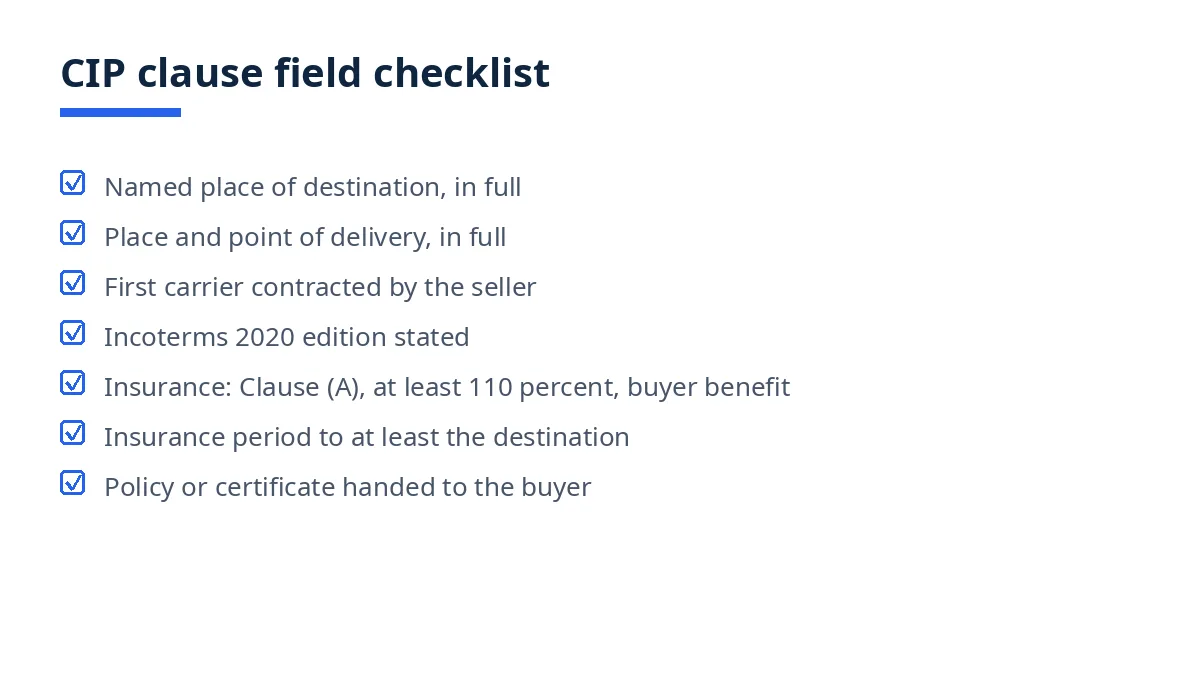
Fill in every field before signing, and check the insurance rows against the policy.
Named place of destination, in full. Write the destination as "CIP (named place of destination) Incoterms 2020". Name the airport, terminal, or depot, not only a city.1
Place and point of delivery, in full. Name where the seller hands the goods to the carrier; delivery and risk transfer happen there.1
First carrier. State that the seller contracts the carrier, and who chooses a substitute.1
Incoterms version. Write "Incoterms 2020" in full, beside the rule and the named destination. Without the edition, the governing rules are not fixed.
Delivery event and risk transfer. State in one sentence that delivery occurs, and risk passes, on handover at the agreed delivery point, not on arrival.1
Main carriage scope. State that the seller will pay for carriage to the named destination, and list what the freight price covers and excludes.2
Insurance level. State cover complying with Institute Cargo Clauses (A), or equivalent cover, as the minimum, and name any wider cover and its payer.1
Insured amount and currency. State at least 110% of the contract price, in the contract currency, as figures that can be checked before signing.2
Insurance period, beneficiary, and claim route. State cover from delivery to at least the destination, bought for the buyer's benefit, with a direct claim route, and name the insurer.1
Policy handover and agreed variations. State when the seller will hand over the policy or certificate, and state any cover different from Clause (A) expressly, with its payer.2 3
Clearance split. State that the seller will complete export formalities, and that the buyer will handle import clearance, duty, and transit customs.1
Delivery window and notice. State the handover date or window, and how the seller will notify the buyer on handover.1
Onward carriage beyond the destination. State that carriage beyond the named destination is for the buyer unless agreed otherwise.1
Goods covered. Name the goods, quantity, marks, and order number.
Template (table)
Copy the table into the contract and fill in every row.
Clause element | Wording to use | Fill in |
|---|---|---|
Delivery term | CIP (destination) Incoterms 2020. | Destination. |
Delivery point | Seller hands goods to the carrier here. | Terminal. |
First carrier | Seller contracts the carrier. | Carrier. |
Delivery and risk | Delivery, and risk, pass on handover. | One point. |
Main carriage | Seller pays carriage to the destination. | Inclusions. |
Insurance level | Clause (A), or equivalent, as minimum. | Level, payer. |
Insured amount | At least 110% of the contract price. | Amount, currency. |
Insurance period | From delivery to at least the destination. | Start, end. |
Beneficiary and claim | For the buyer's benefit; direct claim. | Insurer, route. |
Policy handover | Seller hands over policy or certificate. | Document, date. |
Export clearance | Seller completes export clearance. | Documents. |
Import and transit | Buyer handles import, duty, transit customs. | Assistance only. |
Window and notice | Seller notifies buyer on handover. | Dates. |
Beyond destination | Onward carriage is for the buyer. | Exception. |
Goods covered | Goods, quantity, and order in the contract. | Order, marks. |
If any row is still blank, the clause is not finished.
Filled example
All names, figures, and dates below are examples only. Adapt every entry before signing.
Example clause. Delivery is CIP Milan Malpensa Airport, Italy, Incoterms 2020. Example Leather Goods Ltd will hand 250 cartons of leather wallets, order number EX-6183, to the first carrier at the Chattogram container terminal on or between 7 and 9 July. The seller will contract and pay for carriage to Milan Malpensa Airport, and will notify the buyer on handover. Delivery occurs, and risk passes, on handover to the first carrier at Chattogram. The seller will buy insurance for the buyer's benefit complying with Institute Cargo Clauses (A) as the minimum, for at least 110% of the example contract price of USD 36,000, giving a minimum insured amount of USD 39,600, covering the goods to at least Milan Malpensa Airport, and will hand the buyer the insurance certificate for a direct claim. Example Retail SpA, the buyer, will handle import clearance, duty, unloading, and onward transport.
The example turns on the policy: the buyer carries the risk from Chattogram, and the certificate makes it insurable.
Common errors
Naming only the destination. A CIP clause with one place reads as if risk follows the freight and the insurance. It does not: risk passes at the delivery place.1 Name both places, in full.
Writing arrival wording for a handover rule. Sentences such as "delivery on arrival at destination" contradict CIP: delivery is the handover to the carrier, not arrival.1
Writing Clause (C), or no level at all. CIP's minimum under Incoterms 2020 is Clause (A), not Clause (C).1 Clause (C) is the CIF minimum, and copying it gives narrower cover.
Insuring below 110% of the contract price. The minimum is at least 110%, in the contract currency.2 A policy for the goods value alone does not meet the CIP minimum.
Ending cover before the destination. Cover must run to at least the named place of destination.2 A policy ending at an intermediate port leaves the last leg uninsured.
Naming the seller as the only insured party. The buyer must be able to claim directly from the insurer.1 A policy the buyer cannot claim on is of little use in transit.
Reading Clause (A) as cover for every loss. Clause (A) is broad cover, but it remains subject to exclusions and deductibles; "all risks" does not mean every loss is covered.2
Omitting the Incoterms version. Without "Incoterms 2020", the governing edition is not fixed.2
Assuming CIP includes import duty and destination charges. Import clearance, duty, and unloading are for the buyer.1
FAQs
Who issues this document?
No authority issues a CIP clause, and there is no CIP issuing authority. It is a delivery section the buyer and seller draft into their sales contract, using Incoterms 2020 CIP and the two places it names.
Which fields are mandatory?
The delivery term, edition, delivery point, first carrier, risk sentence, carriage scope, clearance split, and the full insurance set are all needed: Clause (A) level, at least 110% of the contract price, cover to at least the destination, beneficiary and claim route, and policy handover.
Can it be digital?
Yes. The clause is contract text, so it can sit in a digitally signed contract. Keep the policy or certificate with the contract record, and check that the transport document meets the contract and the buyer's import requirements.3
What errors cause delays?
A missing or vague delivery point, an unnamed carrier, cover below Clause (A) or below 110%, cover ending before the destination, and a policy the buyer cannot claim on cause the most delays.
Next steps on Exportain
Read the Incoterms guide for shipments from Bangladesh to compare CIP with the other ten rules, and the CIF guide if you are weighing a sea-only insured term against an any-mode insured term. When you are ready to buy, read how to buy from Bangladesh, then Post a free RFQ on Exportain stating the quantity, destination, and Incoterm, so suppliers quote on the same delivery basis.
Sources
- CPT & CIP Incoterms 2020 explained: Key differences. ICC Academy (accessed )
- CIP Incoterms (Carriage and Insurance Paid To) Explained. iContainers (accessed )
- CIP Incoterms Explained: Risks, Costs & Tips. FreightAmigo (accessed )
About the author
Sourcing from Bangladesh?
Post a request for quotation and suppliers on Exportain can send you their quotes directly.
Post an RFQ


