

Insurance Under CPT: Who Must Insure the Cargo and for How Much?
Under CPT, neither party must insure the cargo: the buyer bears the risk from handover to the first carrier and arranges its own cover. How to choose the clause tier, set the sum insured, and keep cover running to the final warehouse.
Short answer
Under CPT, neither the seller nor the buyer must insure the cargo. The seller pays carriage to the named destination, but risk passes to the buyer at handover to the first carrier, so the buyer arranges cover at its own cost from the handover date, on the seller's delivery notice. The buyer chooses the Institute Cargo Clause tier and sets the sum insured, since CPT prescribes no minimum.
On this page
Key takeaways
Under CPT, neither party must insure the cargo: only CIF and CIP oblige the seller to insure for the buyer, so the buyer arranges cover at its own cost from the handover date.
Risk passes at handover to the first carrier, not on loading or arrival, and the seller's delivery notice is the trigger for the buyer's cover.
Clause (A) is all-risks cover, Clauses (B) and (C) pay only for listed perils, and Clause (C) does not cover theft, washing overboard, or water entry.
CPT sets no sum insured: build the figure from invoice value, freight, duty where permitted, and margin, and record the valuation basis in the schedule.
Cover should run from the first movement for transit to the final warehouse, including the depot wait and transshipment, within the 60-day limit after discharge.
A consignment of cotton home textiles is accepted by a carrier at an inland container depot outside Dhaka. The seller has paid the freight to Rotterdam, yet from that handover the risk is yours, the buyer, and CPT insurance, the cover you arrange yourself, is the only policy standing between damaged goods and a loss you carry alone. This guide follows that handover moment: when risk starts, how long cover should run, which clause tier fits, and how to set the sum insured.
The short answer: nobody must insure under CPT
Under CPT, neither the seller nor the buyer must insure the cargo. Of the 11 Incoterms 2020 rules, only CIF and CIP oblige the seller to insure for the buyer.1 The CPT seller contracts and pays for carriage to the named destination, completes export formalities, and delivers the goods to the first carrier, but no insurance duty sits in that list.1 The buyer who wants cover arranges it at the buyer's own risk and cost, through to the final destination.1
A CPT price contains no insurance line, and no insurance document will follow from the seller unless the parties agree one separately. If the seller offers to arrange cover, record it as a separate agreement: clause, sum insured, currency, premium payer, and policy holder. A verbal assurance creates no policy the buyer can claim on.
CPT beside CIP and CIF: the insurance line is the only difference
CPT and CIP share the same delivery point, risk point, and carriage duty. The difference is insurance only. Under CIP the seller must obtain cover at Institute Cargo Clauses (A) level for at least 110 percent of the contract price, for the buyer's benefit.1 Under CPT the seller owes no insurance at all.1 CIF sits apart: it is a sea and inland waterway rule, risk passes on board the vessel, and the seller's minimum cover is the narrower Institute Cargo Clauses (C) level, which most CIF contracts use as the default.2
Rule | Where risk passes | Seller pays carriage to | Seller must insure |
|---|---|---|---|
CPT | Handover to the first carrier | Named place of destination | No |
CIP | Handover to the first carrier | Named place of destination | Yes, Clause (A), at least 110 percent |
CIF | On board the vessel | Named port of destination | Yes, Clause (C) minimum |
Choosing CPT is a choice about control: a buyer with a standing cargo policy avoids paying twice, once in a CIP price and once under its own cover. A buyer who wants the seller to carry the duty should choose CIP and check the certificate names Clause (A) cover. Never read the CIP minimum back into CPT: the 110 percent figure is a CIP duty, not a CPT rule.
When the buyer's risk starts: the first-carrier handover
Risk under CPT passes when the seller hands the goods over to the carrier the seller contracted, at the agreed place and point of delivery.1 Where several carriers are involved, delivery occurs at handover to the first carrier, even though the seller keeps paying carriage to the named destination, and it does not wait for loading or arrival.1
The seller must notify the buyer in a timely manner that delivery has occurred, with the information the buyer needs to receive the goods at the destination.1 That delivery notice is the buyer's trigger: the timely notice allows the buyer to be aware that it has assumed risk and to organise insurance accordingly.1 Treat the notice as the start of cover, not the sailing date or the flight date. A consignment waiting in the carrier's warehouse over a weekend, or at a transshipment terminal between legs, is already at the buyer's risk while it waits.
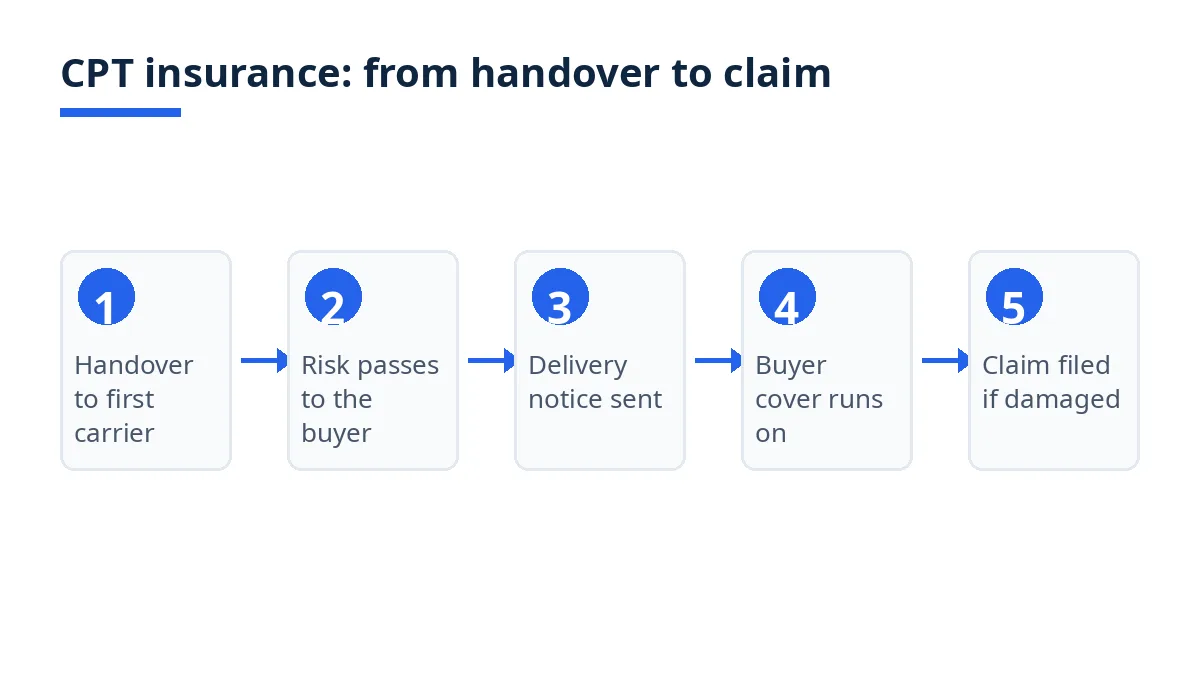
Agree the delivery place in the contract with the same care as the destination: the citation for a C term names the destination, not the delivery point, so "CPT Rotterdam, Incoterms 2020" alone does not say where the goods changed hands.1 If the delivery place is not agreed, the seller may choose it.1 Name the depot, terminal, or warehouse, and the delivery date, so the handover can be proved from the carrier's receipt and the transport document.
How long buyer cover should run: from the warehouse to the final warehouse
Under the Institute Cargo Clauses, cover attaches from the time the goods are first moved in the warehouse or place of storage named in the policy for immediate loading for the commencement of transit, continues during the ordinary course of transit, and terminates on delivery to the final warehouse, on delivery to other storage the buyer elects to use, or on expiry of 60 days after discharge overside at the final port of discharge, whichever occurs first.3
Read that wording against the real journey before the goods move. Name the final warehouse in the policy, not only the destination port or airport, so the onward leg from the terminal to the warehouse sits inside cover. Check the 60-day limit against the real plan: a slow customs release or a wait for an onward booking can consume the period while the goods still sit at the port. Where the goods are forwarded to a destination other than the one insured, the policy does not extend beyond the start of transit to the other destination unless the change is notified and agreed.3 If the destination changes after cover attaches, notify the insurer promptly so rates and terms can be agreed.3
Which clause tier fits the cargo: A, B or C
Most marine cargo policies use the Institute Cargo Clauses, published by the Lloyd's Market Association and the International Underwriting Association of London: Clause (A) CL382, Clause (B) CL383, and Clause (C) CL384, in force since 1 January 2009.2 The tier on the certificate decides which causes of loss pay.2
Clause (A) covers all risks of loss or damage except the risks specifically excluded in the wording.2 Clauses (B) and (C) pay only for listed perils. Clause (B) covers more than Clause (C): earthquake, volcanic eruption, lightning, washing overboard, and entry of sea, lake, or river water are covered under Clause (B) and not under Clause (C).2 Theft, pilferage, non-delivery, malicious damage, and rough handling damage sit in the Clause (A) column only.2
Peril | Clause (A) | Clause (B) | Clause (C) |
|---|---|---|---|
Fire or explosion | Yes | Yes | Yes |
Vessel stranding, grounding, sinking, or capsizing | Yes | Yes | Yes |
Washing overboard | Yes | Yes | No |
Earthquake, volcanic eruption, or lightning | Yes | Yes | No |
Entry of sea, lake, or river water | Yes | Yes | No |
Theft, pilferage, or non-delivery | Yes | No | No |
All three tiers exclude wilful misconduct, ordinary leakage and wear and tear, insufficiency of packing, inherent vice, delay, and war and strikes risks, which sit under separate clauses.2 War cover requires the Institute War Clauses and strikes cover the Institute Strikes Clauses, so ask for them expressly where the route calls for them.2 Match the tier to the cargo, not to the premium alone: Clause (A) suits high-value, fragile, or theft-prone goods; Clause (C) can suit low-value, durable bulk cargo.
How much CPT insurance to buy: a commercial decision, not a CPT figure
CPT sets no sum insured, so the figure is the buyer's commercial decision, agreed with the broker and recorded in the schedule. Start from what a total loss would cost: the goods, freight paid, duty and charges where the wording permits them, and the margin lost with the consignment. Insuring the invoice value alone leaves the rest unrecovered.
Flexport calculates total insured value as invoice value plus freight, uplifted by 10 percent, plus customs and duties fees, with the uplift capturing price movements and unforeseen administrative expenses between purchase and claim resolution.4 That is one provider's practice, not an Incoterms requirement, and under-declaring can leave the buyer under-compensated on a loss.4
Example figures: cotton home textiles invoiced at USD 36,000, plus freight of USD 3,200, gives USD 39,200. A 10 percent uplift adds USD 3,920, giving USD 43,120, and expected duty of USD 2,100 brings the total insured value to USD 45,220. The example shows the arithmetic only: confirm the duty element with the insurer, and tell the broker before loading if the value changes. The 110 percent figure remains a CIP duty, not a CPT rule.1
If the seller offers to arrange cover: treat it as a separate agreement
A seller who arranges cover for the buyer under a CPT sale is providing an extra service, not performing a CPT duty. Put that service in a separate written agreement, apart from the CPT term, and settle each point before the goods move: the clause tier and clause number, the sum insured and its valuation basis, the currency, who pays the premium, who holds the policy, who is entitled to claim, the period of cover from handover to the final warehouse, and when the insurance document will reach the buyer for checking.
Check any letter of credit at the same time: an insurance document appears in its document list only where the credit calls for it, as in the ICC Academy's CIP case.1 Agree the bank's clause, value, and assignment terms before booking, with one set of names across the policy, transport document, and invoice. Where the deal is that the seller carries the duty as a term of the sale, change the term to CIP, which puts the Clause (A) duty and the 110 percent figure in the rule itself.1
Air freight and multimodal legs: the gap follows the handover, not the mode
CPT applies to any mode of transport, including sea, road, rail, air, or a combination, and the insurance gap follows the handover in every one of them.1 On an air shipment, delivery happens at handover to the air carrier at the cargo terminal, not when the aircraft departs, and cover arranged from the flight date starts too late for damage in the terminal after handover. On a multimodal movement, delivery happens at the first carrier, and the risk the buyer carries runs across every later leg the seller's carriage contract covers.1
Cover remains in force during delay beyond the buyer's control, deviation, forced discharge, reshipment or transshipment.3 A changed destination should still be notified promptly, since the wording decides whether the new routing sits inside the insured transit.3 Confirm in writing that the policy spans the feeder leg, the transshipment wait, and the main voyage.
After damage or loss: notice, survey and the claim file
The assured must take reasonable measures to avert or minimise a recoverable loss and to preserve rights against carriers, bailees, and other third parties, and the insurer reimburses charges properly incurred in those duties.3 Inspect before signing a clean receipt, count the packages against the transport document, photograph damage while the goods are still in the container, vehicle, or warehouse, and remark the damage on the delivery documents with the number of damaged packages, the type of damage, and the date.
Give notice twice, in writing: to the carrier, reserving the right to claim, and to the insurer or the agent named on the certificate, within the time the policy allows. Obtain a survey before the goods are moved or repaired, and keep the damaged goods and packing until the insurer accepts disposal. Hold the claim file ready: the policy and schedule, delivery notice and handover receipt, invoice, packing list, transport document, noted delivery receipt, photographs, survey report, and dated correspondence.
Bangladesh handover points: where cover must already be in force
On shipments from Bangladesh, the first-carrier handover often happens inland, well before any port or airport: at the factory gate, at an inland container depot, at a carrier terminal, or at the Dhaka airport cargo terminal. Each is a valid CPT delivery point, and each moves the risk to the buyer at a different place and time, so the contract should name the delivery point with the same precision as the destination, and the buyer should confirm with the forwarder where handover will actually happen.1
A policy that attaches only at the port gate, or only on loading, leaves the factory-to-depot leg and the depot wait outside cover, while the risk has already passed. Ask the insurer in writing whether the policy covers the goods from the first movement for the commencement of transit, through the depot wait, to the final warehouse.3 Do not hold a CPT shipment for a seller insurance document: none is due under CPT.1
Gaps that leave CPT cargo uninsured
Assuming prepaid freight means insured cover. The seller pays carriage to the destination and owes no insurance. No insurance line on a CPT invoice is normal, not an omission.
Starting cover at loading, sailing, or departure. Delivery happens at handover to the first carrier. Cover dated from loading starts too late for damage in the carrier's warehouse or at the terminal.
Accepting Clause (C) for theft-prone or water-sensitive cargo. Clause (C) is the narrowest tier and does not cover theft, washing overboard, or water entry.2
Setting the sum insured at the invoice value only. Freight, duty, and margin are real losses on a total loss. Agree the valuation basis with the insurer and show it on the schedule.4
Relying on the seller's own policy. Unless the certificate names the buyer's interest or is assigned to the buyer, the buyer holds no cover. The assured must have an insurable interest at the time of the loss.3
Signing a clean receipt for damaged goods. Inspect, count, remark, and photograph before signing, and notify the carrier and the insurer in writing within the policy time.
Leaving a changed destination unnotified. A destination changed after cover attaches must be notified promptly for rates and terms to be agreed.3
Using CPT wording for a CIP bargain. If the deal was that the seller insures, record it with CIP. CPT wording does not carry that bargain.1
Before handover: a buyer checklist
The contract states CPT, the named destination, the place and point of delivery, and Incoterms 2020, with the delivery date or period.
The first carrier and handover place are stated in writing, and the seller will send the delivery notice on the day of handover.
The buyer policy is in force from the handover date, with the clause tier, sum insured, valuation basis, currency, and final warehouse named in the schedule.
The transit wording covers the depot leg, the terminal wait, transshipment, and the onward leg to the final warehouse, including the 60-day limit after discharge.
War, strikes, deck carriage, refrigeration, and special stow conditions are asked about and answered in writing.
Any seller-arranged cover is recorded as a separate agreement, or the term has been changed to CIP.
Any letter-of-credit insurance term is agreed before booking, with matching names across the policy, transport document, and invoice.
The shipment file holds the policy, the delivery notice route, the invoice, the packing list, and the transport document, with the insurer's claims contact to hand.
What should I know first about CPT?
Know first that CPT splits cost from risk: the seller pays carriage to the named destination, while risk passes to the buyer at handover to the first carrier, and no party must insure the cargo.1 The buyer arranges cover from the handover date, on the seller's delivery notice, and the clause tier and sum insured are the buyer's decisions, not terms of the rule.
What are the typical costs and timelines?
There is no standard premium in the CPT rule, because no premium is payable under it. The buyer premium follows the sum insured, the clause tier, the cargo, the packing, the route, and the insurer's view of the risk, so ask the broker for the premium in writing against the stated clause and value, and compare quotations only on the same clause and value. Arrange cover and check the certificate before handover, since the delivery notice is the trigger, and act within the notice limits in the policy after arrival.
Which documents are needed?
The seller provides the commercial invoice, packing list, transport document for the mode used, delivery notice, certificate of origin where required, and the export clearance set. The buyer provides the insurance document and the import set. The insurance document should show the insured party, the goods, the voyage or carriage, the sum insured and currency, the clause tier, and cover effective from the handover date. No seller insurance document is due under CPT.
What are the most common mistakes?
Assuming the seller keeps the risk because the seller paid the freight, assuming insurance is included in a CPT price, arranging cover only from loading or departure, accepting Clause (C) for cargo it does not fit, and insuring the invoice value alone. Each is fixed the same way: name both places in the contract, arrange the buyer's own cover from handover, choose the clause tier for the cargo, and agree the valuation basis with the insurer before the goods move.
Next steps on Exportain
Read the full rule in the Incoterms guide for shipments from Bangladesh, compare the seller-insurance duty in the CIF cost, insurance and freight guide, and follow the buying steps in how to buy. Read the trust badges for what they record: verification is a document review by Exportain staff, and a badge is not a guarantee of capacity, quality, or delivery.5 Post an RFQ stating the CPT term in full, with the delivery point and the insurance position.6
Post a free RFQ on Exportain and get quotes from Bangladeshi suppliers → https://exportain.com/rfqs
Sources
- CPT & CIP Incoterms 2020 explained: Key differences. ICC Academy (accessed )
- Institute Cargo Clauses (A), (B), (C) Explained. VoyageCover (accessed )
- Institute Cargo Clauses (A,B,C). Inpro Insurance Brokers (accessed )
- How Do You Calculate Total Insured Value?. Flexport, (accessed )
- Trust & Safety Center. Exportain (accessed )
- How to source and buy from Bangladesh. Exportain (accessed )
About the author
Sourcing from Bangladesh?
Post a request for quotation and suppliers on Exportain can send you their quotes directly.
Post an RFQ


