

What Does a CIP Price Include? Cost Breakdown With a Real Example
Definition
A CIP price is the goods plus export packing and clearance, carriage to a named place of destination, and cargo insurance the seller buys for the buyer under Institute Cargo Clauses (A) for at least 110 percent of the contract price. Risk passes to the buyer at handover to the first carrier. Import clearance, duty and onward transport stay with the buyer.
By Naim Islam
Published 10 min read
On this page
Key takeaways
A CIP price covers the goods, export packing and clearance, carriage to a named destination, and Clause (A) cargo insurance bought by the seller for the buyer.
Risk passes to the buyer at handover to the first carrier, not on arrival, even though the seller pays carriage and insurance to the destination.
The insured amount must reach at least 110 percent of the contract price, in the contract currency; the premium is not the insured amount.
CIP works for any mode of transport, while CIF is sea and inland waterway only with Clause (C) as its minimum cover.
Import clearance, duty and taxes, and transport after the named destination stay with the buyer and sit outside the CIP price.
A CIP quotation arrives as one total, but it pays for two different things: carriage to a named destination, and an insurance policy you may need to claim on. Risk already passed to you at handover to the first carrier, so check the policy before you accept the quote.
Quick answer
CIP stands for Carriage and Insurance Paid To. A CIP price covers the goods, export packing and export clearance, carriage to a named place of destination, and cargo insurance bought by the seller for the buyer. Risk passes to the buyer when the goods are handed to the first carrier, not on arrival. The price does not include import clearance, duty or taxes, or transport after the named destination.1 2
What CIP means in plain English
CIP is one of the 11 Incoterms 2020 rules published by the International Chamber of Commerce (ICC), which allocate costs, risks and obligations between buyer and seller.1 The three letters name what the seller pays for: carriage and insurance, paid to a named place. A complete citation reads "CIP Rotterdam, Incoterms 2020", where Rotterdam is the named place of destination.
Two places matter, and they are not the same. The place of delivery is where the seller hands the goods to the carrier it contracted, such as a factory, depot, terminal, port or airport in the exporting country. The named place of destination is the point named after the letters CIP, usually a port, airport or terminal in the buyer's country. Risk passes at the first place, while the freight and insurance bills run to the second.2 Define both places clearly in the contract, because a contract that names only the destination leaves the risk point to be worked out later.
CIP works for any mode of transport, including sea, road, rail, air and combinations of modes.1 That scope suits container cargo handed over at an inland depot and air freight from Dhaka. For a sea-only insured term with a different risk point, read the CIF guide.
The insurance line: what Clause A cover actually buys
The insurance duty is what makes CIP different from its uninsured counterpart, CPT. Under Incoterms 2020, the CIP rule requires a higher level of cover than the CIF rule: cover compliant with the Institute Cargo Clauses (A), or similar clauses, while Clause (C) remains the default level for CIF.1 Clause (A) is the broad "all risks" level, and Clause (C) covers only named events.
Check four points before you accept the insurance line. First, the level of cover: ask for the clause named in the policy. Second, the insured amount: the sum insured must equal at least 110 percent of the contract price, in the currency of the contract.2 Keep the premium and the insured amount apart: the premium is the price of the policy, while the insured amount is the sum the policy will pay up to. Third, the period of cover: cover must run from the delivery point to at least the named place of destination.2 Fourth, who can claim: the seller must buy the cover for the buyer's benefit, give the buyer the policy or certificate so the buyer can claim directly, and prove that the insurance has been taken out.2 Ask for the certificate before the goods move.
Clause (A) cover is broad, but it is not cover for every loss: war, strikes or wilful damage are not necessarily included, and cover remains subject to exclusions, conditions and deductibles.2 Agree war or strikes cover expressly, with who pays the extra premium. Also check with a broker whether your destination country requires insurance to be taken out inside the country, or prohibits cover from non-admitted insurers. In that case, CPT with buyer-arranged insurance may be the workable choice.2
Reading a CIP quote line by line
Ask the seller to show each line separately, in the order the costs arise.
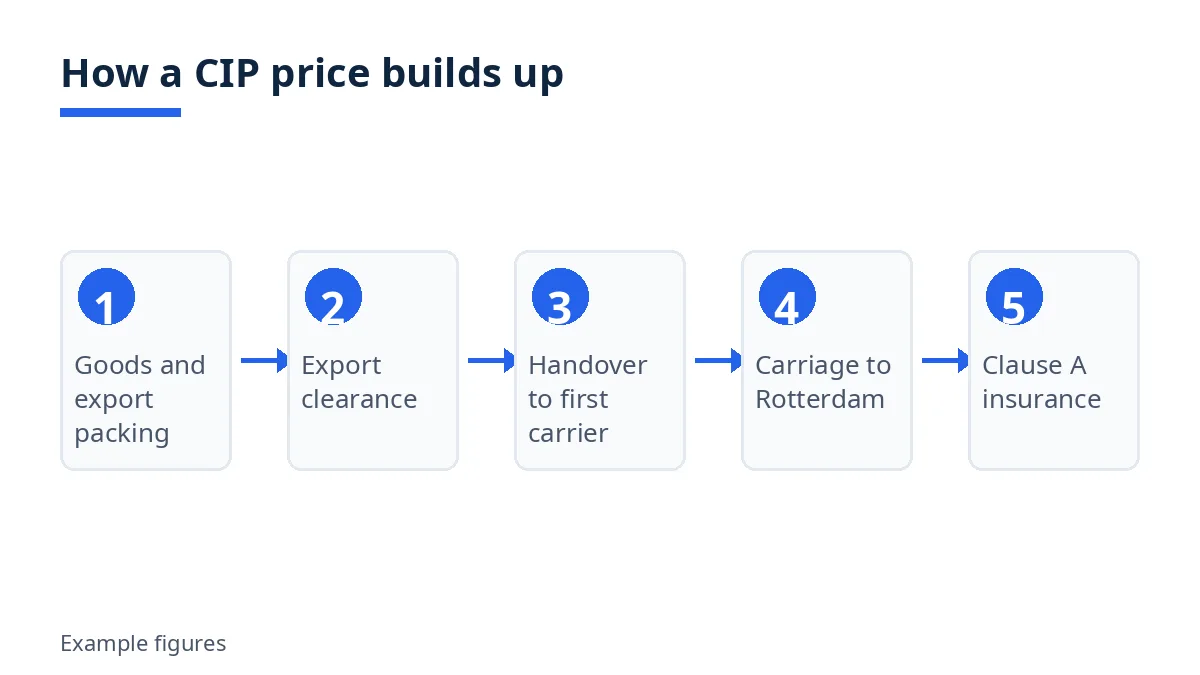
Goods and export packing. The price of the goods, packed for the journey agreed and matched to the modes in the contract of carriage.
Export clearance and origin handling. The seller completes export formalities at its own cost. In Bangladesh, goods may not be loaded for export until a Bill of Export has been submitted to Customs and approved, with the export contract or purchase order, commercial invoice, packing list and other listed documents enclosed.3
Handover to the first carrier. Moving the goods to the carrier and handing them over at the agreed delivery point. Delivery is complete at handover, not on arrival.2
Main carriage to the named destination. The freight the seller contracts and pays to the named place of destination. Confirm in writing which destination charges sit inside the carriage price, such as unloading or terminal charges.
Insurance premium. The premium for the Clause (A) cover above, with the insured amount, clause, currency, period of cover and claim route stated beside it.
Outside the total, the buyer pays import clearance, duty and taxes, transport after the named destination, and destination charges the carriage contract does not include. For a method that compares several CIP quotations on these lines, see the guide to comparing CIP quotations.
Who pays, who bears the risk
Task or cost | Seller | Buyer |
|---|---|---|
Goods and export packing | Pays and arranges | No |
Export clearance | Pays and arranges | No |
Delivery to the first carrier | Pays and arranges | No |
Carriage to the named destination | Contracts and pays | No |
Cargo insurance, Clause (A), at least 110 percent | Arranges and pays premium | No, unless wider cover agreed |
Risk from handover to the first carrier | No | Bears the risk |
Transit formalities in third countries | No | Pays and arranges |
Import clearance, duty and taxes | No | Pays and arranges |
Transport after the named destination | No | Pays and arranges |
The split follows the same pattern as the other C rules: the seller pays further than the point where risk passes.1 2 Under CIP the gap can be long, because the first carrier may take the goods at an inland depot while the named destination is overseas.
Worked example with numbers: home textiles to Rotterdam
Example figures. Every figure below is illustrative only, not a quotation, a freight rate or a premium for any product, route or country. A buyer agrees CIP Rotterdam, Incoterms 2020, for home textiles handed to the first carrier at an inland container depot, for carriage by sea to Rotterdam.
Element of the example CIP price | Example figures (USD) |
|---|---|
Goods and export packing | 18,400 |
Export clearance and origin handling | 320 |
Carriage to the named destination (Rotterdam) | 1,850 |
Insurance premium, Clause (A) cover | 210 |
CIP contract price | 20,780 |
Check the insured amount against the price, not the premium: at least 110 percent of USD 20,780 gives a minimum insured amount of USD 22,858, in the contract currency. The USD 210 premium buys the cover; the USD 22,858 insured amount is the sum the policy pays up to. A lower insured amount on the certificate would need a top-up before ranking the quotation against other offers.
The CIP price is not the final total. Add import clearance and broker fees, duty from the tariff for the confirmed classification, destination handling not in the carriage contract, and onward transport from Rotterdam to the warehouse, each priced separately.
CIP beside CPT, CIF and CFR
CIP and CPT share the delivery point, risk point and carriage duty. The only difference is insurance: under CIP the seller must obtain Clause (A) cover for at least 110 percent of the contract price, while under CPT the seller owes no insurance at all.1 2 CFR and CIF are sea and inland waterway terms only, with risk passing on board the vessel; CIF adds seller insurance at Clause (C) minimum level, while CFR leaves insurance to the buyer.1
Term | Mode | Where risk passes | Seller pays carriage to | Seller must insure |
|---|---|---|---|---|
CPT | Any mode | Handover to the first carrier | Named place of destination | No |
CIP | Any mode | Handover to the first carrier | Named place of destination | Yes, Clause (A), at least 110 percent |
CFR | Sea and inland waterway only | On board at the port of shipment | Named port of destination | No |
CIF | Sea and inland waterway only | On board at the port of shipment | Named port of destination | Yes, Clause (C) minimum |
Choose CIP when you want the seller to arrange carriage and broad cover across modes, including air freight and depot-handed containers. Choose CPT when you want to arrange your own insurance; the CPT price guide shows the same build-up without the insurance line. Choose CIF only for sea shipments where the narrower Clause (C) minimum is acceptable, or where wider cover is agreed expressly.
Common mistakes to avoid
Accepting a premium-only insurance line. A premium figure with no clause, insured amount, currency, period of cover or claim route cannot be checked. Send it back for those five details before ranking the quotation.
Reading the premium as the insured amount. The premium is what the policy costs. The insured amount is what it pays. Check the insured amount against 110 percent of the contract price.
Reading Clause (A) as cover for every loss. Clause (A) remains subject to exclusions, conditions and deductibles, and war and strikes cover is not necessarily included.2
Accepting cover that ends before the destination, or below 110 percent. Cover must run to at least the named destination and reach at least 110 percent of the contract price.2
Naming only the destination. A contract that names only Rotterdam does not say where risk passed. Name the delivery point and the first carrier too, so a claim can be tied to a handover both parties can prove.2
Reading a CIP price as a delivered price. Risk passed at handover, and duty, import clearance and onward transport remain buyer lines. Price every quotation to your warehouse, and confirm whether unloading and terminal charges sit inside the CIP price.
Using CIF for air freight. CIF is a sea and inland waterway rule. For air freight, use an any-mode rule such as CIP.
How Exportain helps
Post a request for quotation stating the specification, quantity, destination place, delivery point and Incoterm, and ask each supplier to split the price into goods, carriage and insurance, and to state the clause, insured amount and claim route. Read how to buy for the buying steps on Exportain. Exportain is not a party to the contract for the goods, and the CIP citation and insurance details belong in the agreement between buyer and seller.
Questions buyers ask about a CIP price
What is CIP?
CIP means Carriage and Insurance Paid To. It is an Incoterms 2020 rule under which the seller delivers the goods to the first carrier, contracts and pays for carriage to a named place of destination, and buys Clause (A) cargo insurance for the buyer for at least 110 percent of the contract price, while risk passes to the buyer at handover.1 2 CIP works for any mode of transport.
How does CIP work in practice?
The seller packs the goods, clears them for export, hands them to the carrier it contracted, pays carriage to the named destination, and buys the insurance cover and hands over the policy or certificate. The buyer bears the risk from handover, arranges import clearance, pays duty and taxes, and handles transport after the destination.
Is CIP used for shipments from Bangladesh?
Yes. CIP can be used for a shipment leaving Bangladesh by sea, air, road or a combination of modes, provided the delivery point and the named destination are both stated in the contract. Export clearance in Bangladesh requires an approved Bill of Export before loading, with the documents Customs lists for the consignment.3 Confirm the destination, delivery point, insurance clause and insured amount, and which destination charges remain payable.
What are common mistakes with CIP?
Accepting an insurance line that states only a premium, confusing the premium with the insured amount, reading Clause (A) cover as cover for every loss, accepting cover below 110 percent or ending before the destination, leaving the delivery point unnamed, and reading the CIP price as a delivered warehouse price. Fix each the same way: name both places, state the insurance position in the contract, and confirm in writing which destination charges the CIP price covers.
Next steps on Exportain
Compare CIP with the other ten rules in the Incoterms guide for shipments from Bangladesh, and read the sea-only counterpart in the CIF guide. Work the buyer-side costs into your landed cost calculation before you accept a quotation.
Post a free RFQ on Exportain and get quotes from Bangladeshi suppliers: post an RFQ.
Sources
- Incoterms® 2020. International Chamber of Commerce (ICC) (accessed )
- CIP Incoterm | Carriage and Insurance Paid To. Röhlig Logistics (accessed )
- Customs Clearance Procedures for Export. Bangladesh Customs, National Board of Revenue (accessed )
Reviewed by Nourin Tabassum
About the author
Sourcing from Bangladesh?
Post a request for quotation and suppliers on Exportain can send you their quotes directly.
Post an RFQ


