How to Choose the Named Place for CIP Correctly
The CIP named place sets where seller-paid carriage and insurance end. Name it by facility and point, name the delivery point separately, and keep the same name on every document.
Short answer
Under CIP, name the destination by facility and point, not by city: the named place is where seller-paid carriage and insurance end, while risk passes earlier, at handover to the first carrier. Name the place and point of delivery on a separate line, confirm the carrier serves the destination, confirm the insurance certificate names the same destination and runs from delivery to at least that point, and keep the name identical on every document.
On this page
Key takeaways
The CIP named place is the destination where seller-paid carriage and insurance end; risk passes earlier, at handover to the first carrier.
Name the destination by facility and point, not by city, and name the place and point of delivery on a separate line.
The insurance certificate must name the same destination as the contract and run from the delivery point to at least that destination, at Clause A cover for at least 110 percent of the contract price.
Unloading and destination charges are the seller's only if the carriage contract says so; the buyer pays import clearance, duty and onward transport.
Keep the destination name identical on the quotation, contract, invoice, packing list, transport document and insurance certificate, and freeze it before handover.
The place named after the letters CIP does three jobs at once: it marks where seller-paid carriage ends, where seller-paid insurance must run to, and where the buyer receives the goods. A city name alone cannot do all three well.
This guide is for buyers in the United States, the United Kingdom, the European Union and the United Arab Emirates who buy from Bangladesh under CIP (Carriage and Insurance Paid To) and must choose the named place of destination. Every figure in the illustration, a shipment of handwoven jute rugs, is an example figure.
The named place sets three boundaries at once
Under CIP, the seller delivers the goods by handing them to a carrier the seller has contracted, at the agreed place and point of delivery, and risk passes to the buyer at that handover.1 The seller then contracts and pays for carriage to the named place of destination, and must also provide insurance cover to that destination.1 The citation for a C rule names the destination, not the place of delivery, even though delivery and risk transfer happen much earlier.1
Under the C terms, delivery and destination have different meanings: delivery is where the seller hands the goods to the carrier, typically in the seller's country, while the destination is where the goods are to be received, usually in the buyer's country.2 Test a candidate name against all three uses before it goes into a contract.
Name the destination by its point, not by its city
Parties are strongly encouraged to agree the place and point of delivery as precisely as possible, and the same discipline applies to the destination.1 "CIP London" names a city of many terminals, and "CIP Felixstowe" names a port with more than one terminal. Neither tells the carrier, insurer or buyer which gate the seller-paid movement ends at. Build the name in layers, down to the exact point.
Layer | Weak form | Strong form |
|---|---|---|
Country | United Kingdom | United Kingdom |
City or port area | Felixstowe | Felixstowe |
Facility | The port | Terminal named in the carriage contract |
Point | The terminal | Terminal, gate and address in the carriage contract |
The strong form is a pattern: fill it with the facility and point the carrier confirms in writing. If the carrier cannot confirm a facility and point, the destination is not yet chosen. For an address destination, write the full street address, town and postcode.
If the parties do not agree the place and point of delivery, or the place and point of destination, the seller may select the locations that serve its own purpose.1 A city name lets the seller choose the terminal.
Four ways a CIP destination can end, and what each costs the buyer
CIP can name any place of destination: a seaport terminal, an airport cargo terminal, an inland or rail terminal, or a named address. Each ending below is a wording pattern to test, not a recommendation for a particular shipment.
A seaport container terminal suits a sea movement where the buyer has a broker and hauler at that port. Name the terminal, not only the port: a port can hold several terminals and the carriage contract may reach only one.
An airport cargo terminal suits an air movement where speed matters. The ICC Academy example names a cargo terminal at the destination airport in full, with the airport, terminal and country.1 Copy that pattern, and confirm which cargo handler works from that terminal.
An inland or rail terminal suits a buyer whose warehouse sits far from the coast, where seller-paid carriage runs inland by rail or road to that point.2 It only helps if the carrier serves that terminal, the broker can clear goods there, and the insurance runs to the same point.
A named address, such as a warehouse, suits a buyer who wants the seller-paid movement to end at a controlled door. Get the carrier's written confirmation that it serves the address, and the broker's confirmation that clearance can be completed there.
Destination ending | Buyer still arranges and pays for |
|---|---|
Seaport container terminal | Destination charges outside the carriage contract, import clearance, duty, onward haul |
Airport cargo terminal | Destination charges outside the carriage contract, import clearance, duty, onward haul |
Inland or rail terminal | Destination charges outside the carriage contract, import clearance, duty, onward haul |
Named address | Import clearance, duty, handling the carriage contract does not include |
In every row, the buyer handles import formalities, including customs procedures in transit countries, and the seller handles export formalities.1 The named place does not move customs duties: the buyer pays duty and completes import clearance under CIP, wherever the destination sits.
How the named place moves the insurance
The insurance difference is what makes the CIP named place different from the CPT named place. Under CPT, the seller need not insure at all. Under CIP, the seller must obtain insurance that meets Institute Cargo Clauses (A), for at least 110 percent of the contract price, issued in favor of the buyer or a party the buyer designates, with cover running from the delivery point to at least the named destination.1 Read the CPT named-place guide to see how the same destination choice works when no insurance is required.
Naming a nearer destination shortens the distance the seller-paid cover must reach; naming a farther one lengthens it. The certificate is the proof: check that the insured voyage, the certificate destination and the contract destination describe the same point.
Example figures: a contract price of $12,000 calls for cover of at least $13,200, 110 percent of the contract price, in the contract currency. If the parties agree higher cover, write it in the contract so the seller can arrange it before handover.1 The seller must provide the insurance certificate so the buyer can claim directly from the insurer.1
Delivery point and destination: write both, in that order
Every CIP contract needs two places, written as two separate lines. The first is the place and point of delivery, where risk passes. The second is the named place of destination, where seller-paid carriage and insurance end. Writing only the second line is the most common naming error under CIP, because the citation itself contains only the destination.
Use this pattern in the contract, the order and the quotation:
CIP [named place of destination, with facility and point], Incoterms 2020. Place and point of delivery: [facility and point where the goods are handed to the first carrier].
The ICC Academy CIP example shows the same separation: the contract names a port and area as the destination, while delivery and risk transfer happen earlier, at handover to the carrier at the seller's premises.1 Its bill of lading records a place of receipt, a port of shipment and a port of destination as three fields.1 With several carriers, delivery occurs on handover to the first carrier, while the seller pays carriage across the chain to the destination.1
Unloading, destination charges and onward transport: what the name does not buy
A precise name does not, by itself, buy unloading, handling or onward transport. Under the C terms, the seller pays unloading charges at the destination only if the contract of carriage stipulates that they are the seller's responsibility; otherwise they are the buyer's.2 Ask whether each destination charge is inside the carriage contract, and get the answer in writing.
After arrival, the buyer must arrange and pay for any additional transportation to the final place.1 Compare candidates on total cost to the warehouse, not on the CIP price alone: the CIP price does not carry destination handling outside the carriage contract, import clearance, duty or onward transport.
Keep one name across every document
The named place must read identically on the quotation, contract, invoice, packing list, transport document and insurance certificate. A spelling change or a city substituted for a terminal on any one document is enough to start an argument about which place was agreed.
Check the transport document first. In the ICC Academy CIP example, the bill of lading records the place of receipt, port of shipment and port of destination as separate entries, is marked freight prepaid, and is signed by the carrier's agent.1 Check your own document the same way: the destination must match the contract word for word, and the delivery entry must match the delivery point. For air, check the air waybill the same way.
Document | Entry to check |
|---|---|
Quotation and sales contract | Destination with facility and point, plus the delivery point on a separate line |
Invoice and packing list | Destination exactly as in the contract, with no shortened form |
Transport document | Destination, delivery or receipt point, and shipment point as separate entries |
Insurance certificate | Destination and cover period matching the contract, in favor of the buyer |
Correct any differing document before the goods move. Read the documents guide for CIP shipments for the full set to check.
Bangladesh departure: name the handover point with the same precision
The Bangladesh side has its own naming decision: the place and point of delivery. The seller handles export formalities and the buyer handles import formalities.1 Name it as precisely as the destination: the facility, the town, and the point within the facility where handover happens.
For a sea movement, the first handover may be at the seller's premises or a carrier terminal. For containers, the handover point matters more than the port name, because delivery occurs at handover to the first carrier, not on loading.1 For air, the handover may be at a carrier facility at the departure airport. In each pattern, get the handover facility confirmed in writing.
Do not let a city name stand in for the handover point: "Chattogram" names a port city, not a handover point, and "Dhaka" names a city, not a cargo facility. Write the facility and point as the carrier confirms them. Confirm the pair together: the carrier can carry from the handover point to the destination, and the insurer confirms cover runs to at least that destination.1
Five naming errors that leave cover or carriage short
Naming a city instead of a point. A city name lets the seller choose the terminal and the buyer arrive at the wrong gate. Name the facility and point.
Naming a port for a multimodal movement. CIP is not limited to sea transport, and the named place can be inland.3 A port name on a movement that ends inland stops seller-paid carriage and insurance at the port. For the contrast, read the CIF guide, where the named place is a port of destination.
Copying a CIF port name onto a CIP contract. CIF names a port of destination and risk passes on board the vessel, while CIP names a place of destination and risk passes at handover to the first carrier.2
Naming a destination the carrier does not serve. A terminal the booked carrier does not serve is not a destination the seller can reach. Get the carrier's written confirmation before the name goes into the contract.
Changing the name after handover. A destination renamed after handover creates two versions of the agreement, one of which the carrier and insurer have already acted on. Freeze the name before handover.
Each error has the same root: a name treated as a label rather than a boundary. Ask what each place name ends, what it starts, and who pays after it.
Named-place checklist before you sign
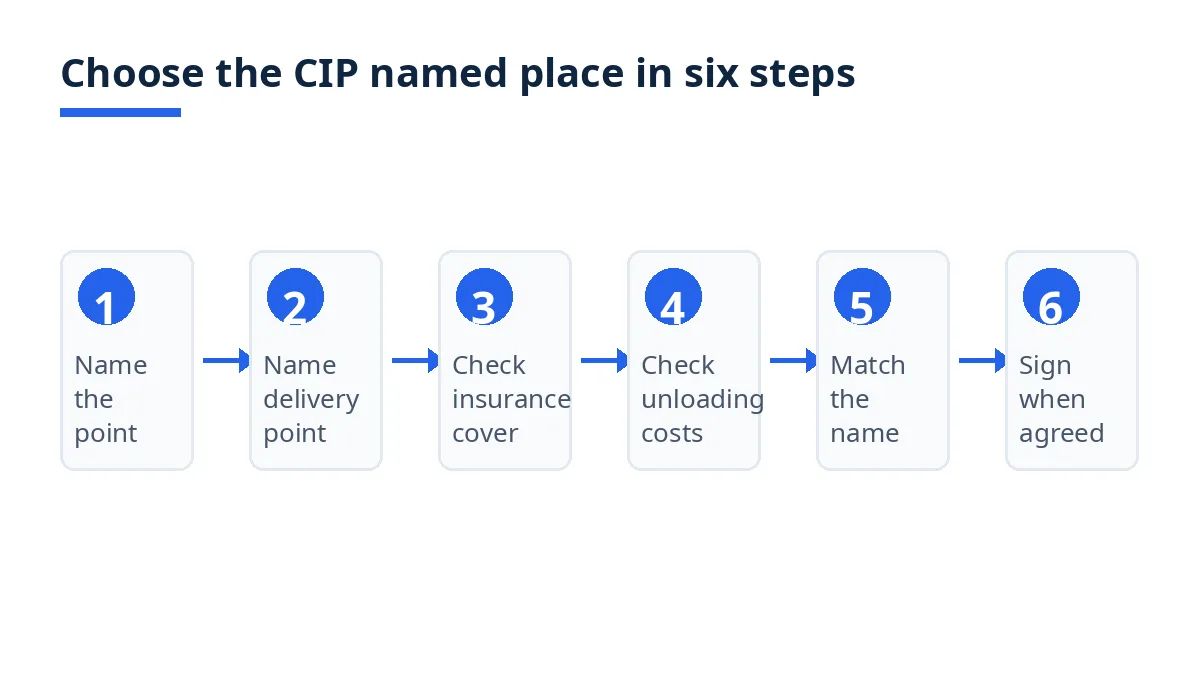
Write the destination as country, city or port area, facility and point, exactly as the carrier confirms it.
Write the place and point of delivery on a separate line, as the facility where the goods are handed to the first carrier.
Confirm the carrier serves the named destination on the booked service, and confirm whether unloading is inside the carriage contract.
Confirm the insurance certificate names the same destination, runs from the delivery point to at least that destination, and is issued in favor of the buyer.1
Confirm the broker can clear the goods at the named destination, and get the onward haul quoted.
Compare candidates on total cost to the warehouse, including destination charges, clearance, duty and onward transport.
Check the destination reads identically on every document listed above.
Freeze the name before handover, and correct any differing document before the goods move.
How Exportain helps
Post an RFQ on Exportain that states the CIP term in full, with the named destination and the delivery point written as separate lines, and ask each supplier to quote on the same wording. A reply that shortens or changes a place name is easy to spot. Exportain is a B2B marketplace where buyers post RFQs, receive quotations and message suppliers. It does not inspect goods, book freight or clear customs. Post a free RFQ and get quotes from Bangladeshi suppliers at post an RFQ.
What should I know first about the CIP named place?
Know first that the named place is the destination, not the delivery point. Risk passes at handover to the first carrier, while the seller pays carriage and insurance to the named destination.1 Name both places by facility and point, and check that the insurance runs to the destination named in the contract.
What costs and timelines does the named place change?
The named place changes where seller-paid carriage and insurance end, and therefore what the buyer still pays after arrival: destination charges, import clearance, duty and onward transport.2 It does not change the risk transfer point, which stays at handover.1 No single transit time follows from a place name: get the carrier's schedule and the broker's clearance time for that point.
Which documents must carry the named place?
The quotation, contract, invoice, packing list, transport document and insurance certificate must all carry the destination name identically, with the delivery point shown separately. Check the transport document's entries as separate fields, and check the insurance certificate names the same destination.1 Correct any differing document before the goods move.
What is the most common naming mistake under CIP?
The most common mistake is naming a city instead of a point, and leaving the delivery point unnamed. The seller may then choose the terminal and handover point that serve its own purpose.1 Name both places in full before signing.
Next steps on Exportain
Compare CIP with the other ten rules in the Incoterms guide for shipments from Bangladesh, and read the risk-transfer guide. When the places are fixed, post a free RFQ with the CIP term in full, and work the buyer-side costs into your landed-cost calculation before you accept a quotation.
Sources
- CPT & CIP Incoterms 2020 explained: Key differences. ICC Academy (accessed )
- Incoterms® 2020 C rules vs D rules: Risk transfer explained. ICC Academy (accessed )
- Incoterms 2020 | Shipping Terms. AIT Worldwide Logistics (accessed )
About the author
Sourcing from Bangladesh?
Post a request for quotation and suppliers on Exportain can send you their quotes directly.
Post an RFQ