

How to Choose the Named Place for CPT Correctly
CPT named place guide: how to choose an inland terminal, airport or rail depot as the destination where seller-paid carriage ends, name the delivery point, and keep the wording identical on every document.
Short answer
Under CPT, the seller delivers the goods to the first carrier and pays carriage to the named place of destination, while risk passes to the buyer at handover. Choose the destination as a specific terminal, airport cargo terminal, rail depot, or port terminal, test it against the carriage contract, broker, onward haul, and release procedure, and name the delivery point separately in the contract.
On this page
Key takeaways
The CPT named place is the destination where seller-paid carriage ends, and it can be an inland terminal, an airport cargo terminal, a rail depot, or a port terminal, not only a seaport.
Risk passes at the earlier place of delivery, when the goods are handed to the first carrier, so the contract must name the delivery point separately from the destination.
Test each candidate destination against the carriage contract, the broker, the onward haul to the warehouse, the release procedure, and the destination charges stated in writing.
Compare candidate destinations on the total cost to the warehouse, because the CPT price excludes insurance, import clearance, duty, and transport after the destination.
Keep the destination name, spelling, and edition identical on the quotation, order, invoice, packing list, and transport document.
A buyer with a warehouse near Duisburg faces a choice that looks like a freight choice and is really a naming choice. The CPT named place in the contract can be the Duisburg Gateway Terminal, an inland terminal on the Rhine, or Rotterdam, the seaport where the ocean leg ends. Either name can be right. The wrong choice is the name nobody tested: a terminal the carriage contract does not reach, a broker cannot work from, or a release procedure nobody confirmed.
This guide is for a buyer who has already chosen CPT and now has to choose the destination that follows the letters. It sorts candidates by type, tests each one against the carriage contract, the broker, and the onward haul, and shows how to write a CPT line naming the destination and the delivery point in full.
The CPT named place is a destination, not a delivery point
Under CPT (Carriage Paid To), the seller delivers the goods to a carrier contracted by the seller, at the place and point of delivery, and arranges and pays for carriage to the named place of destination.1 Risk passes to the buyer when the goods are handed over to the carrier, not when they arrive at the destination.1 The seller handles export formalities, and the buyer handles import formalities, including customs clearance required in transit countries.1 CPT applies to any mode of transport, including sea, road, rail, air, or a combination of modes.1
CPT therefore has two places, and they answer different questions.
Place | Question it answers | Example |
|---|---|---|
Place of delivery | Where did the seller hand the goods to the first carrier, and where did risk pass | A carrier terminal at an inland container depot in Gazipur, or the cargo terminal at Hazrat Shahjalal International Airport |
Named place of destination | Where does the seller-paid carriage end | Duisburg Gateway Terminal, Duisburg, Germany, or the cargo terminal at the destination airport |
If the parties do not agree the place of delivery, or the destination, as precisely as possible, the seller may choose the most suitable locations for both.1 A contract that names only the destination leaves the risk point to be worked out after a loss, so name both places, in full, in separate sentences.
The named place also does not move the insurance duty. Under CPT the seller has no duty to buy cargo insurance for the buyer, so a buyer who wants cover arranges it from the handover date, using the seller delivery notice as the trigger. The seller must notify the buyer in a timely manner that delivery has occurred, with the information the buyer needs to receive the goods at the destination.1 Once the goods arrive, the buyer arranges and pays for any further transport beyond that point.1
Four destination types buyers actually name
A CPT destination is not always a port. The ICC Academy describes the place and point of destination as a port, airport, or terminal in the buyer country, and gives a CPT line naming an airport cargo terminal in Dubai.1 The four types below cover most buyer choices. Each changes a different part of the arrival work, so test the type that fits the onward journey, not the type nearest on a map.
An inland container terminal or depot
An inland terminal suits a buyer whose warehouse sits away from the coast and who wants seller-paid carriage to run past the seaport. Duisburg is the clearest example. The Port of Duisburg describes itself as a trimodal logistics hub, and its Duisburg Gateway Terminal covers 267,000 square meters with a capacity of 850,000 TEU, set to become Europe's largest inland terminal.2
Name it like this: CPT Duisburg Gateway Terminal, Duisburg, Germany, Incoterms 2020, with the delivery point in a separate sentence. Before naming it, confirm with the forwarder and the terminal operator which service pattern brings the container to the terminal, which gate and opening hours apply, and whether unloading or terminal handling sits inside the carriage contract or falls to the buyer.
An airport cargo terminal
An airport destination suits air freight and urgent consignments. The destination is the airport plus the cargo terminal where the goods will be available, not the city the airport serves. The ICC Academy example names the International Airport of Dubai, Cargo Mega Terminal, UAE, as the destination, with delivery at an air cargo terminal in London.1 The freight runs to Dubai, while risk passed at the London handover.
Name it like this: CPT [airport name], [cargo terminal name], [country], Incoterms 2020. Before naming it, confirm the arrival notice and release procedures at that terminal, who acts on the arrival notice, and whether the air waybill shows the same airport and terminal names as the contract. A terminal name that differs between the contract and the air waybill will hold the goods at the airport.
A rail terminal or intermodal depot
A rail or intermodal depot suits a buyer whose onward leg runs by rail, or whose warehouse is served by a rail-served depot rather than a port. The destination is the depot where the container is set down and made available, including the track or siding area the service uses. Confirm with the carrier whether the service runs to that depot on the booked rotation, and with the broker whether import clearance can be completed from that depot or must be completed elsewhere first. A depot that cannot clear the goods is a storage point, not a usable CPT destination, until the clearance route is agreed.
Name it like this: CPT [depot name], [town], [country], Incoterms 2020, with the depot operator and the service pattern recorded alongside the line.
A seaport terminal
A seaport terminal suits a buyer who will clear the goods at the coast and run the onward haul separately. Even here, name the terminal inside the port, not only the port city. A large port holds several terminals, and the carriage contract, the broker, and the onward hauler each need the terminal where the container will be discharged. Unlike CFR and CIF, where the named place must be a port of destination for sea or inland waterway transport only, CPT has no sea-only limit, so a port terminal is one valid CPT destination among others, not the default.3
Name it like this: CPT [terminal name], [port], [country], Incoterms 2020. Before naming it, confirm which terminal the freight contract names, which unloading and handling charges sit inside the carriage price, and which broker will file from that terminal. For a comparison with the sea-only insured term, read the CIF guide.
Test a candidate destination before you name it
Work through the five tests below for every candidate, in the same order, and drop a candidate that fails an early test even when its CPT price looks lower. A candidate that passes all five can go into the contract.
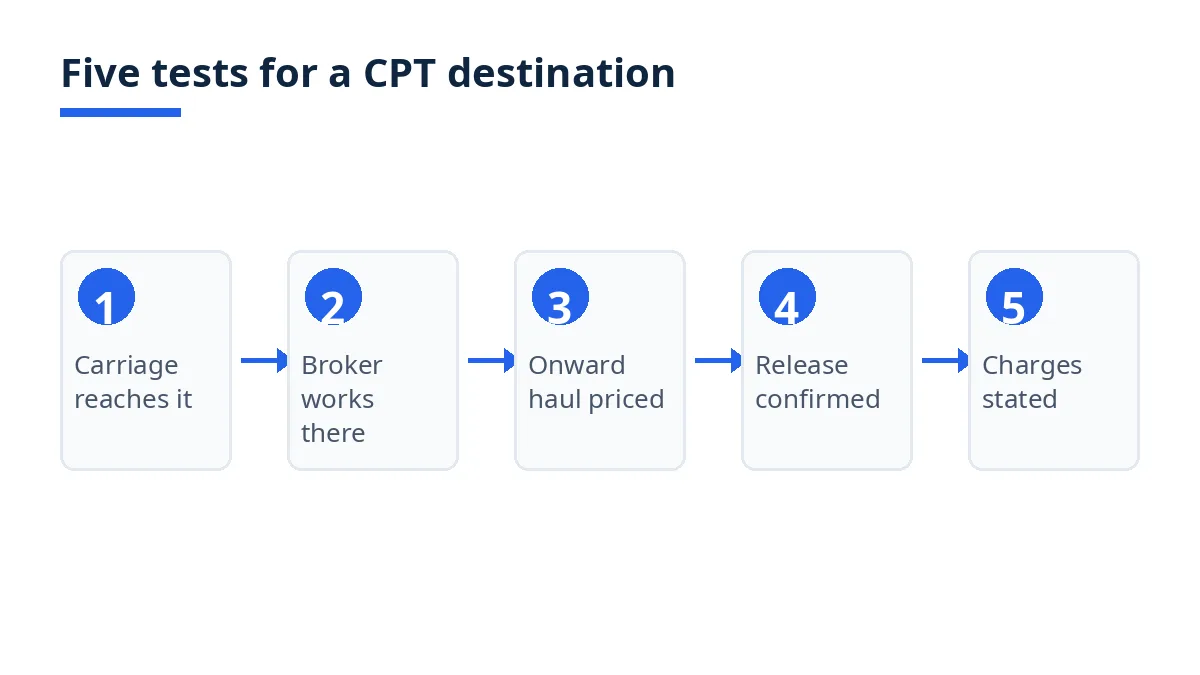
Carriage reaches it. Ask the seller to confirm, in writing, that the carriage contract it will buy serves the named terminal or depot, on the booked service pattern, with freight paid to that place. The seller must arrange and pay for transportation to the agreed destination under CPT.1
The broker works from it. Ask the broker to confirm, in writing, that it can file import formalities for goods arriving at that terminal, and what the filing and release steps are. The buyer is responsible for import formalities under CPT, including customs clearance in transit countries.1
The onward haul is priced to the warehouse. Price the leg from each candidate destination to the warehouse, with the hauler, the storage, and the waiting time stated separately. A destination that shortens the seller-paid leg and lengthens the buyer-paid leg has not saved money until both legs are priced.
Release is confirmed. Confirm the arrival notice, the documents the terminal needs for release, the person who acts on the notice, and the storage clock that starts if collection is late. The seller delivery notice gives the buyer the information needed to receive the goods at the destination.1
Destination charges are stated. Confirm which unloading, terminal handling, and storage charges sit inside the carriage contract and which fall to the buyer at arrival. Treat a charge named in neither document as the buyer until the broker confirms otherwise, and record the answer beside the CPT line.
Compare candidate destinations on total cost to the warehouse
A CPT price to one destination cannot be compared with a CPT price to another destination until both are priced to the same warehouse. The destination moves two lines at once: the seller-paid carriage inside the CPT price, and the buyer-paid onward lines after the destination.
Example figures only. Every number in the table is illustrative, not a quotation. Confirm freight, handling, duty, and broker positions with a forwarder and a broker before ordering.
Example line | CPT Rotterdam terminal | CPT Duisburg Gateway Terminal |
|---|---|---|
CPT contract price, example figures | USD 42,100 | USD 42,650 |
Onward haul to the warehouse, example figures | USD 620 | USD 210 |
Terminal handling outside the CPT price, example figures | USD 180 | USD 90 |
Total before duty and tax, example figures | USD 42,900 | USD 42,950 |
The totals differ by USD 50 on these example figures. The cheaper headline CPT price belongs to Rotterdam, and the cheaper onward leg belongs to Duisburg, and neither fact alone decides the choice. Duty, import clearance, and broker fees sit outside both totals and must be confirmed with the broker for the entry point actually used. Insurance also sits outside the CPT price: the buyer arranges cover from the handover date.1 Where the totals are close, decide on the release procedure and the broker fit, and record the reason beside the CPT line.
For the full build of a CPT price, read the CPT price guide. It separates the goods, export clearance, and carriage lines, and shows what sits outside the price.
Name both places in the contract
Write the CPT line once, in full, and mirror it everywhere it appears. The pattern below keeps the destination and the delivery point in separate sentences, so neither place can be read as the other.
Wording | Result |
|---|---|
CPT Duisburg Gateway Terminal, Duisburg, Germany, Incoterms 2020. Delivery at the carrier terminal at the inland container depot, Gazipur, Bangladesh. | Correct pattern: destination and delivery point both named, in full. |
CPT Germany, Incoterms 2020. | No destination named: Germany is a country, not a terminal, airport, or depot. |
CPT Duisburg, Incoterms 2020. | Weak: Duisburg holds more than one terminal, so add the terminal name. |
CPT buyer warehouse, Incoterms 2020. | Wrong rule for the bargain: a warehouse delivery with seller carriage and seller risk to the door is a D-rule bargain. Use CPT for a terminal destination and DAP where the seller delivers at the warehouse. |
CPT Duisburg Gateway Terminal, Incoterms 2020, with no delivery point stated. | Incomplete: the seller may choose the delivery point, and the risk point stays open.1 |
Keep the same destination name, spelling, and edition on the quotation, the purchase order, the commercial invoice, the packing list, and the transport document. A terminal name that changes spelling between documents will be queried at release, and a destination that changes between the quotation and the contract means the two prices were never for the same journey.
Bangladesh departure checks that change the destination choice
The departure handover point decides when risk passes and when buyer insurance must start. The seller hands the goods to the first carrier at the delivery point, and delivery does not wait until the goods are loaded onto a vessel, aircraft, or train.1 Three patterns are common on Bangladesh exports: handover at the factory gate, where risk passes at collection; handover at an inland depot or terminal, before the port or airport leg; and handover at the airport cargo terminal for air freight, where the named destination is usually the destination airport cargo terminal.
Kamalapur is the established rail-linked inland container depot for Dhaka, and its limits matter to a handover choice. The Daily Star reported in October 2025 that the Kamalapur depot was built in 1987, that Bangladesh Railway could operate only two container trains daily between Chattogram and Kamalapur because of capacity and path limits on the Tongi-Kamalapur line, and that a new depot at Dhirasram, near Tongi in Gazipur, had long been planned.4 Treat that report as a prompt to confirm the current position with the carrier and the forwarder, not as a fixed fact about today: confirm which depot or terminal will take the handover, how many services run, and whether the planned Gazipur depot is operating for the cargo type.
Export formalities sit with the seller under CPT, and the seller must complete them before the goods move.1 Confirm the export set with the forwarder before the handover date, and confirm that the delivery notice will be sent on the day of handover, so the buyer insurance and the destination broker both start from the same date.
Naming errors that strand goods at the wrong destination
Naming a country, a region, or a trade lane. CPT Europe, CPT USA, and CPT Middle East name no terminal, airport, or depot. The seller then chooses the destination.
Naming a city with several terminals. A city name leaves the terminal open. Add the terminal name and the operator.
Naming the warehouse as the CPT destination. A warehouse is the end of the buyer onward leg, not the end of seller-paid carriage. Where the bargain is delivery at the warehouse, rewrite the term, not the label.
Naming a terminal the seller service does not reach. A terminal can be the right market and the wrong service. Ask the seller to confirm the service and the terminal in writing.
Naming an airport for a sea movement, or a port for an air movement. CPT works for any mode, but the destination must match the mode booked.1
Leaving the delivery point blank. The seller may choose the delivery point where the parties have not agreed it.1 Fix it in writing.
Copying a destination from another buyer contract. A destination that suited another buyer, cargo type, or season may not suit this shipment. Run the five tests again.
Reading the CPT price as a delivered, duty-paid price. The CPT price ends at the named destination. Import clearance, duty, onward transport, and insurance sit with the buyer unless the contract says otherwise.1
Destination-choice checklist
Use this checklist before the order is confirmed. Every line should be answered in writing, with the same names used in every document.
One named destination agreed, as a terminal, airport, or depot, in the form CPT [named place of destination], Incoterms 2020.
The place and point of delivery agreed separately, with the first carrier named and the handover date or period stated.
The carriage contract confirmed to serve the named destination, with the service pattern and the terminal recorded.
The broker confirmed to file from the named destination, with the filing and release steps stated.
The onward haul priced to the warehouse for each candidate destination, with storage and waiting time stated separately.
The release procedure confirmed: arrival notice, release documents, acting person, and storage clock.
Destination charges stated in writing: which unloading and handling lines sit inside the carriage price, and which fall to the buyer.
The insurance position stated: buyer cover from the handover date, on the seller delivery notice, or CIP agreed instead.
The destination name, spelling, and edition identical on the quotation, order, invoice, packing list, and transport document.
The Bangladesh handover point confirmed as operating for the cargo type, with the export set ready before the handover date.
What should I know first about CPT?
CPT stands for Carriage Paid To. The seller delivers the goods to the first carrier, pays carriage to a named place of destination, and completes export formalities, while risk passes to the buyer at handover to that carrier.1 The named place is the destination where seller-paid carriage ends. It can be an inland terminal, an airport cargo terminal, a rail depot, or a port terminal. Name the delivery point as well, because the delivery point is where risk passes and it is usually in the seller country.
What are the typical costs and timelines?
There are no typical CPT costs or timelines a guide can state as fact, because the freight build, the destination charges, the duty basis, and the service pattern depend on the route, the destination type, and the shipment. The seller bears the goods, export clearance, and carriage to the named destination, while the buyer bears insurance, import clearance, duty, and transport after the destination.1 Timelines are set by the mode and the service pattern, not by the term, so confirm the schedule for the service booked and put the delivery date or period in the contract.
Which documents are needed?
The seller provides the commercial invoice, the packing list, the transport document for the mode used, and the delivery notice, and completes the export formalities for the shipment.1 The buyer provides the insurance document where cover was arranged and the import set the broker needs at the named destination. Ask the forwarder and the broker which additional documents the destination terminal and the import authority require, and check that every document names the same destination and the same delivery point.
What are the most common mistakes?
Naming only the destination and leaving the delivery point open, naming a city or a country instead of a terminal, naming a terminal the carriage service does not reach, and reading the CPT price as a delivered or duty-paid price. Each is fixed the same way: name both places in full, test the candidate destination against the carriage contract, the broker, and the onward haul, and state the insurance and destination-charge positions in writing before the goods move.
Next steps on Exportain
Compare the full rule in the Incoterms guide for shipments from Bangladesh, then read how to buy on Exportain for the steps from search to shipment. When the destination and the delivery point are settled, post a request for quotation stating the quantity, the named destination, the full CPT wording, and the delivery point, so suppliers quote against the same destination and the same risk point. Supplier profiles show the verification level, location, main products, and certifications the supplier has declared, and badges record document and photo reviews by Exportain staff, not a factory inspection or a guarantee.5
Post a free RFQ on Exportain and get quotes from Bangladeshi suppliers → https://exportain.com/rfqs
Sources
- CPT & CIP Incoterms 2020 explained: Key differences. ICC Academy (accessed )
- Digitalization and innovation. duisport, (accessed )
- Incoterms® 2020. International Chamber of Commerce (ICC) (accessed )
- Why Pubail makes more sense than Dhirashram for Dhaka's next rail-based inland container depot. The Daily Star, (accessed )
- Trust & Safety Center. Exportain (accessed )
About the author
Sourcing from Bangladesh?
Post a request for quotation and suppliers on Exportain can send you their quotes directly.
Post an RFQ


