

7 Costly CIP Mistakes Importers Make (and How to Avoid Them)
CIP mistakes cost importers through the insurance policy, not the freight rate: wrong clause, sum insured below 110%, unnamed handover point, cover ending early, and a claim filed with the wrong party.
Short answer
Under CIP, the seller pays carriage and insurance to a named destination, but risk passes to the buyer at handover to the first carrier. The costliest CIP mistakes are accepting insurance below Clause A cover or below 110% of the contract price, leaving the handover point unnamed, and holding a policy that does not let the buyer claim directly. Check the clause, sum insured, cover period and named beneficiary on the insurance document before the goods move.
On this page
Key takeaways
CIP requires Clause A cover at 110% of the contract price by default; a certificate naming Clause B or C, or no clause, does not meet the 2020 default.
Risk passes at handover to the first carrier, not at the named destination; agree the delivery point as precisely as the destination.
Cover must run from the delivery point to at least the named destination; check certificate dates and places before handover.
The policy must let the buyer claim directly from the insurer; check the named party and the direct-claim wording.
Clause A still has exclusions and a deductible; read them, and agree war and strikes cover in the contract where the route needs it.
Under CIP, Carriage and Insurance Paid To, the seller pays for carriage and insurance to a named destination, but the risk of loss or damage passes to the buyer much earlier, when the goods are handed to the first carrier. The seller keeps paying after handover, the buyer carries the risk during the journey, and the insurance policy the seller bought is the route by which the buyer recovers a loss that is already the buyer's.
This listicle is for importers in the United States, the United Kingdom, the European Union and the United Arab Emirates who buy from Bangladesh under CIP. It works in shipment order, and each mistake states the error, what it costs, and the fix. The running example is woven jute bags from Dhaka to Felixstowe, and its figures are example figures only.
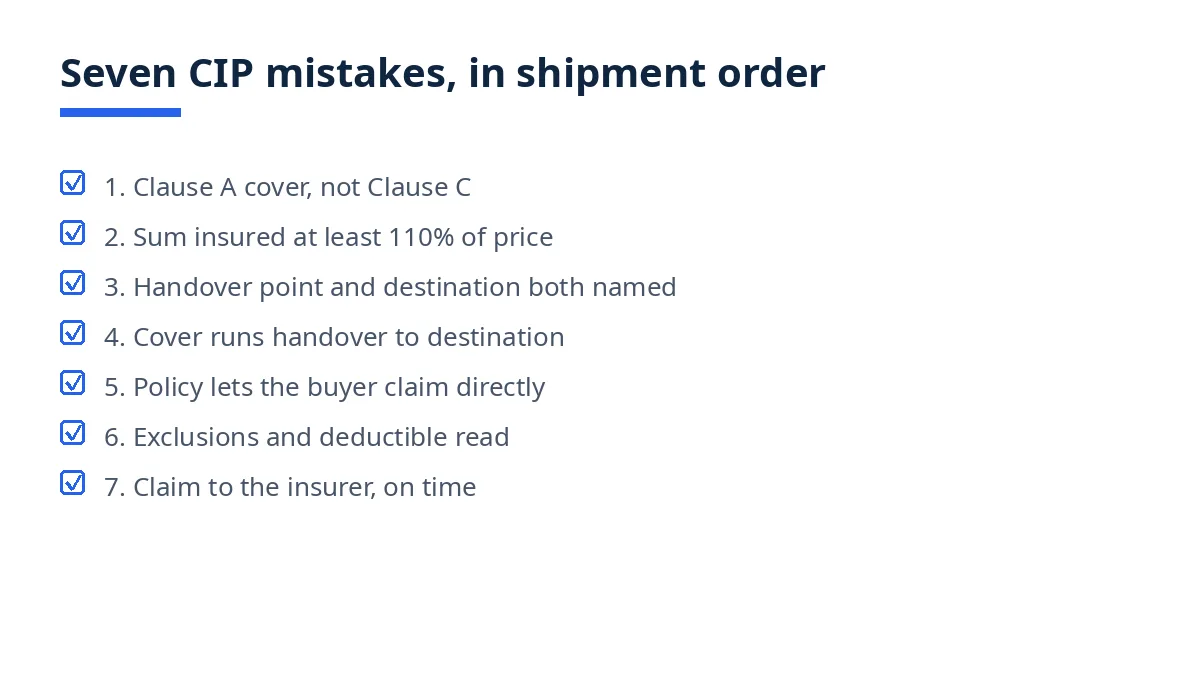
The seven CIP mistakes, in shipment order
1. Accepting Clause C or Clause B cover on a CIP contract
The error. The contract says CIP and names Incoterms 2020, but the insurance certificate names Institute Cargo Clauses (C) or (B), or it names no clause at all. Under Incoterms 2010, CIP required only Clauses (C). Under Incoterms 2020, the default is Clauses (A), the broadest cover, unless the parties expressly agree a different level.1 2 A certificate that names no clause cannot be checked against that default.
Clause (A) covers loss or damage from any cause except listed exclusions. Clauses (B) and (C) cover only named perils. Theft, pilferage, non-delivery and rough handling sit inside Clause (A) and outside Clauses (B) and (C), and washing overboard and water entry sit inside Clauses (A) and (B) but outside Clause (C).3
What it costs. The buyer holds a CIP price sold as insured carriage, and a policy that does not respond to water entry, theft or handling damage. The shortfall is discovered at the claim.
The fix. Write the clause into the contract: Institute Cargo Clauses (A), CL382, or equivalent cover, under Incoterms 2020. Check the clause letter on the certificate before handover, not on the quotation. If the parties agree lower cover, state it expressly in the contract, with the clause letter named.2
Clause | Cover type | Theft and pilferage | Water entry | Rough handling |
|---|---|---|---|---|
Clause (A), CL382 | All risks except listed exclusions | Yes | Yes | Yes |
Clause (B), CL383 | Named perils only | No | Yes | No |
Clause (C), CL384 | Named perils, narrowest | No | No | No |
2. Insuring less than 110 percent of the contract price
The error. The sum insured on the certificate equals the invoice value, a rounded figure, or the goods value before a price amendment, instead of at least 110 percent of the contract price in the contract currency.1 2 A second version treats the premium as the cover. The premium is the price of the policy; the sum insured is the amount it will pay up to.
Example figures: on a contract price of USD 36,000 for the jute bags, the minimum sum insured is USD 39,600. A certificate showing USD 36,000 leaves USD 3,600 of required cover missing. A certificate in a different currency adds a second gap at claim settlement.
What it costs. The buyer carries the shortfall on every loss. A partial loss is paid against the cover actually bought, not the cover CIP requires.
The fix. Check the certificate before handover: contract price times 1.10, in the contract currency, against the sum insured shown. If the price changes by amendment, ask for a reissued certificate. Read the CIP price guide to check which lines sit inside the CIP price.
3. Naming one place and calling the term complete
The error. The contract names only the destination, as in "CIP Felixstowe, Incoterms 2020", and says nothing about where delivery happens. Or it names the origin as if it were the destination, as in "CIP Dhaka". Under the C terms, the citation names the place of destination, but delivery and risk transfer happen earlier, at the place and point where the goods are handed to the carrier, and the parties are encouraged to agree that delivery place as precisely as the destination.1 If the two places are not defined in the contract or by trade practice, the seller may choose the most suitable locations for both.1
For the jute bags, delivery might be at the carrier depot in Dhaka, while the destination is Felixstowe. Risk passes at Dhaka, and the insurance transit runs from delivery to at least the destination.1
What it costs. The seller chooses a handover point that suits its own route, and damage found before the buyer's assumed handover sits in a gap where each side points to a different date. Onward charges fall on the buyer, who covers costs outside the transport contract, including unloading, storage and domestic delivery.2
The fix. Name both places in one citation: "CIP Felixstowe, Incoterms 2020, delivery at the carrier depot in Dhaka". Check the same two places on the quotation, order, invoice and transport document, and ask for the delivery notice on handover day. Read the Incoterms guide for shipments from Bangladesh before the term is written into a contract, and compare CIP with CIF, which still requires only Clauses (C) and works only for sea and inland waterway transport, in the CIF guide.4
4. Accepting cover that starts late or ends early
The error. The insurance certificate is dated after the handover, or its transit wording runs from loading on board, or it ends at discharge at the port while the named destination is an inland terminal further on. CIP cover must extend from the point of delivery to at least the named destination.1 2 A policy that starts at loading leaves the depot-to-port leg uncovered. A policy that ends at the port leaves the port-to-terminal leg uncovered.
What it costs. Damage on an uncovered leg is the buyer's loss with no policy behind it. Storage and transshipment waits make the gap worse, because the goods sit outside the movement the certificate describes.
The fix. Compare the handover date, the certificate start date, and the certificate end place against the named destination. Ask for the transit wording in writing, and how storage and transshipment are treated. If the destination is inland, the certificate must name that place, not only the port.
5. Holding a policy that does not let the buyer claim directly
The error. The insurance certificate names only the seller, or it names a party the buyer cannot identify, and nothing on the document lets the buyer claim from the insurer. Under CIP, the insurance policy or certificate must be issued in favor of the buyer or another party with an insurable interest, and it must enable the buyer to claim compensation directly from the insurer.1 A premium receipt, a forwarder letter, or a line on the invoice saying insurance is included is not that document.
What it costs. The buyer must claim through the seller, who may already have been paid, or through a bank that holds the documents, while the insurer waits for a claim from the party named on the policy. Weeks pass and evidence ages.
The fix. Check three lines before handover: the named party, the direct-claim wording, and the insurer and its agent at destination. Hold the original insurance document before the goods move, and check it against the invoice, packing list and transport document with the CIP documents checklist.
6. Reading all risks as every loss paid
The error. The buyer sees Clause (A) on the certificate and stops reading. Clause (A) is broad, but it is not unlimited. The exclusions that apply across Clauses (A), (B) and (C) include wilful misconduct, ordinary leakage and wear and tear, insufficiency or unsuitability of packing, inherent vice, delay even when caused by an insured risk, insolvency of vessel owners or operators, and war and strikes, which need separate clauses.3 Cover also remains subject to policy conditions and any applicable deductible.2
What it costs. Water damage to badly packed cartons fails on the packing exclusion, a late arrival fails on the delay exclusion, and damage during civil unrest fails where war and strikes cover was never added. In each case the buyer paid for insurance and still carries the loss.
The fix. Read the exclusions, the deductible, and any additional clauses on the policy wording, not only the clause letter. Agree any added cover the route needs, such as war and strikes clauses, in the sales contract, so the seller can arrange it before handover.1 Pack for the transit the goods will face, and keep packing evidence.
7. Claiming from the wrong party, in the wrong order
The error. Damage is found at arrival, and the buyer writes to the seller, waits for a reply, and only then thinks about the insurer and the carrier. Under CIP, the claim runs against the insurer, on the insurance document the seller provided, and the carrier notice preserves the recovery against the carrier. Check the consignment before signing the receipt, count the packages against the bill of lading or waybill, and note damage on both copies of the freight document, with the number of damaged packages, the type of damage, the cause if known, the date and a signature.5 Send a separate written notice of loss to the last carrier even where a remark was made on the transport document.5
Carrier notice limits are short and differ by mode: visible damage at once on receipt, concealed damage within 7 days for road and rail, 3 days from discharge for sea, and 14 days from receipt for air.5 Put the insurance claim forward well before the carrier limit expires, with the invoice, packing specification, bill of lading or waybill, notice of loss, discharge report, and survey report with photos.5
What it costs. A clean signature is the first record the carrier and insurer read. A claim filed with the seller first arrives after the evidence has been disturbed and the carrier window has closed.
The fix. Inspect, count, photograph and note damage before signing, and keep damaged goods and packing until the insurer accepts their disposal. Notify the insurer or its average agent at once, so a survey can establish the extent and cause while the evidence is fresh, and send the carrier notice in writing on the same day.5 Treat any carrier claim as the second track, not the first.
Summary table: mistake, cost, fix
Mistake | What it costs | Fix in one line |
|---|---|---|
Clause C or B cover accepted | Theft, water entry and handling losses uncovered | Require Clauses (A), CL382, on the certificate |
Sum insured below 110 percent | Shortfall falls on the buyer on every loss | Check price times 1.10, in the contract currency |
One place named only | Risk gap and disputed onward charges | Name the delivery point and the destination |
Cover starts late or ends early | Uncovered leg, no policy behind it | Match certificate dates and places to handover and destination |
Policy does not let the buyer claim | Claim must run through seller or bank | Check named party and direct-claim wording |
All risks read as every loss paid | Exclusion, deductible, missing war cover | Read exclusions, agree added cover in contract |
Claim filed with the wrong party | Evidence ages, carrier window closes | Inspect, notify insurer and carrier on arrival day |
How Exportain helps
Post the CIP wording, delivery point, destination, and insurance clause you require as an RFQ, and compare replies on the same wording instead of on price alone. Exportain is a B2B marketplace where buyers post RFQs, receive quotations and message suppliers. It is not a party to the contract for the goods, and it does not inspect goods, book freight or clear customs. When the wording is fixed, post a free RFQ and ask each supplier to confirm the clause, sum insured and two places in writing.
What is the biggest mistake?
The biggest mistake is accepting Clause C or Clause B cover, or a certificate that names no clause, on a CIP contract written under Incoterms 2020. CIP exists to give the buyer broad insurance bought by the seller, and a lower clause removes that protection while the CIP price stays the same. Check the clause letter on the certificate before handover.
How can I avoid it?
Run a four-document check before the goods move. First, read the contract citation: CIP, the named destination, the delivery point, and Incoterms 2020. Second, read the insurance certificate: clause letter, sum insured at 110 percent or more, contract currency, cover period from delivery to destination, and the named party who can claim. Third, read the delivery notice: carrier, place, date and document reference. Fourth, read the transport document: the same two places, description and quantity, and freight prepaid to the destination. Query any disagreement in writing while the goods are still with the seller or the first carrier.
Who is responsible?
The seller delivers the goods to the carrier, pays carriage to the named destination, buys the Clause A insurance, completes export formalities, and notifies the buyer of delivery.1 The buyer bears the risk from handover, completes import formalities and transit customs procedures, pays duty and taxes, and arranges transport beyond the destination.1 For the clearance split, read the CIP customs clearance guide.
Where can I get help?
Ask your freight forwarder or customs broker for the delivery point, the destination wording, and the import clearance plan, and ask your insurer or the seller's insurer for the clause, the exclusions and the claim procedure in writing before handover. For supplier quotes on the same CIP wording, use Exportain to compare replies and to message suppliers about the insurance document before you agree a price.
Next steps on Exportain
Read the CIP documents checklist and check your insurance document against it, then read the CIP risk transfer guide to fix the handover point in your wording. When the clause, sum insured and two places are fixed, post a free RFQ with the CIP wording included, and compare quotes on the same insurance terms.
Sources
- CPT & CIP Incoterms 2020 explained: Key differences. ICC Academy (accessed )
- CIP Incoterms (Carriage and Insurance Paid To) Explained. iContainers (accessed )
- Institute Cargo Clauses (A), (B), (C) Explained. VoyageCover (accessed )
- CIF & CIP Incoterms 2020 explained: Key differences. ICC Academy, (accessed )
- Report cargo claim. If P&C Insurance (accessed )
About the author
Sourcing from Bangladesh?
Post a request for quotation and suppliers on Exportain can send you their quotes directly.
Post an RFQ


