

Who Handles Customs Clearance Under CIP? Export vs Import Explained
Under CIP, the seller clears export customs and pays carriage and Clause (A) insurance to the named destination, while the buyer carries the risk from the first-carrier handover and clears import customs. This timeline guide follows the three handovers and the insurance document that travels between them.
Short answer
Under CIP, the seller clears the goods for export in Bangladesh, pays carriage and Clause (A) insurance to the named destination, and hands the goods to the first carrier, where risk passes to the buyer. The buyer clears the goods for import at the named destination, pays the duty and taxes assessed there, and arranges onward transport. The insurance document travels to the buyer so the buyer can claim directly from the insurer.
On this page
Key takeaways
Under CIP, the seller handles export clearance and pays carriage and Clause (A) insurance to the named destination, while the buyer handles import clearance, duty and tax at destination.
Risk passes to the buyer at handover to the first carrier, which can be far earlier than the named destination, and CIP works for any mode of transport.
The insurance document must show Clause (A) cover for at least 110 percent of the contract price, issued in favor of the buyer, with the claim contact and notice period stated.
In Bangladesh, export clearance means an approved Bill of Export under section 131 of the Customs Act, 1969, with the letter of credit or contract, invoice, packing list, EXP form, certificate of origin, VAT certificate and TIN enclosed.
No duty rate or typical timeline is stated in this guide; confirm every rate, charge and deadline with the destination broker against the live schedule.
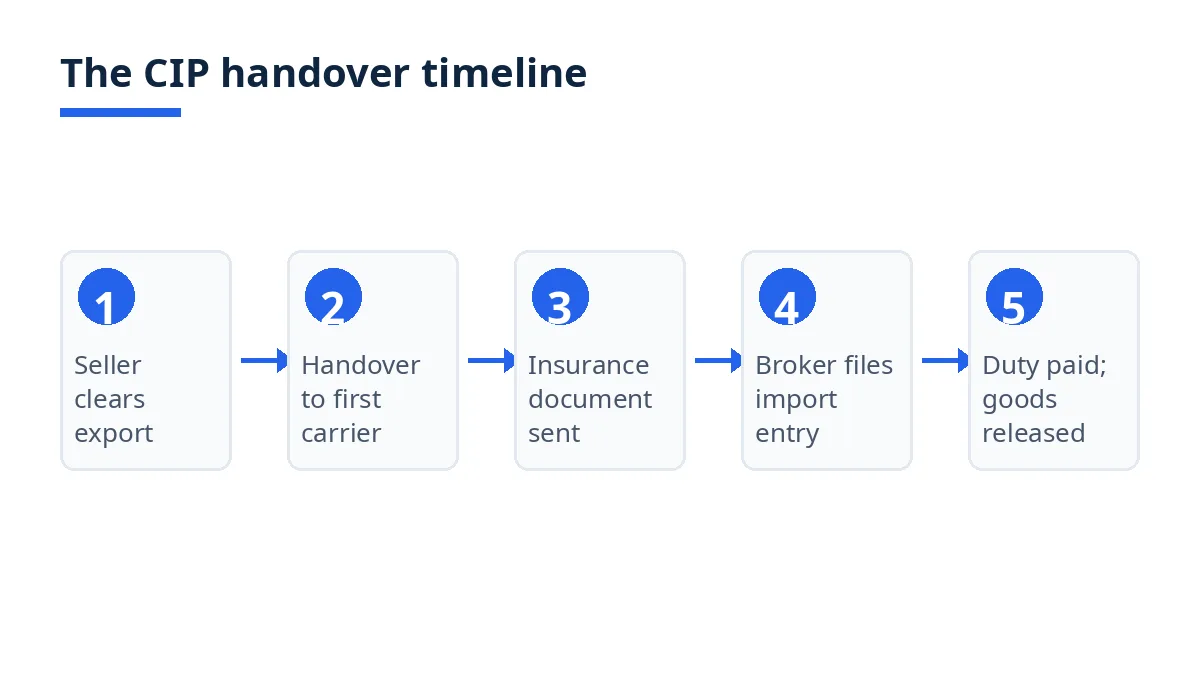
Under CIP, Carriage and Insurance Paid To, clearance changes hands once, but not at the same moment as risk or cost. The seller clears export in Bangladesh. The buyer clears import at the named destination and pays the duty and taxes assessed there. Between those filings, the seller keeps paying carriage and insurance while the buyer carries the risk, and the insurance document travels across.1 2
This guide follows a CIP shipment as three handovers, for a buyer importing from Bangladesh into the United States, the United Kingdom, the European Union or the United Arab Emirates. It states no duty rate, broker fee or transit time as fact. Every rate comes from the destination broker and the live schedule for the confirmed code.
The three actors and the three handovers
Three actors handle a CIP shipment, each at a different point. The seller acts first, the carrier and insurer act in the middle, and the buyer, usually through a broker, acts last.
The seller delivers the goods to the carrier it contracts, at the agreed place and point of delivery, completes export formalities, and pays carriage to the named place of destination.1 The seller also arranges the cargo insurance. CIP works for any mode, so the delivery point may be a warehouse, port, airport or rail terminal.1
The carrier and the insurer take the goods at the delivery point and carry them to the named destination. Neither clears customs.
The buyer and the broker handle the destination side. The buyer is responsible for import formalities, including customs procedures in transit countries, and for further transport beyond the named destination.1 Most buyers appoint a broker to file the import declaration and settle the assessed charges.
The place of delivery and the named place of destination differ. The first is where the seller hands the goods to the carrier; the second is the place to which the seller pays carriage and insurance.1 Name both in full, for example "CIP Hamburg inland terminal, Incoterms 2020, delivery at the carrier depot, Gazipur".
Handover one: export clearance before the first carrier
Handover one belongs to the seller, before the goods move. Under CIP, the seller must complete export formalities.1 For Bangladesh, Section 131 of the Customs Act, 1969 requires clearance for export, and goods must not be loaded or stuffed unless an export declaration, known as the Bill of Export or Shipping Bill, has been submitted in the prescribed format and approved.3
The papers enclosed with the Bill of Export are:3
Export letter of credit, or, where there is none, the export contract, purchase order or export guarantee approved by the negotiating bank.
Commercial invoice, signed by the exporter, with a detailed description of the goods.
Packing list, with quantity, weight and packing information.
EXP form, certified by Authorized Dealers.
Certificate of origin, issued by the Export Promotion Bureau (EPB) or a Chamber of Commerce and Industry.
VAT registration certificate.
Taxpayer Identification Number (TIN).
Product-specific papers sit on top of that set where they apply, including an Export Registration Certificate for jute, jute goods and tea, and a utilization declaration for garment exports under a bonded warehouse.3 Once approved, the goods are loaded, and export is complete once the ship, truck or airline leaves the port, with the customs officer signing the shipping bill as shipped on board.3 No approved Bill of Export means no loading.
The buyer's work here is checking, not filing. Ask for the invoice and packing list before handover, and check that names, description, quantities, values and HS code match the purchase order and certificate of origin. A mismatch found before handover can still be corrected; at the destination it becomes a query on the import declaration. Confirm the delivery point in writing.1
Handover two: risk passes and the insurance document travels
Handover two is the point the CIP term turns on. Risk transfers to the buyer once the goods are handed over to the carrier at the designated point.1 Where several carriers handle successive legs, delivery occurs at handover to the first carrier.1
From that moment, the positions split three ways. The buyer carries the risk. The seller continues to pay carriage and insurance. The insurance document travels to the buyer as protection for the risk the buyer now carries. The seller must notify the buyer in a timely manner that delivery has occurred.1 Ask for that notice on the handover day.
The insurance separates CIP from its uninsured counterpart, CPT. The CIP seller must obtain insurance complying with Institute Cargo Clauses (A), or equivalent cover, for at least 110 percent of the contract price, issued in favor of the buyer or a party the buyer designates.1 Cover must extend to the agreed destination, and the seller must provide the document so the buyer can claim directly from the insurer.1 2
Check three things. The clause: Clause (A) is the CIP minimum, while Clause (C) is the narrower CIF minimum.4 The insured amount: the premium is the price of the policy, while the insured amount is the sum the policy will pay up to, and it must reach 110 percent.2 The claim route: the document must name the insurer and show the claim contact and notice period.1 Broad cover remains subject to exclusions, conditions and deductibles.2
An insurance document is not a customs document: it does not clear the goods or pay duty. The CIF customs clearance guide follows the same boundary for the sea-only term.
Handover three: import clearance at the named destination
Handover three belongs to the buyer, and it should start before arrival. The buyer, or the appointed broker, files the import declaration, answers queries on classification, value and origin, and pays the duty and tax assessed before release. The seller files nothing at the destination. Onward transport from the named destination is the buyer's cost, unless the carriage contract says otherwise.1 2
In the European Union, all traders are required to have an Economic Operators Registration and Identification (EORI) number, required to submit declarations.5 A non-EU company can use a third-party provider as a representative, and the representative provides its EORI number.5 A prenotification is required as an entry summary declaration: at least 24 hours prior to arrival for sea transport, and usually between 1 and 4 hours for other modes.5 Duties are a percentage of the customs value, including transport and insurance costs until the EU border, and import VAT is a percentage of the value with duties included.5
In the United Kingdom, the importer must deliver a written declaration enabling HM Revenue and Customs to assess customs duties, excise duties and VAT.6 Immediate payment is required unless duty or import VAT is paid under deferment.6 A person on whose behalf a declaration is made is also a debtor, and liable persons are jointly and severally liable.6 This guide states no UK duty rate.
In the United States, importers and exporters use the Automated Commercial Environment (ACE), the centralized system for processing imports and exports, to provide the information that enables US Customs and Border Protection to collect tariff revenue and enforce regulations.7 This guide states no US registration, customs value basis or duty rate, because none was verified from an opened schedule. In the United Arab Emirates, it likewise states no filing system or rate. Confirm every rate with the broker before handover.
Names, description, quantity, weight, marks, places and values must read the same way on every document. The EU prenotification needs information from documents originating with the exporter, so those documents must reach the lodging party in time.5
Costs, timelines and documents
CIP fixes who pays, not how much. No CIP rule sets a freight rate, a premium, a transit time or a broker fee. The seller pays carriage and insurance to the named destination. The buyer pays import clearance, duty and taxes, and onward transport.2
The illustration below shows the structure only. Example figures.
CIP price: goods 12,000, carriage 850, insurance premium 95, total 12,945.
Buyer lines: broker fee 180, destination handling 210, onward transport 190, total 580 before duty and tax.
Total before duty and import tax: 13,525. Duty and tax are added from the schedule amount for the confirmed code, confirmed with the broker.
Do not confuse the premium with the insured amount. The premium of 95 buys the policy. The insured amount must reach at least 110 percent of the contract price in the contract currency, which on 12,000 means at least 13,200.2 Check the insured amount on the policy, not the premium line.
Timelines are fixed gates, not typical durations: Bill of Export approval before loading,3 the seller's timely handover notice,1 the EU prenotification deadlines,5 and release once assessed charges are paid.
Documents follow the same order as the handovers. The export set proves the seller's filing: the Bill of Export with its enclosures.3 The transport document and delivery notice prove handover two: carrier, places, freight-prepaid position, and the date risk passed. The insurance policy or certificate proves the cover: clause, insured amount, currency, insurer, claim contact and notice period.1 2 The import set is built from the seller's papers.
Bangladesh-specific rules and tips
Name the handover point and the destination separately, in the same form in every document. If the delivery place is not agreed, the seller may select the place and point that suits its purpose.1 Write both places into the contract.
Reconcile names before sailing. The Bill of Export names the exporter, the foreign buyer and the transport operator, and must match the invoice, packing list and contract.3 Confirm the certificate of origin route: issued by the EPB or a Chamber of Commerce and Industry, with the EXP form certified by Authorized Dealers.3 A seller who cannot produce the certified EXP form has not completed the export set.
Mistakes and red flags
Treating a CIP price as a landed cost. It covers goods, carriage and insurance to the named destination only. Budget the destination side from the broker's written estimate.
Assuming the seller clears import customs. The seller handles export formalities; the buyer handles import formalities, including transit customs.1 Any duty-paid promise needs a different term, in writing, with the duty payer named.
Assuming risk stays with the seller until arrival. Risk passes at handover to the first carrier.1 Put the risk point in the receiving checklist, so the receiver checks the goods and the insurance document on arrival.
Accepting Clause (C) cover, or an unstated insured amount. Clause (C) is the narrower CIF minimum, not the CIP minimum, and an unstated amount cannot be checked against the 110 percent rule.4 1
Reading the insurance document as a customs clearance. It proves cover for a claim. It does not file the import declaration or pay duty.2
Appointing the broker after arrival. Queries are cheapest in transit, and EU prenotification deadlines run before arrival.5 Appoint the broker at order stage.
Naming a country instead of a destination place. "CIP Germany" names no terminal, airport or inland place. Name the place in full.
Sign-off in handover order
Work through this sign-off in order.
Seller and buyer: the term reads "CIP [named place of destination], Incoterms 2020", and the delivery point in Bangladesh is named separately in full.
Seller: the export set is assembled, the Bill of Export is approved before loading, and the approved copy can be supplied on request.3
Seller: the carrier and handover date are confirmed, and the delivery notice will be sent on the handover day.1
Seller: insurance is Clause (A) or equivalent, at least 110 percent of the contract price in the contract currency, issued in favor of the buyer, with claim contact and notice period stated.1 2
Buyer: the insurance document will be held before the goods arrive, and the claim route has been passed to the receiver.1
Buyer: the broker is appointed, import data is ready, and duty, tax and broker charges have been estimated from the live schedule, with no rate assumed.
Buyer: onward transport is booked for the release date, and the duty payment route is agreed with the broker in writing.
How Exportain helps
On Exportain, a buyer states quantity, target price, destination, Incoterm, certifications and deadline in a request for quotation, and suppliers in that category quote against it.8 State the CIP term, destination, delivery point, and insurance clause and amount required in the RFQ. Buyers can also request quotes from listed freight, customs and inspection providers, to appoint the destination broker early.8 If the supplier asks for a funds hold, Exportain keeps it until the supplier has filed an export clearance document and the buyer has confirmed the trade complete.8
Exportain is a marketplace, not a party to the contract for the goods, and it does not inspect goods, book freight or clear customs. Verification is a document and photo review, not a factory inspection, and membership plans never grant a trust badge.9
What should I know first about CIP?
Know the three handovers before the price. The seller clears export customs, pays carriage and insurance to the named destination, and hands the goods to the first carrier, where risk passes to the buyer.1 The buyer clears import customs, pays duty and taxes, and arranges onward transport.
What are the typical costs and timelines?
No typical costs or timelines can be stated as fact. Duty depends on the HS code and origin, tax on the destination schedule, and broker and carriage charges on route, mode and port. The fixed gates are Bill of Export approval before loading,3 the seller's timely handover notice,1 the EU prenotification deadlines,5 and release once assessed charges are paid. Confirm every rate with the broker.
Which documents are needed?
The buyer should hold the commercial invoice, packing list, transport document, delivery notice, and insurance policy or certificate showing clause, insured amount, currency, insurer and claim contact.1 2 The seller's clearance set includes the approved Bill of Export, export letter of credit or approved contract, signed invoice, packing list, EXP form certified by an Authorized Dealer, certificate of origin, VAT certificate and TIN.3 The import set is built from the seller's papers, with the EORI number in the EU where the buyer files through a representative.5
What are the most common mistakes?
Naming a country instead of a destination place, assuming the seller bears transit risk or clears import customs, accepting Clause (C) cover or an unstated insured amount, and appointing the broker after arrival. Check the term, delivery point, clause and insured amount in writing before handover.
Next steps on Exportain
Read the Incoterms guide for shipments from Bangladesh to place CIP beside the other ten rules, then compare the insurance element in the CIP quotations guide before ranking any quotation. When ready, post a free RFQ on Exportain stating the CIP term, named destination, delivery point, Incoterms 2020 edition, and insurance clause and insured amount required, following the how to buy steps.
Sources
- CPT & CIP Incoterms 2020 explained: Key differences. ICC Academy (accessed )
- CIP Incoterms (Carriage and Insurance Paid To) Explained. iContainers (accessed )
- Customs Clearance Procedures for Export. Bangladesh Customs, National Board of Revenue (accessed )
- Incoterms® 2020. International Chamber of Commerce (ICC) (accessed )
- EU Custom Guide: Import Entry Process into the EU. Rules of Origin Facilitator (accessed )
- DMBM540030 - Debt and return pursuit: customs duties: customs duties: who is liable for payment of customs debts. HM Revenue and Customs (accessed )
- ACE: The Import and Export Processing System. U.S. Customs and Border Protection, (accessed )
- How to source and buy from Bangladesh. Exportain (accessed )
- Supplier verification: Earn trust badges buyers can see. Exportain (accessed )
About the author
Sourcing from Bangladesh?
Post a request for quotation and suppliers on Exportain can send you their quotes directly.
Post an RFQ


