

Who Handles Customs Clearance Under CIF? Export vs Import Explained
Under CIF, the seller clears export customs in Bangladesh and pays freight and insurance to the destination port; the buyer clears import customs and pays duty and tax. This guide follows the split, the handover documents and the cost of getting it wrong.
Short answer
Under CIF (Cost, Insurance and Freight), the seller handles export clearance in Bangladesh and pays ocean freight and minimum marine insurance to the named destination port. The buyer handles import clearance at destination and pays the import duty and VAT or GST assessed there. CIF does not include import clearance, duty or tax. Risk passes to the buyer when the goods are loaded on board at the port of shipment.
On this page
Key takeaways
Under CIF, the seller handles export clearance in Bangladesh and the buyer handles import clearance, duty and tax at destination; CIF does not include import clearance, duty or VAT.
The seller pays ocean freight and minimum marine insurance to the named destination port, but risk passes to the buyer when the goods are loaded on board.
The handover at the destination port is a documents handover: bill of lading, invoice, packing list, certificate of origin and insurance document.
Minimum insurance under Institute Cargo Clauses (C) is the CIF default, so wider cover must be agreed expressly or arranged by the buyer.
No destination duty or tax rate is stated in this guide; confirm every rate with the destination broker against the live schedule.
CIF customs clearance splits into two filings. Under Cost, Insurance and Freight (CIF), the seller handles export clearance in Bangladesh and pays freight and insurance to the named destination port, while the buyer handles import clearance and pays the duty and taxes assessed there.
This guide is for buyers importing from Bangladesh into the United States, the United Kingdom, the European Union or the United Arab Emirates.
The CIF customs clearance split at a glance
The Incoterms 2020 rules give 11 rules with a clear allocation of cost, risk and obligations, and the CIF rule is reserved for sea and inland waterway transport.1 Three lines run through every CIF shipment and do not move together: cost runs from the seller to the destination port, risk ends when the goods are placed on board, and clearance changes hands at the border.
Line | Seller | Buyer |
|---|---|---|
Export clearance | Files and clears the goods for export | No part in the export filing |
Freight and insurance | Pays both to the destination port | No part in either contract |
Risk | Carries risk until on board | Carries risk from loading onward |
Import clearance | No part in the filing | Files, or appoints a broker to file, the declaration |
Import duty and VAT or GST | Not in the CIF price | Pays the duty and tax assessed |
Onward transport | Ends at the port | Arranges and pays transport after the port |
Import duty is never the seller's obligation under the default CIF rule. A duty-paid promise comes from a separate agreement in the contract, not from the three letters CIF; confirm it in writing before treating a CIF price as a landed cost. Two brokers are therefore normal: the seller's agent works the export side, the buyer's broker works the import side, and neither filing substitutes for the other.
The export side: CIF export clearance in Bangladesh
CIF export clearance is the seller's filing, completed before the goods move. Under section 131 of the Customs Act, 1969, goods must not be loaded or stuffed into containers or a ship for export unless an export declaration, known as the Bill of Export or Shipping Bill, has been submitted to Customs in the prescribed format and approved.2 The declaration states the description of the goods, their value, the names of the exporter and the foreign buyer or importer, and the name of the transport operator.2 Approval is a gate: no approved Bill of Export, no loading.
The National Board of Revenue (NBR) sets out the papers enclosed with the Bill of Export: the export letter of credit, or the export contract, purchase order or export guarantee approved by the negotiating bank; the signed commercial invoice with a detailed description of the goods; the packing list; the EXP form, certified by an authorized dealer; the certificate of origin, issued by the Export Promotion Bureau (EPB) or a Chamber of Commerce and Industry; the VAT registration certificate; and the taxpayer identification number (TIN).2 Product-specific papers sit on top of that set where they apply, such as an Export Registration Certificate for jute goods and tea or a utilization declaration for garment exports under a bonded warehouse.2
For the buyer, the export side is a checking job: confirm the invoice and packing list match the purchase order, the certificate of origin was issued by the body named in the contract, and the seller will send the bill of lading and insurance document promptly after loading. The seller delivers the goods on board and contracts and pays the freight and insurance to the named port.3 Once the declaration is approved, the goods are loaded, and export is complete when the ship leaves, with the customs officer signing the shipping bill as shipped on board.2
The import side: CIF import clearance at destination
CIF import clearance is the buyer's filing, and it starts before the vessel arrives. The buyer, or the broker the buyer appoints, files the import declaration, answers queries on classification, value or origin, and pays the duty and tax assessed before release. The Incoterms rules place the costs of clearance obligations in each rule's consolidated costs article, so they belong to the party the rule assigns them to.1
In the European Union, traders are responsible for declaring imports through an import declaration, undertaken by EU-established entities or an EU-established representative such as a customs broker acting for a non-EU entity.4 An Economic Operators Registration and Identification (EORI) number is required to submit declarations.4 For sea transport, the entry summary prenotification must be submitted at least 24 hours before arrival.4 Customs duties are calculated on the customs value, including transport and insurance costs until the EU border, and import VAT on the value with duties included; the importer can pay before release, pay an advance to a provider, or use a deferment account.4
In the United Kingdom, the importer must deliver a written declaration enabling HM Revenue and Customs to assess customs duties, excise duties and VAT, with immediate payment by the declarant unless duty or import VAT is paid under deferment.5 A broker's appointment does not move liability alone: a person on whose behalf a declaration is made is also a debtor.5 In the United States, importers must use the Automated Commercial Environment (ACE), the centralized system for processing imports, to provide the information that enables US Customs and Border Protection to collect tariff revenue and enforce regulations.6
In the United Arab Emirates, the buyer side likewise files the import declaration and settles the assessed charges. No figure here states a destination duty or tax rate: confirm with broker is the rule for every rate. Appoint the broker before sailing and agree in writing who pays at the border.
The handover at the destination port
The handover is where the seller's paid carriage ends and the buyer's clearance begins. The named destination port is the port to which the seller has paid freight and insurance, not a delivery address, and not where risk passes. What passes there is control of the papers the buyer needs to clear the goods.
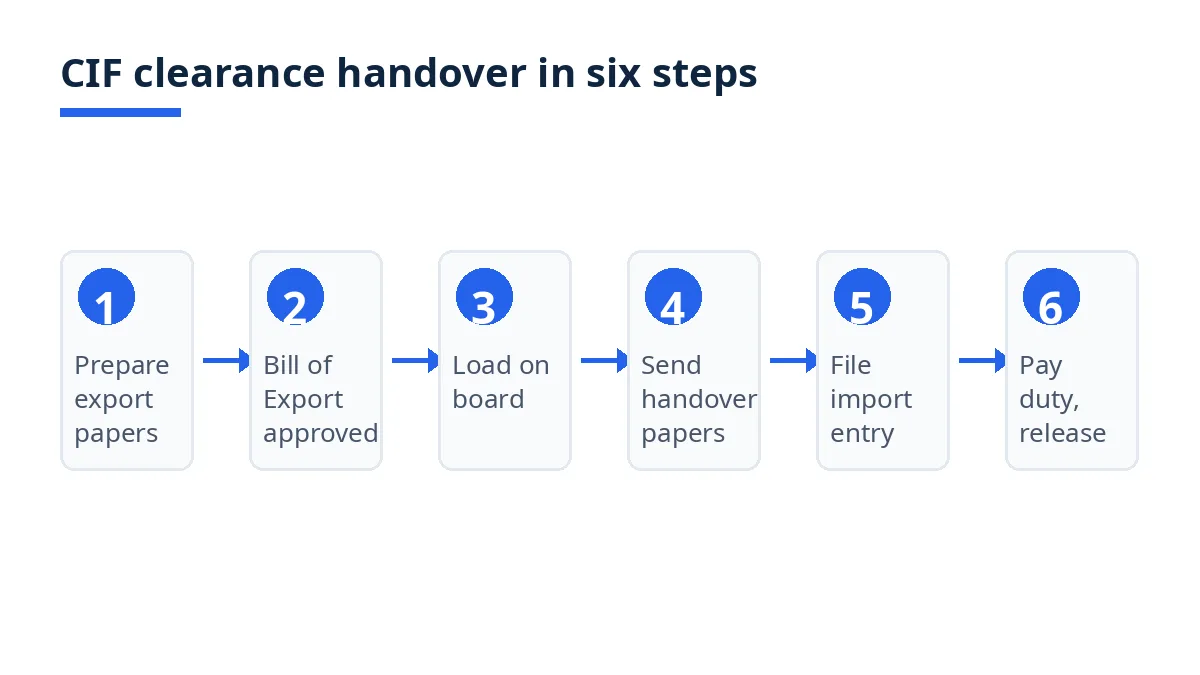
The seller sends the bill of lading, invoice, packing list, certificate of origin and insurance document after loading. The buyer or broker files the import declaration from those papers, and the goods are released once the assessed duty and tax are paid. See the CIF documents checklist guide for the full set.
Three failures recur: a late bill of lading, a name mismatch between the bill of lading and the import declaration, and a missing insurance document. Ask for the full handover set by a named date in the contract, measured from the bill of lading date.
How CIF insurance fits the split
Insurance crosses the split: the seller contracts for cover against the buyer's risk of loss or damage during carriage, and pays the freight and insurance to the named port.3 The buyer carries the risk from loading, but the seller buys the policy, and only on minimum cover. A buyer wanting more protection must agree it expressly or arrange its own cover.3
Under Incoterms 2020, CIF keeps the Institute Cargo Clauses (C) as the default cover, with the option to agree a higher level, while CIP requires the higher Clauses (A) cover.1 Clause (C) cover is the minimum: named perils, not all risks. Insurance never clears customs or pays duty. Read the wording, check the insured value, and agree wider cover before loading.
What the split costs when it goes wrong
Getting the split wrong produces several smaller bills, each charged to the party who did not budget for it. Confirm every charge with the broker: this guide states no rate as fact.
Charge | Who pays under CIF | When it arises |
|---|---|---|
Export clearance and handling | Seller | Before loading in Bangladesh |
Ocean freight and minimum insurance | Seller | Contracted before sailing |
Destination terminal handling, if not in the freight contract | Buyer, unless agreed otherwise | On arrival |
Import declaration and broker fee | Buyer | Before or on arrival |
Import duty, VAT or GST | Buyer | Assessed on the import declaration |
Examination, storage and demurrage | Buyer, unless agreed otherwise | While goods await release |
Onward transport after the port | Buyer | After release |
Example figures: a CIF quotation of 10,000 currency units plus 2,400 in destination charges, duty, tax and onward transport lands at 12,400. The example shows structure only, not a rate. The landed cost guide works through the same build-up. Put the broker appointment, duty payer and handover date in the sales contract, with the CIF term and named port.
Bangladesh export practice: names, papers and checks
Bangladesh export practice rewards exact names. The Bill of Export names the exporter, the foreign buyer and the transport operator, and must match the invoice, packing list and contract.2 Reconcile names, description, quantity and values before sailing: differences become queries at destination, because the import declaration is built from the same papers.
Confirm the certificate of origin route and the EXP form position: the certificate is issued by the EPB or a Chamber of Commerce and Industry, and the EXP form is certified by an authorized dealer.2 A seller who cannot produce the certified form has not completed the export set. Whether the port is Chattogram or Mongla, goods are not loaded until the declaration is approved.2 A loading photograph is not proof of shipment; the bill of lading, with its on-board notation, is.
Red flags: mistakes that move costs across the split
Treating a CIF price as a landed cost. It covers cost, insurance and freight to the destination port only. Budget the destination side from the broker's written estimate. See the CIF cost, insurance and freight guide.
Assuming the seller clears import customs. No default CIF term assigns import clearance to the seller. Any such offer must be written into the contract, with the duty payer named.5 4
Appointing the broker after arrival. Queries are cheapest while the goods are at sea. Appoint the broker at order stage.
Accepting minimum insurance without reading it. Minimum cover under Institute Cargo Clauses (C) is the CIF default, and wider cover must be agreed expressly or arranged by the buyer.1 3
Mismatched names and values. Exporter, buyer, description, quantity and value must match across the invoice, packing list, Bill of Export and bill of lading.2
Using CIF for the wrong transport mode. CIF is a sea and inland waterway rule.1 Air freight or inland handover needs a matching rule, such as CIP. The Incoterms guide compares all 11 rules.
Your split checklist
Work through this checklist before sailing, and keep the answers with the purchase order.
Check | Owner | Done when |
|---|---|---|
CIF term, version and named port in the contract | Both | Contract names the port |
Export papers assembled | Seller | Seller confirms the set before loading |
Bill of Export approved before loading | Seller | Approved copy supplied on request |
Freight and minimum insurance contracted | Seller | Insurance document received and read |
Wider insurance agreed or buyer policy arranged | Buyer, or seller by agreement | Wording held before sailing |
Handover set sent | Seller | Handover date in the contract met |
Destination broker appointed | Buyer | Broker holds the papers before arrival |
Import declaration checked | Buyer | Broker confirms the entry is ready |
Duty, tax and broker charges estimated | Buyer | Estimate filed with the landed cost |
Duty payer and payment route agreed | Buyer | Route confirmed with the broker |
Onward transport booked | Buyer | Booked for the release date |
How Exportain helps
On Exportain, a buyer states quantity, target price, destination, Incoterm, certifications and deadline in a request for quotation, and suppliers in that category quote against it.7 State the CIF term, named port and handover date in the RFQ, so quotations are comparable on the same split. Buyers can also look up forwarder freight rates and request quotes from listed freight, customs and inspection providers, to appoint the destination broker early.7 If the supplier asks for a funds hold, Exportain keeps a paid hold until the supplier has filed an export clearance document and the buyer has confirmed the trade complete.7 The hold is tied to the export filing and does not clear the goods at destination.
Verification is a document and photo review, not a factory inspection, and membership plans never grant a trust badge.8 A badge does not test whether a seller can complete an export filing. Document checks and the broker appointment stay with the buyer.
Questions buyers ask first
What should I know first about CIF?
Know the split before the price. The seller clears the goods for export, pays freight and minimum insurance to the named port, and delivers them on board.3 The buyer carries the risk from loading, clears the import, and pays the duty and tax assessed. Anything beyond that split must be agreed in writing.
What are the typical costs and timelines?
No typical costs or timelines can be stated as fact: duty depends on the HS code and origin, tax on the destination schedule, and broker charges on the port and sailing. The fixed gates are Bill of Export approval before loading,2 the sea leg, and the EU prenotification 24 hours before arrival.4 Confirm every rate with the broker.
Which documents are needed?
The export set is the seller's: letter of credit or approved contract, signed invoice, packing list, certified EXP form, certificate of origin, VAT certificate and TIN, plus product-specific certificates.2 The handover set is the bill of lading, invoice, packing list, certificate of origin and insurance document. The import set is the buyer's: the import declaration, with the EORI number in the EU,4 the broker's authority, and any licence the destination requires.
What are the most common mistakes?
Treating a CIF price as a landed cost, assuming the seller clears import customs, appointing the broker after arrival, accepting minimum insurance unread, and letting names and values differ across the papers. The control is the checklist above: the split in writing, the handover date in the contract, and the broker appointed before sailing.
Next steps on Exportain
Post your requirement, with the CIF term, named port and handover date, on the RFQ board, and compare quotations on the same split using the how to buy steps. Before accepting, read the CIF cost, insurance and freight guide and the landed cost guide, and confirm the duty estimate with your broker in writing.
Sources
- Incoterms® 2020. International Chamber of Commerce (ICC) (accessed )
- Customs Clearance Procedures for Export. Bangladesh Customs, National Board of Revenue (accessed )
- Incoterms Explained - The Complete Guide. IncoDocs, (accessed )
- EU Custom Guide: Import Entry Process into the EU. Rules of Origin Facilitator (accessed )
- DMBM540030 - Debt and return pursuit: customs duties: customs duties: who is liable for payment of customs debts. HM Revenue and Customs (accessed )
- ACE: The Import and Export Processing System. U.S. Customs and Border Protection, (accessed )
- How to source and buy from Bangladesh. Exportain (accessed )
- Supplier verification: Earn trust badges buyers can see. Exportain (accessed )
About the author
Sourcing from Bangladesh?
Post a request for quotation and suppliers on Exportain can send you their quotes directly.
Post an RFQ


