CIF vs CPT: Key Differences, Costs and Which One to Choose
CIF vs CPT for buyers importing from Bangladesh: who buys the insurance, where risk passes, who pays the freight and the destination charges, and which term fits your order, with a worked example pricing one container of knitwear to New York.
Short answer
CIF and CPT both make the seller pay freight, but they differ on insurance, transport and risk. Under CIF the seller delivers on board at Chattogram, pays freight to your port and must buy Clause C insurance for at least 110 percent of the contract value. Under CPT the seller pays carriage to your place for any mode, risk passes at the first-carrier handover, and you arrange your own cover. Choose CIF for bulk sea freight and CPT for containers.
On this page
Key takeaways
Under CIF the seller must buy minimum Clause C cargo insurance for at least 110 percent of the contract value; under CPT the seller buys no insurance and you arrange your own cover.
Risk passes on board at Chattogram under CIF and at the first-carrier handover under CPT, while the seller keeps paying freight in both cases.
CIF works for sea and inland waterway only; CPT works for any mode, so containers and multimodal routes fit CPT.
The worked example lands on the same $12,885 buyer total under both rules; only the payer of the $100 insurance premium changes.
Two quotations land in your inbox for the same cotton knitwear order from Bangladesh: "CIF New York, Incoterms 2020" and "CPT New York, Incoterms 2020". Both sellers promise to pay the freight, and the prices differ by a small amount. The choice is not about the freight. It is about insurance, the transport each rule can describe, and the moment the risk of loss moves from the seller to you.
Under CIF the seller buys cargo insurance for your benefit, at minimum Clause C level, for at least 110 percent of the contract value.1 Under CPT the seller buys no insurance at all.2
CIF vs CPT at a glance
Question | CIF (Cost, Insurance and Freight) | CPT (Carriage Paid To) |
|---|---|---|
Transport modes | Sea and inland waterway only | Any mode, alone or combined |
Seller delivers when | Goods are on board the vessel at the port of shipment | Goods are handed to the first carrier |
Risk passes to you | On board the vessel at Chattogram | At handover to the first carrier |
Seller pays carriage to | Named port of destination | Named place of destination |
Cargo insurance | Seller must buy minimum Clause C cover | No obligation on the seller; you arrange cover |
Both rules sit in the C group of Incoterms 2020, where the seller pays carriage past the point where risk changes hands.3 Both leave import clearance, duty and onward carriage with you.
What CIF buys you that CPT does not
CIF stands for Cost, Insurance and Freight. The seller loads the goods on board at the port of shipment, clears them for export, pays the ocean freight to the named port of destination, and buys cargo insurance for your benefit.1 The insurance is the part of the price that CPT leaves out, and it is the part buyers most often misread.
The cover the seller must buy is minimum Institute Cargo Clauses (C) cover, for at least 110 percent of the contract value, in the currency of the contract.1 Clause C is named-perils cover for major casualties such as fire, explosion, vessel sinking, grounding and collision, and it does not cover theft, water damage from heavy weather or handling damage.1 The extra 10 percent is meant to cover your anticipated profit, and the policy must allow you to claim directly from the insurer.4
The seller buys the policy, but you are the one who claims on it. Before the vessel sails, check the insurance document: the goods and voyage named, the sum insured at 110 percent or more, the clause level, and your name, or a blank endorsement, so the claim sits with you.4 If the cargo is fragile, valuable or theft-prone, agree wider cover in the contract, such as Clause A, and agree who pays the extra premium. The rule only sets the floor.
CPT gives you none of this by default. The seller contracts and pays for carriage to the named place of destination, yet no part of the rule asks the seller to insure the goods.2 You buy the policy, you pick the clause level, and you pay the premium. CPT suits a buyer that already holds an annual marine policy. Our CFR vs CIF guide shows the same question from the CFR side.
Where risk passes under each rule
Under CIF, risk passes to you when the goods are loaded on board at the port of shipment, even though the seller keeps paying freight and insurance to your port.1 Under CPT, risk passes when the goods are handed to the first carrier, which can be a truck at the factory gate or a terminal in Chattogram, days before the vessel sails.2 In both cases you carry the risk through the main carriage, while the seller keeps paying for it.
The timing gap matters most for container cargo. A container is usually handed to a carrier at a terminal well before loading, so the on-board moment CIF names does not match the handover that actually happened. The ICC guidance warns against using FOB, CFR or CIF for containers and points buyers to FCA, CPT or CIP instead.5 CPT fits the box because its delivery point is the handover to the first carrier.2 CIF fits cargo loaded straight onto the vessel, such as bulk goods, where the on-board moment and the handover are the same event.
Under CPT the seller names two places in one contract. The delivery point is where the seller passes the goods to the first carrier, and risk moves there. The destination is the place written after the letters CPT, and it marks the end of the seller freight bill, nothing more.2 "CPT New York" tells you the seller freight account runs to New York, while the risk has sat with you since the first carrier collected the container in Bangladesh.3
Who pays what: the full cost build-up
The seller pays the main carriage under both rules, so a comparison that stops at the freight line tells you nothing. The build-up below sets out every line from the factory gate to your warehouse.
Cost line | Under CIF | Under CPT |
|---|---|---|
Goods, packing, export clearance | Seller, in the CIF price | Seller, in the CPT price |
Ocean freight to the destination port | Seller | Seller |
Cargo insurance premium | Seller, minimum Clause C | You, on your own policy |
Destination terminal handling | You, unless the carriage contract says otherwise | You, unless the carriage contract says otherwise |
Onward carriage to your warehouse | You | You |
Import clearance, duty and taxes | You | You |
The insurance premium is the only line that changes hands: under CIF it sits inside the seller price, and under CPT it sits outside it, on your account. Destination terminal handling is not settled by either rule. Under CPT the seller pays for carriage to the named destination, while the buyer pays insurance, clearance, duties and costs after the named destination, so ask the seller to state in writing which destination charges sit inside the carriage contract.2 The duty basis is the same under both rules, built on the CIF value of the goods, so confirm it with your broker before you settle the term.
Neither rule sets the price of the goods, the payment method, or the moment ownership passes.
Worked example: knitwear from Chattogram to New York
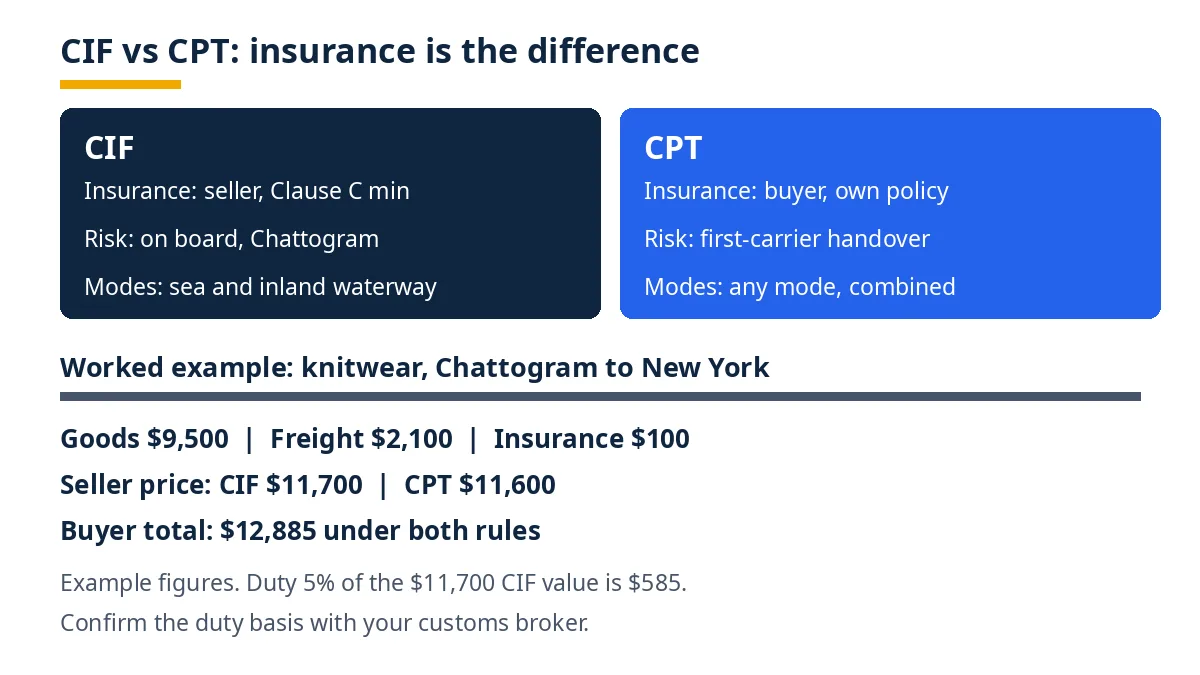
Example figures. A buyer in the United States orders 1,200 cartons of cotton knitwear worth $9,500 from a supplier in Chattogram, shipped in one 40-foot container to New York, then by road to the buyer warehouse in New Jersey. The numbers are illustrative.
Cost line | Under CIF | Under CPT |
|---|---|---|
Goods, packing, export clearance | $9,500, in the CIF price | $9,500, in the CPT price |
Ocean freight to New York | $2,100, paid by the seller | $2,100, paid by the seller |
Cargo insurance, $100 premium | $100, paid by the seller | $100, paid by the buyer |
Seller price | $11,700 | $11,600 |
Import duty, 5% of the $11,700 CIF value | $585, paid by the buyer | $585, paid by the buyer |
Destination handling, New York | $260, paid by the buyer | $260, paid by the buyer |
Road carriage to New Jersey | $340, paid by the buyer | $340, paid by the buyer |
Total the buyer pays | $12,885 | $12,885 |
Check it. Under CIF: 9,500 plus 2,100 plus 100 is 11,700, and duty is 5 percent of 11,700, which is 585. The buyer adds 585 plus 260 plus 340, which is 1,185, and 11,700 plus 1,185 is 12,885. Under CPT: 9,500 plus 2,100 is 11,600. The buyer adds 100 plus 585 plus 260 plus 340, which is 1,285, and 11,600 plus 1,285 is 12,885.
Both columns land on $12,885. The CIF invoice reads $100 more, because the insurance premium sits inside the seller price. Live quotations rarely line up this neatly, because the seller premium and your own premium are priced at different times. Get both prices to your warehouse for the same sailing window, with the insurance line shown in each quotation.
The $100 premium buys minimum cover only. A buyer on CPT can pick Clause A and pay more for wider cover, while a buyer on CIF must agree that with the seller before signing.
The documents each term needs
The papers follow the insurance split. Under CIF, the seller must give you an on-board bill of lading6 and the insurance document, so you can claim on the policy the seller bought.4 Our CIF guide sets out the full rule. Under CPT, the seller gives you the transport document issued by the first carrier, and the insurance policy, if there is one, is yours.
The Bangladesh side needs the same papers under both rules: commercial invoice, packing list, bill of lading and certificate of origin.6 Bangladesh adds its own: the EXP form is the export declaration, certified by the authorised dealer bank, and the Bill of Export is the exporter declaration to Customs, after which the goods can be shipped out.6 Check that the names, goods, quantities and amounts agree across every paper.
Under CIF, check the insurance document before the vessel sails, not after it arrives. Under CPT, ask the seller for written notice of the first-carrier delivery, with the date and carrier name, because that notice fixes the moment risk moved to you.
A decision rule for choosing between them
Apply the rule in order, and stop at the first line that settles the case.
If the cargo moves by air, road or rail, or across more than one mode, choose CPT. CIF cannot describe those legs, because it works for sea and inland waterway only.1
If the cargo moves in a container handed to a terminal, choose CPT, or CIP if you want the seller to insure. The container handover is the point CPT names, while CIF names an on-board moment that happens days later.5
If the cargo loads straight onto the vessel in bulk or break-bulk, and you want the seller to arrange the insurance, choose CIF. The seller buys the minimum cover for your benefit.1
If you already hold an annual marine policy, choose CPT. You control the insurer, the clause level and the claim. If you have no insurer and no broker, choose CIF for a first bulk sea-freight order, so you hold a policy to claim on while you set up your own cover.
For seller-paid carriage plus seller-bought insurance on a container, CIP adds Clause A cover to the CPT structure.5 Our FOB vs CPT guide covers the buyer-arranged side, and our CFR vs CPT guide covers the sea-only version. Work the figures into your landed cost for imports from Bangladesh before you sign.
FAQs
Which is cheaper, CIF or CPT?
Neither, on the same shipment with the same cover. The worked example lands on the same $12,885 total under both rules, because only the payer of the insurance premium changes. In live quotations the totals diverge, because the two premiums are priced at different times.
Which is safer for a first-time importer?
CIF is the safer pick for a first sea-freight order in bulk, because the seller arranges minimum insurance for your benefit. CPT is safe only with your own insurance in place from the first-carrier handover. For a first container order, CPT with your own policy, or CIP, is safer than CIF, because the risk point matches the real handover.
Next steps on Exportain
Ask for a CIF quotation and a CPT quotation for the same goods and the same named place, with the insurance line broken out in each. Search Bangladeshi suppliers and post an RFQ that states the rule, the place and the edition, and see how to buy for the steps once you have ordered.
Sources
- Understanding CIF Pricing & Incoterms 2020 for Shipping. FreightAmigo (accessed )
- CPT (Carriage Paid To) Meaning in Incoterms: Risk Transfer and Who Pays. GoFreight, (accessed )
- Incoterms 2020: Group C rule explained. Export Development Canada, (accessed )
- CIF Incoterm Explained: 7 Critical Rules Every Importer and Exporter Must Know in 2026. ejet (accessed )
- Incoterms 2020 Explained: All 11 Rules, Chart & Meaning. Xflowpay (accessed )
- The papers that move trade. Open Trade Bangladesh (accessed )
About the author
Sourcing from Bangladesh?
Post a request for quotation and suppliers on Exportain can send you their quotes directly.
Post an RFQ