

Insurance Under CFR: Who Must Insure the Cargo and for How Much?
Under CFR no party must insure the cargo, so the buyer arranges cover for the sea leg. This guide explains Clause A, B and C, how to set the insured value, and the survey, notice and documents needed if goods arrive damaged.
Short answer
Under CFR, neither the seller nor the buyer must insure the cargo. The seller contracts and pays ocean freight to the named destination port, but risk passes to the buyer when the goods are loaded on board the vessel. The buyer should therefore arrange its own marine cargo cover for the sea leg, in its own favor, before loading, and confirm the clause, insured value and transit wording with its insurer or broker.
On this page
Key takeaways
CFR imposes no insurance obligation on either party; only CIF and CIP oblige the seller to insure for the buyer.
Risk passes to the buyer on board at loading while the seller still pays freight to the destination port, so freight prepaid does not mean risk covered.
Buyer-arranged cover usually follows Institute Cargo Clauses A, B or C; Clause A is broadest and Clause C most restricted.
Agree the insured value, clause, currency and transit wording with the broker or insurer before loading, and confirm the uplift convention used.
On arrival, inspect the goods, note damage in writing, photograph it, notify the carrier and insurer promptly, and obtain a survey before goods are moved or repaired.
A CFR price looks reassuring: the seller pays ocean freight to your named port and the invoice shows one CFR value. What it does not show is who carries the loss if the vessel runs into trouble after loading. Under CFR, that person is you, the buyer, and no insurance is included unless you arrange it yourself.
This guide covers CFR insurance: who must insure, what cover to arrange, how to set the insured value, and what to do after damage. Confirm terms with your insurer or broker first.
Who must insure under CFR?
Nobody must insure under CFR: of the 11 Incoterms 2020 rules, only CIF and CIP oblige the seller to insure for the buyer.1 The seller must contract and pay for carriage to the named port, but that freight duty is not an insurance duty.1
Risk passes when the goods are placed on board the vessel at the port of shipment.1 From loading onward, the buyer bears the risk during the sea voyage, even though the seller is still paying the freight. Under the C rules, cost and risk move on different points.1
The contrast with CIF is sharp. Under CIF, the seller must arrange insurance meeting the minimum cover of the Institute Cargo Clauses (C) for the buyer's benefit.2 The International Chamber of Commerce (ICC) confirms that Institute Cargo Clauses (C) remains the default level of coverage under CIF, with the option to agree a higher level.3 Under CFR there is no equivalent duty. If the seller offers insurance voluntarily, that is a separate agreement, not a CFR duty. Do not assume a CFR quotation includes cover because the freight is prepaid; the CFR price guide shows that insurance is not among the cost lines a CFR price includes. A seller's own transit cover does not protect the buyer after risk passes.
Why this matters for buyers and sellers
For the buyer, the gap bites at the worst moment: paid-for goods at sea, with no policy to claim on. A damaged consignment becomes a negotiation with the seller or the carrier, neither of which owes the buyer an insurance payment under CFR. For the seller, an uninsured buyer may press for a discount or replacement even though the seller met the CFR term. Stating the insurance position plainly in the quotation avoids that dispute.
The gap also decides the choice of term. If you want the seller to insure, choose CIF and check that the Clause C minimum is enough, or agree a higher level in the contract. If you want control over the insurer, the clause, and the insured value, CFR plus your own policy gives you that control. Compare the two terms in the CIF guide before you sign.
What the buyer should arrange: Clause A, B and C in outline
Most cargo cover is written by reference to the Institute Cargo Clauses, published by the Institute of London Underwriters, now part of the International Underwriting Association.4 There are three sets, A, B and C.
Clause A is the broadest tier: it covers all risks of loss or damage unless a specific exclusion applies.4 Clause B and Clause C pay only for listed perils.4 Clause B covers more than Clause C, including earthquake, washing overboard, and entry of sea, lake, or river water.4 Theft and pilferage appear in the Clause A column only, so cartons on Clause C cover may hold no theft protection.4
Peril | Clause A | Clause B | Clause C |
|---|---|---|---|
Fire or explosion | Yes | Yes | Yes |
Vessel stranding, grounding, sinking, or capsizing | Yes | Yes | Yes |
Washing overboard | Yes | Yes | No |
Earthquake or volcanic eruption | Yes | Yes | No |
Entry of sea, lake, or river water | Yes | Yes | No |
Theft or pilferage | Yes | No | No |
The table follows National Cover's comparison.4 It is an outline only; policy wording decides the claim. All three sets exclude deliberate damage by the insured, inherent vice, and delay.4
Ask your broker about war and strikes cover, handled through separate clauses,4 and about the transit wording. Cover is commonly warehouse-to-warehouse, ending at the earliest of delivery to the final warehouse named in the policy, delivery to other storage, or 60 days after discharge.4 Clause A usually suits high-value, fragile, or frequently handled goods; Clause C suits low-value bulk cargo only if its named perils match the journey.4
How much cover: the insured value and the uplift convention
Under CFR, no rule fixes the sum insured for the buyer's own policy. Agree the figure with your insurer or broker before loading. The reference point is the CIF convention: under CIF, the seller must insure for at least 110% of the contract value, in the contract currency.5 That 110% figure is a CIF duty, not a CFR rule. For a CFR buyer, the same arithmetic is a market convention to discuss with the broker: the CFR or CIF value plus an uplift for anticipated profit or margin, confirmed in the policy.
The uplift exists because a lost consignment costs more than the invoice price: freight already paid, related costs, and the expected margin. Example figures: a CFR consignment valued at USD 48,000, insured at 110%, carries a sum insured of USD 52,800. The example shows the arithmetic only. If the contract value changes after the certificate is issued, tell the broker before loading; if the declared value is below the real value, the insurer may reduce the payment.
Step-by-step: how it works
Arrange cover before loading. The steps below are insurance steps, not shipping steps.
The diagram below summarizes the sequence from loading to claim.
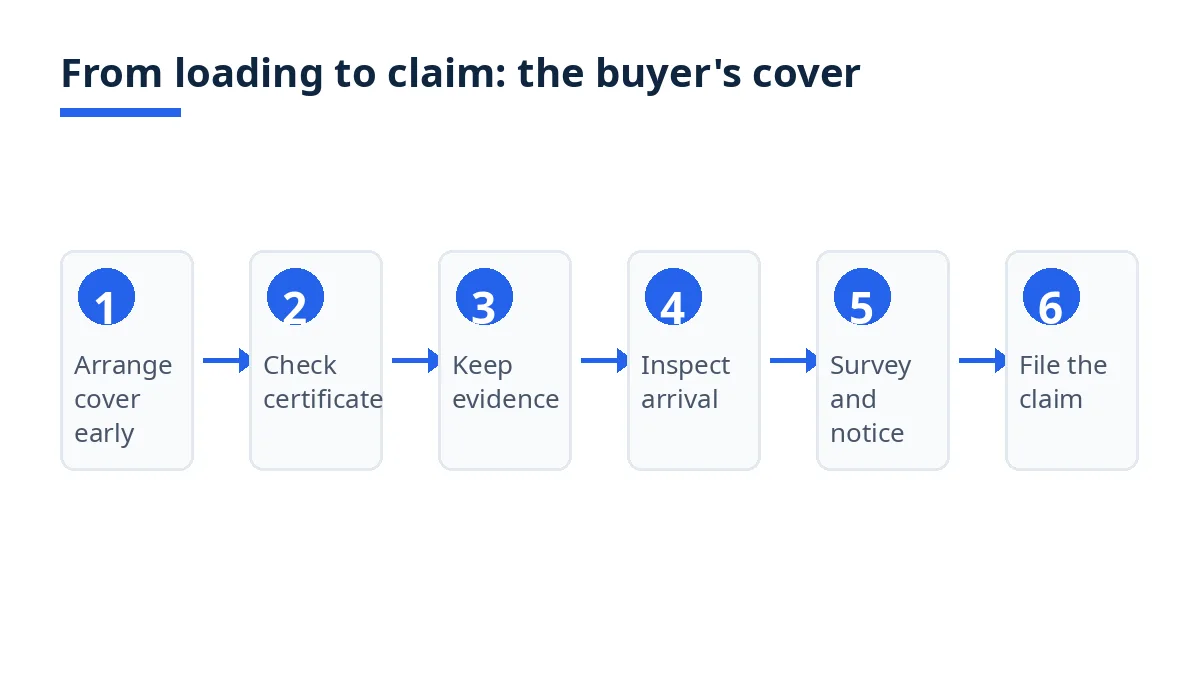
Brief the broker before you confirm the order. State the goods, value, route, packing, and Incoterm, and record the recommended clause, value, currency, and transit wording.
Agree the clause, value, and transit extent. Confirm Clause A, B, or C, the sum insured, the currency, and whether cover runs to your final warehouse or ends at the destination port.
Check the certificate. Confirm the insured party, goods, sum insured, clause letter, voyage, and transit wording. Fix any error before loading.
Keep loading evidence. Retain the bill of lading, commercial invoice, packing list, and any loading photographs or inspection records.
Inspect on arrival before signing a clean receipt. Count the packages, check them against the bill of lading, and photograph damage while the goods are still in the container or truck.
Notify, survey, and file in order. Give written notice to the carrier, notify the insurer, obtain a survey, and file the claim below. Keep damaged goods until the insurer accepts disposal.
If the goods arrive damaged: survey, notice and documents
Before signing the receipt, count the packages against the bill of lading and inspect them: slight package damage can mean serious damage inside.6 Photograph damage in the truck or container, separate damaged goods, prevent further damage, and do not destroy them without the insurer's acceptance.6
Give notice twice, in writing. First, remark the damage on the freight documents, on both the carrier's copy and your own, stating the number of damaged packages, the type of damage, the cause if known, and the date and signature.6 Second, send a separate written notice of loss to the last carrier, reserving the right to present a specified claim later.6 For sea transport, If P&C Insurance advises written notice at once for visible damage and within 3 days from discharge for damage not apparent at delivery.6
Notify the insurer at the same time. The insurer's average agent surveys the goods to establish the extent of the damage, its cause, and the relevant facts, and may arrange a joint survey with the carrier.6 Do not repair or dispose of anything until the survey is done or the insurer agrees.
The claim file commonly includes:6
Document | Why it is needed |
|---|---|
Commercial invoice | Value of the goods |
Weight or packing specification | What was shipped, and how packed |
Bill of lading or waybill | Carriage and packages carried |
Notice of loss to the carrier | Timely notice; preserves recovery rights |
Discharge report or receipt | Condition on discharge |
Survey report with photos | Extent, cause, and value of the damage |
File the claim well before the carrier recovery time limit expires; the policy wording decides the outcome.6
Costs, timelines and documents
What are the typical costs and timelines?
There are no typical premium figures this guide can state. The premium depends on the goods, insured value, route, clause set, packing, and the insurer's view of the risk. Ask the broker for the premium in writing, with the clause and sum insured it buys, and compare quotations only on the same clause and value. Cover must be agreed and the certificate checked before loading. After arrival, act within the notice limits, including written notice at once for visible damage and within 3 days from discharge for concealed damage on sea transport.6
Which documents are needed?
The cover set is the policy or certificate, showing the insured party, goods, sum insured, clause letter, and transit wording. The claim set is the invoice, packing specification, bill of lading, notice of loss, discharge report, survey report, and carrier correspondence.6 Neither set is supplied by the CFR term; the freight and export documents are listed in the CFR documents checklist.
CFR insurance: what to agree in the contract
Insurance under CFR is agreed, or it is absent. Agree these points in writing before shipment: the term in full, "CFR [named destination port], Incoterms 2020," with the port of shipment named where possible; that insurance is excluded from the CFR price and the buyer arranges its own cover, or, if the seller arranges cover voluntarily, the clause, sum insured, currency, and premium payer; the insurance document the seller will provide, in time to check before sailing; notice and information duties, including vessel, voyage, and arrival details; and, for container cargo, whether the parties accept CFR or use FCA or CIP instead. The CFR and air freight guide explains why CFR never fits air cargo.
Bangladesh-specific rules and tips
Bangladesh exports move mainly in containers through Chattogram and Mongla. The four sea-only rules, FAS, FOB, CFR, and CIF, are only intended for port-to-port shipments, meaning bulk or break-bulk cargo, and are not suitable for container shipments in their current form.1 For containerized garments, home textiles, or frozen seafood on CFR terms, the risk point on board may fall long after the container was handed to the terminal, so cover should run from the point the goods are taken in charge, not only from loading. Consider FCA or CIP for containers; discuss the handover point with the broker.
Keep loading evidence from the Bangladesh leg: photographs of the goods, packing, and container seal, the bill of lading, and any inspection record. Export clearance and the freight booking prove neither the condition of the goods nor the cover. Confirm the destination port is the port the seller's freight contract serves, and that cover extends at least to that port, checking the 60-day cut-off after discharge against the real transit plan.4
Mistakes and red flags
What are the most common mistakes?
Assuming freight prepaid means insured. No insurance line on a CFR invoice is normal, not an omission. Relying on the seller's policy. Unless the certificate names the buyer's interest, the buyer holds no cover. Accepting Clause C by default. It excludes washing overboard, water entry, earthquake, and theft.4 Insuring the invoice value only. Agree the valuation basis, including freight and margin, with the broker. Signing a clean receipt. Inspect, count, remark, and photograph before signing. Notifying late or only by phone. Notice must be written and in time. Repairing goods before survey. Do not destroy or repair damaged goods without the insurer's acceptance.6 Using CFR for containers or air cargo unchecked. CFR is sea and inland waterway only, for bulk and break-bulk cargo.1 Use FCA, CPT, or CIP for air cargo, and check the handover point for containers.
Checklist
Before the vessel sails, every line should be answered in writing.
Term, version, port of shipment, and named destination port agreed: "CFR [port], Incoterms 2020."
Insurance position stated: buyer arranges its own cover, or seller-arranged cover agreed with clause, value, and premium payer named.
Broker briefed, with the clause recommendation in writing; certificate checked for insured party, value, clause letter, currency, voyage, and transit wording.
War and strikes position confirmed; loading evidence kept; arrival plan set for inspection, photographs, carrier notice, and insurer notification.
Claim file ready: invoice, packing specification, bill of lading, notice of loss, discharge report, and survey route agreed with the broker.
How Exportain helps
On Exportain, browse suppliers and post a request for quotation (RFQ) on the RFQ board stating the term in full, the named destination port, and the insurance position, so suppliers quote on the same basis. Ask each reply whether its CFR price includes any insurance, and if so, the clause, sum insured, and document it will provide. Exportain is not a party to the contract for the goods and does not arrange insurance, book freight, or clear customs, so the cover decision and the claim stay with you and your insurer or broker. Read the Incoterms guide to compare CFR with the other 10 rules.
Questions buyers ask before signing
What should I know first about insurance under CFR?
CFR imposes no insurance duty on either party: the seller pays freight, risk passes on loading, and the buyer arranges its own cover.1 Clause A is broadest and Clause C most restricted.4
What does cargo cover cost, and when must it be in place?
The premium depends on the goods, value, route, clause, and packing; there is no typical figure. Agree cover and check the certificate before loading, and meet the notice time limits after arrival.6
Which documents prove cover and support a claim?
Cover is proved by the policy or certificate. A claim needs the invoice, packing specification, bill of lading, notice of loss, discharge report, and survey report with photographs.6
What are the most common insurance mistakes under CFR?
Assuming prepaid freight includes insurance, relying on the seller's policy, accepting Clause C unchecked, insuring only the invoice value, signing a clean receipt, and notifying late or by phone.
Next steps on Exportain
Read when risk transfers under CFR, then compare the seller-insured alternative in the CIF guide. For all 11 rules, read the Incoterms guide for shipments from Bangladesh. Then post your requirement on the RFQ board with the CFR term, the named destination port, and the insurance position stated,.
Sources
- Insider thoughts: Bob Ronai on Incoterms 2020 Rules; What are they about?. International Chamber of Commerce (accessed )
- CIF & CIP Incoterms 2020 explained: Key differences. ICC Academy, (accessed )
- Incoterms® 2020. International Chamber of Commerce (ICC) (accessed )
- Institute Cargo Clauses Explained: A, B and C Cover Compared. National Cover (accessed )
- CIF (Cost Insurance and Freight) | Incoterms 2020. Röhlig Logistics (accessed )
- Report cargo claim. If P&C Insurance (accessed )
About the author
Sourcing from Bangladesh?
Post a request for quotation and suppliers on Exportain can send you their quotes directly.
Post an RFQ


