

When Does Risk Transfer Under CFR? A Visual Guide for Importers
Under CFR, risk passes to the buyer when goods are loaded on board at the port of shipment, while the seller still pays ocean freight to the destination port. This guide follows the timeline, a tea shipment from Chattogram to Hamburg, and the claim scenarios that decide who pays for damage at sea.
Short answer
Under CFR, risk passes from seller to buyer when the goods are loaded on board the vessel at the port of shipment. The seller still contracts and pays ocean freight to the named destination port, but carries no transit risk after loading. CFR imposes no insurance duty on the seller, so the buyer arranges cover from loading.
On this page
Key takeaways
Risk passes on board at the port of shipment; the seller's freight payment to the destination port does not carry the transit risk with it.
CFR imposes no insurance duty on the seller, so the buyer must arrange cover in force at loading, or agree voluntary seller cover in writing.
CFR is sea and inland waterway only: it never fits air freight, and a container handed over at a terminal does not transfer risk before loading.
CIF differs from CFR on insurance alone: the seller must buy minimum Clause (C) cover for at least 110 percent of the contract price.
A claim follows the risk, not the freight invoice: voyage damage is claimed on the buyer's own policy unless the contract agreed otherwise.
A buyer opens a shipment at Hamburg, finds water damage, and asks the seller to pay. The seller points to the freight invoice it already paid. Both statements can be true at once under CFR. This guide explains cfr risk transfer: the moment goods go on board, the freight that still follows them, and the insurance that decides who can claim.
Quick answer: risk passes on board, freight keeps going
Under CFR, risk passes from seller to buyer when the goods are loaded on board the vessel at the port of shipment. The seller still contracts and pays ocean freight to the named destination port, but carries no transit risk after loading. CFR imposes no insurance duty on the seller, so the buyer arranges cover from loading.1 2
What CFR means in plain English
CFR stands for Cost and Freight. It is one of the Incoterms 2020 rules published by the International Chamber of Commerce (ICC), in the group of four rules written for sea and inland waterway transport only: FAS, FOB, CFR, and CIF.3 Write it with the named destination port and the edition, for example "CFR Hamburg, Incoterms 2020". A bare "CFR" names no port.
The name describes the price, not the risk. "Cost" covers the goods and the work of getting them on board; "freight" covers the ocean carriage the seller pays for to the destination port. Risk follows delivery, and delivery under CFR happens on board at the port of shipment.1 The rules do not set the price, the payment terms, or the point where ownership passes, so those points need their own clauses in the sales contract.3
How CFR risk transfer works, step by step
Risk transfer is a single event in a longer chain. Note which step changes the risk and which steps only change who pays.
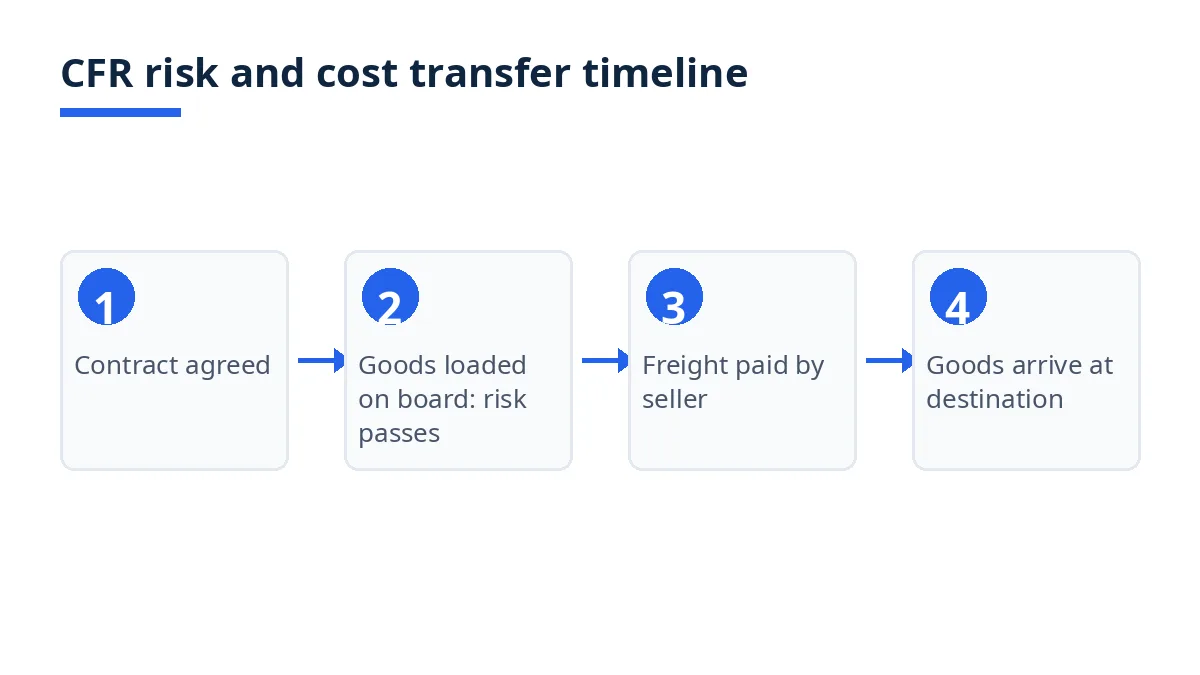
Agree the contract in writing. Name the destination port, the edition, and who arranges insurance. A CFR price alone says nothing about insurance.
Pack and move the goods to the port. The seller packs the goods, moves them to the port of shipment, and clears them for export.2 Risk stays with the seller.
Load the goods on board. Delivery happens, and risk passes to the buyer, when the goods are placed on board.1 The seller must give the buyer enough notice of delivery, so the buyer can act on the insurance it arranged.2
Pay the freight. The seller contracts the carrier and pays ocean freight to the named destination port.2 Paying freight after loading does not take the risk back.
Carry the voyage risk, then arrive and clear import. From loading, the buyer bears the voyage risk, and its cover should be in force at loading.1 At destination, the buyer takes delivery, pays unloading charges the carriage contract leaves to the buyer, clears import customs, and pays duty and taxes.2
The timeline below shows the two tracks: risk ends for the seller at loading, while the seller's freight payment runs to destination.
Two cautions: a container handed to a carrier at a terminal before loading does not transfer risk under CFR, since delivery still occurs on board.2 For containers, CPT or CIP usually fits better. CFR also never fits air freight, since it is a sea and inland waterway rule only; an air shipment needs an any-mode rule such as FCA.3
Who bears the loss at each stage
"Risk bearer" means the party who bears the loss if goods are damaged at that stage, before any insurance claim. Insurance does not move the risk point; it only decides who pays for the loss after it happens.
Stage | Who bears the loss | Who pays for that stage |
|---|---|---|
Factory to port | Seller | Seller |
Loading on board | Seller until loaded, buyer once loaded | Seller |
Ocean voyage | Buyer | Seller pays freight |
Arrival and unloading | Buyer | Buyer, unless the carriage contract includes unloading |
Import clearance, duty, onward transport | Buyer | Buyer |
During the voyage, the seller pays the carrier and the buyer bears the risk. If heavy weather damages cargo, the loss falls on the buyer even though the seller chose and paid the carrier, unless the sales contract says otherwise. A paid freight invoice proves the seller met the freight part of CFR, not that it kept the voyage risk.2
Worked example with numbers: tea from Chattogram to Hamburg
All figures here are example figures only, not market rates. A buyer orders 20 tonnes of tea in chests from a supplier in Chattogram, on CFR Hamburg, Incoterms 2020. The buyer arranges its own cargo cover from loading, at an example premium of USD 210, paid separately.
Line | Example figures | In the CFR price |
|---|---|---|
Goods: 20 tonnes of tea | USD 22,500 | Yes |
Export packing and marking | USD 650 | Yes |
Inland transport to Chattogram | USD 480 | Yes |
Export clearance handling | USD 180 | Yes |
Port handling and loading | USD 420 | Yes |
Ocean freight to Hamburg | USD 2,150 | Yes |
Total CFR price | USD 26,380 | |
CFR unit price | USD 1,319 per tonne | |
Buyer's cargo insurance | USD 210 | No |
USD 26,380 divided by 20 tonnes equals USD 1,319 per tonne. Now add the risk event: seawater enters the hold and damages tea worth USD 4,000 at cost. Risk had already passed at loading, so the loss is the buyer's, and the buyer claims on its own policy, subject to the policy terms. The seller's freight payment continues as agreed, and the seller does not owe the USD 4,000 because it paid the freight. With no cover, the same loss would sit with the buyer with no insurer to claim from.
Claim scenarios: damage in transit and who claims
A claim follows the risk, not the freight invoice. Start from when the damage happened, then from whose policy covers that period.
A claim on the buyer's own policy
This is the normal CFR position. The buyer arranged cover from loading, risk passed at loading, and voyage damage falls inside the buyer's cover period. The buyer notifies its insurer, keeps the transport document, the commercial invoice, the packing list, and photos of the damage at unloading, and claims under its own policy terms. The seller does not become the claimant because it paid the freight.
Voluntary cover the seller agreed to buy
CFR does not require the seller to insure, but the parties can agree in the sales contract that the seller will buy cover for the buyer's benefit.2 The claim route then depends on what the contract and the policy say: who is named, what perils are covered, and how far the cover runs. Get those points in writing before loading, with the policy or certificate in the buyer's hands.
No cover in place
If neither party arranged cover, a voyage loss is the buyer's loss with no insurance claim to make. The buyer can still raise a claim against the carrier or another party at fault under the contract of carriage or the applicable law, but that depends on fault, the carriage terms, and evidence about when the damage happened. Do not treat a carrier claim as a substitute for cargo cover: it is slower, contested, and may not pay the full loss.
Damage found before loading
Damage before loading sits on the other side of the transfer point. While the goods are still the seller's risk, the seller bears the loss. Photograph the damage, note it on the handover documents, and tell the seller before the goods go on board. Once goods are on board, the same damage becomes much harder to attribute to the pre-loading leg.
CFR vs related terms: CIF and FOB
CFR, CIF, and FOB share the same risk point: risk passes when the goods are on board at the port of shipment.1 They differ in who pays freight, who must insure, and who holds the policy when a claim arises.
Term | Risk passes | Freight paid by | Seller must insure | Who claims after voyage damage |
|---|---|---|---|---|
FOB | On board at origin | Buyer | No | Buyer, on its own policy |
CFR | On board at origin | Seller, to destination port | No | Buyer, on its own policy |
CIF | On board at origin | Seller, to destination port | Yes, minimum cover | Buyer, on the seller-bought policy |
CIF is CFR plus seller-bought insurance. Under CIF, the seller must arrange insurance meeting the minimum level in Incoterms 2020: cover complying with Clause (C) of the Institute Cargo Clauses, for at least 110 percent of the contract price, in the contract currency, running to at least the destination port.4 Clause (C) is minimum, named-perils cover. Read the CIF guide for the full terms. Under CFR there is no seller-bought policy to claim on, so the buyer's own policy is the only insurance route unless the parties agreed otherwise. FOB differs from CFR on freight only: the buyer arranges and pays the ocean carriage, while the risk point and the insurance gap match CFR.
Common mistakes to avoid
Treating a paid freight bill as risk cover. Freight payment and risk travel to different points. The seller can pay every freight charge to Hamburg and still hold no voyage risk after loading.
Arranging insurance from arrival instead of from loading. Cover that starts at the destination port leaves the whole voyage uninsured. Confirm the cover period before the vessel sails.
Accepting "CFR" with no named destination port. Without the port, the freight obligation has no endpoint. Name the port and the edition in the quote and the contract.
Using CFR for air freight or terminal-handed containers. CFR is sea and inland waterway only, and risk still passes only on board.3 Pick an any-mode rule that matches the real handover.
Assuming voluntary seller cover equals CIF cover. A voluntary promise has the scope the contract gives it, which may be narrower than Clause (C) minimum cover. Ask for the policy terms and the certificate before loading.
Reading damage at arrival as the seller's loss. Damage found at arrival usually happened during a leg the buyer already bore the risk for. Record the condition at unloading and notify the insurer named on the voyage policy.
Paying destination unloading twice. Unloading is the buyer's cost unless the seller's carriage contract includes it.2 Confirm which destination charges the freight price already includes.
How Exportain helps
Exportain is a B2B marketplace where buyers find suppliers on Exportain, post requests for quotation, receive quotations, message suppliers, and place orders. When you ask for a CFR quotation, ask each supplier to state four points in writing: the named destination port and edition, the freight lines inside the price, who arranges insurance from loading, and which destination charges the carriage contract includes. Comparing quotations on those points shows whether two CFR prices cover the same journey.
Ask the insurance question in the same message as the price question, not after the order is placed. Read how to buy on Exportain for the steps from first search to shipment, and keep the quotation, the insurance confirmation, and the transport documents together in the shipment file. Badges on Exportain record document and photo reviews. They are not factory inspections, certifications, or guarantees, and they do not change the CFR risk split or insure the voyage.
FAQs
What is CFR?
CFR stands for Cost and Freight. It is an Incoterms 2020 rule for sea and inland waterway transport only: the seller delivers the goods on board at the port of shipment and pays ocean freight to the named destination port. Risk passes to the buyer on board at origin, and the seller has no obligation to insure the buyer's risk.1 2
How does CFR work in practice?
The seller packs the goods, moves them to the port, clears them for export, and loads them, then contracts and pays freight to the destination port. The buyer bears the risk from loading, arranges insurance if wanted, and handles import clearance, duty, and onward transport.
Is CFR used for shipments from Bangladesh?
Yes, CFR is used for sea shipments from Bangladeshi ports, including Chattogram, and it fits bulk and break-bulk cargo loaded directly on board. For terminal-handed containers, check CPT or CIP, where risk passes on handover to the carrier.3 For air freight, use an any-mode rule such as FCA.
What are the common mistakes with CFR?
The common mistakes are reading a paid freight bill as risk cover, arranging insurance from arrival rather than from loading, accepting CFR with no named destination port, using CFR for air freight or terminal-handed containers, treating voluntary seller cover as CIF cover, reading damage at arrival as the seller's loss, and paying destination unloading twice.
Next steps on Exportain
Post a request for quotation on Exportain with your product, quantity, and destination port, and ask each supplier to quote CFR with the named port and edition, the freight lines shown separately, and the insurance position stated in writing. Read how to buy on Exportain before you accept a quotation, check the Incoterms guide to compare CFR with FOB and CIF, and read the CIF guide if you want the seller to buy the insurance instead.
Sources
- Insider thoughts: Bob Ronai on Incoterms 2020 Rules; What are they about?. International Chamber of Commerce (accessed )
- CFR Incoterms: Meaning, Costs & Risk. iContainers (accessed )
- Incoterms 2020 | Shipping Terms. AIT Worldwide Logistics (accessed )
- CIF & CIP Incoterms 2020 explained: Key differences. ICC Academy, (accessed )
About the author
Sourcing from Bangladesh?
Post a request for quotation and suppliers on Exportain can send you their quotes directly.
Post an RFQ


