Can You Use CFR for Air Freight? Rules, Alternatives and Examples
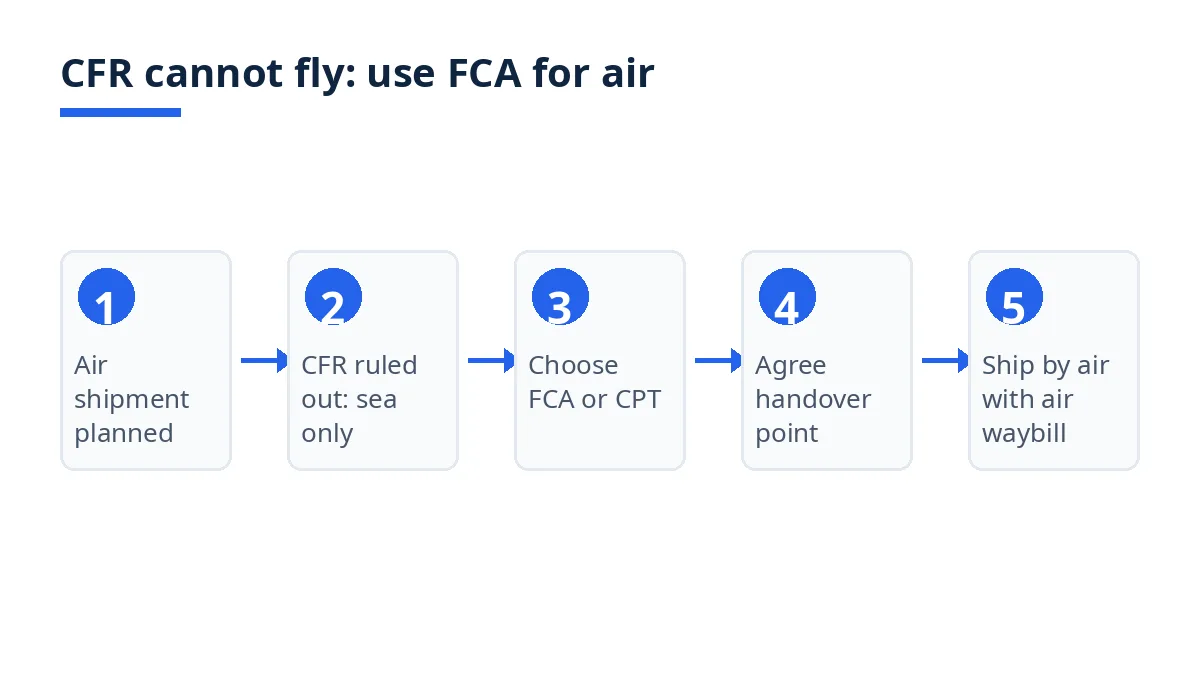
CFR cannot be used for air freight: it is a sea and inland waterway rule whose delivery point is on board a vessel. Use FCA, CPT or CIP for air cargo, with the named place and Incoterms 2020 in full.
Short answer
No. CFR (Cost and Freight) applies only to sea and inland waterway transport under Incoterms® 2020, because delivery happens on board a vessel at a named port of shipment. Air cargo has no vessel loading point, so use FCA where the buyer arranges the flight, or CPT or CIP where the seller arranges it, with the named place and Incoterms® 2020 written in full.
On this page
Key takeaways
CFR applies only to sea and inland waterway transport under Incoterms 2020, because delivery happens on board a vessel at a named port of shipment.
Paying the freight does not make a term CFR: for air freight, the freight-paid term is CPT, and CIP where the seller must also insure.
CFR imposes no insurance duty on the seller, so a buyer who wants seller-arranged cover for a flight needs CIP.
For courier and express parcels, use DAP or DDP with the full delivery address and the duty payer stated, never CFR.
Dhaka airport shipments use FCA, CPT or CIP with an airport named place, never CFR, and every document must carry the same term, named place and edition.
No, you cannot use CFR for air freight. CFR (Cost and Freight) is a sea and inland waterway rule under Incoterms® 2020, and it has no delivery point at an airport. This guide explains why the freight-paid part of CFR does not make it fit air cargo, which term to write instead, and how to fix a quotation that already says CFR for a flight from Bangladesh.
Short answer: NO — CFR is sea and inland waterway only
No. CFR applies only to sea and inland waterway transport under Incoterms® 2020.1 The seller delivers the goods on board a vessel at the named port of shipment, and risk passes at that on-board moment, even though the seller pays the freight to the named port of destination.2 A flight has no vessel, no port of shipment, and no on-board moment, so the event that completes delivery under CFR never happens by air. That is why CFR for air freight is not a valid term, even when both parties agree to use the letters.
Writing "CFR Dhaka airport" does not create an air version of CFR. If damage or loss occurs, the parties have no agreed moment at which risk passed. Use FCA (Free Carrier) where the buyer arranges the air freight, or CPT (Carriage Paid To) or CIP (Carriage and Insurance Paid To) where the seller arranges it, with the named place and "Incoterms® 2020" in full on every document.
Why CFR for air freight fails at the airport
CFR joins two ideas that only fit together on water: delivery on board a vessel, and freight paid to a named port of destination. Take either idea to an airport and the term stops working.
No on-board delivery point
Under CFR, the seller delivers the goods on board the vessel, and risk passes when the goods are on board.2 The seller has then performed the delivery duty whether or not the goods arrive in sound condition, in the stated quantity, or at all.2 At an airport, goods are handed to a carrier, screened, built into a unit load device, and loaded on an aircraft. None of those steps is delivery on board a vessel, and the parties cannot agree later which step was meant to be the CFR moment. The risk point stays undefined.
No named port
CFR needs a named port of destination, because the seller contracts and pays the freight to that port.1 An airport is not a port, and an airport code is not a port of destination. A quotation that says "CFR London" for a flight leaves the freight duty unclear: freight to which airport, to which terminal, and up to which handover? The any-mode terms name a place that fits the journey instead: a cargo terminal, an airport, or a named place of destination.
No on-board bill of lading
Air freight uses an air waybill, not a bill of lading. The air waybill is the document created by or on behalf of the shipper that begins the contract between the shipper and the carrier, and it is a non-negotiable document required for each air cargo shipment.3 A bill of lading can be a document of title in sea freight; an air waybill is not a document of title and cannot be transferred to change ownership.4 A contract that calls for CFR documents or a bill of lading for a flight asks for papers the air journey does not produce.
The freight-paid part does not save the term
CFR looks attractive for air because the seller pays the freight. But paying the freight is not what makes a term CFR. Under CFR, the seller pays freight to the destination port while risk passes much earlier, on board the vessel at the port of shipment.1 That split of early risk and paid freight depends on the on-board moment. For air, the term that carries the same freight-paid idea is CPT: the seller contracts and pays for carriage to the agreed destination, while risk passes when the goods are handed to the carrier.2 If insurance is also wanted from the seller, the term is CIP. Change the three letters and keep the commercial intent.
Insurance is not included under CFR
CFR carries no insurance duty for the seller, and the buyer is advised to purchase cover for itself.2 A buyer who reads "CFR" and assumes the seller has insured the flight has no cover under the term. The air alternative that adds seller insurance is CIP: it requires the higher all-risks level of cover under Incoterms® 2020, compliant with Institute Cargo Clauses (A) or similar clauses.5 If the quotation must include insurance, write CIP and state the cover level agreed.
What to use instead: FCA, CPT and CIP
Incoterms® 2020 divides its 11 rules into two groups: seven rules for any mode of transport, and four rules for sea and inland waterway transport only.6 Air freight belongs in the first group. The three terms that replace CFR in practice are FCA, CPT, and CIP. Under FCA, the seller delivers the goods to the carrier at the named place, having cleared the goods for export, and risk passes at that handover.2 Under CPT, the seller hands the goods to the carrier it contracted and pays for carriage to the agreed destination, while risk passes at handover.2 CIP follows CPT and adds the seller insurance duty.2
Term | Who pays the air freight | When risk passes to the buyer | Seller insurance duty | Named place to write |
|---|---|---|---|---|
FCA (Free Carrier) | Buyer | On delivery to the carrier at the named place | None under the term | Cargo terminal or other named place of delivery |
CPT (Carriage Paid To) | Seller, to the agreed destination | On handover to the carrier | None under the term | Named place of destination |
CIP (Carriage and Insurance Paid To) | Seller, to the agreed destination | On handover to the carrier | Yes, all-risks cover, Clauses (A) level | Named place of destination |
CFR (Cost and Freight) | Do not use for air | On board a vessel, which never occurs on a flight | None under the term | Named port of destination, for sea only |
Use FCA when the buyer arranges and pays for the flight, and the seller delivers the goods, cleared for export, to the cargo terminal. Name the terminal precisely, because that place fixes both delivery and the risk point.2 "FCA Dhaka airport cargo terminal, Incoterms® 2020" states a handover point a forwarder can act on; "FCA Dhaka" alone leaves the handover point to guesswork. Use CPT when the seller arranges and pays for the flight to the named destination, and CIP on the same facts when the seller must also insure the goods.
What are the typical costs and timelines?
Air freight has no flat rate. Carriers charge by volumetric weight, also called dimensional weight, or by actual weight, and the higher of the two is used for pricing.3 The general rule for volumetric weight is to divide the volume in cubic centimetres by 6,000.3 Extra charges sit on top of the carriage rate, including airport handling, screening, transfer, dangerous goods, fuel surcharges, handling, security, and terminal handling fees.3 Charges are payable by the shipper where prepaid, or by the consignee where collected.3
Example figures: a carton set with a chargeable weight of 120 kg, an example air freight charge of 480 dollars, example handling and screening charges of 65 dollars, and an example insurance premium of 25 dollars gives an example freight-side total of 570 dollars before duty and taxes at destination. The figures show the build-up only. They are not a rate or a quote.
Courier and express shipments
Courier and express shipments follow the same rule: CFR does not apply. A parcel sent by courier travels on an air waybill, described as the single most important document in air freight and express courier shipping, acting as a non-negotiable contract of carriage between the shipper and the carrier.4 The air waybill carries the shipper and consignee details, the carrier, the shipment details including weight and HS code, the declared value for customs, and any special handling instructions.4 There is no bill of lading and no port, so CFR has nothing to attach to.
For a courier parcel, the term usually turns on duty and taxes. For most parcel shipments, the question is who will pay the duty and taxes, and carriers often use the terms DDP (delivery duty paid) and DDU (delivery duty unpaid), with DDU retired and replaced by DAP under Incoterms® 2020.7 DAP means the seller delivers the goods at the named destination ready for unloading, while the buyer pays import duties and taxes; DDP means the seller pays shipping, insurance, and all import duties and taxes.7 DAP suits business-to-business parcels where the buyer can reclaim import tax, while DDP suits a no-surprise delivery.7 Write DAP or DDP, with the full delivery address, on the invoice and in the booking. A parcel marked "CFR courier" tells the courier nothing usable and tells the buyer nothing about the duty bill.
Bangladesh-specific notes
Air shipments from Bangladesh leave through airports, so the named place must be an airport place, not a port. For a Dhaka airport shipment, write the FCA named place as the cargo terminal where the seller hands the goods to the carrier, or write CPT or CIP with the destination airport as the named place of destination. Never write CFR for a Dhaka airport shipment, even when the seller pays the flight and the goods are garments, samples, or urgent replenishment stock. The mode decides the term, not the product or the urgency.
A shipment that flies one leg and sails another cannot carry CFR across the air leg. Either use an any-mode term for the whole journey, or set a separate term for each leg, with the handover point for each leg stated. Confirm the export papers with the forwarder before the term is fixed, and make sure all papers carry the same term, named place, and edition.
Mistakes and red flags
What are the most common mistakes?
Quoting CFR for air at all. CFR is a sea and inland waterway rule whose delivery point is on board a vessel.1 A freight-paid price for air is CPT or CIP. If a quotation says CFR and the goods fly, re-issue it with the right term.
Copying sea wording onto air papers. "On board", "port of shipment", "port of destination", and "bill of lading" belong to sea documents. Check the air waybill, the invoice, and any letter of credit instructions for sea words before the goods are tendered.
Assuming CFR includes insurance. CFR imposes no insurance duty on the seller.2 A buyer who wants seller-arranged cover for a flight needs CIP, with the cover level agreed.
Naming only an airport code. Under FCA, the named place fixes where delivery happens and where risk passes.2 Name the cargo terminal or the other agreed place, and confirm it with the forwarder in writing.
Using CFR for courier samples. Samples and small parcels sent by courier are air shipments too. Use DAP or DDP for a courier parcel, and put the duty payer in writing.
Leaving the edition out. Older editions can still be used when they are named, so a term without an edition is ambiguous. Always write the rule, the named place, and the edition, for example "CPT London Heathrow Airport, Incoterms® 2020".
Checklist
Before the goods move, every line should be answered in writing.
Mode confirmed as air, and CFR removed from every document.
Term chosen by who pays the flight: FCA for buyer-arranged freight, CPT or CIP for seller-arranged freight.
Named place stated as a cargo terminal or named place of destination, not as a port.
Edition written in full: Incoterms® 2020, with the rule and the named place.
Insurance decided: CIP with the cover level agreed, or buyer-arranged cover confirmed before handover.
Air waybill expected, not a bill of lading, with the term matching the invoice.
Freight build-up confirmed with the forwarder: chargeable weight, rate, handling, screening, and surcharges as separate lines.
Courier parcels marked DAP or DDP with the full delivery address and the duty payer stated.
Mixed sea and air legs given a term that fits each leg, with no CFR term stretched over a flight.
Quotation, contract, invoice, and air waybill all carry the same term, named place, and edition.
How Exportain helps
On Exportain, state the delivery term in the request for quotation so suppliers on Exportain quote against the same term and the same named place. The buying steps run from searching the catalogue, through reviewing supplier profiles and trust badges, to posting an RFQ that states quantity, destination, Incoterm, required certifications, and deadline, and then comparing versioned quotations that record the Incoterm.8 Use that RFQ field to write FCA, CPT, or CIP with the named place.
Badges such as Exportain Verified and Export Verified record which checks the Exportain team has reviewed, and a badge is not a capacity or quality guarantee.8 The delivery term, the named place, and the insurance position still need to be agreed in writing on the order itself. See the Incoterms guide for all 11 rules, and the CIF guide for the sea rule that pairs freight payment with seller insurance.
FAQs
What should I know first about CFR?
CFR (Cost and Freight) is a sea and inland waterway rule under Incoterms® 2020.1 The seller delivers the goods on board a vessel at the named port of shipment, risk passes at that on-board moment, and the seller pays the freight to the named port of destination.2 The seller owes no duty to insure the goods.2 CFR cannot be used for air freight. For air, use FCA, CPT, or CIP.
What are the typical costs and timelines?
There are no typical air freight costs or timelines a guide can state as fact. Carriers charge on chargeable weight, the higher of actual and volumetric weight, with volumetric weight found by dividing the volume in cubic centimetres by 6,000, plus handling, screening, transfer, fuel, security, and terminal charges.3 Ask the forwarder for the rate, the chargeable weight, and each surcharge as separate lines, and for departure, arrival, clearance, and onward delivery as separate dates.
Which documents are needed?
The air transport document is the air waybill, a non-negotiable contract of carriage that carries the shipper and consignee details, the carrier, the shipment details including weight and HS code, the declared value for customs, and any special handling instructions.4 The commercial invoice travels alongside it for customs valuation, and the forwarder confirms the remaining export papers. The air waybill is not a document of title, and a bill of lading is not used for air freight.4 Every document should carry the same term, named place, and edition.
What are the most common mistakes?
The most common mistakes are quoting CFR for a flight, copying sea wording onto air papers, assuming CFR includes insurance, naming only an airport code, and marking courier parcels "CFR courier". Each mistake leaves the risk point, the freight duty, the insurance position, or the duty payer unclear. Fix the term to FCA, CPT, or CIP on every document before the goods move.
Next steps on Exportain
Search suppliers on Exportain and post a request for quotation on the RFQ board that states FCA, CPT, or CIP with the named place and Incoterms® 2020, so every reply quotes the same air term. Before you confirm, read how to buy from Bangladesh and the Incoterms guide to check the term against the full set of 11 rules.
Sources
- Incoterms 2020 CFR: Spotlight on Cost and Freight. Shipping Solutions, (accessed )
- Incoterms. DHL (accessed )
- Air Cargo Tariffs and Rules: What You Need to Know. International Air Transport Association (accessed )
- What is an Air Waybill (AWB)?. DHL, (accessed )
- Incoterms® 2020. International Chamber of Commerce (ICC) (accessed )
- Air Freight Incoterms: Use FCA, Not FOB. Ovrseas (accessed )
- DDP vs. DAP (DDU): Complete Guide to Incoterms and Shipping Terms. Jet Worldwide, (accessed )
- How to source and buy from Bangladesh. Exportain (accessed )
About the author
Sourcing from Bangladesh?
Post a request for quotation and suppliers on Exportain can send you their quotes directly.
Post an RFQ