Top Bed Sheets Manufacturers in Bangladesh: How to Find and Verify Them
Seven bed sheet supplier types in Bangladesh, what each suits, and the sheet-specific verification checks to run before ordering.
Short answer
Bed sheets manufacturers in Bangladesh fall into seven supplier types: integrated home-textile mills, weaving mills selling fabric only, cut-and-sew sheet makers, print and dye specialists, hotel and institutional linen specialists, private-label OEM and ODM suppliers, and exporters and trading companies. Match the type to your set range, then verify thread count counting, weave, shrinkage, pilling, colour fastness and finishing before paying.
On this page
Key takeaways
Bed sheet supply in Bangladesh is organised by supplier type, not by ranking: integrated mills, weaving mills, cut-and-sew makers, print and dye specialists, hotel linen specialists, private-label suppliers, and exporters and traders.
Thread count must be compared on one counting method: count each thread as one even when it is spun as two- or three-ply yarn, and state the count, ply and method in writing.
Shrinkage, pilling and colour fastness are sheet-specific checks with named methods: ISO 5077 for dimensional change, ISO 12945-2 for pilling, and ISO 105-C06 and ISO 105-X12 for wash and rubbing fastness.
For the European Union, fibre labelling must name every constituent fibre by name and percentage by weight in descending order.
Exportain badges record document and photo checks reviewed by the Exportain team; they are not factory inspections or quality guarantees.
Buyers searching for bed sheets manufacturers in Bangladesh face a different question from the one most supplier lists answer. A bed sheet is rarely one product: it is a set of flat or fitted sheets, pillowcases and often a duvet cover, cut from wide sheeting fabric, finished, and packed so every piece in the set matches. The supplier that weaves the fabric, the supplier that prints it, and the supplier that sews the set are often three different businesses, and each one fails in a different place. This guide sorts Bangladeshi bed sheet supply by supplier type, so you can match the type to your range and run the sheet-specific checks before you pay.
This guide covers supplier types and how to check them. It does not rank companies, and it does not quote prices or minimum order quantities, because both are set per set, fabric, print and packing. For ordering steps, read how to import bed sheets from Bangladesh. For shipment-level checks, use the bed sheets quality control checklist.
The list: bed sheets manufacturers in Bangladesh by supplier type
The seven types below describe how bed sheets are made and sold from Bangladesh. One company can sit in more than one type, and the type tells you what the supplier controls, what you must check yourself, and where an order usually goes wrong.
1. Integrated home-textile mills
What they are. Mills that weave sheeting fabric, dye or print it, and then cut, sew and pack finished sets within the same company.
Who they suit. Repeat programs in the same constructions and colours, and retailers who need shade consistency across a set.
How to verify and fix. Ask which stages are in-house and which are sent out, in writing: a mill that weaves but sends dyeing out is not integrated for colour control. Check a finished set from current production against your size chart. If shade varies between pieces, agree a single dye lot per set colour before bulk.
2. Weaving mills selling sheeting fabric
What they are. Mills that weave greige or finished sheeting fabric at full width and sell it by the roll, without sewing finished sets.
Who they suit. Buyers who sew sets in their own factory or in a third country, buyers developing a fabric range before choosing a sewing partner, and importers who buy fabric as a product in its own right.
How to verify and fix. Inspect the fabric before it ships: width, weight, weave and shade, roll by roll. Agree the thread count counting method in writing (see below) and the tolerance for width and weight. If a roll fails, hold it out and replace it from the same lot.
3. Cut-and-sew sheet makers
What they are. Makers that cut and sew sets from fabric bought from a local mill against the buyer's specification.
Who they suit. Smaller or more varied ranges, and buyers testing a new set construction before committing to an integrated mill.
How to verify and fix. Inspect the fabric before cutting and agree shrinkage and shade tolerances in writing. Approve a pre-production sample made from the bulk fabric, then wash it and fit the fitted sheet to the mattress depth in your chart. If the washed sample shrinks out of tolerance, fix the cutting plan or the fabric before bulk cutting starts.
4. Print and dye specialists
What they are. Suppliers built around colour and pattern: rotary or digital printing, yarn dyeing and piece dyeing, applied to sheeting fabric they weave or buy in.
Who they suit. Retail ranges built on prints, stripes and seasonal colour stories.
How to verify and fix. Confirm whether printing and dyeing are in-house or sent to a separate unit, because that decides who controls shade and lead time. Approve a lab dip for solid colours and a strike-off for prints on the production fabric, and wash-test both. If a print blurs, shifts against the hem, or bleeds in washing, stop and re-approve the strike-off before bulk sewing.
5. Hotel and institutional linen specialists
What they are. Suppliers whose regular production is contract linen for hotels, hospitals and serviced apartments: plain sets in standard sizes, made to withstand repeated commercial laundering.
Who they suit. Hotel groups, healthcare buyers and rental linen operators who need the same set replaced piece by piece over years.
How to verify and fix. Ask which sizes the supplier runs monthly for contract customers, and how long each construction stays in production for replacements. Wash-test the sample through several cycles and measure pocket depth and elastic recovery after each wash. If a fitted sheet stops staying on the mattress, fix the pocket and elastic specification.
6. Private-label OEM and ODM bed linen suppliers
What they are. Suppliers set up to make sets under the buyer's label. Original equipment manufacturers (OEM) produce to your tech pack; original design manufacturers (ODM) offer their own set designs for you to label.
Who they suit. Brands and retailers who need their own labels, barcodes and retail packing, and importers who want a ready set range without developing every construction themselves.
How to verify and fix. For OEM work, send a complete specification covering every piece in the set and judge the counter-sample against it piece by piece. For ODM work, check that the offered sets are the supplier's own current production and confirm labelling rules for your market before bulk labels are printed. Fix any label error at the sample stage.
7. Exporters and trading companies
What they are. Export-licensed companies that sell sets made in partner factories rather than on their own sewing lines.
Who they suit. Buyers ordering several home-textile types at once, buyers whose quantities are too small or too mixed for one mill, and buyers who want one contract and one contact across a range.
How to verify and fix. Ask which factory will weave, dye or print, and sew each set, and get the producing factory named before you pay a deposit. The trading company's export record does not tell you which sewing line makes your sheets. If the named factory changes mid-order, treat it as a new supplier and re-approve the sample.
Summary table
Type | Suits | Main check before ordering |
|---|---|---|
Integrated home-textile mill | Repeat programs | Which stages are truly in-house |
Weaving mill, fabric only | Buyers who sew elsewhere | Fabric inspection roll by roll |
Cut-and-sew sheet maker | Smaller ranges | Fabric inspection before cutting, washed sample |
Print and dye specialist | Printed ranges | Lab dip and strike-off, wash test |
Hotel and institutional specialist | Hotels, hospitals | Wash durability, replacement continuity |
Private-label OEM / ODM | Own-label brands | Specification match, label approval |
Exporter / trading company | Mixed orders | Producing factory named in writing |
Sheet-specific verification checks
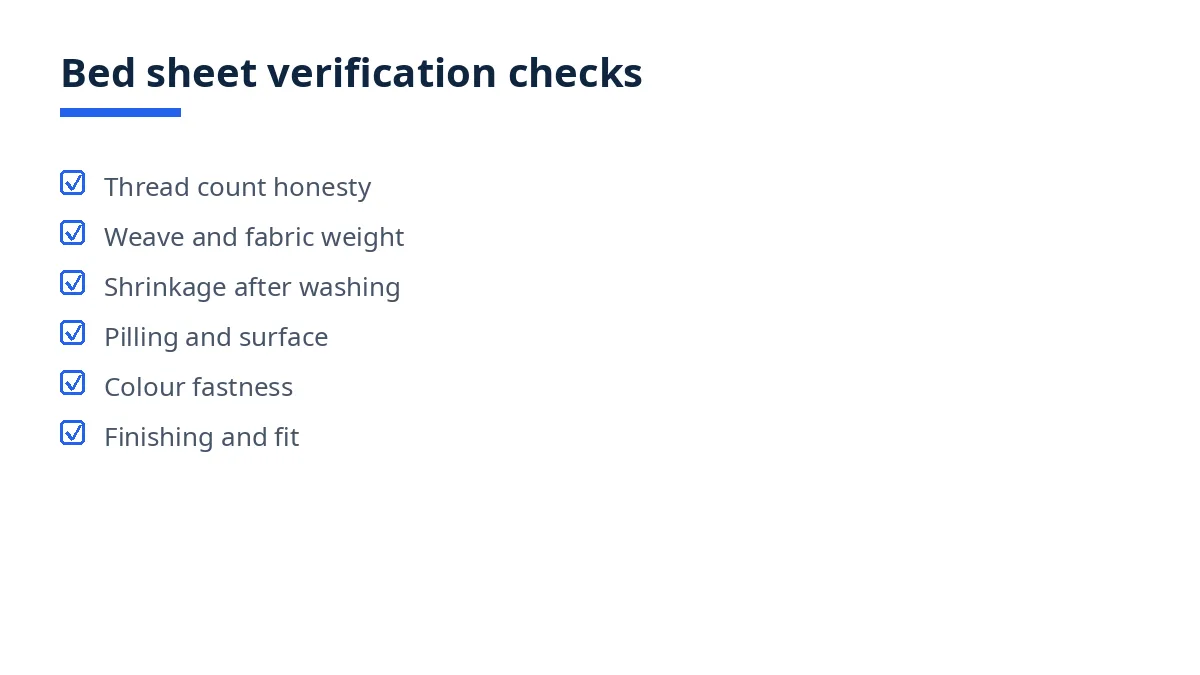
Run the checks below on the production fabric and the finished set, not on a catalogue sample, and write the method and the acceptance limit into the order before production starts.
Thread count honesty
Thread count is measured by counting the threads in one square inch of fabric, including both lengthwise (warp) and widthwise (weft) threads, added together: 100 lengthwise threads woven with 100 widthwise threads gives a thread count of 200.1 The count can be inflated by counting each strand of a plied yarn separately, although accepted industry practice is to count each thread as one even when it is spun as two- or three-ply yarn.1 Ask the supplier to state the count, ply and counting method in writing.
Weave and fabric weight
Name the weave and the finished weight in your specification, and compare quotes only on the same pair. A percale and a sateen sheet in the same fibre are different products even at the same size and colour. Ask the supplier to state the weave, finished weight and fibre composition for the fabric quoted, and check the sample against those three figures.
Shrinkage after washing
Shrinkage is where fitted sheets fail in use: a sheet that measures correctly flat can stop fitting after washing. ISO 5077 specifies a method for determining the dimensional change of fabrics, garments or other textile articles when subjected to a combination of specified washing and drying procedures, with specimens conditioned and measured before washing, then washed, dried, conditioned, remeasured, and the change calculated.2 Agree the washing procedure, cycle count, and tolerance for length, width and pocket depth in the order, and require the report to name the fabric, colour and lot.
Pilling and surface appearance
Pilling is a surface check, not a fabric strength check. ISO 12945-2 describes a modified Martindale method in which textile materials are subjected to defined rubbing actions and then visually assessed against standard photographic references and rating scales, to judge propensity to pilling, fuzzing and surface change.3 Agree the method, rubbing cycles and minimum rating in the specification, and test the fabric as received and after washing.
Colour fastness
Colour fastness has three parts for sheets: washing, rubbing and perspiration. Colour fastness to domestic laundering was evaluated in one published study according to ISO 105-C06, and colour fastness to rubbing according to ISO 105-X12, with change and staining rated on the grey scale.4 Name both methods, the test conditions and the minimum grades in the order, and require reports per colour and per lot.
Finishing, fit and labels
Finishing is checked on the finished set: hem width and straightness, fitted corner seams and elastic recovery, pillowcase flap depth, duvet closure alignment, and shade consistency across pieces, sets and cartons. Fit the sampled fitted sheet to the mattress size and depth in your chart, and check every piece in the set is present before approving bulk. For the European Union, a textile product shall be labelled or marked with the name and percentage by weight of all constituent fibres in descending order.5 Agree fibre wording and marking at sampling stage, and check the finished label before bulk label sewing begins.
Certificates and audit claims
A certificate is only useful inside its scope. Under OEKO-TEX STANDARD 100, bed linen falls in Product Class I or II depending on use, and the certificate and label are only awarded if all components of an item meet the required criteria without exception.6 Check the certificate number with the issuing body, confirm the factory address matches the producing site, and check the expiry date, standard, product category and scope.
How to verify a supplier before you pay
Check the company documents. Trade licence, Export Registration Certificate (ERC) and factory or office photos are the standard set, and the names and addresses on them should agree across every document.
Name the producing factory. For every set, record which factory weaves, dyes or prints, and sews it, and make the order terms name that factory.
Sample in the production fabric. Approve a pre-production sample made from bulk fabric and trims, wash it, fit it, and measure it against your size chart. Keep one sealed sample as the reference for the shipment inspection.
Agree the inspection standard in the order. ISO 2859-1:2026 defines a system of acceptance sampling plans for inspection by attributes, and its summary states that AQL stands for acceptance quality limit, the maximum average percentage of defective items considered acceptable during random sampling, used to determine sample sizes and acceptance and rejection thresholds.7 Set the AQL and inspection level before production. See the AQL acceptance quality limit guide and the pre-shipment inspection guide.
Put payment protection in writing. Agree inspection and shipment conditions before settling. Exportain is a marketplace and is not a party to your goods contract, and where a supplier asks for a funds hold, the buyer can pay it or decline it.8
How Exportain helps
Exportain is a B2B marketplace for sourcing from Bangladesh. Buyers search published products by keyword and category, filter to suppliers holding the Exportain Verified badge, sample availability and OEM or ODM capability, and sort by MOQ or lead time.8 Each supplier profile shows its verification level, location, main products and the certifications the supplier has declared.8 Buyers then post a request for quotation (RFQ) stating quantity, target price, destination, Incoterm, required certifications and deadline.8 Use the badges as a starting filter, not a conclusion. Verification on Exportain is a document and photo review by the Exportain team, not a factory inspection, and membership never grants a badge.9 Run the verification sequence above on your shortlist.
FAQs
What is the biggest mistake buyers make when sourcing bed sheets from Bangladesh?
Choosing a supplier by the quoted price before checking the supplier type and the counting method behind the specification. An integrated mill, a cut-and-sew maker and a trading company quote three different offers, and a thread count counted by plies is not comparable with one counted by threads.
How can I avoid it?
Write one specification covering every piece in the set, fibre composition, weave, thread count counting method, finished weight, sizes, pocket depth, elastic, closures, colour or print, labels and packing, and send the identical document to every supplier you quote. Name the producing factory in the order terms, approve a washed pre-production sample, and set the AQL level in writing before production starts.
Who is responsible for quality, the factory or the buyer?
Both, at different points. The factory is responsible for making sets to the agreed specification and the approved sample. The buyer is responsible for making that specification complete and checkable, and for inspecting against it before shipment.
Where can I get help verifying a supplier?
Start with the records that exist: company documents for registration, the certificate issuer for any audit or fibre claim, and an inspection provider for the pre-shipment check. On Exportain, read what each profile badge covers before relying on it.9 The home textiles sourcing guide covers the wider range, and the HS code for bed sheets guide covers classification.
Next steps on Exportain
Browse Bangladeshi suppliers and filter the home-textile listings by badge, MOQ and OEM or ODM capability. Before you order, read how supplier verification works on Exportain so you know what each badge covers. Then post a free RFQ with your set specification, quantity, destination and Incoterm.
Sources
- Thread Count. Apparel Search (accessed )
- ISO 5077:2007 — Textiles — Determination of dimensional change in washing and drying. International Organization for Standardization (ISO), (accessed )
- DIN EN ISO 12945-2 Pilling, Fuzzing (accredited). FILK Freiberg Institute (accessed )
- Dyeing and Multifunctional Finishing of Cotton Fabrics Using Ethiopian Rumex steudelii Root Extract. ACS Omega, (accessed )
- Regulation (EU) No 1007/2011 on textile fibre names and related labelling and marking of the fibre composition of textile products. European Union, (accessed )
- OEKO-TEX STANDARD 100 for textiles tested for harmful substances. Hohenstein (accessed )
- ISO 2859-1:2026 - Sampling procedures for inspection by attributes — Part 1: Sampling schemes indexed by acceptance quality limit (AQL) for lot-by-lot inspection. International Organization for Standardization (accessed )
- How to source and buy from Bangladesh. Exportain (accessed )
- Supplier verification: Earn trust badges buyers can see. Exportain (accessed )
About the author
Sourcing from Bangladesh?
Post a request for quotation and suppliers on Exportain can send you their quotes directly.
Post an RFQ