

Wholesale Leather Wallets From Bangladesh: Prices, MOQ and Reliable Suppliers
Wholesale leather wallets from Bangladesh, planned as a programme: assortment and MOQ arithmetic, price drivers, classification at 4202.31, chemical limits, supplier reliability checks, samples, inspection and delivery terms.
Short answer
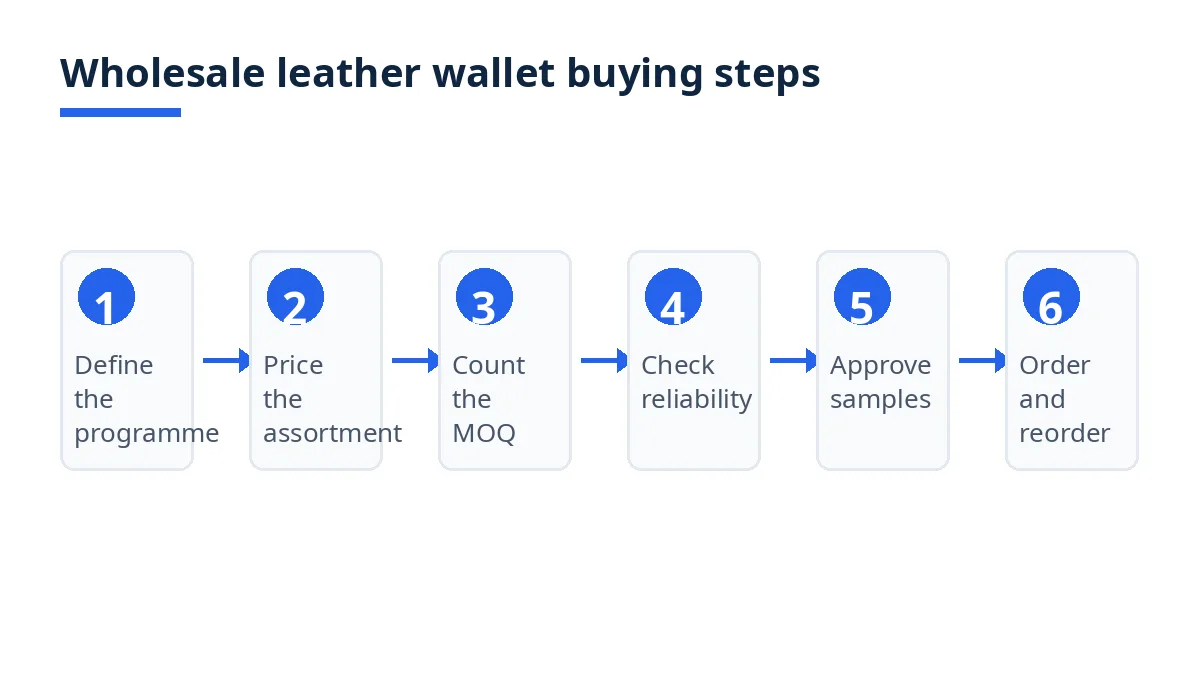
To buy wholesale leather wallets from Bangladesh, define the programme first: styles, colors, leathers and quantities, because the minimum applies per style, per color and per leather. Fix leather and hardware in a written specification, classify pocket articles at 420231 as an indicative starting point, check chemical limits and product testing for skin-contact leather, score suppliers on current wallet production and sample discipline, approve a pre-production sample, and agree the delivery term, inspection plan and documents before ordering.
On this page
Key takeaways
The minimum applies per style, per color and per leather, so the assortment minimum, not the per-style minimum, is the quantity you must actually buy.
Pocket articles with a leather outer surface sit at subheading 420231, indicative only: confirm the full national code, duty rate and tax treatment for each market with a broker.
For Gold and Silver LWG certification chromium VI must be below 3 mg/kg, but tannery certification does not guarantee a finished wallet passes product testing; require testing on the production leather lot.
Judge suppliers on a record, not a claim: current wallet production, named tannery and leather, repeat orders, sample discipline, commercial clarity and checked documents.
Approve a pre-production sample in the production leather, agree defect classes and the AQL before production, use FCA with a named place for containers, and hold shipment where inspection fails.
A wholesale leather wallet order fails in the planning stage. Ordering by unit price alone leads to a minimum that applies per color, a shade that changes between leather lots, or a wallet that does not fit the card it was bought to hold. Plan the programme first, price the full assortment second, and check reliability third.
This guide is for buyers in the United States, the United Kingdom, the European Union and the United Arab Emirates who buy leather wallets wholesale from Bangladesh. Every number in the worked examples is an example figure only. Replace each line with a confirmed figure for your exact programme, route and order date.
Start from the programme, not the price list
A wholesale programme is the full set of wallets you will sell over a season, not one style in one color. Define it before you ask for a price. List each style by name and purpose: bifold, trifold, card holder, zip wallet, money clip wallet and passport wallet. For each style, record the intended buyer, the retail price band, and whether it is a core line you will reorder or a seasonal line you will buy once.
Then fix the variants inside each style. Three styles, each in four colors, each in two leather types, is 24 separate production lines, where minimum quantities and shade errors live. Set first-order, reorder and timing quantities in the same document.
What wholesale means for a leather wallet order
Wholesale, in this guide, means buying finished wallets in bulk for resale under your own brand, a retail brand or a corporate programme, at a unit price that leaves room for freight, duty, tax and your margin. The supplier must be able to repeat the wallet: same leather, same shade, same hardware, same stitching, same internal layout, on every order.
Ask, for each style, whether the supplier makes wallets of that construction now, in current production, rather than whether it can make one. A wallet is a small, pocket-scale product: slot fit, fold alignment, edge finishing and closure strength are decided at millimetre scale. Ask to see current wallet production. Private label is the usual arrangement: agree the branding method style by style, with the exact artwork, position and size, and approve it on the pre-production sample. Agree packing too: individually boxed, in polybags, with a hang tag, or loose in cartons, and whether the box, tag and insert are included in the unit price.
Price architecture: what moves the unit price
No single market price exists for a wholesale leather wallet, because the unit price is built from separate decisions: leather type and grade, leather source and tannery, construction, hardware and closures, internal layout, branding, packing, order size and repeats, and the delivery term. Compare quotations line by line, on identical inclusions.
Leather is usually the main cost element, Fix it in the specification by tannery, leather name or code, thickness range and finish, and require the supplier to state the leather it priced. Hardware is the second place where headline prices diverge: record the hardware type, finish and source, and check it on the sample. Require each supplier to reply in the same format: unit price per style and color, leather and hardware assumed, branding and packing included or excluded, delivery term and named place, validity period, and the minimum per style, per color and per leather. Compare on the landed cost per wallet, adding freight, insurance, duty and tax
Duty follows the confirmed classification, origin and entry route for your market, and no single rate covers the United States, the United Kingdom, the European Union and the United Arab Emirates. Confirm the rate, the value base and the payment route with your broker before using any figure as a budget.
MOQ arithmetic: count the order three ways
The minimum order quantity for leather wallets is almost never one number. Count it three ways, and get all three in writing: the minimum per style, the minimum per color within a style, and the minimum per leather within a color. A supplier may accept 500 wallets in total while still requiring 300 in each color, which makes a four-color assortment a 1,200-wallet order. The per-color and per-leather minimums decide the real order size,
Read the MOQ guide for the general meaning of minimum order quantity, then apply it at wallet scale. Ask how the minimum splits, and why: leather lot size, dye lot size, hardware order size and cutting plan setup each push it in a different direction. Work the assortment arithmetic on paper before you negotiate. The example below uses example figures only, for a three-style programme in four colors.
Style | Colors | Minimum per color (example figures) | Assortment minimum |
|---|---|---|---|
Bifold | 4 | 300 | 1,200 |
Card holder | 4 | 500 | 2,000 |
Zip wallet | 4 | 300 | 1,200 |
Programme total | 4,400 |
Cutting a color from a style cuts the programme minimum by that color's minimum, not by an average. The cheapest way to lower the order is to order fewer variants, Reorder minimums are a separate question: ask whether the reorder minimum is lower, whether the same leather lot can be held for a reorder, and what happens if the lot is sold out.
Classification and market rules before you price
Classify the wallet before you price it. Pocket articles with an outer surface of leather or composition leather sit at subheading 420231, within heading 4202, while pocket articles with an outer surface of plastic sheeting or textile materials sit at 420232, and other pocket articles sit at 420239.1 The subheading turns on the outer surface material.1 The full national code adds digits beyond the shared six, and the rate beside it must be confirmed for your market and entry date. Treat every code here as indicative, to be verified against the importing country's tariff.
Chemical limits for skin contact are a market-access question, not a quality preference. The Leather Working Group audit covers 17 sections, and for Gold and Silver certifications chromium VI levels must be below 3 mg/kg, with any level above 3 mg/kg resulting in automatic failure.2 A tannery audit is evidence about the tannery's processes; it does not guarantee that a finished wallet passes product testing, and certification does not guarantee there will be no restricted substance failures in a final product.2
Require product testing: a test report for the exact leather, color and finish, from a laboratory your market accepts, held before bulk shipment. Confirm the classification, duty, tax, labelling and chemical rules for each market with your broker and compliance adviser.
Judge reliability before you commit
Reliability, for a wholesale wallet order, is a record, not a claim. Score each shortlisted supplier on the same evidence, and keep the record in the order file. For product checks, read the leather wallets quality control checklist and the leather wallets manufacturers guide.
Current wallet production: wallet styles in production now,
Leather and tannery evidence: tannery named, leather code, evidence for that leather.
Repeat-order record: repeat buyers, reorder quantities, shade control across lots.
Sample discipline: samples built to your specification, dated, counter-sample kept.
Commercial clarity: quotation in your format, validity, payment terms, change control.
Registration and badges: company documents checked, badge meaning read first.
On Exportain, supplier profiles carry document and photo review badges, and the badge meanings must be read before relying on them. A badge records which checks the Exportain team has reviewed; it is not a capacity or quality guarantee.3 For a first wholesale order, add a video or in-person factory check, and pay only the company account named in the checked documents, never a personal account. Verify any bank detail change separately before paying.
Samples, inspection and the first bulk order
Samples work in stages. A development sample shows whether the supplier can construct the wallet to your layout and size chart. A pre-production sample, made in the actual production leather, color, hardware and finish, is the sample you approve for bulk. Approve each stage in writing, keep one sealed counter-sample per style and color,
Test the sample the way the wallet will be used. Fill every card slot with your own test cards, fold and unfold the wallet, open and close every closure repeatedly.
Agree the inspection method before production. ISO 2859-1 specifies an acceptance sampling system for inspection by attributes, indexed by the acceptance quality limit (AQL), 4 The AQL is the quality level that is the worst tolerable process average when a continuing series of lots is submitted for acceptance sampling.4 Set the defect classes first: critical defects at zero acceptance, major defects at the agreed AQL, and minor defects at a looser AQL. Agree who inspects, when, and what happens to a failed lot, and hold shipment where inspection fails.
Delivery terms, documents and timeline
The delivery term decides who arranges carriage, who clears customs at each end, and where risk passes. The Incoterms 2020 rules number eleven, split into seven rules for any mode of transport and four rules for sea and inland waterway transport only.5 An Incoterm settles carriage, formalities, delivery and risk transfer; it does not transfer title or ownership, set the price or payment terms, or say what happens if the goods are defective.5 For containerized wallet shipments, goods handed to a carrier at a container yard are out of the seller's control long before they reach the ship, yet under FOB risk stays with the seller until loading, and for containers FCA is the correct choice.5 Under CIF the seller pays freight and buys minimum insurance, but risk passes to the buyer when the goods are loaded at origin.5 State the rule, the named place and the version in the purchase order, the pro forma invoice and the RFQ, and never use a bare FOB or FCA with no named place.
Documents are agreed at order stage, not chased at shipment. Confirm with your broker and forwarder which documents your route and market require, and list them in the purchase order: commercial invoice, packing list, certificate of origin, transport document, and any test report your market needs. Keep quantities, values, descriptions and marks identical across the invoice, packing list and transport document.
Build the timeline backwards from the on-sale date, with production, inspection, transit, clearance and delivery as separate lines. If the production window is shorter than the supplier's stated lead time, decide before ordering: fewer variants, an earlier start, or a split shipment.
Mistakes that cost wholesale buyers money
Ordering by headline price without the inclusions. A quotation that excludes packing, branding, hardware or freight is not a lower price.
Ordering too many variants for the first order. Every color and leather multiplies the minimum, the shade risk and the inspection load.
Approving a sample in the wrong leather. A sample in a substitute leather proves construction only. Bulk approval needs the production leather, color, hardware and branding together.
Treating a tannery audit as a product pass. An audit describes the tannery's processes, and it does not guarantee that a finished wallet passes restricted-substance testing.2 Product testing on the production leather lot is a separate step, held before shipment.
Wholesale wallet buying checklist
Define the programme: styles, variants, colors, leathers, price bands, first order and reorder plan.
Write one specification per style: leather, thickness, construction, layout, hardware, branding, packing, size chart.
Count the minimum three ways: per style, per color, per leather, and cut variants until the assortment minimum is sellable.
Classify each wallet at 420231 or the correct subheading, and confirm the national code and duty rules with your broker.
Check chemical limits for skin-contact leather, and require product testing on the production leather lot.
Shortlist suppliers on current wallet production, and score each one on the same reliability evidence.
Request quotations in one format, and compare on landed cost per wallet, not headline price.
Approve a development sample, then a pre-production sample in the production leather, in writing.
Agree the inspection plan, defect classes and AQL, the inspector, and the failed-lot consequences before production.
Fix the delivery term, named place and version, the document list, and the backwards-built timeline in the purchase order, then inspect, hold failed lots, and reconcile the actual landed cost after delivery.
How Exportain helps
Browse suppliers on Exportain and read each profile against your wallet specification, then post the specification, quantities and delivery term as an RFQ and compare replies RFQs state quantity, target price, destination, Incoterm, certifications and deadline, and quotations are versioned with price, MOQ, lead time, Incoterm, payment terms and validity.3 Exportain does not inspect goods, book freight or clear customs, and a badge is a review of documents and photos, not a guarantee.3
What should I know first about buying wholesale leather wallets from Bangladesh?
Know the programme before the price. Fix the styles, colors, leathers and quantities first, because the minimum applies per style, per color and per leather, and the assortment minimum is what you must actually buy. Then fix the leather and hardware in a written specification, classify the wallet at 420231 as an indicative starting point, and check the supplier before discussing price.
What are the typical costs and timelines?
There are no typical figures to quote. The unit price is built from leather, construction, hardware, branding, packing, order size and delivery term, and the landed cost adds freight, insurance, duty and tax Timelines are built backwards from the on-sale date, with production, inspection, transit, clearance and delivery as separate lines. Use confirmed quotations and forwarder and broker figures for your exact programme, and treat every number in this guide as an example figure only.
Which documents are needed for a wholesale leather wallet order?
The purchase order, the specification, the written sample approvals and the pro forma invoice come first, For shipment, confirm the document list with your broker and forwarder: commercial invoice, packing list, certificate of origin, transport document, and any test report or label approval your market requires. Keep quantities, values, descriptions and marks identical across every document.
What are the most common mistakes wholesale wallet buyers make?
Ordering by headline price without the inclusions, ordering too many colors and leathers for a first order, approving a sample in substitute leather, treating a tannery audit as a product test pass, and using FOB for containerized cargo. Prevent each one at the planning stage: one quotation format, fewer variants, a pre-production sample in the production leather, product testing, and FCA with a named place.
Next steps on Exportain
Read the general guide to importing from Bangladesh and the HS code guide for leather wallets before you price. When the programme and specification are fixed, post a free RFQ on Exportain with the style, color and quantity breakdown.
Sources
- HS, 2017 - Code 4202 Classification Detail. United Nations Statistics Division (accessed )
- Certification - Leather Working Group. Leather Working Group (accessed )
- How to source and buy from Bangladesh. Exportain (accessed )
- SIST ISO 2859-1:2003 - Sampling procedures for inspection by attributes, Part 1: Sampling schemes indexed by acceptance quality limit (AQL). International Organization for Standardization, (accessed )
- Incoterms 2020 Explained: All 11 Rules. Blue Ocean Academy (accessed )
About the author
Sourcing from Bangladesh?
Post a request for quotation and suppliers on Exportain can send you their quotes directly.
Post an RFQ


