Top Leather Wallets Manufacturers in Bangladesh: How to Find and Verify Them
Eight criteria for judging leather wallet suppliers in Bangladesh: construction at pocket scale, leather and tannery evidence, chemical limits, classification, MOQ and price drivers, registration, and sample and inspection discipline.
Short answer
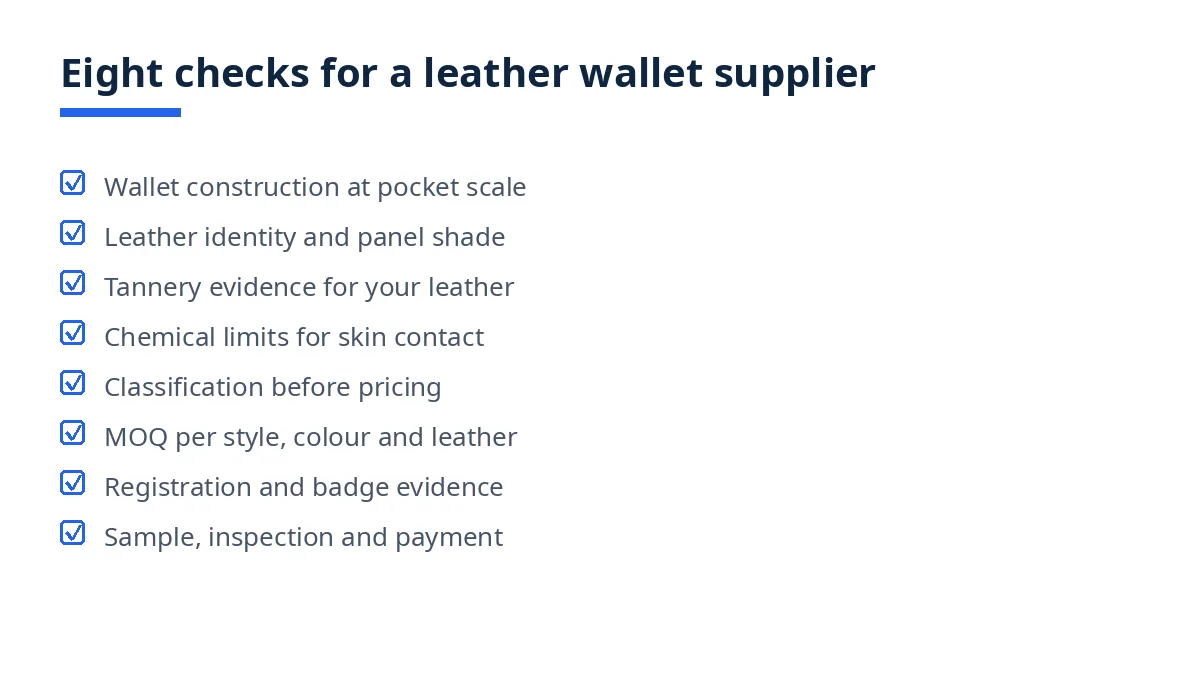
Do not judge a leather wallet supplier by a company list. Judge each supplier on eight checks: wallet construction at pocket scale, leather identity, tannery evidence, chemical limits for skin contact, HS classification, MOQ counted per style and colour, registration and badge evidence, and a sample and inspection record in your own leather.
On this page
Key takeaways
Wallet construction decides the order: slot fit, fold, closures and measurements must pass on a sample built to your tech pack, tested with your own test card.
Tannery evidence must name your leather and tannery: an LWG audit covers 17 sections, is valid for 24 months, and does not replace product testing.
For UK skin-contact leather, chromium VI at or above 3 mg/kg must not be placed on the market, with limits also applying to azo dyes and dimethyl fumarate.
Classification comes before price: pocket articles with a leather outer surface sit at 4202.31, and the counting basis for MOQ must be stated per style, colour and leather.
Exportain badges record document and photo reviews, not factory inspections; the buyer owns the checking decision and the sample approval.
A wallet is judged in a pocket and in a hand, not in a catalogue photograph. A card slot that grips too tightly, a fold that springs open, or a coin section that will not stay shut will be found on the first day of use, even when the outside of the wallet looks clean. That small scale is what makes wallet sourcing different from sourcing larger leather goods: faults that would be minor on a handbag panel can dominate a card slot or a fold edge.
This article gives no company roster and ranks no supplier. It sets out eight criteria for judging any leather wallet supplier in Bangladesh, each with what to check, why it matters, and how to fix a gap. Apply the same criteria to every supplier, and keep the evidence in one file per supplier.
Leather and leather products grew 14.74 percent in the first quarter of fiscal 2026-27, within merchandise exports of US$13.094 billion, up 6.34 percent, on Export Promotion Bureau (EPB) data reported by the Dhaka Tribune.1 Growth in the sector is a reason to search carefully, not a reason to shorten the search.
The list
The criteria below run from the wallet itself outward to the leather, the tannery, the market rules, the commercial terms, and finally the documents and the sample. Every gap needs a named fix and a date, recorded in writing. A gap with no fix is a reason to hold the order.
1. Wallet construction at pocket scale
What to check. The layout against your tech pack: bifold, trifold or card-holder layout, the number and position of card slots, note and coin sections, fold lines, closed and open measurements, and closed thickness with the contents you specify. Test every slot with a test card of the size you specify: it must enter without forcing, release without tearing the slot mouth, and stay in place when the wallet is tipped gently.
Why it matters. A wallet has to hold, protect and release its contents. The quality control checklist for leather wallets lists card-slot fit, fold behaviour and coin-section function among the first checks, because a wallet that fails in the pocket fails completely, however good its leather looks.2 At wallet scale, one weak point affects the whole article.
How to fix a gap. Do not accept a sample in a different layout or slot count. Ask for a corrected sample built to your tech pack, and re-test it with the same test card before approving bulk production.
2. Leather identity and panel consistency
What to check. The leather type and grain named in the quotation, the thickness and finish, the panel selection across the wallet, and the shade under an agreed light. Check shade between the exterior and the card panels of the same wallet, between wallets in the lot, and between the wallet and its trim. Check the surface for scars, holes, veins, loose grain and cracking, judged by position and size.
Why it matters. Genuine leather comes from animal hides, so natural marks are inherent and the task is grading, not demanding a mark-free hide.2 At wallet scale, a minor mark can dominate a card slot, and a shade split between the exterior and the card panels is visible every time the wallet is opened.
How to fix a gap. Agree the leather type, grain, thickness, finish and colour standard in writing, with a shade standard under a named light. If a sample shows a shade split or a mark in a slot mouth, ask for replacement panels and hold bulk cutting until a corrected sample passes.
3. Tannery evidence for your leather
What to check. Which tannery made the leather in your sample, what audit evidence names that tannery and that leather, and when the evidence expires. The Leather Working Group (LWG) audit, first launched in 2005, assesses how a tannery measures, controls and reports the impact of its operations across 17 sections.3 Thresholds are 85 percent for Gold, 75 percent for Silver, 65 percent for Bronze and 50 percent for Audited, the final medal is the lowest category achieved, and certification is valid for 24 months.3
Why it matters. An audit covers the named tannery for the stated period, not a different tannery or leather, and LWG states that certification does not ensure there will be no restricted substance failures in a final product.3 LWG classifies leather as chrome-free below 1,000 mg/kg of total chromium on a dry weight basis under BS EN 15987, and Gold and Silver certifications require chromium VI below 3 mg/kg.3
How to fix a gap. Ask for the certificate and test report naming your leather, tannery and method, and check the holder, site, coverage and expiry date. If the evidence names a different tannery or leather, treat it as background only. Retest when the leather, tannery or colour changes.
4. Chemical limits for skin contact
What to check. The restricted substances list for each destination market, given to the factory at enquiry stage, and test reports naming your product and leather for each limit. United Kingdom guidance under assimilated REACH rules states that skin-contact leather must not be placed on the market at or above 3 mg/kg chromium VI of the total dry weight, that azo dyes releasing listed aromatic amines above 30 mg/kg must not be used in articles in direct and prolonged skin contact, a list naming wallets, and that leather products above 0.1 mg/kg dimethyl fumarate must not be placed on the market.4
Why it matters. A wallet is handled daily, so it sits squarely in the skin-contact group. A chemical failure is invisible in a photograph and in a hand check, and is found only by laboratory testing.
How to fix a gap. Send your restricted substances list before sampling and require test reports naming your product, leather and method. If no report exists for a limit your market applies, hold bulk approval until a report on your own wallet exists.
5. Classification before pricing
What to check. The indicative classification of each wallet style before you negotiate price: whether it is of a kind normally carried in the pocket or in the handbag, and what material forms its visible outer surface. Subheading 4202.31 covers pocket articles with an outer surface of leather or composition leather, while 4202.32 covers the same articles with an outer surface of plastics sheeting or textile materials.5 A leather-look wallet therefore takes a different line from a leather wallet. The HS code guide for leather wallets sets out the tests and national extensions in full.
Why it matters. The code decides which duty line customs applies. Classification follows the product type and the outer surface, not the marketing name or the coin section, which stays one pocket article.5 Size and fittings must be settled before the code is filed, since a strap or size outside the pocket-article group moves the article to the handbag group.
How to fix a gap. Write the description for each style, confirm the subheading and full national code with your broker, and re-check the code when the specification changes. Treat every heading as indicative until the broker confirms the full code.
6. MOQ counted per style, per colour and per leather
What to check. The minimum order quantity (MOQ) against your exact specification, including the counting basis: per order, per style, per colour or per leather. MOQ is the smallest quantity a supplier will accept on its normal terms, and the same number can mean very different commitments depending on how it is counted.6
Why it matters. Leather is bought in lots, and lining, hardware, labels and cartons each bring their own runs. A quotation that omits the leather type, thickness and finish cannot be compared with another. The MOQ guide shows how the same number changes with the counting basis.6
How to fix a gap. Ask each supplier to state its minimum against your specification, including the counting basis, and send every supplier the same specification. Example figures: an MOQ of 1,000 pieces counted per colour, across two styles in two colours each, means a smallest order of 4,000 pieces. If the minimum blocks your range, ask about a stock leather, fewer colours, standard trims or a surcharge, and expect a trade-off in unit price. All figures in this paragraph are Example figures.
7. Registration, association and badge evidence
What to check. The legal name and address on the trade licence and Export Registration Certificate (ERC), matched against the quotation and invoice, and any association claim confirmed with the association. The sector association is the Footwear Leathergoods and Accessories Exporters Association (FLAXA), formerly LFMEAB, which rebranded at its annual general meeting on 5 March 2026.7 Use membership as one identity check, not as evidence a factory can make your wallet.
Why it matters. Mismatched documents are a warning sign whatever the price. On Exportain, verification is a document and photo review by staff, not a factory inspection and not a check against a government database.8 Exportain Verified records identity, phone, email and registration checks, Export Verified records an ERC check, and Factory Verified and Trading Company Verified record reviewed photos.8 A badge does not promise capacity, quality or delivery.8
How to fix a gap. Ask for the documents yourself and resolve any mismatch in writing before discussing price. Confirm membership and certificates with the issuing bodies, and check the bank account name yourself before paying.
8. Sample, inspection and payment discipline
What to check. A pre-production sample in your leather, colour, lining and hardware, checked for dimensions, stitching, edges, shade and closures, with a sealed counter-sample kept. Agree the inspection standard in writing before production: the sampling plan, defect classes and action on a fail. Agree payment terms in writing, and confirm bank details through a second channel.
Why it matters. Bulk production must start only after your written approval of the sample. On Exportain, every quotation is versioned, and accepting one creates an order record with those terms.9 Exportain is a marketplace, not a party to your goods contract, and holds money only when both parties agree to a funds hold.9 A supplier that refuses to sample in your leather or pressures quick payment to a personal account is giving you the information you need: hold the order.
How to fix a gap. State in the order that bulk production starts only after written sample approval, and keep the specification, sample record, certificate checks and quotation versions in one file per supplier. A small order that ships wrong still costs the full freight and clearance.
Summary table
Criterion | Pass evidence to hold | Hold signal |
|---|---|---|
1. Construction at pocket scale | Sample passes slot, fold and closure tests with your test card | Slot, fold or closure fails on the sample |
2. Leather identity and panels | Leather, grain, thickness and shade agreed; marks graded by position | Shade split or mark in a slot mouth or fold panel |
3. Tannery evidence | Certificate and test report name your leather and tannery, in date | Evidence names a different tannery or leather |
4. Chemical limits | Test reports name your product, leather and method per market | No report for a limit your market applies |
5. Classification | Broker confirms subheading and national code per style | Code copied from another country or product |
6. MOQ and price drivers | Minimum stated per style, colour and leather; quotes on identical terms | Counting basis unstated; quotes on different specifications |
7. Registration and badges | Names match across documents; membership and certificates confirmed | Mismatched names; certificate names another company |
8. Sample and payment | Sealed counter-sample; inspection plan and payment terms in writing | Pressure to pay before sample approval |
How Exportain helps
Exportain connects buyers with Bangladeshi suppliers, and the catalogue filters help at the shortlist stage: search by keyword and category, filter by badge, sample availability and OEM or ODM capability, and sort by MOQ or lead time.9 Read each badge for what it records, using the supplier verification guide: verification is free, membership never grants a badge, and a badge records a document and photo review, not a factory visit.8 Message suppliers through their profiles, send every supplier the same specification, and compare versioned quotations on the same fields.9 Exportain does not inspect goods, book freight or clear customs, so keep your broker and inspection provider central.
FAQs
What is the biggest mistake buyers make when choosing a leather wallet supplier?
Choosing by price before checking which leather sits behind it. A low quote in thinner leather or a different finish is a different wallet, not a saving. The price only means something once leather, construction, chemical evidence and inspection terms match across quotations.
How can I avoid it?
Send one specification to every supplier, run the same eight criteria on each, approve a sample in your leather, check the tannery and chemical evidence, confirm the classification, and agree inspection and commercial terms in one versioned quotation before paying.
Who is responsible for checking a leather wallet supplier?
The buyer owns the checking decision. The supplier must supply the documents and samples, the certificate issuer can confirm one claim, and an inspector can confirm the finished goods. None can create the specification or approve the sample for you. A badge records only the checks Exportain staff reviewed.8
Where can I get help checking a supplier?
Start with the records that exist: FLAXA for membership, the certificate issuer for any audit claim, and an inspection provider for the pre-shipment check.7 8 On Exportain, read what each badge covers, and use the quality control checklist for leather wallets with the approved sample and tech pack.2
Next steps on Exportain
Browse Bangladeshi suppliers and filter leather goods listings by badge, sample availability and OEM or ODM capability. Read how supplier verification works on Exportain before you order. Then post a free RFQ with your specification, leather, quantity, destination and Incoterm, and compare the versioned quotations on the same fields.
Sources
- Exports up over 6% to $13.1bn in Q1 of FY27. Dhaka Tribune, (accessed )
- Quality Control Checklist for Leather Wallets From Bangladesh. Exportain (accessed )
- Certification - Leather Working Group. Leather Working Group (accessed )
- Leather goods | Business Companion. Business Companion (accessed )
- HS, 2017 - Code 4202 Classification Detail. United Nations Statistics Division (accessed )
- MOQ Meaning (Minimum Order Quantity). Exportain (accessed )
- LFMEAB has rebranded as FLAXA. Footwear Leathergoods and Accessories Exporters Association (FLAXA) (accessed )
- How Supplier Verification Works on Exportain. Exportain, (accessed )
- How to source and buy from Bangladesh. Exportain (accessed )
About the author
Sourcing from Bangladesh?
Post a request for quotation and suppliers on Exportain can send you their quotes directly.
Post an RFQ