

Wholesale Dried Fish From Bangladesh: Prices, MOQ and Reliable Suppliers
Wholesale dried fish from Bangladesh by species, drying method and pack: tiers, per-line quantities, assortment balancing, moisture-controlled storage and replenishment rhythms for wholesale buyers.
Short answer
Wholesale dried fish from Bangladesh is bought by species, drying method and pack, with a separate tier, per-line minimum, moisture limit and replenishment rhythm for each line. Anchor lines take the largest share, mid-speed lines follow their turnover, and slow lines stay small, so the assortment balances by sell-through speed rather than equal weight. Compare suppliers line by line on the same specification, moisture limit and delivery term, and confirm the certificate route before loading.

On this page
Key takeaways
Wholesale dried fish is bought by species, drying method and pack, with a separate tier, per-line minimum, moisture limit and replenishment rhythm for each line.
Species yields differ sharply: about 3.25 kg of raw pomfret, 2.8 kg of raw mackerel and 5.5 kg of raw Bombay duck are needed per kilo of dried product in the Cox's Bazar study.
Balance the assortment by sell-through speed, with the fastest line as the anchor, rather than by equal weight across lines.
A usable moisture specification states a maximum moisture level or water activity, the test method and the moisture-proof pack, not a general description.
Exportain verification is a document and photo review, not a factory inspection, and a badge is not a guarantee.
A wholesale dried fish order from Bangladesh is not one product bought in bulk. It is an assortment of species, each dried by a different method, packed in a different size, and consumed at a different speed. A buyer who orders a single total weight and leaves the split to the supplier will usually receive too much of the slow lines and too little of the lines that sell first. The work is done before the order is placed: define the tiers, set a minimum per line, balance the assortment by sell-through speed, and fix the moisture and storage terms that keep the fish saleable after arrival.
Wholesale dried fish from Bangladesh is bought by species, drying method and pack, with a separate tier and per-line minimum for each combination. In the Harmonized System, heading 0305 covers fish, dried, salted or in brine, and smoked fish, whether or not cooked before or during the smoking process.1 That breadth is the first reason a wholesale specification must be precise: a salted and sun-dried line, a lightly salted line and a smoke-dried line are different products under the same heading, with different salt levels, moisture limits, shelf behaviour and buyers.
Why this matters for buyers and sellers
For the buyer, the assortment decides cash flow: a slow line ties up shelf space and working capital and cannot be cleared quickly without discounting. For the seller, a wholesale order is a production plan: raw fish must be bought, salted, dried, graded and packed in the right proportions.
The Cox's Bazar drying yards illustrate why species cannot be treated as interchangeable. A study of major drying yards in the district recorded the raw fish needed for 1 kg of finished dried product at about 3.25 kg for pomfret, 2.8 kg for mackerel, 4.5 kg for sardine, 4.01 kg for anchovy and 5.5 kg for Bombay duck, with salt use ranging from 3 percent to 16 percent across species.2 Those conversion ratios explain why per-kilo prices differ sharply between species and why a supplier cannot simply substitute one species for another at the same price. They also explain why a wholesale tier must be set per species: the drying yield, and therefore the cost base, is species-specific.
Moisture regain during storage and transport can undo a good drying job. The wholesale buyer therefore buys a moisture outcome as much as a species: a maximum moisture level, a pack that resists humidity, and a storage instruction the whole chain can follow.
Step-by-step: how it works
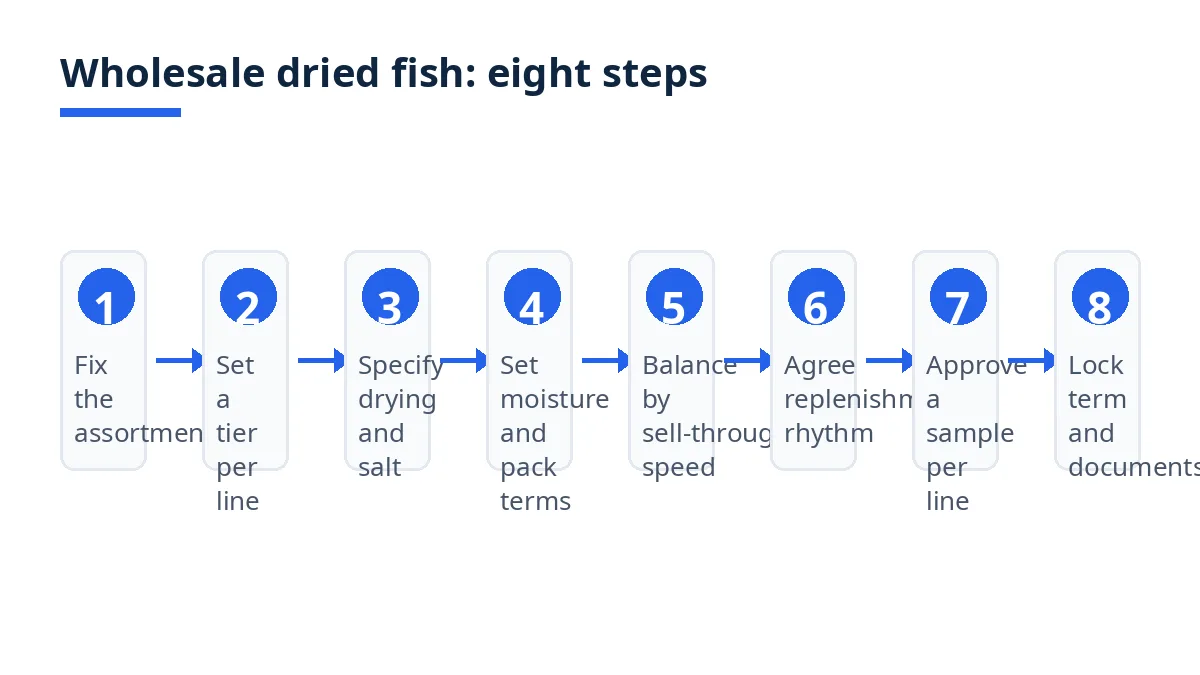
Fix the assortment first. List every species, drying method and pack you intend to sell, and rank each line by expected sell-through speed. A line that moves weekly and a line that moves monthly belong in different tiers even if they share a supplier.
Set a tier for each line. For each species and method combination, record the pack size, the minimum quantity per line, the price basis and the replenishment rhythm. A tier is a buying unit, not a description.
State the drying and salt specification per line. Record whether the fish is sun-dried or mechanically dried, whether it is dry-salted, wet-salted or brined, and the salt range the supplier must meet. For salted and dried salted fish of the Gadidae family, the Codex standard describes dry salting, wet salting and brine injection, with natural drying by exposure to open air or artificial drying in mechanically circulated air.3
Set the moisture and pack terms. State a maximum moisture level or water activity for the line, the inner and outer pack, and whether the pack must be moisture-proof. For smoke-dried fish, the Codex standard describes storage and transport without refrigeration at a water activity of 0.75 or less, equivalent to 10 percent moisture content or less, where that control is needed against bacterial and fungal spoilage.4
Balance the assortment by speed, not by equal weight. Allocate the order weight in proportion to how fast each line sells, with the fastest line as the anchor. Equal weights across lines guarantee overstock on the slowest line.
Agree the replenishment rhythm in writing. Record whether each tier is replenished weekly, fortnightly or monthly, the reorder trigger for each line, and whether slow lines are topped up only when the anchor line is reordered.
Approve a sample per line, not per order. Check each species and method combination separately for salt level, dryness, breakage, odour and foreign matter, and record approval line by line.
Lock the delivery term and the document set. State one Incoterm and named place for every quotation, and confirm the export documents before the goods move. The Incoterms 2020 rules are eleven three-letter trade terms that clarify tasks, costs and risks in delivery.5
Costs, timelines and documents
What are the typical costs and timelines?
There are no typical wholesale prices or timelines that a guide can state as fact, because each species, drying yield, salt level, pack and delivery term changes the cost. The Cox's Bazar conversion ratios show why: a species that needs 5.5 kg of raw fish per kilo of dried product carries a different raw-material cost base from one that needs 2.8 kg.2 Price drivers a buyer should ask about, line by line, are the raw fish cost and yield, the salt treatment, the drying method and time, grading and breakage losses, packing, inland movement from the drying yard, and the delivery term.5
Timelines follow the same logic. Sun drying depends on weather and yard capacity, mechanical drying on equipment time, and grading and packing on the number of lines. Ask for separate dates for drying, grading, packing, inspection and loading, rather than a single delivery week.
Example figures: a buyer builds a 600 kg wholesale order as 300 kg of a fast-selling anchovy line, 180 kg of a mid-speed mackerel line and 120 kg of a slow ribbon-fish line, each with its own pack size and per-line minimum. If the anchovy line sells twice as fast as the mackerel line, the next replenishment order repeats the same proportions rather than equal thirds. The example shows assortment structure only, not a typical price, MOQ or lead time.
Wholesale tier | What defines it | State in your enquiry |
|---|---|---|
Anchor line | Fastest-selling species and method | Species, method, pack, per-line minimum, weekly rhythm |
Mid-speed line | Steady seller, moderate turnover | Species, method, pack, per-line minimum, fortnightly rhythm |
Slow line | Niche or seasonal seller | Species, method, pack, per-line minimum, monthly or on-demand rhythm |
Trial line | New species or method under test | Small per-line quantity, sample approval, review date |
Which documents are needed?
For export clearance in Bangladesh, goods may not be loaded until a Bill of Export is submitted and approved. The standard set includes an export letter of credit or, where there is none, an export contract or purchase order, the commercial invoice, the packing list, the EXP Form certified by an authorized dealer, a certificate of origin issued by the Export Promotion Bureau or a Chamber of Commerce and Industry, and a VAT registration certificate, plus a health certificate for food products.6 Bangladesh Bank's electronic EXP Form option lets the customs-issued Bill of Export suffice for customs assessment, with a signed hardcopy of the EXP Form and the certified Bill of Export submitted to the authorized dealer within 14 days of shipment.7
For buyers selling into the European Union, Regulation (EC) No 853/2004 lays down specific hygiene rules for food of animal origin, including fishery products, and products from outside the EU must satisfy at least EU requirements, demonstrated by authorised country and establishment listings and accompanying certificates.8 Ask the supplier early which certificate route applies to your destination.
See the HS code for dried fish guide and the MOQ definition guide for classification and minimum-order terms.
Bangladesh-specific rules and tips
Start from the drying yard, not the trading desk. The study of Cox's Bazar yards found processors using mostly traditional methods for handling, processing, packaging, storage and marketing.2 Ask directly about drying surfaces, covering during rain, grading tables and storage rooms, and see dated photos of each stage rather than a single yard photograph.
Match the method to the market. Sun-dried fish suits buyers whose customers expect a traditional product, while mechanically dried fish suits buyers who need a tighter moisture range. Record the method on the purchase order for each line, because a substitution of method changes salt, moisture and shelf behaviour without changing the species name.
Ask how salt is controlled. The Cox's Bazar study recorded salt use from 3 percent to 16 percent across species.2 State a salt range per line, ask how it is measured, and check the sample against that range rather than accepting a description such as lightly salted.
Protect the load from humidity after drying. Fish that leaves the yard at the right moisture level can still regain moisture in a damp warehouse, a leaking container or a long port wait. State the storage instruction on the order: dry, ventilated storage, pallets off the floor, no contact with wet goods, and a moisture-proof inner pack.4
Keep one legal name across every paper. The export declaration, invoice, packing list and payment account should carry the same exporter name, because the Bill of Export and EXP Form are checked against each other.6 7
Mistakes and red flags
What are the most common mistakes?
Ordering by total weight only. A single total without a per-line split lets the supplier fill the order with the easiest lines. Every wholesale order needs a line-by-line table with species, method, pack and quantity.
Balancing the assortment by equal weight. Equal weights ignore sell-through speed. The slow line becomes dead stock while the anchor line runs out, and the next order repeats the error if the proportions are not corrected from sales data.
Accepting a moisture claim without a number. Descriptions such as well dried or fully dry cannot be checked on arrival. A usable specification states a maximum moisture level or water activity, the test method and who tests it.
Mixing methods under one line name. Sun-dried and mechanically dried fish of the same species are different lines. If the order file names only the species, the supplier can switch methods without breaching the letter of the order.
Skipping a per-line sample. Approving one sample for a six-line order approves nothing about the other five lines. Each line needs its own sample check for salt, dryness, breakage and odour.
Treating a profile or a badge as a quality guarantee. A supplier profile is a starting point for enquiries. Exportain verification is a document and photo review, not a factory inspection, and a badge is not a guarantee of production capacity, product quality or delivery.9 10
Leaving replenishment to chance. Without a rhythm and a reorder trigger per line, fast lines stock out between orders and slow lines accumulate. Write the rhythm into the order file at the start, and review it after the first sales cycle.
Red flags include a refusal to state a per-line minimum, a price quoted without naming the drying method or salt range, and a sample that differs in method from the quoted line.
Checklist
Before you confirm, every line should be answered in writing.
Assortment table complete: species, drying method, salt range, pack size and quantity per line.
Tier and per-line minimum recorded for each line, with the binding line named.
Assortment balanced by sell-through speed, with the anchor line identified.
Maximum moisture level or water activity stated per line, with the test method named.
Inner and outer pack specified as moisture-resistant, with pallet and storage instructions.
Sample approved per line for salt, dryness, breakage, odour and foreign matter.
Replenishment rhythm and reorder trigger recorded per line.
Quotations compared on the same specification and the same Incoterm.5
Export set agreed: Bill of Export, commercial invoice, packing list, EXP Form, certificate of origin, health certificate where required.6 7
Destination certificate route confirmed before loading.8
How Exportain helps
On Exportain, browse suppliers and post a request for quotation (RFQ) on the RFQ board with your assortment table, per-line minimums, moisture terms and replenishment rhythm, so suppliers quote against the same lines and terms. Ask each reply for its per-line minimum, drying method, salt range and moisture limit. When you accept a quotation, Exportain creates one order and issues one proforma invoice from the accepted terms.9
Read the badges for what they record. Exportain Verified means Exportain has checked identity, phone, email and business registration, and Export Verified means it has checked the Export Registration Certificate (ERC).9 Factory Verified means it has reviewed photos of the manufacturer factory, while Trading Company Verified means it has reviewed photos of the trading company office or warehouse.9 Verification is a document review by staff, free, and never granted by membership plans.10 It is not a factory inspection,9 10 so per-line samples stay with you. See how supplier verification works on Exportain and the dried fish quality control checklist.
FAQs
What should I know first about dried fish?
Dried fish is bought by species, drying method, salt treatment and pack, not by total weight alone. Heading 0305 covers fish dried, salted or in brine and smoked fish,1 and the Codex standard describes dry salting, wet salting and brine injection with natural or artificial drying.3
What are the typical costs and timelines?
There are no typical figures a buyer can rely on, because species yield, salt level, drying method, pack and delivery term drive the price, and weather, yard capacity and the number of lines drive the timeline.2 5 Ask for a line-by-line price and separate dates for drying, grading, packing, inspection and loading.
Which documents are needed?
The order documents are the assortment table, itemized quotation and purchase order, with per-line minimums and moisture terms on both. The export set is the Bill of Export, commercial invoice, packing list, EXP Form certified by an authorized dealer, certificate of origin and, for food products, a health certificate.6 The electronic EXP Form route requires a signed hardcopy with the certified Bill of Export to reach the authorized dealer within 14 days of shipment.7
What are the most common mistakes?
The most common mistakes are ordering by total weight only, balancing lines by equal weight instead of sell-through speed, accepting a moisture claim without a number, mixing drying methods under one line name, and reading a badge as a guarantee. A badge is not a guarantee of capacity, quality or delivery.9
Next steps on Exportain
Browse suppliers, then post your assortment table, per-line minimums and moisture terms on the RFQ board so suppliers quote line by line on one delivery term. Before you confirm, read how supplier verification works on Exportain and how to import dried fish from Bangladesh.
Sources
- Harmonized System — Heading 0305: Fish, dried, salted or in brine; smoked fish. World Customs Organization (accessed )
- Marine Fish Drying in Major Drying Yards: An Explorative Study in the Bay of Bengal of Bangladesh. WorldFish Bangladesh and South Asia (accessed )
- Standard for Salted Fish and Dried Salted Fish of the Gadidae Family of Fishes (CXS 167-1989). Food and Agriculture Organization of the United Nations (accessed )
- Standard for Smoked Fish, Smoke-Flavoured Fish and Smoke-Dried Fish (CXS 311-2013). Codex Alimentarius (accessed )
- Incoterms® rules. International Chamber of Commerce (ICC) (accessed )
- Custom Clearance in Bangladesh: Port Procedures and C and F Agent Guide. Bizmend (accessed )
- FE Circular No. 17: Introduction of electronic option of EXP Form submission for export of goods from Bangladesh. Bangladesh Bank, (accessed )
- Regulation (EC) No 853/2004 laying down specific hygiene rules for food of animal origin. European Union (accessed )
- Trust & Safety Center. Exportain (accessed )
- Supplier verification: Earn trust badges buyers can see. Exportain (accessed )
About the author
Sourcing from Bangladesh?
Post a request for quotation and suppliers on Exportain can send you their quotes directly.
Post an RFQ


