Quality Control Checklist for Dried Fish From Bangladesh
A numbered QC checklist for dried fish from Bangladesh: raw material, drying and salting, sorting and grading, moisture and salt tests, defect inspection, packing, dry storage and pre-shipment insect checks, with fixes for common failures.
Short answer
Use this dried fish quality control checklist before shipment to check raw material condition, drying and salting, sorting and grading by the purchase order basis, moisture and salt results tested lot by lot, defects, packing and dry storage on dried fish from Bangladesh. Agree species, moisture and defect limits in the specification first, because the Codex Gadidae standard covers only one family.

On this page
Key takeaways
Codex CXS 167-1989 covers salted and dried salted fish of the Gadidae family only: its salt floor of not less than 12 percent by weight applies inside that scope, in Section 1, and not to other dried species.
Set moisture and water activity limits per species in the purchase order and test every lot against them: the Codex smoke-dried figure of less than 10 percent moisture or water activity less than 0.75 in CXC 52-2003 Section 14.3.2 is for smoke-dried fish only.
Grade by the purchase order basis: Codex CXC 52-2003 Section 13.5.1 directs sorting into species, sizes and trade quality categories, and Section 13.5.2 warns that too high a drying temperature hardens the outer layer and can stop drying.
Score defects only against an attributed standard or your specification: CXS 167-1989 Section 8 defines Gadidae defectives, including pink, halophilic mould (dun) and objectionable odour, and other species need buyer-agreed defect limits.
Use this dried fish quality control checklist before shipment: raw material, drying, grading, moisture, defects, packing and storage. For ordering and shipping, see how to import dried fish from Bangladesh first.
Scope controls the numbers here. Codex CXS 167-1989 covers Gadidae salted and dried salted fish only: fully saturated fish, or fish preserved by partial saturation to a salt content not less than 12 percent by weight (Section 1).1 Most Bangladeshi dried fish is not Gadidae, so Codex numbers below are labelled Gadidae; other lines follow your purchase order.
Why this checklist matters
Dried fish fails in ways a carton hides: a dry surface over a wet core, insects from the store, mould on damp packs, mixed grades under a correct top layer. A certificate for a different species or lot does not cover your goods. Each point is recorded per lot as a reading or a pass or fail result. Codex CXC 52-2003 treats pest control as a prerequisite programme, covering preventing access, eliminating harbourage and infestations, and monitoring and eradication.2
Before you start
Do not begin until the references are complete: the approved pre-shipment sample, the specification (species, form, salt treatment, grade basis, moisture and water activity limits per species, defect limits, test list, packing), and label artwork. Name the destination market first: evidence differs by market, and FDA guidance assists processors in developing HACCP plans and control strategies.3 Prepare calibrated scales, a sampling knife or saw, sample bags and a camera, draw the sample randomly across cartons and dates, and agree the sampling plan and acceptance numbers in the purchase order.
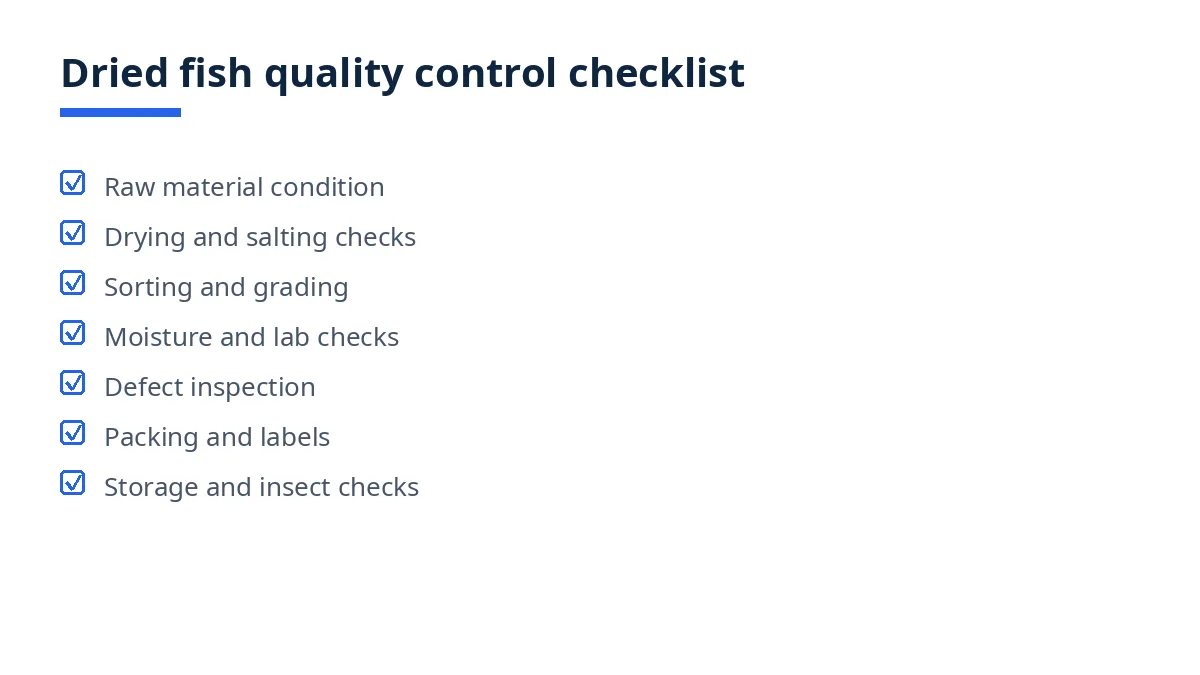
The full checklist (numbered, printable)
Raw material and reception
Match lot identity: species, form, salt treatment and drying dates on records, reports and cartons must agree.
Check raw fish condition. Gadidae: Codex CXS 167-1989 Section 3.1 requires sound, wholesome fish fit for human consumption.1 Apply the same test to other species via the specification.
Reject unfit raw material: Codex CXC 52-2003 Section 4 provides that fish known to contain harmful decomposed or extraneous substances should not be accepted unless sorting or processing reduces them.2
Check preparation for the form ordered: washing, splitting or filleting as specified, gut and blood removed where required, one species per lot.
For salted lines, check the salt: under Codex CXC 52-2003 Sections 13.3.1 and 13.3.2 it should be clean, unused, free from foreign matter, food grade, stored dry and covered, reuse avoided.2
Drying-yard and process checks
Dry on raised, covered racks or in the named dryer, off the ground, protected from dust and rain.
Keep fish of similar size together: Codex CXC 52-2003 Section 13.5.2 states that fish should be of similar size to ensure proper drying.2
Record drying time and temperature per lot: under Section 13.5.2 they depend on species, size and handling and stacking.2 Turn or re-stack at the purchase order intervals.
Check case-hardening by cutting the thickest fish. Section 13.5.2 states that too high a temperature can harden the outer layer and stop drying.2 A hard surface over a wet core fails.
For salted lines, check salt amount, time and temperature. Gadidae only: test salt against Codex CXS 167-1989 Section 1, not less than 12 percent by weight for partial saturation.1 Other species: the purchase order.
Sorting, grading and size checks
Sort into species, sizes and trade quality categories (Codex CXC 52-2003 Section 13.5.1); for salted lines, remove loose salt first and add new salt before packaging.2
One species and one presentation per pack. Gadidae: Codex CXS 167-1989 Section 2.3.5 provides that containers contain only one form of presentation from one species.1
Grade by the purchase order basis (weight or length per fish, or count per carton); record off-grade fish per carton.
Separate broken pieces; weigh or count them per carton against the tolerance.
Repeat grading across cartons and dates: a grade correct in the first carton and wrong later is a failure.
Weigh sampled units on the purchase order basis. Gadidae: Codex CXS 167-1989 Section 7.3 determines net weight excluding packaging and excess salt.1 State the same exclusion for other species.
Moisture, salt and laboratory checks
Test moisture on every lot, and water activity where named, against the limits agreed per species and form; reports name species, lot and result.
Do not borrow a general moisture figure. Codex CXC 52-2003 Section 14.3.2 continues smoke-drying until moisture is less than 10 percent or water activity less than 0.75.2 Smoke-dried only: your specification figure governs.
Test salt on salted lines lot by lot against the purchase order, and against the Section 1 figure in item 10 only for Gadidae.1
Confirm drying sits in the processor control file: FDA guidance Chapter 14 covers pathogenic bacteria growth and toxin formation from inadequate drying.3 Ask for the lot records.
Confirm the microbiological, contaminant and residue tests named in the purchase order were run on this lot, lot code and date on each report.
For EU orders, check histamine evidence for susceptible species: Regulation (EC) No 853/2004, Annex III, Section VIII, Chapter V requires that histamine limits are not exceeded.4
Check any preservative against the specification. Gadidae: Codex CXS 167-1989 Section 4 permits sorbic acid and its sodium and potassium salts at a maximum of 200 mg/kg as sorbic acid.1
Defect and sensory inspection
Use trained examiners: Codex CXS 167-1989 Section 7.2 requires examination by trained persons, and Annex A directs examination of every fish sampled.1
Check foreign matter. Gadidae: Section 8.1.1 treats matter not derived from Gadidae fish, readily recognized without magnification, as defective.1
Check odour on every fish. Gadidae: Section 8.1.2 treats persistent, distinct objectionable odours indicative of decomposition or contamination as defective.1 Other species: judge against the sample.
Check pink and appearance. Gadidae: Section 8.1.3 treats visible red halophilic bacteria (pink) as defective; Section 8.1.4 treats cracks on more than 2/3 of the surface, or a split fish in pieces held by skin, as defective.1
Score the Section 8.2 group, Gadidae only: 30 percent or more of a unit's fish affected makes it defective — dun over more than 1/3 of the face (8.2.1), liver stains over more than 1/4 (8.2.2), bruising over more than 1/2 (8.2.3), severe burning over 1/2 of the back (8.2.4).1 Other species: your specification.
For EU orders: Regulation (EC) No 853/2004, Annex III, Section VIII, Chapter V requires organoleptic examination, visual examination for visible parasites, and that obviously contaminated products are not marketed.4
Packing, labels and cartons
Check packaging: Codex CXC 52-2003 Section 13.5.3 requires clean, sound, durable, food-grade material, with packaging that minimizes contamination and decomposition.2
Check moisture protection pack by pack: the named moisture-proof inner pack, sealed while dry.
Check labels against the lot. Gadidae: Codex CXS 167-1989 Section 6.1 requires the food name and species name on the label.1 Every line shows species, form, salt treatment, grade, net weight and lot.
Check this lot's certificates. The Department of Fisheries e-certification system covers licences, health certificates and additional certificates per importing-country requirements, with sample collection and test reports.5 A certificate for a different establishment or lot does not cover this lot.
Weigh sample cartons, confirm pack count and grade ratio against the packing list; photograph markings.
Storage, insect checks and loading
Store cartons in a dry, inspected store, off the floor, pest programme and monitoring records current.2
Run the pre-shipment live-insect check: open sampled cartons from different store positions and inspect fish, packs and seams for live insects, larvae and webbing. Hold infested cartons; open neighbours first.
Segregate damp or soft cartons and re-test moisture before loading.
At loading, check the container is dry, clean and free of odour and pest signs; load only passed cartons; photograph the seal.
Common failures and how to fix them
The most frequent failure is uneven drying: a hard surface over a wet core, from too high a temperature. Hold the lot, cut fish from the affected batch, and re-test moisture before re-drying. Next is live infestation at the pre-shipment opening, from the store: segregate affected cartons, inspect neighbours, and do not load infested cartons. Mould, pink and dun trace to damp storage, reused salt or packs sealed wet: segregate affected dates. Short weight traces to packaging or excess salt in the weighing: re-weigh on the purchase order basis. Mixed species or sizes trace to sorting: re-sort and re-check.
Downloadable template and summary table
Copy this table into your inspection sheet, add the specification figures, and record the reading per line.
Section | Checks | Evidence |
|---|---|---|
Raw material | Species, form, condition, salt | Yard records |
Drying | Similar size, time and temperature, case-hardening | Drying log, cut check |
Sorting and grading | Species, sizes, categories, breakage | Grade sheets |
Moisture and lab | Moisture, salt, market tests | Lab reports per lot |
Defects | Odour, foreign matter, pink, dun, parasites | Report, photos |
Packing | Food-grade packs, moisture protection, labels | Packing list |
Storage and loading | Dry store, live-insect check, container check | Store log, loading photos |
How Exportain helps
Exportain is a B2B marketplace connecting buyers with Bangladeshi suppliers of dried fish and seafood, so this specification can be agreed at the enquiry stage. Browse suppliers and use inspection services to plan the check. Supplier profiles show document and photo checks recorded, not factory inspections. Exportain is not a party to the goods contract and does not inspect goods. You can also post a free RFQ and compare quotes.
FAQs
When should this checklist be used?
At final inspection, when goods are dried, sorted and largely packed, and again at loading. For first orders, also run drying and grading lines during production.
Who should complete it?
The buyer, a local agent or an independent inspector, using the approved sample and specification. Sensory lines need a trained examiner.
What are the most common failures?
Uneven drying with a wet core, live insects in cartons, mould or pink, short net weight, and mixed species or sizes.
Can a third party do it?
Yes, if you share the sample, specification, limits, test list and acceptance numbers first, and the inspector records readings per lot.
Next steps on Exportain
Agree your species list, moisture and defect limits and test list, then read how to import dried fish from Bangladesh, the frozen fish quality control checklist for frozen orders, and the pre-shipment inspection guide. Plan the check with inspection services and post an RFQ via RFQs.
Sources
- Standard for Salted Fish and Dried Salted Fish of the Gadidae Family of Fishes (CXS 167-1989). Food and Agriculture Organization of the United Nations (accessed )
- Code of Practice for Fish and Fishery Products (CXC 52-2003). FAO and WHO, Codex Alimentarius (accessed )
- Fish and Fishery Products Hazards and Controls Guidance. U.S. Food and Drug Administration (accessed )
- Regulation (EC) No 853/2004 laying down specific hygiene rules for food of animal origin. European Union (accessed )
- Bangladesh rolls out online certification system to simplify fish and seafood trade. International Collective in Support of Fishworkers (ICSF) (accessed )
About the author
Sourcing from Bangladesh?
Post a request for quotation and suppliers on Exportain can send you their quotes directly.
Post an RFQ