What Is TT Payment in Shipping? Explained With Examples
A TT payment in shipping is a telegraphic transfer: a bank-to-bank wire that moves money without any bank promise to pay. This guide covers the steps, OUR, SHA and BEN charges, timelines, documents, Bangladesh EXP rules, and a pre-payment checklist.
Short answer
A TT payment in shipping is a telegraphic transfer: the buyer instructs their bank to send money electronically to the seller's bank abroad, usually over the SWIFT network. TT is a way to move money, not a bank promise to pay. The timing the parties agree, in advance, against documents, or after shipment, decides who carries the risk if the other side does not perform.
On this page
Key takeaways
TT payment is a bank-to-bank electronic transfer, usually over SWIFT. The bank moves money on instruction and does not guarantee the trade.
The timing agreed, in advance, against documents, or after shipment, decides whether the buyer or the seller carries the performance risk.
The OUR, SHA, or BEN charge code on the instruction decides who pays the bank fees and whether the seller receives the full invoice amount.
In Bangladesh, export proceeds are repatriated through an authorised dealer bank and matched to the EXP export declaration, so beneficiary details must match exactly.
If a supplier writes "Payment by TT" on a proforma invoice, the first question to settle is what is tt payment in shipping terms. A telegraphic transfer (TT) is an electronic way to send money internationally through a financial institution. It is also known as an international wire transfer, and it often uses the SWIFT network to move funds between banks.1
The name is historical. Transfers between banks were once communicated by telegraph, with an operator sending the amount and recipient details by Morse code. The telegraph is obsolete, but the term stayed, and a TT today moves over secure cable networks.1 In a proforma invoice from a Bangladeshi exporter, "30% TT in advance, balance against documents" means a bank transfer in two parts, not cash, a card payment, or a letter of credit. This guide explains how a TT moves, what it costs and how long it takes, which documents support it, how Bangladesh rules affect it, and the mistakes that cost both sides money.
Why this matters for buyers and sellers
A TT is a payment method, not a bank promise to pay. Your bank moves money on your instruction. No bank checks that the goods exist, match the order, or have shipped.
A TT is widely available, quick to arrange, and workable for samples, ready stock, and smaller first orders where a documentary credit would cost more than the order justifies. The risk sits in the timing the two parties agree, because one side always performs first:
TT timing | When the buyer pays | Who carries more risk |
|---|---|---|
TT in advance | Before production or shipment | The buyer |
TT against documents | After shipment, against document copies named in the contract | Shared; buyer pays before holding originals |
TT on open-account terms | Set days after shipment or delivery | The seller |
Traders manage that risk by splitting the payment: a deposit by TT to start production, a balance against a copy bill of lading, or a letter of credit for a large first order. For the underlying term, see TT — telegraphic transfer and telegraphic transfer, defined.
How does a TT payment work, step by step?
A TT follows the same chain for any goods. SWIFT is the global messaging system used by the correspondent banking network for cross-border transactions, so the instruction travels through banks holding accounts with each other.2
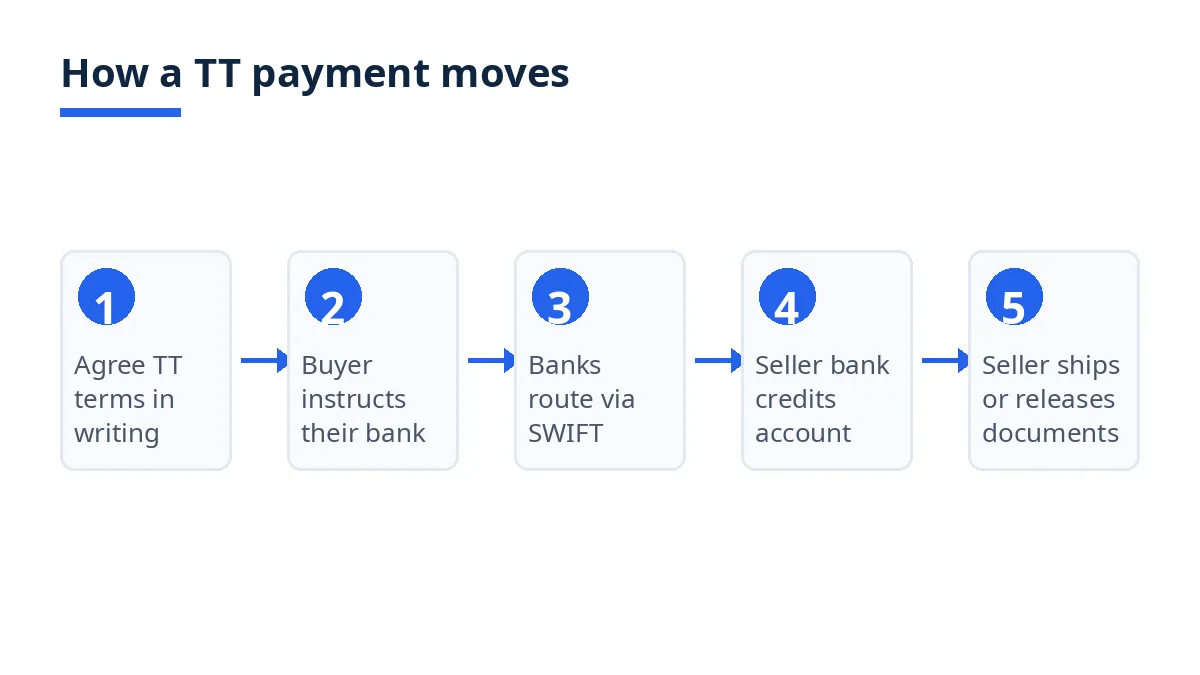
Agree the term in writing. The contract or proforma states the amount, currency, timing, the charge instruction (OUR, SHA, or BEN), and the seller's full bank details.
The buyer instructs their bank, submitting the beneficiary details, amount, currency, and purpose of payment, usually the invoice number.
The sending bank debits and sends. The standard SWIFT format for a single customer credit transfer is the MT103 message, and its Field 71A carries the charge code that decides who absorbs the fees.3
Correspondent banks pass the payment along. Few banks hold accounts with every other bank, so the payment hops through banks that do. Each hop adds a step, and an intermediary may deduct a charge where the instruction allows it.3
The receiving bank credits the seller, after checking the beneficiary name and account and applying its inward remittance requirements, converting the currency if needed.
The seller confirms and performs. Production, shipment, or document release starts only after the funds are credited, confirmed with the seller's own bank. A remittance slip is not proof of credit.
Both sides reconcile. The seller matches the credited amount to the invoice, records any shortfall the same day, and files the remittance advice with the invoice and shipping documents.
SWIFT gpi payments carry a unique end-to-end transaction reference (UETR) for tracking the payment and its fees.2
What does a TT payment cost?
The cost of a telegraphic transfer depends on variables such as the transfer amount and the institution chosen, so there is no universal TT price.1 Four elements make up the true cost: the sending bank's outgoing fee; intermediary deductions, which can stack on a longer chain; the receiving bank's inward fee, where set; and the exchange-rate markup, where the converting bank applies a rate away from the mid-market rate and keeps the difference. That last layer is not billed as a fee, which is why senders miss it.3
The charge code on the instruction decides who absorbs the flat fees:
Charge code | Who pays | What the seller receives |
|---|---|---|
OUR | The sender pays every charge, including correspondent fees | Full invoice amount |
SHA | Shared between sender and beneficiary | Invoice amount minus intermediary and receiving charges |
BEN | The beneficiary bears every fee layer | Invoice amount minus all charges |
Under SWIFT payment practice, OUR means the payer accepts all charges and the payment arrives in full, while under SHA each party is charged by its own bank.2 The definitions follow the Field 71A options on the MT103 instruction.3 For an advance payment, OUR is the cleanest instruction, because the seller can reconcile the full amount against the invoice. For the wider cost picture, see landed cost for imports from Bangladesh.
How long does a TT payment take?
Sources give a range, not a promise. A telegraphic transfer is generally complete within two to four business days, depending on the origin, destination, and any currency-exchange requirements.1 SWIFT payments are typically sent and received within 24 hours, but can take three to five days depending on the bank, the value, and the destination.2 A SWIFT wire usually clears in one to five business days, because each correspondent hop adds a step, and a time-zone gap, a weekend, or an extra compliance check pushes it longer.3
Cut-off times, correspondent numbers, weekends, and compliance screening decide where a payment lands in that range. Set the payment duty in days from a named event, such as "balance within three business days of the bill of lading copy."
Which documents support a TT payment?
A TT needs fewer documents than a letter of credit, but it is not a no-document payment. The most pertinent information for the transfer is the account numbers and details of the corresponding financial institutions, together with identification details for security purposes.1 In practice, the instruction needs five pieces of information, and an error in any of them can stall or return the payment: the beneficiary's full legal name and address as held by their bank, plus the account number or IBAN; the receiving bank's name, branch, and country; the SWIFT/BIC code; the purpose of payment; and the amount and currency.3
Behind the instruction sit the trade documents: the proforma invoice for an advance payment, the commercial invoice for a payment against or after shipment, and the packing list where the contract or bank asks for it. At the against-documents stage, the bill of lading or airway bill named in the contract triggers the balance. For the full set behind a Bangladesh shipment, see export documents from Bangladesh.
How is TT different from a letter of credit?
The difference is who promises to pay. A documentary credit (letter of credit) is a written undertaking by the issuing bank to pay the seller up to a stated amount, conditional on the seller's complying presentation of documents.4 Under a TT, no bank gives that undertaking.
Under TT, no bank checks documents and the cost is lower. Under a letter of credit, the bank examines documents against the terms of the credit, at higher cost and paperwork. A letter of credit suits a large first order or a new counterparty; TT suits smaller orders and established relationships, provided the timing is staged. See LC — letter of credit.
Worked example (Example figures). A buyer in the United Kingdom orders home textiles from a Bangladeshi seller for US$10,000 on terms of 30% TT in advance and 70% against a copy bill of lading, charges OUR. The buyer wires US$3,000. Production starts when the seller's bank confirms the credit, not when the buyer sends the slip. After shipment, the seller sends the bill of lading copy, the buyer wires US$7,000, and once that credit is confirmed the seller releases the original documents. The amounts are Example figures; bank fees and the exchange rate are additional.
What are the Bangladesh rules for TT payments?
Bangladesh runs a regulated foreign-exchange system: exports are declared, proceeds are repatriated through authorised dealer (AD) banks, and the inward TT must match the export record.
First, the export is declared on an EXP Form. Under chapter 8 of Bangladesh Bank's Guidelines for Foreign Exchange Transactions, exports of goods from Bangladesh are subject to repatriation of full proceeds, if not exempted, within the specified period from the date of shipment, and the declaration runs on the EXP Form, submitted by the exporter and certified by an AD, before customs formalities.5 On the form, the exporter undertakes to repatriate the full proceeds within the period Bangladesh Bank specifies under the Foreign Exchange Regulation Act.5
Second, the paperwork follows a timetable. Within 14 days from shipment, the exporter submits the EXP Form with the Bill of Export certified by the customs authority and the relevant shipping documents to the AD.5 A payment naming a different beneficiary, or carrying no invoice reference, cannot be matched cleanly to that record. The beneficiary on a TT to Bangladesh should therefore be the exporting company, paid to its business account, with the invoice number in the reference.
Third, advance payments have their own conditions. Bangladesh Bank has waived the earlier requirement to retain 10 percent of advance remittances against exports, so banks may now release the full amount to the exporter, subject to due diligence and verification of export performance. The exporter must have an irrevocable letter of credit or a contract for the shipment, and the advance must remain interest-free. If the export is not executed, including where no EXP Form is issued, the AD bank may allow a refund, funded first from the Exporters' Retention Quota account and then from Taka accounts.6
For buyers: spell the beneficiary name exactly as on the invoice and bank details, put the invoice number in the reference, and ask for the bank's credit confirmation once the funds land.
What are the common mistakes and red flags?
Most TT losses come from ordinary errors and ignored warning signs.
Acting on a screenshot. A remittance slip proves, at most, that an instruction was created. Sellers should act only on credited funds confirmed by their own bank.
Accepting a last-minute change of bank details by email. Business email compromise (BEC) is a form of social engineering in which people are tricked into making large transfers to a fraudster posing as a legitimate entity such as a supplier, and the attacker often compromises email accounts and monitors messages to make the request sound realistic.7 The FBI's Internet Crime Complaint Center (IC3) put BEC losses at nearly US$55.5 billion between October 2013 and December 2023, across more than 305,000 incidents, and FBI advice includes using a second pair of eyes to verify requests for changes in account information.7 Verify any change by voice call to a number you already hold.
Paying a full advance to an unchecked counterparty. A 100% advance leaves the buyer with no hold over the shipment. Money sent to a wrong or fraudulent account is hard to recover once credited: a bank can attempt a recall, but every bank in the chain has to agree, and the receiving bank is not obliged to return funds already paid out.3 Check the business first, start smaller, and stage the payment. See how supplier verification works on Exportain.
Leaving the term unwritten. "Payment by TT" without timing, currency, and a charge code is a dispute waiting for its order.
Ignoring short credits. If a SHA or BEN transfer arrives short and nobody records why, the invoice never reconciles and the shortfall becomes a dispute on the next order. Record deductions the day the credit lands.
Mismatched names and personal accounts. A beneficiary name that differs from the contracting company, without a documented reason, is a red flag for the buyer and a matching problem for a Bangladeshi seller whose bank must tie the receipt to the EXP record.
TT payment checklist
Before sending or relying on a TT payment:
The contract or proforma states the amount, currency, timing, and charge instruction.
Beneficiary name, account number or IBAN, bank name, and SWIFT/BIC code match the seller's written details exactly.
Any change to bank details has been verified by voice call to a known number.
The payment reference carries the invoice or proforma number.
Your bank's fees and exchange rate are known before the final price is agreed.
The seller will act only on credited funds confirmed with their own bank.
For staged terms, the document that triggers the balance is named in the contract.
Shortfalls from intermediary deductions will be recorded and reconciled on arrival.
For Bangladesh trades, the beneficiary is the exporting company's business account, matched to the EXP record.
Remittance advice, invoice, and shipping documents are filed together.
Frequently asked questions
What should I know first about TT payment?
Three things. A TT payment is a bank wire transfer: the bank moves money on your instruction but does not guarantee the trade. The timing you agree decides who carries the risk. The details must be exact, including beneficiary name, account number or IBAN, SWIFT/BIC code, invoice reference, and the charge code, because an error can delay or misroute the payment.3
What are the typical costs and timelines?
Timelines run from about one business day on a short route to several days where correspondent hops, currency conversion, weekends, or compliance checks are involved, with published ranges of two to four business days for a typical transfer.1 Costs combine the sending fee, intermediary deductions, any receiving fee, and the exchange-rate markup, and vary by bank, country, and currency.3
Which documents are needed?
The remittance instruction with full beneficiary details, supported by the proforma invoice (advance) or the commercial invoice (against or after shipment). The bill of lading or airway bill named in the contract triggers the balance, and the seller's AD bank works from the EXP record and the shipping documents.5
What are the most common mistakes?
Paying in full in advance to an unchecked seller, acting on a screenshot instead of confirmed credited funds, accepting a last-minute change of bank details by email without voice verification, leaving the TT term unwritten, and ignoring short credits.
Next steps on Exportain
Browse suppliers for Bangladeshi exporters, read how to buy, and post an RFQ stating your TT timing and charge instruction, so quotations are written on the terms you intend to use.
Sources
- Telegraphic Transfers 101: Everything You Need to Know. Investopedia (accessed )
- What are Swift payments and how do they work?. Currencycloud (accessed )
- SWIFT Wire Transfer: How It Works, Costs & Requirements. Xflow (accessed )
- A guide to types of documentary credit. ICC Academy (accessed )
- FE Circular No. 17: Introduction of electronic option of EXP Form submission for export of goods from Bangladesh. Bangladesh Bank, (accessed )
- BB eases rules to support exporters. The Financial Express, (accessed )
- Business Email Compromise Costs $55bn Over a Decade. Infosecurity Magazine, (accessed )
About the author
Sourcing from Bangladesh?
Post a request for quotation and suppliers on Exportain can send you their quotes directly.
Post an RFQ