Sustainable Light Engineering & Bicycles From Bangladesh: Certifications and Green Factories
Bicycle exports recovered to USD 151.04 million in FY2025-26 within engineering exports of USD 652.15 million. This pillar guide covers products, clusters, supplier and green-factory checks, MOQ, pricing, ISO 4210, ISO 14001, ESPR, Incoterms and duties.
Short answer
Sustainable light engineering from Bangladesh pairs workshop-made machined parts and agricultural machinery with export bicycle production, mainly for Europe. Buyers source it sustainably by checking a factory Environmental Clearance Certificate, ISO 14001 scope, ISO 4210 bicycle test reports and EU ecodesign and origin files, then fixing MOQ, price and Incoterm per order.
On this page
Key takeaways
Bicycle exports were USD 151.04 million in FY2025-26 on EPB data, within engineering exports of USD 652.15 million, up 21.77 percent on the year.
Sustainable in this category is checkable: an Environmental Clearance Certificate under the Environment Conservation Rules 2023, an ISO 14001 system read for site and scope, and ISO 4210 test reports for complete bicycles.
Bogura is the workshop centre for agricultural machinery parts, while export bicycle factories report local value addition of 50 percent to 70 percent, a company figure from July 2026 reporting.
There is no industry-wide MOQ, price or lead time; all three are quoted per factory against a written specification, with imported components the swing cost.
Sustainable light engineering in Bangladesh covers two linked offers: machined parts, agricultural machinery, auto parts and other light engineering goods from workshop clusters, and complete bicycles and bicycle parts built for export, mainly to Europe. This pillar guide is for importers, brands, distributors and sourcing agents in the United States, the United Kingdom, the European Union and the United Arab Emirates. It covers export data, products and clusters, supplier checks, MOQ, pricing and lead times, the certifications and environmental rules that give the word sustainable a verifiable meaning, shipping, Incoterms and duties, and a step-by-step buying process.
Market overview with latest data
Read the market in two separate Export Promotion Bureau (EPB) series, bicycles and engineering products, and keep each fiscal year with the source that reported it. Bangladesh uses a July to June fiscal year, and the figures below are not blended across sources. Bicycle exports are the most visible part of the category.
On the EPB series reported in August 2025, bicycle exports peaked at USD 168 million in FY2021-22, fell to USD 142 million in FY2022-23 and to USD 83 million in FY2023-24, then rose 41 percent to USD 117 million in FY2024-25.1 A separate report of the same FY2024-25 release put engineering products overall at USD 535.56 million, up 10.03 percent, with demand named for machinery, tools and auto parts.2 Do not average the two bicycle figures that circulate for FY2024-25, USD 117 million and USD 116.44 million: they are two reports of one EPB release, rounded differently.1 2
The next fiscal year extended the recovery. On EPB data reported in September 2026, engineering exports rose 21.77 percent to USD 652.15 million in FY2025-26, electrical products became the largest engineering earner at USD 206.19 million, up 23.82 percent, and bicycles earned USD 151.04 million, up 29.71 percent.3 A July 2026 report rounds the bicycle figure to USD 151 million and records the industry reading that the rise is a recovery from an unusually weak base rather than a full rebound.4 Treat FY2025-26 as a recovery year, not as a return to the FY2021-22 peak.1 4
Three features shape what a buyer can source. First, Europe is the centre of the bicycle trade: exporters name renewed European orders, easing freight costs and new markets including the United States behind the recovery.1 Second, the product is moving up the value chain, toward lightweight and electric bicycles, and one major exporter reports making most components locally, including frames, forks, rims, tyres, tubes, pedals, saddles, handlebars and grips, with only specialised inputs such as paint and multi-gear systems imported.1 4 Third, local value addition is becoming a market-access question. The same exporter reports value addition of 50 percent to 70 percent by bicycle type and specification, and a newer entrant reports planning around a rise in the value-addition requirement for export preferences from around 30 percent to about 50 percent after least developed country graduation; both are company statements reported in July 2026, not official thresholds.4
The wider sector is mostly domestic and mostly small, supplying capital machinery, spare parts and import-substitute goods to agriculture, transport, textiles and construction.5 6 Machining capability is deep, but export discipline, testing and environmental documentation vary firm by firm, which is why the verification and compliance sections below carry the weight of this guide.
Main products and production clusters
Light engineering, in the definition used by the Dhaka Chamber of Commerce and Industry policy paper on the sector, is production with at least a machining activity at its core: shaping metal into parts and machinery.5 The paper groups the wide product range by the industry served:
Product group | Typical products |
|---|---|
Agricultural machinery | Seeders, rice husking machines, sprayers, threshers, irrigation pumps and spare parts |
Automobile parts | Crankshafts, brake drums, gears, pistons and piston rings, filters, silencers and brackets |
Industrial machinery and spares | Plastic moulding machines, lathe machines, textile and jute machinery spares, construction mixers and brick crushers |
Pedal vehicles | Bicycles, cycle rickshaws and their parts |
Electrical goods | Fans, fittings, distribution boards, switchgear and control panels |
Metal furniture and domestic goods | Hospital beds, steel furniture, gas burners and bathroom fittings |
The Bogura cluster fills in the agricultural end of that table with named products: pistons and piston rings, liners, seed drills, threshers, shallow tube wells, grain dryers, hand pumps, centrifugal pumps, insecticide sprayers, crankshafts, gears and pinions.6 Write a machined-parts enquiry around a drawing and a material specification, not a product name, because the same workshop may make the same part to very different tolerances.
For customs and duty purposes, bicycles and their parts sit in Chapter 87 of the Harmonized System, the classification maintained by the World Customs Organization (WCO).7 Complete non-motorised bicycles fall under heading 8712, and bicycle parts and accessories fall under heading 8714, in subheadings 8714.91 to 8714.99.8
HS heading or subheading | What it covers |
|---|---|
8712 | Bicycles and other cycles, including delivery tricycles, not motorised |
8714.91 | Frames and forks, and parts thereof |
8714.92 | Wheel rims and spokes |
8714.93 | Hubs, other than coaster braking hubs and hub brakes, and free-wheel sprocket-wheels |
8714.94 | Brakes, including coaster braking hubs and hub brakes, and parts thereof |
8714.95 | Saddles |
8714.96 | Pedals and crank-gear, and parts thereof |
8714.99 | Other bicycle parts and accessories, including handlebars and derailleur gears |
Agree the six-digit subheading with your supplier and broker before ordering, because parts presented together can be reclassified as a complete bicycle, as the duties section explains.8 Other light engineering goods spread across many chapters by product, so the heading follows the machine or part itself, not the sector label.
Production clusters sit in two layers. The first is the workshop layer, centred on Bogura and on Dhaka. One account of the Bogura cluster describes a Bangladesh Small and Cottage Industries Corporation (BSCIC) estate cluster of ten foundries, 800 manufacturing facilities and 745 workshops producing agricultural machinery, with a further 60 foundries and 1,000 units elsewhere in the district, together meeting 70 percent of national demand for agricultural machinery and spare parts, producing more than 3,000 product types worth BDT 500 crore a year and employing 15,000 people; these are figures reported in that account, not an official census.9 An earlier report counted about 30,000 workers in the district's sector in 2017.6 The second layer is the export factory layer: larger bicycle and engineering plants, including the Mirzapur, Tangail plant reported in 2026 and the exporters whose largest reported market is Germany, followed by Denmark.4 Dedicated industrial parks were decided for Dhaka, Narayanganj, Jashore, Bogura and Narsingdi, with a Light Engineering Training Institute, after light engineering was declared the Product of the Year for 2020.10 A park address is not evidence of export readiness; assess the firm, not the cluster label.
How to find and verify suppliers
Find suppliers through more than one channel so you can cross-check what a firm tells you. Start with the industry associations named in sector reporting, including the Bangladesh Engineering Industry Owners Association (BEIOA) for workshop firms, add Bangladesh export data and Exportain trade intelligence for context, then work Bangladeshi suppliers listings by product and ask each candidate for its export markets and reference products in your heading.6 10
Verification is a document exercise first and a visit exercise second. Ask for, and read, the following before you discuss price:
Trade licence and export registration in the company's own name, and the factory address where your goods will be made, because cluster workshops and trading offices are often different places.
Association membership, where claimed, checked against the association named in the firm's own documents.6
Export history: anonymised bills of lading or shipment summaries for your target market, showing heading, volume and recency.
The environmental file: the factory's Environmental Clearance Certificate and its category under the Environment Conservation Rules 2023.11
Management system certificates where claimed, read for scope and site: an ISO 14001 certificate covers the environmental management system of the named site, not the performance of a single product.12
Test reports for the exact product you plan to buy, including bicycle safety test evidence against ISO 4210 for complete bicycles.13
Capacity evidence: machine list with computer numerical control (CNC) and testing equipment named, daily output by product, and which stages, such as painting or heat treatment, are subcontracted.
On Exportain, read badges for what they are. Supplier profiles carry document and photo review badges: the badge records that documents and photos were reviewed by Exportain staff, verification is free, and membership never grants a badge.14 A badge is not a factory inspection, a certification or a guarantee, and Exportain is not a party to the contract for goods between buyer and seller. Use the badge as a first filter, then run the checks above yourself or through an inspection firm you appoint.
Two red flags end a conversation early: a workshop that quotes a firm export price before it has seen your drawing, material grade and tolerances is not pricing your product, and a supplier that calls its factory green but cannot produce an Environmental Clearance Certificate, a certificate with a named scope, or a test report has given you a marketing word, not evidence.11 12
MOQ, pricing and lead times
There is no industry-wide MOQ, standard price or standard lead time for light engineering goods or bicycles from Bangladesh, and no official body publishes one. All three are quoted per factory and per order, against a written specification. What follows is how each is built, so you can compare quotes on equal terms.
MOQ. The minimum order quantity is set by the production stage. A bicycle order carries the factory's minimum per model, frame size and colour set, plus carton and container loading economics. A machined parts order carries setup economics: casting minimums per pattern, CNC setup time per drawing, and finishing minimums per coating. State your target quantity per product, per size and per design, and ask each supplier to quote its MOQ on the same basis.
Pricing. Your unit price is built from steel and other metal inputs, the share of imported components, machining, casting or assembly labour, finishing, testing, packing and export costs to the agreed Incoterm point. The imported share matters: one major bicycle exporter reports importing specialised paint, which is not produced in Bangladesh and attracts an import duty of about 60 percent, and multi-gear systems, because overseas buyers prefer named brands for those components.4 Compare quotes only at the same Incoterm and component list, and ask each factory to state the steel grade, component brands and price-validity period in writing.
Example figures. For illustration only: a buyer's specification for complete city bicycles is quoted by two factories at the same Incoterm, FOB Chattogram. Example figures: Factory A quotes USD 118 per bicycle itemised as frame set and components USD 86, assembly and painting USD 17, testing and packing USD 6 and export costs USD 9, for a 500-bicycle order total of USD 59,000. Example figures: Factory B quotes USD 109 per bicycle with no itemisation and no named gear system, a total of USD 54,500. The example shows the method, not a market price: the USD 4,500 gap is tested by asking Factory B for the same itemisation, the gear system brand and the ISO 4210 test evidence behind the quote, before the gap is treated as a saving.13
Lead times. A lead time is a chain, not a single number: steel and component purchase, casting or frame building, machining, painting and finishing, assembly, testing, inspection and booking, then transit. Ask for the lead time broken into stages, with the imported-component stage stated separately, because that is where exporters reporting recovery also report their remaining import dependence.4 Agree what starts the clock, normally written order confirmation plus approved sample, not the first enquiry.
Quality, certifications and compliance
Sustainable in this category has a precise, checkable meaning, in three layers: the factory's legal environmental clearance in Bangladesh, the management system and product standards it can evidence, and the destination market's product rules. A claim that points to none of those layers is not a compliance statement.
Bangladesh environmental clearance. An Environmental Clearance Certificate (ECC) from the Department of Environment is a mandatory requirement for operating an industrial entity in Bangladesh, governed by the Environment Conservation Act 1995 and the Environment Conservation Rules 2023, and it is required before commercial production.11 Under the 2023 rules as summarised in that guide, projects are classified as Green, Yellow, Orange or Red by pollution impact; Yellow, Orange and Red projects need a Location Clearance Certificate before the ECC, Orange projects require an Initial Environmental Examination and Red projects a full Environmental Impact Assessment, while units inside government-designated zones such as BSCIC estates may apply directly for the ECC.11 Certificate validity in that summary runs from five years for Green to one year for Orange and Red, with renewal applied for at least 30 days before expiry.11 Ask for the ECC, read its category, site address and expiry date, and match all three to the factory that will make your goods. A subcontracted foundry, painting or plating stage needs its own clearance story, because your product's footprint sits where the work is done.
Environmental management systems. ISO 14001 is the international standard for environmental management systems (EMS): it provides a framework to design and implement an EMS and continually improve environmental performance, covering resource use, waste management and monitoring.12 Certification is voluntary and is carried out by independent certification bodies, not by ISO itself; certified organisations are usually audited in surveillance visits each year, with a recertification audit every three years.12 Read a certificate for the legal entity, site, scope wording and expiry date. ISO 14001 certifies a management system; it does not certify that a bicycle or a machine part is a green product, and a supplier that presents it as a product label has overstated the document.
Green finance behind green factories. Factory upgrades, such as energy-efficient machinery, effluent treatment and rooftop solar, have a named funding route. Bangladesh Bank's sustainable finance framework, built on its Sustainable Finance Policy introduced in 2020 and updated in 2023, runs refinance schemes that include a Green Transformation Fund of BDT 50 billion, a Technology Development and Upgradation Fund of BDT 10 billion and a BDT 10 billion scheme for green products, projects and initiatives.15 Ask a supplier planning an upgrade which scheme, bank and stage the financing has reached. That answer separates a funded programme from an intention.
Bicycle product safety. For complete bicycles, the reference standard is ISO 4210, Cycles, Safety requirements for bicycles, a nine-part series specifying safety and performance requirements for the design, assembly and testing of bicycles and sub-assemblies with a maximum saddle height of 635 mm or more.13 Part 2, ISO 4210-2:2023, sets requirements for city and trekking, young adult, mountain and racing bicycles, covering brakes, steering, frames, forks, wheels and tyres, pedals and drive systems, saddles and seat posts, lighting and markings.13 A bicycle must carry at least two independently actuated braking systems, one for each wheel, meeting the standard's braking performance tests.13 Require test reports for the exact model and component set you are buying; a report for a different model does not transfer.
EU sustainability rules. The Ecodesign for Sustainable Products Regulation (ESPR) entered into force in the EU in July 2024 and enables ecodesign requirements to be set product group by product group, covering durability, reusability, upgradability and reparability, substances that hinder circularity, energy and resource efficiency, recycled content, remanufacturing and recycling, carbon and environmental footprints, and information requirements including a Digital Product Passport.16 Requirements arrive through product-specific delegated acts, so no single ESPR duty applies to every engineering product today; where a delegated act applies, manufacturers need information on materials, components, environmental characteristics, durability and repairability.3 16 One dated obligation is already fixed: under the EU Batteries Regulation as reported in September 2026, an electronic battery passport becomes mandatory from 18 February 2027 for electric-vehicle batteries, industrial batteries above 2 kWh and light means of transport batteries on the EU market, which reaches the battery in an electric bicycle.3 Bangladeshi electrical exporters report traceability as their hardest ESPR problem, because imported components make carbon footprint tracking difficult.3 Ask for the bill of materials with component origins at sampling stage.
Your own quality system. Write the specification so an inspector can measure it: drawing and revision, material grade, tolerances, finish, bicycle model and component list, packing, and the tests to be run and by whom. Approve a counter-sample, set the inspection point before cartons are closed, and test production-representative goods, not showroom samples.
Shipping, Incoterms and duties
Light engineering goods and bicycles from Bangladesh normally leave by sea from Chattogram. Packing drives the freight economics: bicycles are bulky relative to weight, and machined parts are dense and heavy relative to volume. Confirm carton dimensions, units per carton and gross weight per carton in the specification, because those numbers set your freight cost per unit under any Incoterm.
Incoterms® 2020 is the current edition of the ICC rules, in force since 1 January 2020. The rules are eleven three-letter trade terms that clarify the tasks, costs and risks in the delivery of goods from sellers to buyers, recognised as the global standard for interpreting the most common terms in foreign trade.17 The four rules you will meet most often in this category work as follows:
Rule | Who arranges and pays main freight | Where risk passes to the buyer | Practical note for this category |
|---|---|---|---|
EXW (Ex Works) | Buyer | At the seller's premises | Buyer carries export clearance workload; rarely suitable for a first order |
FOB (Free On Board) | Buyer | When goods are on board the vessel at the named loading port | The common Bangladesh export term; name the port, for example FOB Chattogram, Incoterms® 2020 |
CIF (Cost, Insurance and Freight) | Seller, plus minimum insurance | When goods are on board at the loading port | Seller's freight is convenient, but risk still passes at loading, not at arrival |
DAP (Delivered at Place) | Seller | At the named destination place, ready for unloading | Buyer still clears import and pays duty unless the contract says otherwise |
Always write the rule with its named place and edition, for example "FOB Chattogram, Incoterms® 2020".
Duties are decided by the heading, the origin of the goods and the destination's preference scheme, in that order. As a least developed country, Bangladesh benefits from the Everything But Arms (EBA) arrangement under the EU's Generalised Scheme of Preferences, which grants duty-free, quota-free access to the EU for exports of all products except arms and ammunition.18 Bangladesh is the largest beneficiary under the EBA arrangements, with EUR 19 billion in exports benefitting from these preferences in 2024 at a 96 percent utilisation rate, and 91 percent of Bangladesh's exports to the EU enter duty- and quota-free.18 Goods that meet the EBA rules of origin and ship with the required proof of origin therefore enter the EU without customs duty while Bangladesh holds that status. Two cautions apply. First, preference is a property of the consignment, not the country: without preference, a complete non-motorised bicycle with ball bearings under EU code 8712 00 30 carries a 14 percent third-country duty, and parts presented together can be reclassified as an unassembled bicycle under heading 8712 when a frame and fork arrive with at least two of a pair of wheels, a crank-gear, a steering unit or a braking system.8 Second, exporters report working to a higher local value-addition requirement for preferences after graduation, which is why the component origin file matters commercially as well as environmentally.4 For the United States, the United Kingdom and the UAE, read the duty beside your confirmed six-digit code in the destination tariff for the entry date; this guide states no rate for them, because rates vary by heading.
Step-by-step buying process
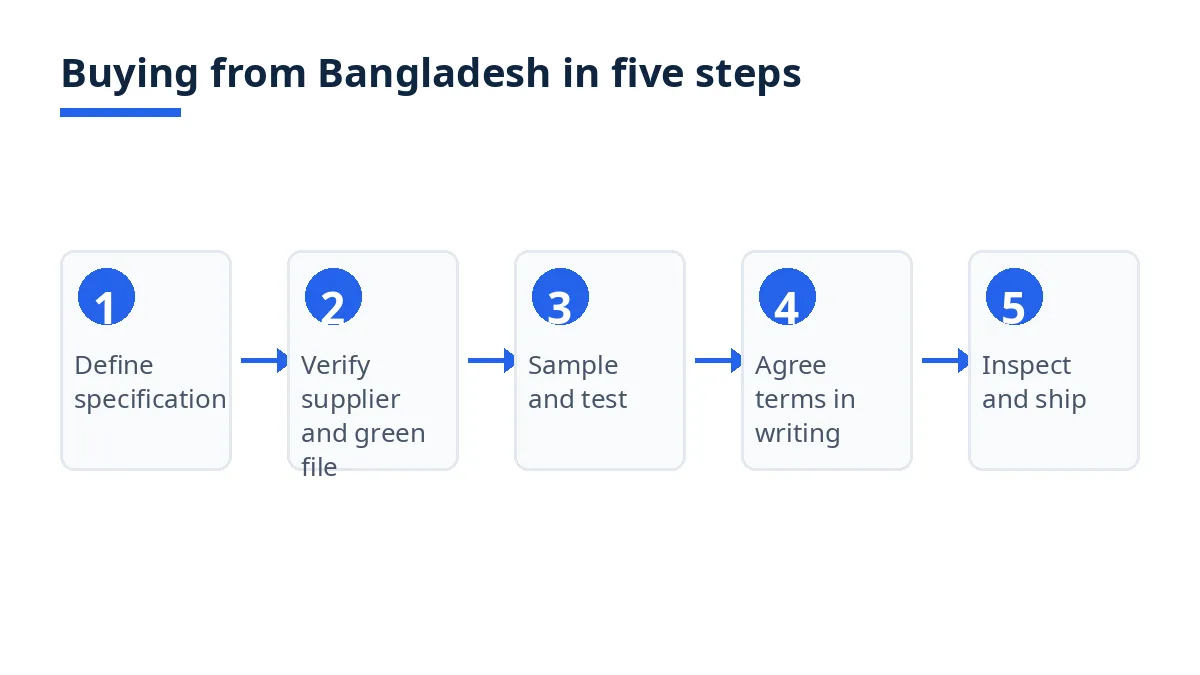
Define the specification. Write the product before you shop for it: HS heading, drawing or bicycle model and component list, material grades and tolerances, finish, packing, target quantity, and destination market with its environmental and product rules.16 8
Shortlist and verify suppliers. Build a shortlist from association lists and supplier listings, confirm which factory will make the goods, then run the document checks in the verification section, including the Environmental Clearance Certificate and any management system certificate read for scope and site.14 11 12
Sample and test. Order samples against the specification, test complete bicycles against ISO 4210 for the exact model, and approve a counter-sample in writing.13
Agree commercial terms in writing. Fix MOQ per product and design, itemised unit price with its validity period, the Incoterm with its named place, the staged lead time and its start point, payment terms and the inspection point, all in the purchase order.17
Produce, inspect and ship. Monitor the component and machining stages first, inspect finished goods against the approved counter-sample and specification, then ship with the origin evidence your duty position depends on.18
Related guides
Read how to import from Bangladesh for the general import sequence, Bangladesh export data for category scale, and Incoterms for shipments from Bangladesh for the delivery terms in detail.
FAQs
Is Bangladesh a good place to source light engineering & bicycles?
Bangladesh is a credible sourcing option for complete bicycles and for machined parts and agricultural machinery where the specification, component list and compliance file are managed actively. Engineering exports reached USD 652.15 million in FY2025-26 on EPB data, with bicycles at USD 151.04 million recovering toward, but not yet at, the FY2021-22 peak of USD 168 million.3 1 The constraints are the small scale and domestic focus of most workshop firms, dependence on imported specialised components, and the documentation EU sustainability rules now require.5 4 3 Source factory by factory, not on the country label.
What is the typical MOQ?
There is no published typical MOQ for light engineering goods or bicycles from Bangladesh, and no official body sets one. Each factory quotes its MOQ from its production stage: a minimum per bicycle model, frame size and colour set, or a casting, setup and finishing minimum per machined part drawing. State your target quantity on the same basis in your enquiry, so quotes can be compared directly.
How long is the lead time?
There is no standard lead time: yours is the sum of its stages, from steel and component purchase to transit. The imported-component stage is the one exporters name as their remaining dependence, so ask for the stages separately and agree in writing what starts the clock.4
Which certifications matter?
The requirements that matter are the ones your destination market and your buyers require for the exact product, plus the factory's legal clearance at home. At home, the operative document is the Environmental Clearance Certificate under the Environment Conservation Rules 2023, read for category, site and expiry.11 For the factory system, ISO 14001 evidences an environmental management system, certified by an independent body for a named site and scope; it is not a product label.12 For complete bicycles, the operative product standard is ISO 4210, including ISO 4210-2:2023 for city, trekking, young adult, mountain and racing bicycles.13 For the EU, add the ESPR product-group requirements and Digital Product Passport information duties where a delegated act applies to your product, and the battery passport for light means of transport batteries from 18 February 2027 where an electric bicycle is in scope.16 3
Next steps on Exportain
Browse Bangladeshi suppliers by product or bicycle category, use Exportain trade intelligence for the market picture behind this guide, and post a free RFQ at Exportain RFQs with your specification, quantity and destination market.
Sources
- Bicycle exports rebound after two-year slump. The Daily Star, (accessed )
- Textiles, seafood and bicycles led export surge in FY2024–25. TOB News, (accessed )
- Electrical, electronics exports hit record growth amid rising EU compliance hurdles. The Business Standard, (accessed )
- Bicycle exporters look beyond recovery to post-LDC challenges. The Daily Star, (accessed )
- Economic Policy Paper on Light Engineering & Electronics Enterprise in Bangladesh. Dhaka Chamber of Commerce and Industry (DCCI) (accessed )
- Cheaper import hurts Bogra light engineering sector. The Financial Express, (accessed )
- Harmonized System. World Customs Organization (accessed )
- Bicycle Parts HS Code: When Parts Become an Unassembled Bicycle in the EU. Customs Support Group, (accessed )
- Leveraging light engineering: searching for sustainable edge. The Financial Express (accessed )
- 5 districts to get light engineering industrial parks. The Business Standard, (accessed )
- How to Obtain Environmental Clearance in Bangladesh. LegalSeba LLP, (accessed )
- ISO 14001:2026 - Environmental management systems. International Organization for Standardization (accessed )
- ISO 4210-2:2023 - City, Trekking, Mountain & Racing Bicycles. ANSI, (accessed )
- Supplier verification: Earn trust badges buyers can see. Exportain (accessed )
- Quarterly Review Report on Sustainable Finance, April-June 2026. Bangladesh Bank (accessed )
- Sustainable products to be norm for consumers with new Regulation. European Commission, (accessed )
- Incoterms® rules. International Chamber of Commerce (ICC) (accessed )
- EU trade relations with Bangladesh. European Commission, (accessed )
- Incoterms
- Bangladesh Export Data
- Category Pillars
- Supplier Sourcing
- Light engineering Bangladesh
- Bicycles Bangladesh
- Green manufacturing
About the author
Sourcing from Bangladesh?
Post a request for quotation and suppliers on Exportain can send you their quotes directly.
Post an RFQ