

Solar Panels Lead Time From Bangladesh: Production and Shipping Timeline
Solar panel lead time from Bangladesh is set by module gates, not one factory figure: material readiness, lamination, flash testing, certification, packing, and shipping. How to get dated lines for each gate.
Short answer
Solar panel lead time from Bangladesh has no single typical figure. It is set by module gates: material readiness, stringing and layup, lamination, flash and safety testing, certification evidence, pallet packing, and shipping with export clearance. Ask each supplier for dated lines for each gate, and treat any single week count as unconfirmed until those lines are in writing.

On this page
Key takeaways
There is no single typical lead time for solar panels from Bangladesh, because the timeline is set by module gates, not by one factory figure.
The gates are material readiness, stringing and layup, lamination, flash and safety testing, certification evidence, pallet packing, and shipping with export clearance.
IEC 61215 covers performance and reliability and IEC 61730 covers safety, and each certificate covers a defined construction, not any module of the same wattage.
All timeline ranges in this guide are illustrative examples only; ask each supplier for dated lines for your specification.
A late export document set can hold a finished, packed container, so prepare the Bill of Export set while production runs.
Ask several solar panel suppliers in Bangladesh for a lead time and you will get different answers, because the timeline is set by gates specific to modules, not by a single factory clock. A module order moves through material readiness, stringing and layup, lamination, flash and safety testing, certification evidence, pallet packing, container loading, and export clearance. A delay at one gate moves every gate after it.
There is no single typical lead time for solar panels from Bangladesh that a buyer can safely plan a project around. Use the ranges in this guide only as illustrative examples, and ask each supplier for dated lines: material ready, production complete, test evidence issued, packed, and shipped. A production line converts fragile cells and material into sealed, tested modules in a fixed sequence: cells are sorted, soldered into strings, laid out with encapsulant and glass, laminated under vacuum and heat, framed, fitted with a junction box, and flashed on an IV tester before final sorting.1
Why this matters for buyers and sellers
For the buyer, the lead time decides whether modules arrive in time for an installation window or a project milestone. A late container can leave installers, racking, and inverters waiting. For the seller, the lead time protects the production slot: cells, glass, encapsulant, backsheet, frames, and junction boxes must arrive, be checked, and be sequenced through a line whose slowest stage sets the pace.
Six solar-specific gates decide most of the timeline. They differ from the gates on a garment, furniture, or food order.
Gate | What happens | What stretches it |
|---|---|---|
Cell and material sourcing | Cells are sorted, and glass, encapsulant, backsheet, frames, and junction boxes are staged | A late imported cell or glass lot, or a wattage change |
Stringing and layup | Cells are soldered into strings and laid out with encapsulant and glass | Cell breakage or a string fault at inspection |
Lamination | The stack is bonded under vacuum, heat, and pressure | A recipe change, a chamber queue, or a void after bonding |
Flash testing and certification | Each module is flashed, checked by imaging, and matched to its certificate | A power bin shortfall, a microcrack, or a certificate mismatch |
Packing | Modules are stacked, separated, strapped, and wrapped on pallets | A pallet rebuild after damage |
Shipping and customs | Pallets are stuffed into a container, papers are filed, and the container moves | A late export document set or a booking change |
The certification gate deserves special attention. IEC 61215 is the performance and reliability qualification, covering environmental durability, mechanical strength, and retention of electrical performance, while IEC 61730 is the safety qualification, covering construction requirements and tests for insulation, mechanical hazards, and fire behavior.2 Neither certificate implies the other, and a certificate covers a defined construction and bill of materials, so a change to a backsheet, junction box, or cell supplier must be assessed against the certificate rather than assumed to be covered.2
Packing is also a timeline gate. Solar panels contain delicate crystalline silicon cells susceptible to microcracks, so foam, corner protectors, and separators sit between units, and vertical stacking is recommended because it spreads pressure along the stronger frame edges rather than across fragile glass.3 A pallet rebuilt for wrong stacking costs days no production schedule can recover.
Step-by-step: how it works
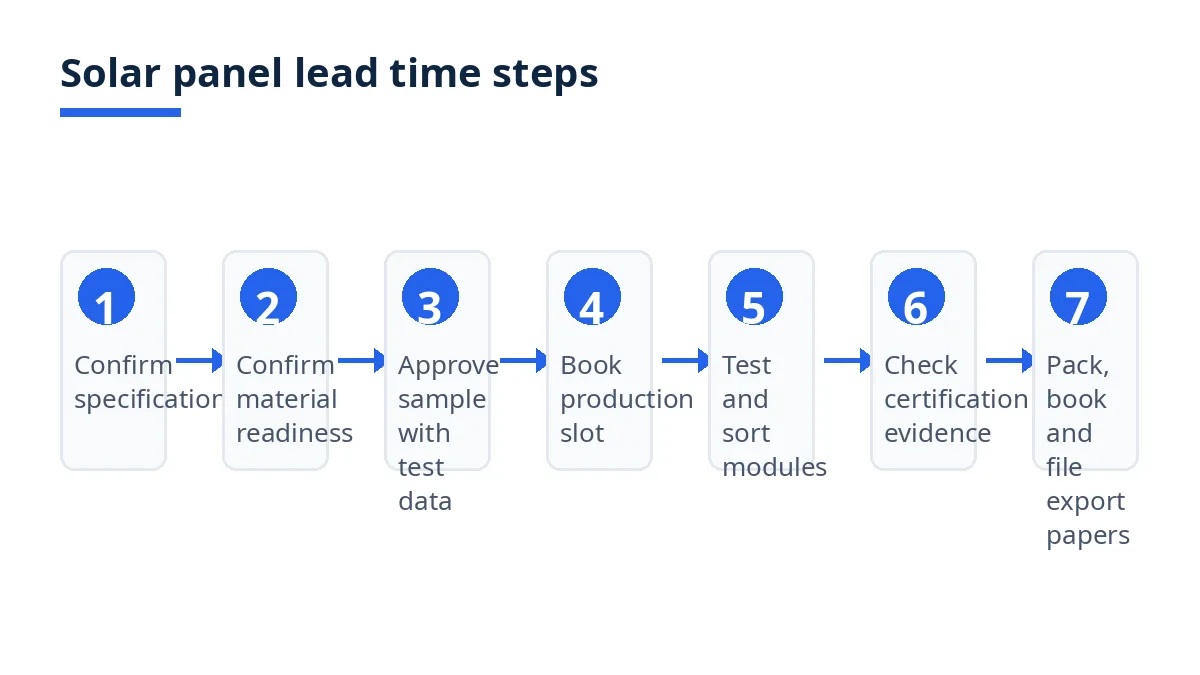
Confirm the specification in writing. State wattage and tolerance, cell type and format, dimensions, glass type, backsheet or glass-glass construction, frame, connector, and certificate scope. A lead time for a different wattage is not a lead time for your order.
Confirm material readiness line by line. Ask for a ready date for cells, glass, encapsulant, backsheet, frames, and junction boxes separately, and ask which inputs are imported. One inbound lot can hold the whole line.
Approve a sample module with its test data. Ask for the flash result, the electroluminescence image, and measured dimensions, and approve or list corrections in writing.
Book the production slot against the sample. Production runs stringing, layup, and lamination in that order, and pre-lamination inspection matters because a damaged string can still be corrected before bonding, while after lamination the correction becomes difficult or uneconomic.1
Hold the testing and sorting gate in the plan. Final testing checks the circuit by imaging, records performance on an IV tester, and checks insulation and safety paths, and modules are sorted by measured output so mismatched units do not share a string.1 Ask for the flash data file and reject rate, not only a pass statement.
Check certification evidence before packing. Match the certificate, edition year, and construction to the module quoted, and confirm any destination rule for your market.2
Agree packing, booking, and export papers together. State the pallet type, stacking method, protection, stuffing plan, and export document set, and get the booking date in writing.
Costs, timelines and documents
What are the typical costs and timelines?
There are no typical costs or timelines a guide can state as fact for solar panels from Bangladesh, because each supplier prices your wattage, cell format, glass and frame construction, order size, packing, and delivery term, and each line sets its own slot. The Incoterms 2020 rules give a clear allocation of cost, risk, and obligations across 11 rules, so compare quotations only on the same rule and named place.4
The table below is an illustrative example only, showing how a timeline is built from dated lines, not a promise for any order. Your supplier should replace every example range with dated lines for your specification.
Stage | Illustrative example range | What the date must cover |
|---|---|---|
Specification and sample approval | 1 to 3 weeks | Specification, sample, flash data, and imaging |
Cell and material readiness | 1 to 4 weeks | Ready dates per input, including imported lots |
Production: stringing, layup, lamination | 1 to 3 weeks | Line slot, lamination queue, and inspection |
Testing, sorting, certification evidence | 3 to 10 working days | Flash data, imaging, and certificate match |
Packing and export clearance | 3 to 10 working days | Pallet build, stuffing, and approved declaration |
Sea transit | Route dependent | Forwarder-confirmed transit for your port |
Treat any single-figure lead time with care. Ask which stage it covers, whether it starts at order confirmation or sample approval, and whether packing, testing, and export clearance sit inside it or after it.
Which documents are needed?
For export clearance in Bangladesh, goods may not be loaded or stuffed into containers unless an export declaration, the Bill of Export or Shipping Bill, is submitted to Customs and approved, and the declaration names the goods, value, exporter, foreign buyer, and transport operator.5 Enclosed documents include the export contract or purchase order where there is no export letter of credit, the commercial invoice, the packing list, the EXP form certified by an authorized dealer, and a certificate of origin issued by the EPB or a Chamber of Commerce and Industry.5
For a solar panel order, add the module-specific set, and ask for it before packing is complete:
Datasheet for the exact wattage, cell format, dimensions, and construction quoted
Flash test data file with serial numbers, plus electroluminescence results for the lot
IEC 61215 and IEC 61730 certificates naming the standard, edition year, and construction covered2
Packing list by pallet, with module count, serial range, and gross weight per pallet
HS classification: photovoltaic modules are listed at 8541.43, checked against product specifications and destination requirements before shipping6
Destination conformity or import documents for your market, confirmed before the container is booked
Bangladesh-specific rules and tips
Keep one legal name across every paper. The export declaration names the exporter and the foreign buyer,5 so the name on the trade license, quotation, proforma invoice, payment account, and packing list should match.
Ask which inputs are imported for your order. Cells, glass, encapsulant, or junction boxes bought in for your specification can set the earliest production and packing dates. Agree the inbound date per input.
Check whether a Bangladesh standard or destination rule applies. Bangladesh Customs notes that a BDS standard is mandatory for clearance of certain listed items, and that where no certificate from an accredited laboratory is available, a certificate from BSTI is necessary for those items.5 That note does not by itself make a particular BSTI certificate apply to your module, so ask the supplier and your destination broker, in writing, which standard evidence your shipment needs, before production rather than after packing.
Use a container rule that matches the real handover. For container cargo handed over at a terminal in Bangladesh, FCA, CPT, or CIP usually describe the handover more accurately than FOB, CFR, or CIF, because the container is handed to the carrier before it is loaded on board.7 State the rule, named place, and edition together, for example FCA Chattogram, Incoterms 2020, and confirm who books the container, who pays freight and insurance, and where risk passes.4
Plan the port leg as part of the lead time. Goods are loaded into containers and stuffed into the ship only after the export declaration is approved following documentary check and physical verification, and export is complete once the ship leaves the port.5 Ask for the stuffing date rather than only the sailing date.
Mistakes and red flags
What are the most common mistakes?
Accepting a single date instead of dated lines. A lead time given as one week count, with no material, production, testing, packing, and shipping lines, cannot be checked, and a slip at any gate stays hidden until the container is late.
Treating a certificate as covering any module with the same wattage. Certificates cover a defined construction and bill of materials, so a change to a backsheet or junction box must be assessed against the certificate rather than assumed to be covered.2
Skipping flash and imaging evidence to save days. Final imaging catches microcracks that a power measurement alone would pass, and IV testing records the performance supporting power classification.1 Removing those checks saves days at the factory and can cost a whole pallet at destination.
Comparing lead times on different delivery terms. The Incoterms 2020 rules allocate cost, risk, and obligations differently,4 so a shorter lead time on one rule may simply end earlier, at the factory gate rather than on board. Compare only quotations on the same rule and named place.
Leaving packing until production ends. Modules are fragile glass products, and vertical stacking with separators, corner protection, and strapping is part of the shipment.3 Agree the pallet type, stacking method, and damage check before production starts.
Filing export papers after packing. Goods may not be loaded unless the Bill of Export is submitted and approved,5 so a late invoice, packing list, EXP form, or certificate of origin holds a packed container. Prepare the export set while production runs.
Paying for speed without naming what gets faster. An expedite fee that does not name a faster material lot, an earlier lamination slot, or an earlier vessel booking buys no gate. Ask which dated line moves, and by how much.
Checklist
Before you confirm, every line should be answered in writing.
Specification confirmed: wattage, tolerance, cell type and format, dimensions, glass, backsheet or glass-glass, frame, connector, certificate scope.
Material-ready dates per input, with imported cell and glass lots named.
Sample approved in writing, with flash data and imaging attached.
Production slot booked, with stringing, layup, lamination, and pre-lamination inspection agreed.1
Testing agreed: imaging, IV flash data, insulation and safety checks, power sorting.1
Certificates matched: IEC 61215 and IEC 61730, edition year, construction covered.2
Packing agreed: pallet type, vertical stacking, separators, corner protection, strapping, damage check.3
Delivery term agreed: one Incoterms 2020 rule, named place, edition, freight and insurance stated.4
Export set prepared: Bill of Export, invoice, packing list, EXP form, certificate of origin.5
HS classification confirmed at 8541.43, checked against destination requirements.6
Container booking, stuffing date, and vessel cut-off confirmed in writing.
Reject and rework rule agreed: replacement, cost, and shipping-date effect.
How Exportain helps
On Exportain, browse suppliers and post a request for quotation on the RFQ board with your full specification, the dated lines you need, and your delivery term, so suppliers quote against the same module and timeline gates. Ask each reply for material-ready dates, the production slot, flash and imaging evidence, the certificate construction, and the packing method.
Before you confirm, read how to import solar panels from Bangladesh and the solar panels quality control checklist, check the HS code for solar panels guide, and compare the solar panels MOQ guide so order size and timeline are agreed together.
FAQs
What should I know first about solar panels?
Know that the lead time is set by module gates, not a single factory figure: material readiness, stringing and layup, lamination, flash and safety testing, certification evidence, pallet packing, and shipping with customs handling. A module line runs a fixed sequence from sorted cells to strings, layup, lamination, framing, junction box fitting, and IV flash testing before final sorting.1
What are the typical costs and timelines?
There are no typical costs or timelines a buyer can rely on, because each supplier prices your wattage, cell format, glass and frame construction, order size, packing, and delivery term. The ranges in this guide are illustrative examples only. Compare quotations only on the same Incoterms 2020 rule and named place.4
Which documents are needed?
The order documents are the written specification, itemized quotation, sample approval with flash data and imaging, and purchase order with dated lines. The export set is the Bill of Export, commercial invoice, packing list, EXP form certified by an authorized dealer, and certificate of origin issued by the EPB or a Chamber of Commerce and Industry.5 Add the module set: datasheet, flash data file, IEC 61215 and IEC 61730 certificates for the construction quoted,2 pallet packing list, and HS classification at 8541.43 checked against destination requirements.6
What are the most common mistakes?
The most common mistakes are accepting a single date instead of dated lines, treating a certificate as covering a different construction,2 skipping flash and imaging evidence to save days,1 comparing lead times on different delivery terms,4 leaving glass packing until production ends,3 and filing export papers after packing, when goods may not be loaded unless the Bill of Export is submitted and approved.5
Next steps on Exportain
Browse suppliers, then post your specification, dated timeline lines, and delivery term on the RFQ board so suppliers quote against the same module gates. Before you confirm, read the Incoterms for shipments from Bangladesh guide and put one rule, named place, and edition on every quotation.
Sources
- Solar Panel Production Line — Cells to Finished Modules. Ooitech (accessed )
- IEC 61215 vs IEC 61730: What Each One Actually Proves. Ooitech (accessed )
- Delivering the future: shipping solar panels safely and efficiently. DHL (accessed )
- Incoterms® 2020. International Chamber of Commerce (ICC) (accessed )
- Customs Clearance Procedures for Export. Bangladesh Customs, National Board of Revenue (accessed )
- Solar Products in Egypt: Know Your HS Code Before You Ship. SGS (accessed )
- Incoterms for Shipments From Bangladesh. Exportain (accessed )
- export documents
- supplier verification
- buyer guide
- Bangladesh sourcing
- Solar panels
- Solar panel standards
- Lead time
About the author
Sourcing from Bangladesh?
Post a request for quotation and suppliers on Exportain can send you their quotes directly.
Post an RFQ


