

Typical MOQ for Solar Panels in Bangladesh (and How to Negotiate It Down)
No single solar panels MOQ in Bangladesh: what sets the minimum per wattage, pallet and container, how certification limits the offer, and how to negotiate or structure a smaller order.
Short answer
There is no single typical MOQ for solar panels from Bangladesh. Each supplier sets its minimum for your wattage and construction, usually per wattage class and per pallet or container load rather than for the order as a whole. Ask for the minimum in panels, pallets and kilowatts in writing, then negotiate the structure: fewer wattages, one shared construction, and set-up or certification costs priced apart from the unit price.

On this page
Key takeaways
There is no single typical MOQ for solar panels from Bangladesh, because each supplier sets its minimum per wattage and construction, per pallet or container load, rather than for the order as a whole.
Ask for the minimum in panels, pallets, and kilowatts for your wattage, because a minimum in one unit is not comparable with a minimum in another until all three are converted.
An IEC certificate covers a defined construction and bill of materials, not a module in general, so a wattage or component change outside that construction needs assessment against the certificate.
Negotiate the structure first: fewer wattages, a stocked wattage, whole pallets, and set-up, testing, or certification costs priced apart from the unit price.
Exportain verification is a document and photo review, not a factory inspection, and a badge is not a guarantee.
Ask several suppliers for the solar panels MOQ in Bangladesh for the same wattage and you will get different answers. There is no single typical MOQ for solar panels from Bangladesh, because each supplier sets its minimum for your wattage and construction, usually per wattage class and per pallet or container load rather than for the order as a whole.
The MOQ is not a number to look up and compare. It is a structure built from the unit the supplier counts in, the wattage classes you ask for, the construction the module is certified in, and the pallet and container quantities the shipment fills. Change the structure and the minimum changes.
Why this matters for buyers and sellers
What should I know first about solar panels?
Start with the unit. A solar panel order can be counted in panels, in pallets, in containers, or in kilowatts of capacity, and a supplier may quote in any of them. A minimum stated in kilowatts is not the same offer as a minimum stated in panels, because the panel count behind a kilowatt total depends on the wattage you choose. Ask every supplier to state the minimum in all three units for your wattage: panels, pallets, and kilowatts.
Wattage classes multiply the minimum. Each wattage is its own product variant, with its own cell string layout, glass size, frame, and packing pattern. A supplier cannot treat a second wattage as part of the same minimum, because the run, the packing, and the test data change with it. State the wattage of every line in your enquiry, and ask whether the minimum applies per wattage or across wattages combined.
Construction and certification travel together. IEC 61215 is the performance and reliability qualification for a module, covering environmental durability, mechanical strength, and retention of electrical performance, while IEC 61730 is the safety qualification, covering construction requirements and tests for electrical insulation, mechanical hazards, and fire behaviour.1 Neither certificate implies the other, and a certificate covers a defined construction and bill of materials rather than a module in general.1 Ask which construction each certificate covers, and whether your wattage and variant sit inside it.
Pallets and containers set a second floor. Panels are packed, handled, and shipped in pallet quantities, and pallets fill containers. A quantity that is not a whole number of pallets can carry repacking or part-load handling. Ask for the panels per pallet and the pallets per container for your panel size, and whether the quoted minimum is a pallet, container, or production quantity.
Classification and destination rules sit underneath the price. Photovoltaic modules are listed at HS 8541.43 in SGS guidance on solar product classification, with inverters listed separately at 8504.40.2 That classification should be verified against the product's technical specifications and the destination's requirements, because the HS code alone does not establish all conformity or import obligations.2 Ask the supplier to confirm the classification it will declare, and ask your customs broker which conformity documents your market requires.
For the buyer, the MOQ decides how much capital sits in stock and whether a first order can test a wattage before a larger repeat. For the seller, the minimum protects the run: inputs bought or cut for your wattage and construction cannot be sold to another buyer unchanged, and a short run still uses the set-up, the packing pattern, and the test sequence.
Two controls keep the negotiation grounded: an inspection plan agreed before production, and one delivery term for every quotation. ISO 2859-1 defines a system of acceptance sampling plans for inspection by attributes, indexed by acceptance quality limit (AQL) for lot-by-lot inspection.3 The Incoterms 2020 rules provide 11 rules with a clear allocation of cost, risk, and obligations.4
Step-by-step: how it works
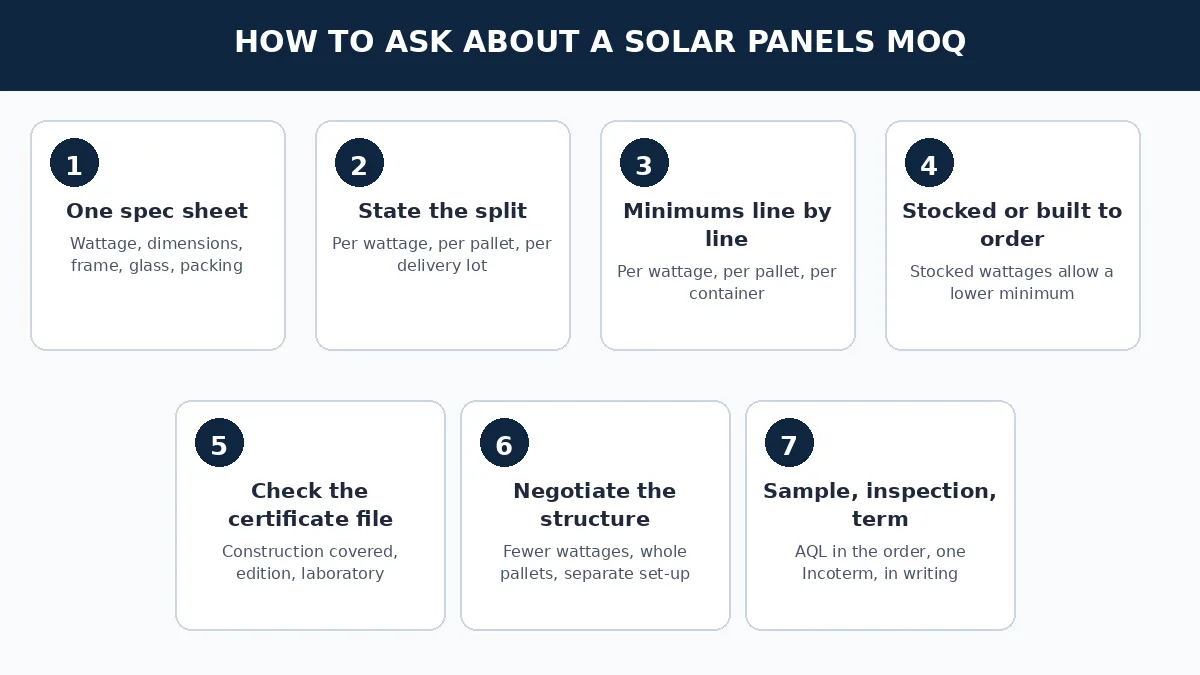
Send one specification sheet to every candidate. State the wattage, module dimensions, frame and glass requirements, junction box and connector type, backsheet type, packing requirement, and destination market, with the quantity in panels, pallets, and kilowatts.
State the split, not only the total. Give the quantity per wattage, per pallet pattern, and per delivery lot. A total without a split cannot be answered with a usable MOQ.
Ask for the minimums line by line. Ask for the MOQ per wattage, per pallet, and per container, and which line is binding for your split. Ask whether a minimum in kilowatts converts to a whole number of pallets at your wattage.
Ask what is stocked and what is built to order. Record whether your wattage and construction are stocked, assembled from stocked components, or built to order.
Check the certificate file before you negotiate price. Ask for the standard number and edition year, the parts covered, the construction and bill of materials the certificate covers, and the laboratory behind the test report.1
Negotiate the structure, not the number. Get the result in writing, on the quotation and the purchase order, with the split it applies to.
Approve samples and agree inspection and delivery term before you confirm. Order a sample in your actual wattage and construction, check it against the datasheet, and approve or list corrections in writing. Write the inspection level and AQL values into the purchase order, following ISO 2859-1,3 and state one Incoterm and named place for every quotation.4
Reduce the number of wattages first. Wattages multiply production runs, packing patterns, and certificate scope. Cutting one wattage raises the quantity per remaining wattage at the same total, and that alone can clear a per-wattage minimum that the split version missed.
Pay set-up, testing, or certification as a separate line. Where the floor comes from a test sequence, a certificate file, or a packing pattern, ask for those costs apart from the unit price. The run can then be shorter, and the same file serves the repeat order. Record which lines you have paid for, so you do not pay them twice on the repeat.
Order in whole pallets and whole containers where you can. A quantity rounded up to whole pallets removes part-load handling, and a full container load removes consolidation.
Stage the order. If the supplier cannot move on the first order, place a smaller first order in fewer wattages, with a written repeat price and MOQ for the same specification.
Costs, timelines and documents
What are the typical costs and timelines?
There are no typical costs or timelines a guide can state as fact, for the same reason there is no typical MOQ. Each supplier prices your wattage, construction, packing, test and certificate file, and the delivery term you choose.4 A price quoted per panel and a price quoted per watt are not comparable until both are converted to the same unit for the same wattage, so ask for both figures on every quotation.
Example figures: a buyer orders 1,000 panels at 600 watts each, which totals 600 kilowatts, and a second buyer orders 1,000 panels at 500 watts each, which totals 500 kilowatts. The panel counts match and the kilowatt totals do not. The example shows structure only, not a typical MOQ, price, or lead time.
For timelines, sampling depends on component availability and correction rounds, and bulk production on the run, packing, testing, and loading. Ask for sampling, production ready, inspection, and loading dates as separate lines.
Which documents are needed?
For export clearance in Bangladesh, goods may not be loaded unless an export declaration, the Bill of Export or Shipping Bill, is submitted to Customs and approved.5 Enclosed documents include the export contract or purchase order where there is no export letter of credit, the commercial invoice, the packing list, the EXP form certified by an authorized dealer, and a certificate of origin issued by the EPB or a Chamber of Commerce and Industry.5
For the order itself, ask for the datasheet for your exact wattage and construction, the IEC 61215 and IEC 61730 certificate details for the construction quoted,1 the packing specification showing panels per pallet, and the test and inspection reports agreed in the purchase order.
Bangladesh-specific rules and tips
Keep one legal name across every paper. The export declaration names the exporter and the foreign buyer,5 so the name on the trade licence, quotation, proforma invoice, and payment account should match.
Confirm what the domestic market means for your allocation. Bangladesh updated its net metering guidelines for 2025 to support rooftop solar, allowing 100 percent of the sanctioned load for net-metered rooftop solar, compared with 70 percent in the past.6 A supplier that also serves the domestic rooftop market may have competing demand for the same wattage, so ask in writing whether your export quantity is allocated from a production run or from stock.
Confirm association and registration claims at the source. If a supplier claims membership of a trade body or holds an Export Registration Certificate, confirm it with the issuing body. On Exportain, Export Verified means Exportain has checked the Export Registration Certificate, and that check is a document review, not a factory inspection.7
Ask which inputs are bought in for your order. Glass, frames, junction boxes, and connectors may be bought in for your wattage and construction, and a bought-in component can set both the minimum and the earliest production date. Agree the component list before production, so a component change does not quietly change the certified construction.1
Mistakes and red flags
What are the most common mistakes?
Asking for a total MOQ only. The binding minimum is usually per wattage, per pallet, or per container. An order can clear the total and still fall below the per-wattage minimum for one line.
Mixing units across quotations. A minimum in kilowatts, a minimum in panels, and a minimum in pallets are three different offers until all three are converted for the same wattage.
Comparing MOQs on different wattages or terms. A lower minimum on a different wattage, a different construction, or a different delivery term is a different offer. Compare only replies to the same specification sheet on the same Incoterm.4
Assuming a certificate covers your variant. A certificate covers a defined construction and bill of materials.1 A change outside that construction needs assessment against the certificate, not an assumption.
Accepting a verbal exception. Record any agreed lower minimum, shared construction, combined-lot quantity, or waived set-up on the quotation and purchase order, with the split it applies to.
Treating a profile or a badge as verification. A badge is not a guarantee of production capacity, product quality, or delivery.7 Verification on Exportain is a document and photo review, not a factory inspection.8
Skipping inspection to save time. Sampling under ISO 2859-1 checks a lot against an agreed AQL,3 the last control before the goods become your stock. A short run has the same defect risk per panel as a long one, so a smaller order is not a reason to skip it.
Checklist
Before you confirm, every line should be answered in writing.
Specification sheet sent: wattage, dimensions, frame, glass, junction box, connector, backsheet, packing, destination market.
Split stated per wattage, per pallet, and per delivery lot, in panels, pallets, and kilowatts.
MOQ confirmed per wattage, per pallet, and per container; binding line named.
Wattage status per line recorded: stocked or built to order.
Certificate file checked: standard number and edition, parts covered, construction covered, laboratory named.1
Set-up, testing, and certification costs itemized apart from the unit price; paid lines recorded.
Sample in the actual wattage and construction checked against the datasheet and approved in writing.
Inspection level and AQL values in the purchase order.3
Quotations compared on the same specification, unit, and Incoterm.4
Export set agreed: invoice, packing list, EXP form, certificate of origin, Bill of Export.5
How Exportain helps
On Exportain, browse suppliers and post a request for quotation (RFQ) on the RFQ board with your specification sheet, split per wattage, and delivery term, so suppliers quote against the same wattage and construction. Ask each reply for its minimum in panels, pallets, and kilowatts, and for the certificate construction it covers. When you accept a quotation, Exportain creates one order and issues one proforma invoice from the accepted terms.7 See how supplier verification works on Exportain.
Read the badges for what they record. Exportain Verified means Exportain has checked identity, phone, email, and business registration, and Export Verified means it has checked the Export Registration Certificate (ERC).7 Factory Verified means it has reviewed photos of the manufacturer factory, while Trading Company Verified means it has reviewed photos of the trading company office or warehouse.7 Verification is a document review by staff, free, and never granted by membership plans.8 It is not a factory inspection,7 8 so sample approval, certificate checks, and inspection stay with you.
FAQs
What should I know first about solar panels?
There is no single MOQ to look up. The minimum is set per wattage and construction, by the unit the supplier counts in, the pallet and container quantities, and the certificate file for that construction. Photovoltaic modules are listed at HS 8541.43 in solar classification guidance, and that classification should be verified against the product's technical specifications and the destination's requirements.2
What are the typical costs and timelines?
There are no typical figures a buyer can rely on, because each supplier sets its price, MOQ, and lead time for your wattage and construction. The wattage, construction, packing, certificate file, and delivery term drive the price,4 and component availability, production, packing, testing, and loading drive the timeline.
Which documents are needed?
The order documents are the specification sheet, itemized quotation, and purchase order, with the MOQ per wattage and per pallet on both, plus the datasheet and the IEC certificate details for the construction quoted.1 The export set is the Bill of Export, commercial invoice, packing list, EXP form certified by an authorized dealer, and a certificate of origin issued by the EPB or a Chamber of Commerce and Industry.5
What are the most common mistakes?
The most common mistakes are asking only for a total MOQ, mixing panels, pallets, and kilowatts across quotations, comparing minimums on different wattages or terms,4 assuming a certificate covers a variant outside its construction,1 and accepting a lower minimum verbally.
Next steps on Exportain
Browse suppliers, then post your specification sheet, split per wattage, and delivery term on the RFQ board so suppliers state their MOQ in panels, pallets, and kilowatts. Before you confirm, read how to import solar panels from Bangladesh and the MOQ definition guide.
Sources
- IEC 61215 vs IEC 61730: What Each One Actually Proves. Ooitech (accessed )
- Solar Products in Egypt: Know Your HS Code Before You Ship. SGS (accessed )
- ISO 2859-1:2026 - Sampling procedures for inspection by attributes — Part 1: Sampling schemes indexed by acceptance quality limit (AQL) for lot-by-lot inspection. ISO (accessed )
- Incoterms® 2020. International Chamber of Commerce (ICC) (accessed )
- Customs Clearance Procedures for Export. Bangladesh Customs, National Board of Revenue (accessed )
- Bangladesh revises net metering rules to expand solar. pv magazine (accessed )
- Trust & Safety Center. Exportain (accessed )
- Supplier verification: Earn trust badges buyers can see. Exportain (accessed )
About the author
Sourcing from Bangladesh?
Post a request for quotation and suppliers on Exportain can send you their quotes directly.
Post an RFQ


