Top Socks Manufacturers in Bangladesh: How to Find and Verify Them
Bangladeshi sock supply is organised by factory type, not by ranking: seven types, what each suits, what drives price and MOQ, and how to verify each one before ordering.
Short answer
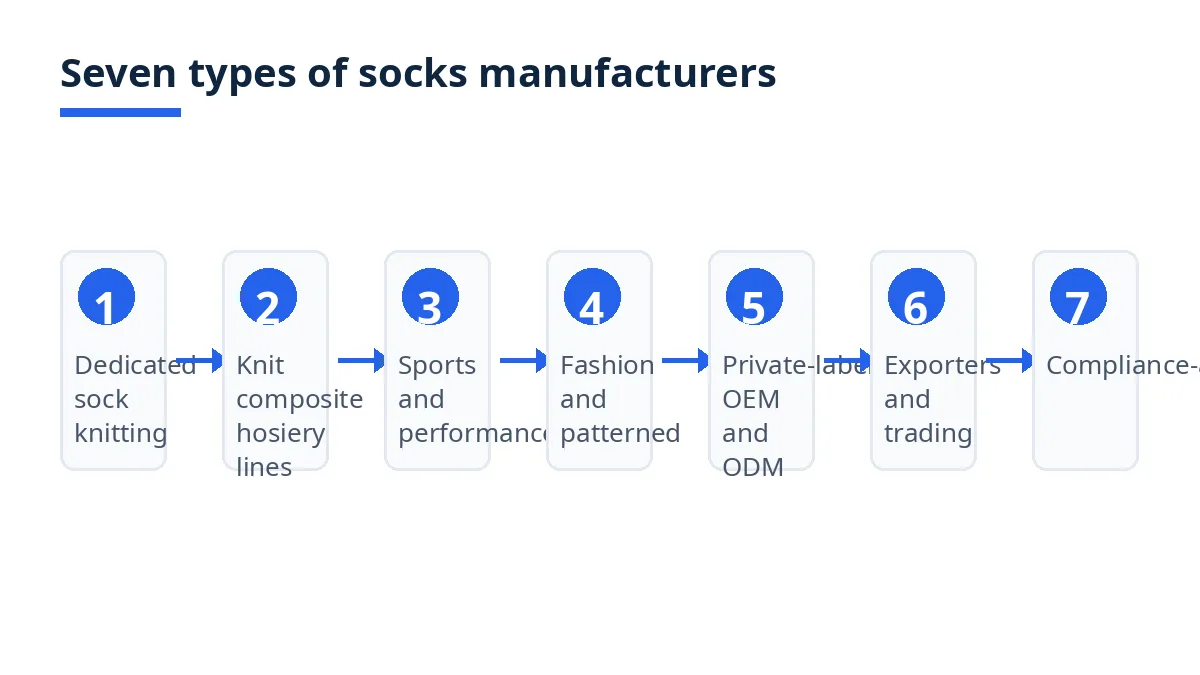
Socks manufacturers in Bangladesh fall into seven types: dedicated sock-knitting factories, knit composites with hosiery lines, sports and performance specialists, fashion and patterned makers, private-label OEM and ODM suppliers, exporters and trading companies, and compliance-audited factories. Match the type to your sock, yarn and size curve, then verify membership, documents, a washed sample and inspection terms before paying.
On this page
Key takeaways
Socks are machine-knitted on circular sock machines, so machine gauge, yarn and finishing decide what a factory can make; a sewing factory without sock machines cannot make your socks.
Sizing is by foot length and size curve, not body size, and the failure points are narrow and testable: heel and toe wear, toe-seam comfort, elastic hold after washing, colour fastness and pair matching.
Socks sit in heading 6115, knitted or crocheted hosiery, inside a knitwear sector where BKMEA represents approximately 2,540 member factories.
Price and MOQ are set per style: yarn, gauge, colour count, size curve and packing move the quote more than location does.
Verification is a sequence the buyer runs: association membership, document review, a washed sample in production yarn, and an agreed AQL inspection before payment.
Start from the sock program, not from a factory list. Cushioned hiking socks, thin patterned dress socks and printed promotional socks for an event are different products, even though all three orders say socks on the purchase order. Each program needs a different machine gauge, a different yarn, a different heel and toe build, and a different packing method. A mismatch shows up late: a dress-sock machine cannot knit a thick cushioned sole.
The machine decides the product in a way that has no parallel in cut-and-sew knitwear. A sock takes shape while it is knitted on a circular sock machine, with the heel pocket and the toe formed as part of the tube, and the toe then closed by linking, the sock washed and boarded into shape, and pairs matched before packing. Yarn count, needle gauge, cuff elasticity and the linking method are therefore fixed at the knitting stage, not corrected later. Sewing skill cannot compensate for the wrong sock machines.
Bangladesh offers a deep knitwear base to draw on. Export Promotion Bureau figures reported in the press put knitwear exports at US$5.963 billion in the first quarter of fiscal 2026-27, up 6.88 per cent on the same quarter a year earlier.1 The Bangladesh Knitwear Manufacturers and Exporters Association (BKMEA) states that it represents approximately 2,540 member factories in the knitwear sector.2 For tariff purposes, socks sit under heading 6115, which covers pantyhose, tights, stockings, socks and other hosiery, knitted or crocheted, with cotton and synthetic-fiber socks classified separately.3 This guide sorts that base into seven factory types.
Key points to take away
Order by program first: sports, workwear, fashion, promotional and everyday multipacks each point to a different factory type.
Gauge, yarn count, heel and toe build, toe-linking and cuff elasticity are set during knitting; confirm them against the machine.
Sock sizing runs on foot length and on the shape of the size curve, so a sample approved in one size says little about the smallest and largest sizes.
Testable defects are small: heel and toe thinning, an irritating toe seam, elastic slackening after washing, color migration, and mismatched pairs.
Checking a supplier means working through registration, machine evidence, a washed sample in bulk yarn, and written inspection and payment terms, in that order.
The list: socks manufacturers in Bangladesh by type
Read the seven types as a matching exercise: a supplier that fits a fashion program may be wrong for heavy workwear. Judge on production evidence: machines on the floor, yarn in use, washed samples.
1. Dedicated sock-knitting factories
These factories knit socks as their core business on circular sock machines, turning out leg, heel and toe as one shaped piece before linking, washing, boarding and pairing. Everyday multipacks, school and uniform socks, and plain ribbed styles in volume are the natural programs here, along with repeat orders where the same sock must look and feel identical six months later. Before committing, ask the factory to name the gauge it would run for your sock weight and to show the boarding forms that cover your full size range. Insist the approval sample is knitted in bulk yarn, wash it several times, and measure heel thickness, cuff hold and length against your foot-length chart.
2. Knit composite groups with hosiery lines
Some large knit groups run hosiery lines inside a wider knitwear operation, with dyeing and finishing capacity on the same site or within the same group. For a buyer, the attraction is continuity: the same dye-lot logic and color standards can carry across seasons, and a sock program can sit beside a wider knitwear order from one supplier group. That continuity only helps if the hosiery line has its own sock machines, boarding equipment and packing benches. In discussion, separate the sock stages from the garment stages: ask which steps for socks happen in-house, which steps go to outside units, and what happens to your order if an outside dye unit is busy, and record the answer in the order correspondence.
3. Sports and performance sock specialists
Performance makers build their production around socks that must stay put and keep their shape through movement and repeated washing: cushioned soles for running and hiking, arch bands that hold the sock on the foot, mesh panels for ventilation, and yarn blends chosen for moisture handling. Sports, outdoor, running and heavy workwear programs belong here. Testing must go beyond looking at the sample: wear it through a full day, wash it repeatedly, and check whether the cushioning compresses flat, whether the arch band still grips, whether the heel pocket stays in place, and whether the cuff holds without cutting into the leg. Ask which yarn blends and cushion constructions the factory already runs monthly, not which it could source.
4. Fashion, patterned and dress sock makers
This type exists for appearance-led programs: jacquard and intarsia motifs, stripes, embroidered detail, novelty graphics and fine dress socks where the design carries the sale. The skill here is pattern control across sizes: a motif programmed for a medium foot can distort at the ends of the size curve, and pattern yarns must match after washing. Approval needs a sample showing the complete pattern repeat in the smallest, middle and largest sizes, not a single medium sample. After washing, check shade change across pattern yarns and that the motif still sits as designed. Settle ownership of the pattern files and grading data in writing before production, so a later change of supplier does not strand your artwork with the first factory.
5. Private-label OEM and ODM sock suppliers
Private-label suppliers organize their work around the buyer's brand. Under an original equipment manufacturing (OEM) arrangement, the factory knits to the buyer's tech pack; under an original design manufacturing (ODM) arrangement, the factory offers its own developed styles and size curves for the buyer to brand. For OEM orders, the tech pack must cover yarn composition and count, gauge, heel and toe construction, toe-linking, cuff, a size chart by foot length, labeling and packing. Judge the counter-sample against that document line by line. For ODM orders, confirm that the styles on offer are the supplier's own developed range, check the size curve behind each style, and agree in the order terms who owns any pattern or grading files created for your brand.
6. Exporters and trading companies
Trading companies hold export licences and sell socks knitted in partner factories, pooling capacity across several plants and handling documentation and shipment for the buyer. They suit mixed orders, small quantities, and buyers wanting one contract. The trade-off is distance from the machines: the seller is not necessarily the knitter. Name the producing factory for each style in the order terms before any deposit moves, and ask what happens if that factory is full or rejects the style. A strong export record proves the trader can ship, not that a particular partner factory can knit your gauge or hold your color. Arrange inspection at the producing factory, and keep its name on every specification and packing instruction.
7. Compliance-audited factories
Some factories carry current audits or certifications under schemes their buyers require. BGMEA lists the frameworks used to assess factories in Bangladesh, including BSCI, WRAP, SMETA, ICS, the Higg Index, ZDHC, GOTS and OEKO-TEX.4 They suit retail chains and US or EU programs imposing a code of conduct, chemical limits or fiber claims, such as organic cotton socks. Treat every certificate as a document with a boundary: confirm the certificate number directly with the issuing body, check that the factory address printed on it is the site that will knit your socks, and read the expiry date, the standard named, and the product scope it covers. A certificate image on a profile page proves nothing until the issuer confirms it
Summary table
Type | Suits best | Deciding check |
|---|---|---|
Dedicated sock-knitting factory | Everyday volume, even sizing | Gauge named, sample washed |
Knit composite with hosiery lines | Repeat color programs | Sock stages in-house, in writing |
Sports and performance specialist | Athletic, outdoor, workwear | Wear and wash test, cushioning held |
Fashion and patterned maker | Dress, gift, novelty | Full pattern repeat, all sizes |
Private-label OEM / ODM | Own-label brands, retailers | Tech pack match, file ownership |
Exporter / trading company | Mixed orders, single contract | Producing factory named |
Compliance-audited factory | Retail codes, fiber claims | Issuer confirmation, scope, expiry |
What drives price and MOQ for socks
Compare quotations line by line: the cheapest headline figure often reflects thinner yarn, machine toe linking instead of hand linking, or lighter packing. Yarn usually forms the largest share: cotton, wool, bamboo and synthetic blends sit at different prices, and elastane content, yarn count and any certified fiber move the figure further. Gauge matters in parallel, since a finer gauge packs more stitches into each sock and runs slower than a coarse gauge, raising machine time per pair. Colour count adds setup and yarn-lot cost for every colorway, and the size curve adds boarding forms and pairing work across the range. Quantity spreads fixed costs, such as pattern programming, dye lots and machine setup, across more pairs, so unit price falls as volume rises, and each style and color normally carries its own minimum. Packing is priced apart: banded pairs, header cards, dozen inner boxes and barcoding each add cost. Ask every shortlisted supplier to quote the identical specification, delivery term and packing, then query any line that diverges instead of accepting the total. The guide to MOQ in the supply chain explains how minimums behave across a range of styles and colors.
How to verify a supplier before you pay
Work through the checks cheapest first; a later step never excuses an earlier failure.
Start with registration and documents
A knitwear exporter should appear in BKMEA or BGMEA member records, and BGMEA operates a member search on its own site.2 Registration shows the company exists inside the trade; it says nothing about its sock machines, so treat it as an opening filter. Also collect the trade licence, Export Registration Certificate (ERC) and recent factory photographs, checking names and addresses agree. Exportain publishes its own description of the checks behind its profile badges, which is worth reading before giving any badge weight in your decision.5
Prove the machines
Ask for the machine list by gauge, the number of machines that would run your style, and the dyeing, boarding and pairing capacity that supports them. Floor photographs of sock machines, boarding forms in your sizes and a dozen-packing bench outweigh a catalogue page. Where a supplier subcontracts dyeing or boarding, find out which unit does it and whether your order can be inspected there.
Test a washed sample in bulk yarn
Approve a pre-production sample knitted from bulk yarn, not from sample yarn, and put it through several washes before signing it off. Measure it against your foot-length size chart in the smallest, middle and largest sizes, try it on, and check heel and toe wear, toe-seam comfort, cuff hold, color fastness and pair matching. Keep one sealed pair as the shipment reference.
Fix inspection and payment terms in writing
Set the acceptance quality limit (AQL) and the inspection level before production begins. ISO 2859-1 specifies sampling schemes indexed by AQL for lot-by-lot inspection, giving an inspector a published rule for accepting or rejecting a shipment.6 The socks quality control checklist converts that standard into sock-level checks. Agree inspection point, shipment conditions and payment sequence in the order terms, keeping every change in the same thread.
How Exportain helps
Exportain operates as a marketplace for sourcing from Bangladesh, where buyers can search supplier listings and send a request for quotation (RFQ) with their specification, quantity, destination and delivery term.7 Use the listings and RFQ thread to record your specification, factory name and agreed terms, and run the checks above on any shortlist.
FAQs
What is the biggest mistake?
Choosing on headline price before matching the program to the factory type. A bulk line, a trader quoting a partner factory and a performance specialist are different offers; the cheapest may quote a different sock from the one specified.
How can I avoid it?
Write one specification covering yarn and count, gauge, heel and toe construction, toe-linking, cuff, size chart by foot length, labeling and packing, and send it unchanged to every supplier. Name the producing factory in the order terms, approve a washed sample across the size range, and set the inspection level in writing before production.
Who is responsible?
Responsibility splits at the specification: the factory knits to the agreed specification and sealed sample; the buyer writes a measurable specification and inspects against it before accepting.
Where can I get help?
Use three separate sources, and do not let one stand in for another: the association listings for registration, the certificate issuer for any audit or fiber claim, and an inspection provider for the pre-shipment check.4 For the platform side, read the Exportain guide to how supplier verification works before relying on any profile badge.
Next steps on Exportain
Look through Bangladeshi suppliers with your program in mind and shortlist by factory type, not headline price, then run the machine and washed-sample checks. Then post a free RFQ carrying your full sock specification, size curve and packing, and compare the quotations line by line. The importing-socks guide follows the ordering and shipping stages after the supplier is chosen.
Sources
- Merchandise exports rise 6.34pc to $13.09b in Q1 FY27: EPB. The Financial Express, (accessed )
- BKMEA at a Glance. BKMEA (accessed )
- HS heading 6115: hosiery, knitted or crocheted. GOV.UK (accessed )
- BGMEA | Home. Bangladesh Garment Manufacturers and Exporters Association (BGMEA) (accessed )
- Supplier verification: Earn trust badges buyers can see. Exportain (accessed )
- ISO 2859-1:2026 — Sampling for Inspection by AQL. American National Standards Institute (ANSI) (accessed )
- How to source and buy from Bangladesh. Exportain (accessed )
About the author
Sourcing from Bangladesh?
Post a request for quotation and suppliers on Exportain can send you their quotes directly.
Post an RFQ