Quality Control Checklist for Socks From Bangladesh
A numbered QC checklist for socks from Bangladesh: measurements including heel, toe and cuff points, workmanship, stretch checks, labels, pairing and packing, with fixes for common failures.
Short answer
Use this socks quality control checklist to check quantity, measurements, toe closing, heel and cuff formation, color, labels, pairing and packing on socks from Bangladesh before shipment. Inspect against the approved sample, tech pack and purchase order, agree AQL acceptance numbers in advance, and record actual measurements and defect photographs for every failure.
On this page
Key takeaways
Inspect against the approved sample, tech pack and purchase order, and agree the sampling plan and AQL acceptance numbers before the inspection day.
Measure every size, and check foot, leg, cuff, heel and toe points, comparing the two socks in each pair against each other.
Test cuff recovery and stretch on the sample, and confirm color fastness and other test reports cover this production lot.
Check fiber and care labels against the destination market wording before cartons are sealed, and recount a sample of cartons against the packing list.
Use this socks quality control checklist before a shipment of crew, ankle, knee-high, sports or dress socks leaves Bangladesh. Socks pass through knitting, toe closing, boarding, pairing and packing, and a fault at any step reaches the wearer: a rough toe seam rubs, a slack cuff slides down, a mismatched pair is unsellable. Work through quantity, measurements, workmanship, function, labeling and packing against the approved sample, tech pack and purchase order. Sampling should follow an agreed plan rather than pairs the factory selects. ISO 2859-1 defines AQL-indexed sampling schemes for lot-by-lot inspection, so buyer and supplier can agree sample size and acceptance and rejection numbers in advance.1
Why this checklist matters
A general garment inspection will miss the failures that matter most in socks: mismatched pairs, open or ridged toe closings, heels formed off center, cuffs that do not recover, thin places at the heel and toe, and shade differences within a pair. These appear only when pairs are opened, measured flat, stretched lightly and compared side by side.
Faults found at a final inspection can still be sorted, re-paired, reworked or replaced while cartons are open. Found by customers, the same faults become returns, claims and lost repeat orders.
Before you start
Do not start until the reference documents are on the table.
Approved sample, sealed or clearly identified, as the standard for color, hand feel, construction and finish.
Tech pack and measurement specification, with the size chart, the points of measure for socks and your contract tolerances. Measure against these figures, never against a previous order.
Purchase order and packing instructions: sizes and ratios, colors, fiber composition, pairing method, bands or tags, inner packs, carton specification and shipping marks.
Agreed inspection plan. Confirm sampling and acceptance criteria before the inspection day, using the AQL approach described above.1 Agree which defects count as critical, major and minor. Any AQL level or tolerance used is a value agreed in your contract or order, not a universal figure for all socks orders.
Tools: a flat board, a flexible tape or ruler, neutral lighting, a camera for defect photographs, and record forms.
Goods should be finished, boarded and substantially packed before a final inspection begins. Draw the sample from top, middle and bottom cartons and from every size and color.
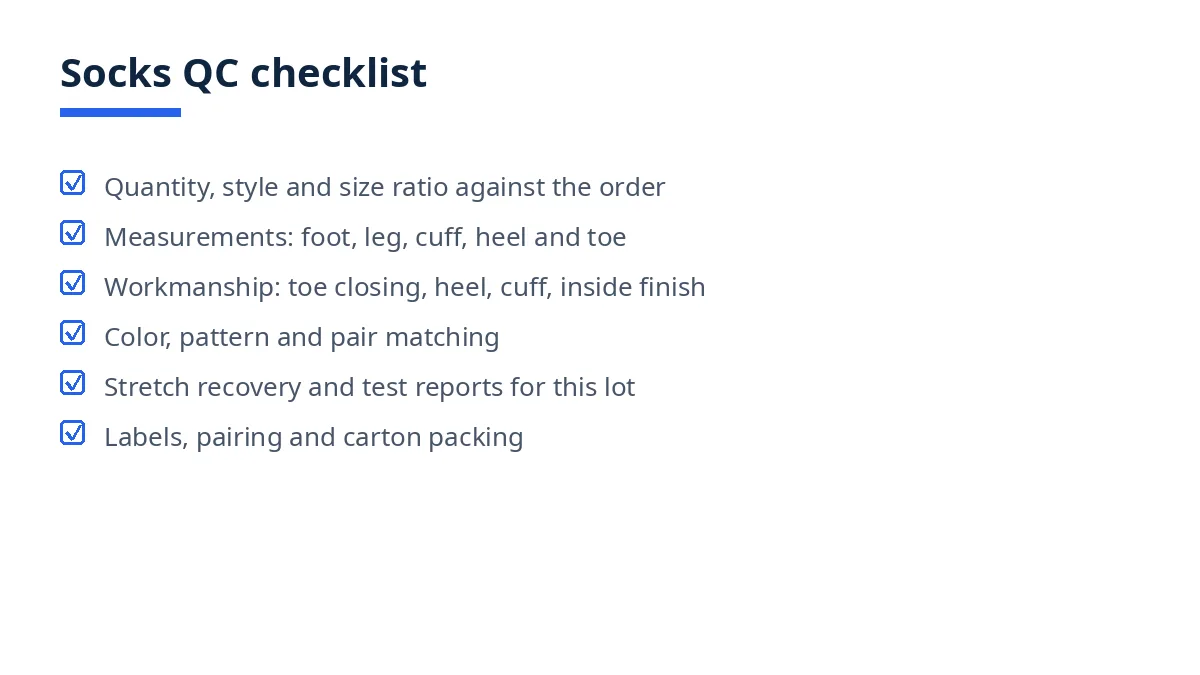
The full checklist
Record pass, fail and quantities found for each item, with a photograph for every failure.
Quantity and style
Style, construction and size range match the purchase order and the approved sample.
Total pairs reconcile with the order quantity; record any shortage or overage before sealing.
Size and color ratios in the sample match the order, with no size or color missing.
Measurements
Measure foot length on sampled pairs for every size, flat, relaxed and unstretched, and record the actual value against the tech pack tolerance.
Measure leg length from the top of the cuff to the heel turn, and cuff or top band width, on the same pairs.
Check heel dimensions and pocket position, and confirm the toe seam sits where the approved sample shows it.
Compare the two socks in each pair for length and width. Pair mismatch is a classic socks defect that single-sock checks miss.
Record every point out of tolerance by size and color, and widen the sample before deciding whether the fault is isolated or general.
Fabric and color
Fabric composition and hand feel match the specification and approved sample, with consistent thickness across leg, heel and toe.
Color matches the approved standard under consistent lighting, with no shade variation within a pair, across the sample or between cartons.
No staining, soiling, uneven dyeing, oil marks or odor on any sampled pair.
Patterns, stripes and jacquard motifs are correctly placed, clearly defined and matched on both socks of a pair, with nothing distorted or missing.
Workmanship
No holes, dropped stitches, ladders, runs, thin places or broken yarns. Hold socks to the light and stretch lightly so hidden faults open up.
Toe closing is smooth, flat and fully closed, with no ridge, open section, puckering or loose ends.
Cuff, welt and ribbing are evenly knitted, with clean edges and consistent elasticity.
Heel is formed evenly and centered, the same on both socks of a pair.
Inside finish is clean, with no loose threads, knots or rough patches.
Boarding matches the approved sample, with no scorch marks, distortion or uneven pressing.
Functional checks
Stretch the cuff gently and release it: it should recover promptly and sit evenly, with no wavy or slack top band. Where the contract requires a laboratory figure, ISO 20932-1 sets out strip tests for fabric elasticity, including elongation, permanent deformation and elastic recovery after cycling.2
Stretch and release the leg and foot: the sock should extend and return without bagging, stitch breakage or distortion of any motif.
Rub the surface lightly and compare pilling and fiber shedding with the approved sample.
Where your contract requires color fastness testing, confirm the report covers the bulk yarn or fabric and this lot. ISO 105-C06 covers color fastness to domestic and commercial laundering, where the color loss and staining in a single test closely approximate one laundering.3
Confirm that other required test reports, such as dimensional stability after washing, relate to this lot, not an earlier order.
Labeling, pairing and packing
Every pair carries the correct size marking and the fiber and care information required for the destination market, legible and in the agreed position.
Fiber content on the label matches the actual composition. For the European Union, Regulation (EU) No 1007/2011 requires textile products to be labeled or marked with their fiber composition whenever they are made available on the market, in a form that is durable, easily legible, visible and accessible.4
For the United States, check care wording against the Care Labeling Rule at 16 CFR 423.6: care labels must be attached so they can be seen or easily found, and must state the regular care needed, including a washing or drycleaning instruction and any needed warnings.5
Pairing and presentation match the order: socks paired the agreed way, folded as specified, and any band, tag or hanger attached straight and securely without damaging the knit.
Assortment is correct: sizes, colors and pair counts per inner pack and carton match the packing list, with no mixing inside a pack. Recount a sample of cartons.
Cartons are clean, dry and strong enough for export transport, with correct markings and quantities. Open at least one sealed carton from the middle of the stack.
Goods are dry and free from damp before sealing. Socks packed with moisture can arrive with mildew or staining.
Common failures and how to fix them
Mismatched pairs usually come from pairing by eye after boarding, when socks from different lots are mixed in one bin. Re-pair by measured size from matched production, and keep lots separate.
Open or rough toe closings point to a linking or seaming problem that repeats quickly once a machine drifts. Hold affected pairs for re-linking or re-seaming where the construction allows, correct the machine setup, and sample the toe more heavily until the fault stops.
Shade difference within a pair or carton means the socks came from different dye or yarn lots. Segregate by shade, re-pair only within matching lots, and tighten lot control.
Short measurements or slack cuffs point to knitting settings, yarn or boarding problems. Measure a larger sample to establish whether the fault is isolated or general, then decide on sorting, rework or rejection. Do not approve on a promise about the next order.
Wrong labels or mixed packing are administrative errors that buyers experience as quality failures. Relabel or repack under supervision, then check a fresh sample before release.
Summary table
Use this table as the cover sheet for each inspection.
Check area | What is checked | Result recorded |
|---|---|---|
Quantity and style | Style, sizes, ratios, total pairs against the order | Shortages, overages and discrepancies |
Measurements | Foot, leg, cuff, heel and toe, every size | Actual values and out-of-tolerance points |
Fabric and color | Composition, thickness, shade, pattern placement | Pass or fail per color and lot |
Workmanship | Toe closing, heel, cuff, inside finish, boarding | Defects found by type and quantity |
Function | Cuff recovery, stretch, surface, test reports | Pass or fail with report reference |
Labeling and packing | Size, fiber and care labels, pairing, cartons | Errors found and corrected |
Keep the completed checklist, measurements and photographs with the inspection report.
How Exportain helps
Exportain connects buyers with Bangladeshi socks and knitwear suppliers, so the sample, tolerances and acceptance criteria behind this checklist can be agreed at the enquiry stage. Post your exact specification, covering sizes, composition, labeling and packing, so quotations come back against the same requirements your inspection will check. Supplier profiles show what each factory produces and which document and photo checks have been recorded for that supplier. Those checks are reviews of documents and photos, not factory inspections, and they do not replace your own inspection, testing or contract.
FAQs
When should this checklist be used?
Use it at the final pre-shipment inspection, once production is complete and most of the order is packed, so the sample comes from finished goods in all sizes and colors. A shorter version can run during production.
Who should complete it?
Your own quality staff, the supplier quality team working to your written standard, or an independent third-party inspector can complete it. Whoever completes it needs the approved sample, tech pack and agreed acceptance criteria, and must record measurements, defect counts and photographs.
What are the most common failures?
Mismatched pairs, open or rough toe closings, shade differences within a pair or carton, measurements outside the tech pack tolerance, cuffs that do not recover, and packing errors such as mixed sizes or wrong labels.
Can a third party do it?
Yes. Independent inspectors routinely carry out final inspections in Bangladesh using the buyer checklist and specification. Give the inspector your sample details, tech pack, tolerances and acceptance criteria in advance, and require a report with measurements, defect classification and photographs.
Next steps on Exportain
Set your sampling plan with the AQL acceptance quality limit explainer, time the final check with the pre-shipment inspection guide, and compare this list with the hoodies and sweatshirts quality control checklist.
Sources
- ISO 2859-1:2026 - Sampling procedures for inspection by attributes — Part 1: Sampling schemes indexed by acceptance quality limit (AQL) for lot-by-lot inspection. ISO (accessed )
- ISO 20932-1:2018/Amd 1:2021 Textiles — Determination of the elasticity of fabrics — Part 1: Strip tests. International Organization for Standardization (accessed )
- ISO 105-C06:2010 Textiles — Tests for colour fastness — Part C06: Colour fastness to domestic and commercial laundering. International Organization for Standardization, (accessed )
- Regulation (EU) No 1007/2011 on textile fibre names and related labelling and marking of the fibre composition of textile products. European Union, (accessed )
- 16 CFR Section 423.6 Textile wearing apparel — Care Labeling Rule. Legal Information Institute, Cornell Law School (accessed )
About the author
Sourcing from Bangladesh?
Post a request for quotation and suppliers on Exportain can send you their quotes directly.
Post an RFQ