

Private Label Leather Bags Manufacturing in Bangladesh: A Brand Owner's Guide
Private label leather bags from Bangladesh: brand ownership, the sampling ladder, leather and hardware lots, labelling rules, and how to check a maker before bulk production.
Short answer
Private label leather bags from Bangladesh are bags a maker produces to your specification under your brand name, with your labels and hardware marking. Before you order, settle trademark permission, artwork and plate ownership, and label terms in writing. Then approve a sealed sample, check the leather, shade and hardware lots line by line, and confirm labelling rules for your selling market before bulk production.
On this page
Key takeaways
Settle trademark, artwork, pattern and label ownership in writing before you ask for a price.
Approve a sealed sample and judge all bulk inspection against it, not against a photograph.
The binding minimum is per leather lot, shade lot, hardware finish and label run, not the order total.
Confirm label, material and care wording for your selling market before the label run is printed.
Exportain verification is a document and photo review, not a factory inspection, and a badge is not a guarantee.
Private label leather bags manufacturing in Bangladesh means a maker produces bags to your specification and under your brand name, with your labels, hardware marking and packing. You own the brand decisions, the artwork and the approved sample. The maker owns the cutting, stitching and finishing work. That split is the whole point of the arrangement. It is also where most private label orders go wrong, because the brand work is agreed in conversation and the production work is agreed in writing.
This guide is for a brand owner placing a first private label leather bag order from Bangladesh. It covers the brand decisions to settle before you ask for a price, the sampling ladder that locks the design, how leather and hardware lots set the real order size, what labels your market requires, and how to check a maker before bulk production starts.
Own the brand before you order the bags
Settle four ownership questions in writing, in the same document that will become your purchase order. First, the trademark. Decide who owns the brand name and logo, in which markets you will use them, and who may use them if the order ends. A maker who prints your logo uses your mark under your instruction. That permission should be written, limited to your orders, and revocable. If you have not yet filed for protection in your selling market, get advice from a trademark professional first, because filing and clearance rules differ by market.
Second, the artwork. Your logo files, label artwork, deboss plates, zipper pull designs and hang tag layouts are your assets. Send them as controlled files with a version number and keep the masters yourself. State in writing that plates, dies and screens made for your artwork are made for your orders only.
Third, the pattern and the moulds. A bag pattern, a cutting die and a hardware mould can each have a different owner. If the maker develops the pattern from your sketch or reference bag, state who owns the finished pattern and whether the maker may sell the same shape under another name. Photograph the reference bag from every side, record its measurements, and attach both to the agreement.
Fourth, the label stock. Woven labels, leather patches, care labels and hang tags are printed in runs of their own. Decide who orders them, who holds the balance, and who pays if a label run is larger than one order. Unused labels bearing your mark should be returned to you or destroyed, with written confirmation.
Why this matters for the brand owner and the maker
For the brand owner, private label is a bet on repeatability. The first order tests whether the second order will look the same. A change in leather shade, hardware finish or stitch colour between orders reads as a different product, even when the pattern is identical.
For the maker, a private label order carries work that a stock order does not: labels fitted, hardware matched to your finish, lining matched to your specification, packing to your carton plan. That work is set up for your order alone and cannot be sold on if you cancel. Expect the maker to protect that set-up cost in the minimum order, in a set-up charge, or in the unit price.
The difference from wholesale buying is the direction of control. In a wholesale order you choose from a maker's existing range and accept the maker's label, lining and hardware. In a private label order you specify those things, and you accept responsibility for them, including the label wording and the claim on the hang tag. See the wholesale leather bags guide for the wholesale buying mechanics this guide deliberately does not repeat.
The sampling ladder: from reference bag to sealed sample
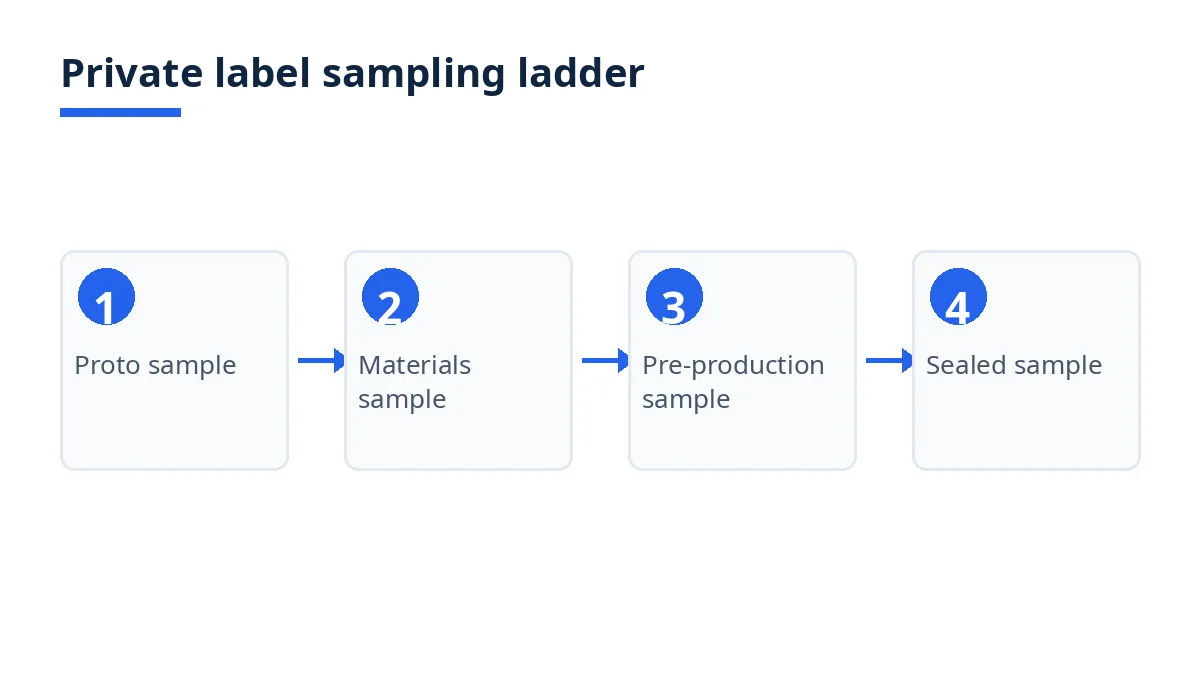
Do not approve bulk production from a photograph. Work through a sampling ladder and approve each rung in writing before the next rung starts. Skipping a rung moves its risk into bulk production, where fixing it costs far more.
The proto sample tests the shape. It is usually made in a substitute leather, or in your leather without final hardware. Its job is to confirm proportions, pocket placement, handle drop, strap length and closure position. Measure it against your specification sheet, carry it, load it, and list every correction with a measurement.
The second sample tests the materials. It should use your leather, lining, hardware finish and label. Judge shade, hand feel, edge finish and the way the hardware sits against the leather. Check the shade in daylight and keep this sample as the shade reference for the bulk run.
The pre-production sample tests the line. It is made on the production line, by the team that will make the bulk order, with the final pattern, materials, labels and packing. Inspect stitching, edge paint, hardware fixing, lining fit, label position and carton packing.
The sealed sample, sometimes called the gold sample, is the agreed standard. Both sides sign or mark it, photograph it from every side, and keep one copy each. Every later inspection compares bulk bags against the sealed sample, not against the proto and not against memory. If the sealed sample changes, issue a new version number and re-seal it.
Example figures: a ladder of four samples at a stated charge each, with two rounds of corrections, puts the sample cost at a fixed sum before bulk starts, separate from the unit price. The example shows structure only, not a typical sample charge. Agree the inspection plan while samples are being made. ISO 2859-1 defines a system of acceptance sampling plans indexed by acceptance quality limit (AQL) for lot-by-lot inspection, and AQL is the maximum average percentage of defective items considered acceptable during random sampling.1 Write the inspection level and the AQL values into the purchase order, and name who inspects and when.
Leather, hardware and colour lots decide the order size
The headline minimum in a quotation is rarely the binding one. A private label order carries several minimums underneath it, and the smallest split in your order must clear each of them. Ask for every minimum line by line, in writing, before you settle the split across colours.
The leather lot comes first. Leather is bought and dyed in lots, and a colour is usually run as one lot. If your order splits across three colours, each colour must clear its own lot minimum. A large total across colours does not help a colour that is too small to run alone. Ask whether the leather is stocked in your colour or dyed to order, and record the answer per colour.
The shade lot comes second. Leather shades vary between lots and across hides. A bag cut from two lots can show a visible shade difference between panels. Ask how the maker matches shade across a run and what tolerance applies between the sealed sample and bulk. Keep the second sample as the shade reference, judged in daylight.
The hardware lot comes third. Zips, buckles, rivets, D-rings and logo plates are finished in batches. A finish such as antique brass can vary between batches. A hardware finish that does not match the sealed sample is visible at once and cannot be fixed by re-dyeing. Ask for the hardware finish minimum per finish, and whether the finish is checked against the sealed sample before bulk assembly starts.
Lining, thread, edge paint and interlining each carry their own run. A lining dyed to your colour and a thread matched to your leather are small items with their own minimums. A short order can meet the leather minimum while falling below the lining run. Ask the maker to list which inputs sit inside the bag minimum and which sit outside it, and get the binding line named. The MOQ guide explains how minimums are structured in general. The leather, shade and hardware lots are the leather-specific form of the same problem.
Restricted substances are a lot question too. The European Union limit for chromium VI in leather articles that come into contact with the skin is 3 mg/kg, set by the regulation amending the REACH annex on chromium VI compounds.2 Ask for test evidence that names the leather and the lot tested, not a general statement about the tannery. The Leather Working Group audit covers the tannery side: its audit covers 17 sections, with Gold at 85 percent, Silver at 75 percent and Bronze at 65 percent, and certification valid for 24 months for leather manufacturing facilities.3 A tannery audit and a lot test are different evidence. One describes the tannery, the other describes your leather.
Labels and care information for the market you sell in
Your label is a legal statement as well as a brand statement. The rules that govern it are set in the market where the bag is sold, not where it is made. Confirm every label requirement with a professional adviser or your customs broker for your selling market before the label run is printed. A label error found after printing costs a full reprint and can hold a shipment.
State the brand name exactly as filed or used, the country of origin wording your market requires, and where the label sits on the bag. A label sewn into a lining seam, a leather patch on the outside and a printed care label inside a pocket each have a different job. Specify each one separately, with position, size and fixing method.
State what the bag is made of, in the wording your market requires, and make sure the statement matches the leather, lining and trim actually used. If the bag has a textile lining or textile outer parts, the fibre labelling rule that applies to textile products in the European Union requires the name and percentage by weight of all constituent fibres, in descending order.4 That rule is about the textile part, not the leather part. It is why a bag with a cotton lining needs a fibre statement that a fully leather bag may not. Do not copy a material statement from another product.
Leather care depends on the leather type, the finish and the hardware. Care wording should come from the maker and the tannery for the actual leather used, and should be checked against the sealed sample. Keep it short, specific to the leather and lining in the order, and in the language your market requires. A hang tag that claims a material, an origin or a certification must match the evidence you hold, and the claim should be no wider than the document behind it.
Costs, timelines and documents
Price a private label order on the same basis for every quotation, or the comparison will mislead you. State one delivery term, one currency, one quantity split and one specification for every maker you ask. Ask each maker to quote the same lines: leather, lining, hardware, labels and packing as separate lines where possible, sample charges as a separate line, and any set-up charge for plates, dies or moulds as a separate line.
The delivery term decides where cost and risk pass from seller to buyer. The Incoterms 2020 rules set out 11 rules with a clear allocation of cost, risk and obligations for each rule.5 Compare quotations only on the same rule and the same named place, and write the rule and the place into the purchase order.
Example figures: a first order of 300 bags in two colours, at 150 per colour, with a leather lot minimum of 150 per colour, a hardware finish minimum of 150 per finish and a label run of 300, clears each line. The same 300 bags split across four colours at 75 per colour clears no colour line, even though the total is identical. The example shows structure only, not a typical order size, price or lead time.
Timelines follow the sampling ladder, the lot runs and the label run, not the stitching time alone. Leather dyeing, hardware finishing and label printing each run on their own schedule. Ask for a timeline that names each stage: sample dates, approval dates, material ready dates, production start and finish, inspection date and shipment date.
For documents, the export side in Bangladesh follows the customs clearance procedure for export. It requires approval of the Bill of Export or Shipping Bill and an enclosed set of documents including the export contract or purchase order, the commercial invoice, the packing list, the EXP form and the certificate of origin.6 Confirm the current document list with your broker before shipment. Keep the purchase order, the sealed sample record, the test evidence and the label artwork under the same version numbers, so any document can be traced back to its order.
Classification is a separate check. Heading 4202 of the Harmonized System covers trunks, suitcases, handbags, shopping bags and similar containers, with subheadings 4202.11, 4202.21, 4202.31 and 4202.91 distinguishing articles with an outer surface of leather.7 Treat any heading for your bag as indicative and verify it against the tariff of your destination market before you quote a duty rate. See the HS code guide for leather bags for the classification structure.
Cost or time line | What to ask for | Why it decides the order |
|---|---|---|
Sample charges | Charge per sample, correction rounds, courier cost | Sampling is paid before bulk, separate from the unit price |
Set-up charges | Plates, dies, moulds, screens, itemized | Set-up paid once should not be paid again on the repeat |
Leather lot | Minimum per colour, stocked or dyed to order | A colour below its lot minimum cannot run |
Hardware finish | Minimum per finish, stock or ordered | A finish mismatch is visible and cannot be re-dyed |
Labels and packing | Label run, carton spec, who holds balance | A label error costs a reprint and can hold shipment |
Delivery term | One Incoterms rule, one named place | Cost and risk pass at the point the rule names |
Inspection | Level, AQL values, inspector, date | The plan must exist before production, not after |
How to check a maker before you commit
Check a maker in the same order you will depend on them: documents first, then samples, then production evidence.
Start with the business and export documents. Ask for the trade licence, the export registration and the documents that support the badges shown on the maker's profile. Read what each badge actually means before you rely on it. Exportain verification is a document and photo review, not a factory inspection, and a badge is not a guarantee.8 The badge tells you that documents were reviewed, not that your leather, hardware or labels were checked.
Ask about the trade body and the tannery record. The Leathergoods and Footwear Manufacturers and Exporters Association of Bangladesh is the trade body for the export-oriented leather footwear and leather goods industry, with over 300 members.9 Membership is a starting point, not evidence about a specific maker. Ask which tannery supplies the leather for your order, whether the tannery and the workshop are the same site or two sites, and keep a two-site record when they are separate.
Then check the work. Ask for a sample made to your specification, not a catalogue bag, and judge it against the ladder in this guide. Ask what went wrong on the last order of the same type and what changed as a result. Agree the production controls before you confirm the order: the sealed sample, the shade reference, the hardware finish reference, the inspection plan and the test evidence, written into the purchase order. The leather bags quality control checklist covers the inspection points for the bag itself, and the leather goods sourcing guide covers the wider sourcing sequence.
When you ask for quotations, state the quantity and unit, the target price, the destination, the Incoterm, the required certifications and the deadline in the request, as a well-formed request for quotation should.10 A request that omits the split across colours, the hardware finish or the label specification will return a price for a different bag from the one you want.
Mistakes and red flags
Approving bulk from a photograph hides shade, hand feel, edge finish and hardware weight. Settling the brand questions after the price invites renegotiation when you have the least room to move. Splitting the order below the lot lines fails every minimum underneath a balanced-looking total. Copying label wording from another product describes a different bag. Accepting test evidence that does not name your lot describes a different lot. Treating a badge as a factory inspection confuses a document review with an inspection. Leaving the label balance with the maker without terms leaves your mark in other hands after the order ends.
Checklist: before you approve bulk production
Work through this checklist with the sealed sample in front of you. Do not approve bulk until every line has an answer in writing.
Trademark permission, plate and die ownership, and label balance terms are written into the order.
Logo, label, hang tag and carton artwork are version-numbered, and you hold the master files.
The sealed sample is signed, photographed from every side, and held by both sides.
Leather lot, shade reference, hardware finish reference and lining specification are recorded per colour.
Test evidence names the leather and the lot, and the bulk testing plan is agreed.
Label wording, material statement, care information and origin wording are confirmed for your market.
The split across colours clears the leather, shade, hardware and label minimums line by line.
Sample charges, set-up charges and the unit price are itemized, with repeat-order treatment of set-up in writing.
The delivery term, named place, currency, inspection plan and inspection date are in the purchase order.
Export documents, classification check and broker confirmation are scheduled before the ship date.
What should I know first about private label?
Private label means you own the brand decisions and the approved sample, and the maker produces to your specification under your name. Settle trademark permission, artwork and plate ownership, pattern ownership and label balance terms in writing before you ask for a price. Those decisions decide who may use your brand after the order ends.
What are the typical costs and timelines?
There is no single typical cost or timeline for a private label leather bag order from Bangladesh. The leather lot, the hardware finish, the label run and the sampling ladder each set their own floor and schedule. Price every quotation on the same delivery term, split and specification, with sample and set-up charges itemized apart from the unit price. Ask for a timeline that names sample, material, production, inspection and shipment dates separately.
Which documents are needed?
The order documents are the purchase order with the specification, the version-numbered artwork, the sealed sample record and the test evidence for the leather lot. The export documents follow the customs clearance procedure for export, including the Bill of Export approval and the enclosed contract, invoice, packing list, EXP form and certificate of origin.6 Confirm the current list with your broker, and verify the HS heading for your bag against your destination tariff before quoting duty.7
What are the most common mistakes?
The most common mistakes are approving bulk from a photograph, settling brand ownership after the price, splitting the order below the leather and hardware lot lines, and accepting test evidence that does not name the lot. Each one is fixed by the same control: a written specification, a sealed sample, lot-by-lot evidence and a split checked against every minimum line before bulk is approved.
Next steps on Exportain
Search Bangladeshi suppliers for leather bag makers, compare their document evidence and samples on the same specification and split, and then post an RFQ stating your quantity per colour, leather and hardware finish, label specification, delivery term and deadline. Keep the sealed sample, the lot evidence and the label artwork under the same version numbers, so the order you approve is the order that ships.
Sources
- ISO 2859-1:2026 - Sampling procedures for inspection by attributes — Part 1: Sampling schemes indexed by acceptance quality limit (AQL) for lot-by-lot inspection. ISO (accessed )
- Commission Regulation (EU) No 301/2014 amending Annex XVII to REACH as regards chromium VI compounds. European Commission, EUR-Lex, (accessed )
- Certification - Leather Working Group. Leather Working Group (accessed )
- Regulation (EU) No 1007/2011 on textile fibre names and related labelling and marking of the fibre composition of textile products. European Union, (accessed )
- Incoterms® 2020. International Chamber of Commerce (ICC) (accessed )
- Customs Clearance Procedures for Export. Bangladesh Customs, National Board of Revenue (accessed )
- HS, 2017 - Code 4202 Classification Detail. United Nations Statistics Division (accessed )
- Trust & Safety Center. Exportain (accessed )
- Terms of Reference (TOR) for Factory Assessment on BSCI, SEDEX and OHSMS ISO 45001:2018. Leathergoods and Footwear Manufacturers and Exporters Association of Bangladesh (LFMEAB) (accessed )
- How to source and buy from Bangladesh. Exportain (accessed )
- MOQ
- supplier verification
- quality control
- HS Codes
- buyer guide
- Bangladesh sourcing
- Private label
- Leather bags
About the author
Sourcing from Bangladesh?
Post a request for quotation and suppliers on Exportain can send you their quotes directly.
Post an RFQ


