Private Label Cardigans Manufacturing in Bangladesh: A Brand Owner's Guide
Private label cardigans from Bangladesh are decided at the open front: gauge, band, button stance, and labels locked before sampling, so a repeat order matches the first.
Short answer
Private label cardigans from Bangladesh are made to a brand owner's own tech pack: gauge and yarn, button band and collar construction, buttons and buttonholes, and labels approved in writing before bulk production. The two fronts must match in length, shade, and band recovery, so approve a washed band proto and a buttoned pre-production sample, inspect both fronts paired, and file the approved sample for repeat orders.
On this page
Key takeaways
Private label cardigans are decided at the open front: the two fronts must match in length, shade, band recovery, and button alignment, so the brief, proto, and inspection are all built around that test.
Lock gauge with yarn, stitch structure, dye route, and finishing, approve a washed swatch, and approve a washed band proto with buttons and buttonholes before a full sample.
Labels follow the selling market: fiber names and percentages in descending order for the EU, and fiber content, origin, and responsible business plus care instructions for the US.
There is no typical price, MOQ, or lead time: ask for minimums per style, color, and dye lot, plus separate button, label, and carton minimums, and compare quotations only on the same delivery term.
Exportain checks are document and photo reviews, not factory inspections, and a badge is not a guarantee of capacity, quality, or delivery.
A cardigan is judged while it is open. A buyer holds the two fronts together, checks whether the buttons line up, and watches whether the bands hang straight or curl. That open-front test is what makes private label cardigans bangladesh orders different from a closed sweater order, and it is the test your brief, proto sample, and inspection must be built around.
Private label means the cardigan carries your brand, measurements, buttons, and labels. Bangladesh supplies the knitwear base: the Bangladesh Knitwear Manufacturers and Exporters Association (BKMEA), established in 1996, represents approximately 2,540 knitwear member factories as the apex trade body for the sector.1 A large supply base does not remove the brand owner's work: write the front construction down before any factory quotes.
Why private label cardigans, why Bangladesh
A cardigan is worn open, buttoned, or layered under a coat. Two fronts must match in length, shade, and rib recovery, or the garment looks wrong the first time a customer puts it on. A pullover can hide a small shade difference; a cardigan puts the two fronts side by side, in the same light, every time it is worn.
Bangladesh fits this work when the buyer treats the front as a controlled assembly. The brand owner must supply the decision record: gauge, yarn, band, collar, buttons, and front checks. See the cardigans manufacturers guide and HS code for cardigans guide. In the Harmonized System, heading 6110 covers jerseys, pullovers, cardigans, waistcoats and similar articles, knitted or crocheted.2 Private label suits a brand owner who plans to reorder: the first order pays for the program, band pattern, tooling, label plates, and paired sample, and the repeat should reuse them unchanged.
How private label works step by step
Work in this order, with a written approval at each gate.
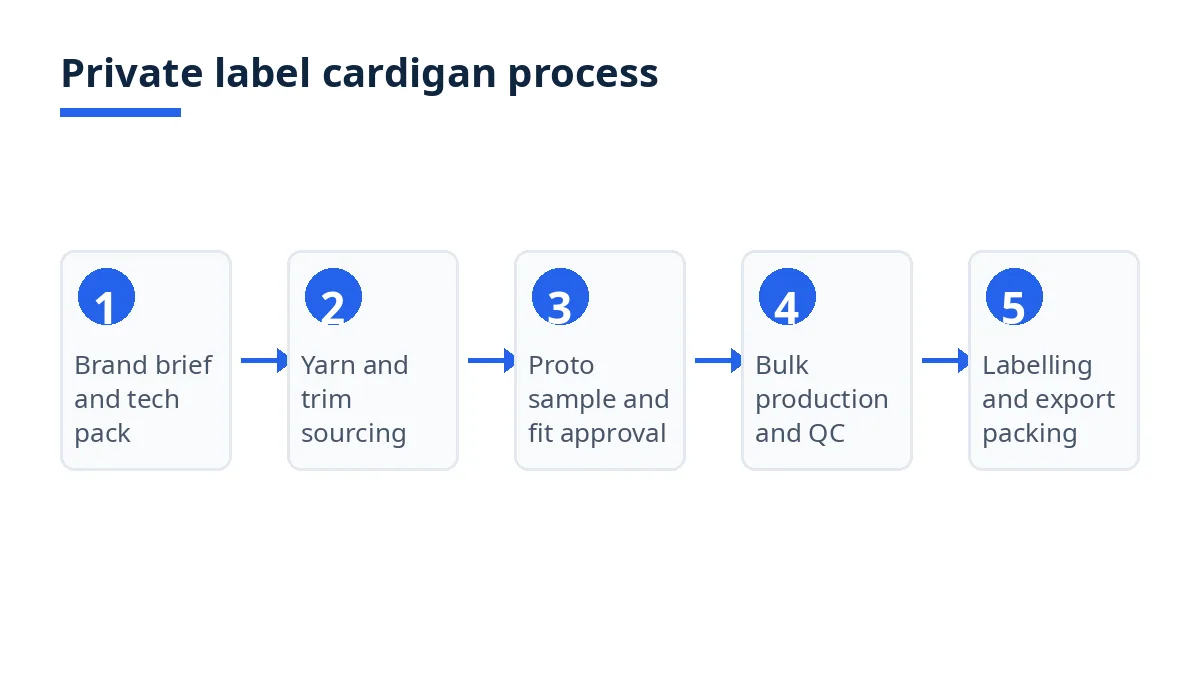
Write the brand brief. State wearer, occasion, front type, collar, pocket plan, colorways, size range and ratio, and target date. Name the selling markets, because label wording follows the market.
Build the tech pack. State silhouette and front opening, measurements per size, gauge and yarn, stitch structure, band and collar construction, button type, size, spacing and stance, buttonhole and pocket construction, finishing, washing, labels, packing. Version and date it; no substitution without your written approval.
Send the same pack to every candidate. Ask each factory to answer in writing: gauge, yarn, dye route, band construction, button method, and stocked or made-to-order status.
Approve the band and button proto first. Ask for a band section with buttons and buttonholes in production yarn and colorway, and check width, spacing, hole size, and whether the band lies flat after washing.
Approve a full proto, then a pre-production sample in production yarn, gauge, colorway, buttons, trims, and labels, washed and finished as intended. Button it, wear it open and closed, and measure both fronts separately.
Confirm the order in writing. State the approved tech pack version, quantities, label and packing specification, inspection standard, delivery term and place, and payment terms.
Inspect with the fronts paired. Inspect both fronts together: length, shade, button alignment, band recovery, and pocket position. ISO 2859-1:2026 defines acceptance sampling plans indexed by acceptance quality limit (AQL).3 Write the inspection level, AQL values, and accept and reject numbers into the order before production starts.
File the repeat pack. Keep the approved sample, tech pack version, band proto, label proofs, shade standard, and inspection report in one file.
Cardigan specifics: gauges, yarns, button bands, collars, trims and labels
Gauge and yarn decisions
Machine gauge is the count of needles per inch along the needle beds; fabric gauge is the count of stitches per inch, which may differ along courses and wales, and fabric can contract or expand after being knitted.4 Lock gauge with yarn, stitch structure, dye route, and finishing, and approve a washed swatch.
Choose the gauge for the wearing occasion: coarse for a heavier outer layer, fine for smooth layering. Confirm the yarn count suits the gauge.
Decision | Lock in the tech pack | How it shows |
|---|---|---|
Gauge | Gauge, yarn count, stitch | Density, drape, hand |
Yarn | Composition, count, dye route | Shade, softness, wash behavior |
Band | Construction, width, rib type, attachment | Front lies flat |
Collar | Shape, depth, rib or shawl construction | Neckline fit |
Buttons | Material, size, color, spacing, stance | Front alignment |
Pockets | Type, position, reinforcement | Fronts stay level |
Button bands, collars and pockets
The button band is the part the customer touches most. Specify its width, rib or stitch construction, attachment to the body panels, and finish at the neck and hem. Measure the band after washing on the proto, and record its recovery.
Button stance is the position and spacing of the buttons. State neck-to-first-button, spacing, and last-button-to-hem distances per size, and check buttonhole size against the actual button including any shank.
Collars change front balance: a shawl collar adds weight to the upper fronts, and a hood adds a neck join that must sit evenly on both. Pockets pull too: state pocket type, position, and reinforcement, and check both pockets buttoned on the pre-production sample.
Trims and labels
For the European Union, Regulation (EU) No 1007/2011 requires a textile product to be labelled or marked with the name and percentage by weight of all constituent fibers in descending order.5 Only annex fiber names may be used, so check wording against the finished garment, including band yarn. For the United States, federal law requires most textile and wool products to be labeled with fiber content, country of origin, and the responsible business, and the Care Labeling Rule requires cleaning instructions.6 Approve each element as a physical proof: brand, size, fiber, care, and hang tag.
Trademark control is separate and written. The Madrid System lets an owner file one application to seek protection in up to 133 countries, while each member's domestic laws determine the scope of protection.7 Confirm your mark is filed in your selling markets, bar factory use of your mark, artwork, or tech pack for other buyers, and state who owns the knitting program, pattern, label plates, and artwork files.
Costs, timelines and documents
What are the typical costs and timelines?
There is no typical private label cardigan price or lead time a guide can state as fact. Cost is the sum of specification lines: yarn, knitting and linking, dyeing, band and collar work, buttons, labels, testing, packing, and freight. The Incoterms 2020 rules provide 11 rules with a clear allocation of cost, risk, and obligations.8 State one rule and one named place on every quotation, and compare only on the same rule.
Sampling time depends on yarn availability, band proto rounds, and corrections. Bulk time depends on dyeing, finishing, button delivery, and line capacity. Label and button lead times are often the quiet constraint. Ask for separate dates for band proto, sample approval, yarn ready, button ready, production, inspection, and shipment.
Example figures: 900 cardigans in three colorways at 300 per colorway clear the garment minimum, but a button lot set for all 900 in one color means a late button-color change in one colorway needs a second lot. The example shows structure only, not a typical price, minimum, or lead time.
Which documents are needed?
Keep three groups in one file: brand (tech pack, band proto record, label proofs, trademark and certification records, sample record), order (quotation, purchase order, inspection standard, delivery term), and shipment (export set). For export clearance, goods may not be loaded unless an export declaration, the Bill of Export or Shipping Bill, is submitted to Customs and approved.9 Enclosed documents include the export letter of credit or contract/purchase order, commercial invoice, packing list, EXP form certified by an authorized dealer, and certificate of origin from the EPB or a Chamber of Commerce and Industry.9
MOQ and negotiation
A cardigan minimum is counted per front assembly, not only per order total. Ask for minimums per style, color, and dye lot, plus separate button, label, tag, and carton minimums, and record which line binds your split. A total that clears the garment minimum can still fall below the per-color dye minimum or the button lot. Read the MOQ definition guide for counting units, and the wholesale cardigans guide for assortment planning across colorways.
Reduce colorways first, because colors multiply dye lots, button sets, and cutting runs. Share one yarn and gauge across two styles, such as a V-neck and a shawl-collar cardigan in the same colorway, and ask in writing whether the dye lot can be met across both combined. Use one button across all colorways, or a stocked button, so the trim lot sets no separate floor per color. Pay tooling or label plates as a separate line where the floor comes from set-up, and record what you paid for. Offer a small-order surcharge as a question, with the figure on the quotation. Do not remove the band proto, pre-production sample, or paired-front inspection.
Bangladesh-specific rules and tips
Confirm association claims at the source. If a supplier claims BKMEA membership, confirm it with the association itself. BKMEA represents the knitwear sector and its member factories,1 so membership signals an active knitwear business, not the gauge range on offer or the ability to hold your shade across two fronts. Ask for the gauge range, stocked yarn, and a recent sample near your gauge.
Keep one legal name across every paper. The export declaration names the exporter and the foreign buyer,9 so the name on the trade licence, quotation, proforma invoice, and payment account should match. Confirm the producing factory by name and record any subcontracted step, such as linking or buttonholing done elsewhere. Keep a retained paired sample in Bangladesh as well as at your office. Confirm button and label lead times, and agree the size ratio per color before production.
Mistakes and red flags
What are the most common mistakes?
Approving a proto without buttoning it. Button the proto, wear it open and closed, and measure both fronts separately after washing.
Approving the band unwashed. Curl, shrinkage, and recovery only show after washing, so approve the band proto washed, in production yarn and colorway, with buttons and buttonholes in place.
Letting button stance copy across sizes. State the stance per size in the tech pack and check it on the graded proto set.
Approving label artwork on screen only. Ask for a printed or woven proof of each label element and check spelling, fiber content, size, and care wording on the proof.5 6
Leaving mark use and file ownership unwritten. Write the bar on reuse, file ownership, and return of artwork and knitting programs into the agreement.7
Treating a profile or a badge as proof of capability. A profile does not test gauge, shade, or band work, and a badge is not a guarantee of capacity, quality, or delivery.10
Red flags: no named producing site, no gauge, yarn, or button answer, a band proto without buttonholes, a label proof without market fiber wording, or a request to approve an unwashed sample. Pause and ask for the missing document or sample.
Checklist
Before you confirm, every line should be answered in writing.
Tech pack version, dated and approved, with construction stated.
Gauge, yarn, stitch structure, dye route, and finishing route confirmed, with a washed swatch approved.
Band proto approved washed, with spacing, buttonhole size, and band recovery recorded; button stance stated per size and checked buttoned.
Shade standard agreed, with washed swatches per colorway, checked as pairs.
Label set approved as proofs, with fiber and care wording checked per market.5 6
Trademark filings checked, and mark use and file ownership in the agreement.7
Quantities per style, color, and size, with button, label, tag, and carton runs priced separately.
Pre-production sample measured, washed, buttoned, and approved in writing.
Inspection level and AQL values in the purchase order, with paired-front checks included.3
Quotations compared on the same specification and delivery term; export set agreed.8 9
Approved paired sample, band proto, label proofs, and inspection report filed for the repeat order.
How Exportain helps
On Exportain, browse suppliers and post a request for quotation (RFQ) on the RFQ board with your tech pack summary, front and band construction, quantities per color, and delivery term, so suppliers on Exportain quote against the same specification. Ask each reply for gauge, yarn, band and button method, and minimums. On acceptance, Exportain creates one order and one proforma invoice from the accepted terms.10
Read the badges for what they record. Exportain Verified means Exportain has checked identity, phone, email, and business registration; Export Verified means it has checked the Export Registration Certificate (ERC).10 Factory Verified means it has reviewed photos of the manufacturer factory, and Trading Company Verified means it has reviewed photos of the trading company office or warehouse.10 Verification is a document review by staff, free, and never granted by membership plans.10 It is not a factory inspection,10 so band approval, sample approval, and inspection stay with you. See how supplier verification works on Exportain before you shortlist.
FAQs
What should I know first about private label?
Private label means you own the specification: tech pack, gauge and yarn lock, band and button decisions, label set, and written approvals tying a repeat to the first order. For cardigans, decide the front assembly first. Knitted cardigans sit under HS heading 6110.2
What are the typical costs and timelines?
There are no typical figures a buyer can rely on: each factory prices your specification. Yarn, gauge, band and collar work, buttons, labels, and the delivery term drive price,8 and sampling, dyeing, finishing, button delivery, and line capacity drive time.
Which documents are needed?
The order documents are the tech pack, band proto record, itemized quotation, and purchase order. The brand documents are the label proofs, trademark records, and certification records. The export set is the Bill of Export, commercial invoice, packing list, EXP form certified by an authorized dealer, and certificate of origin from the EPB or a Chamber of Commerce and Industry.9
What are the most common mistakes?
The most common mistakes are approving a proto without buttoning it, approving a band unwashed, copying one button stance across sizes, approving labels on screen only, and reading a badge as a guarantee of capability.10 Each is prevented by a written approval at the right gate: the washed band proto, the buttoned pre-production sample, the physical label proof, and the paired-front inspection.
Next steps on Exportain
Browse suppliers, then post your tech pack summary, front and band construction, and quantities per color on the RFQ board so suppliers on Exportain answer the gauge, yarn, and button questions in writing. Before you confirm, read the MOQ definition guide and check how the minimum is counted for your split.
Sources
- BKMEA at a Glance. BKMEA (accessed )
- Classification Detail — HS Code 6110. United Nations Statistics Division (accessed )
- ISO 2859-1:2026 - Sampling procedures for inspection by attributes — Part 1: Sampling schemes indexed by acceptance quality limit (AQL) for lot-by-lot inspection. International Organization for Standardization (accessed )
- Gauge - Knitwork. Knitwork (accessed )
- Regulation (EU) No 1007/2011 on textile fibre names and related labelling and marking of the fibre composition of textile products. European Union, (accessed )
- Textile, Wool, Fur, Apparel and Leather Matters. Federal Trade Commission (accessed )
- Madrid System Members. World Intellectual Property Organization (accessed )
- Incoterms® 2020. International Chamber of Commerce (ICC) (accessed )
- Customs Clearance Procedures for Export. Bangladesh Customs, National Board of Revenue (accessed )
- Trust & Safety Center. Exportain (accessed )
About the author
Sourcing from Bangladesh?
Post a request for quotation and suppliers on Exportain can send you their quotes directly.
Post an RFQ