Wholesale Cardigans From Bangladesh: Prices, MOQ and Reliable Suppliers
Wholesale cardigans from Bangladesh are bought as assortments, not single styles. This guide covers assortment planning, price drivers, MOQ structure, and how to check a supplier before ordering.
Short answer
Wholesale cardigans from Bangladesh are bought as assortments of styles, gauges, yarn tiers, colors and sizes, with a quantity for each combination. Price follows a ladder of yarn, gauge and structure, buttons and trims, dyeing and finishing, packing and the delivery term, while the minimum is structured per style, per color and across the size curve. Check each supplier's minimums, yarn and button lines in writing, approve a washed sample, and inspect before shipment.
On this page
Key takeaways
A wholesale cardigan order is an assortment matrix of styles, gauges, yarn tiers, colors and sizes, and the color count and size curve decide whether the order can run.
Price follows a ladder: yarn, gauge and structure, buttons and trims, dyeing and finishing, packing and the delivery term, compared only on the same specification and Incoterms rule.
There is no single typical MOQ: the minimum is structured per style, per color and across the size curve, and the per-color line usually binds.
Approve a washed pre-production sample as a pair of fronts, agree inspection in writing, and record repeat minimums and paid set-ups at the first order.
Exportain badge checks are document and photo reviews, not factory inspections, and a badge is not a guarantee of capacity, quality or delivery.
A buyer planning a cardigan range starts with a rail, not a single garment: an open-front layering piece, a button-front core style and a heavier statement cardigan.
A cardigan is a sweater that opens like a jacket and is fastened in the front with buttons.1 Two fronts must match in shade after washing, and the button band must hold its shape. This guide treats a wholesale cardigan order as an assortment problem: which styles, colors and sizes sell together, what drives the price, how the minimum is structured, and how to check a supplier before money moves.
The supply base is the knitwear sector. The Bangladesh Knitwear Manufacturers and Exporters Association (BKMEA), established in 1996, is the apex trade body for the knitwear sector and represents approximately 2,540 knitwear member factories.2 Ready-made garment exports reached US$10,578.56 million in the first quarter of fiscal 2026-27, up 6.10 percent year on year, and knitwear exports rose 6.88 percent to US$5,963.76 million, according to data released by the Export Promotion Bureau (EPB).3
The cardigan assortment: what a wholesale order actually contains
A wholesale order is a matrix. Before asking for a price, fix four decisions: silhouette, gauge, yarn tier and color count.
Silhouette. The open-front cardigan has no buttons and lives or dies on drape and front-edge finish, while the button-front cardigan carries the button band and button count as cost and risk.
Gauge. Gauge describes the needle density of the flat-knitting machine, in needles per inch, with lower numbers producing coarser stitches and higher numbers producing finer stitches.4 As a practical starting point, 3GG to 5GG suits chunky knitwear, 7GG to 10GG suits mid-gauge products, and 12GG to 18GG suits finer, smoother knitwear.4 Gauge alone does not set weight or quality, so approve a swatch and a finished sample.4
Yarn tier. A range usually needs more than one tier: fine-gauge layering, mid-gauge everyday, and chunky statement yarns. State the fiber composition, yarn count or ply and hand feel for each tier, and whether each color uses stock yarn or dyed-to-order yarn.
Color count. Each color needs its own dye lot, button and trim match, and cutting and linking run. Fewer colors at higher quantities per color almost always buy better. Decide the color count per style before the quantity, and keep one hero color across two or three styles.
Assortment decision | What it fixes | State in the enquiry |
|---|---|---|
Silhouette | Panels, front treatment, linking | Style, length, front opening, collar |
Gauge | Stitch scale, yarn compatibility | Gauge direction with yarn and structure |
Yarn tier | Price line, dye route | Fiber composition, count or ply, stock or dyed |
Color count | Dye lots, trim sets, shade risk | Colors per style, quantities per color |
Size range | Marker efficiency | Sizes and ratio per color |
Wholesale buying models: stock lots, made-to-order and mixed orders
Cardigan wholesale from Bangladesh runs on three models. Stock lots already exist in set styles, colors and sizes; shipment can be fast, but sizes and colors are fixed and a broken size curve cannot be repaired. Made-to-order production knits to the buyer specification approved on a sample, giving the exact range at the cost of time. Mixed orders combine the two: a stock lot for proven core colors, made-to-order production for new colors or the statement style, and a small top-up for sizes that sold out. Write down which lines are stock and which are made to order, because they have different shade tolerances, inspection points and delivery dates.
Repeat-order economics sit underneath all three models. A first order pays for development: swatches, samples, dye-lot set-up, button and label runs. A repeat on the same specification reuses them, so it should be quoted as a repeat. Ask for the repeat price and minimum in writing at the first order.
Price drivers: the ladder from yarn to unit cost
No published price list covers wholesale cardigans, because the unit cost is a ladder of separate lines. Yarn is the first and usually the largest line: fiber choice, count and ply, and the stock-or-dyed route set both cost and minimum, so ask for the yarn specification on the quotation. Gauge and structure decide knitting time and yarn consumption, and a change of gauge after quotation is new development, not a tweak.4 Buttons and trims cost more on a cardigan than on a pullover: count the buttons per garment and ask whether they sit inside the garment price or on a separate line. Dyeing and finishing set cost and shade risk: approve the washed sample, not the unwashed panel.4 Packing and delivery term close the ladder: the Incoterms 2020 rules set out 11 rules with a clear allocation of cost, risk and obligations.5
Price line | What moves it | Ask for it as |
|---|---|---|
Yarn | Fiber, count, ply, dye route | Yarn spec and price basis |
Gauge and structure | Machine time, yarn use | Gauge with yarn and structure |
Buttons and trims | Button count, trim runs | Button count and trim lines itemized |
Dyeing and finishing | Lot size, wash and finish steps | Finishing route, washed-sample approval |
Packing and delivery term | Carton runs, freight, risk transfer | Packing spec, one Incoterms rule5 |
MOQ structure: the style-color-size matrix
There is no single typical MOQ for wholesale cardigans. The minimum is a structure: a minimum per style, a minimum per color, and a minimum that emerges from the size curve. Per style, a change means a new pattern, markers, machine program and linking set-up. Per color, a change means a new dye lot and trim match, and this is usually the binding line: a large total can clear the factory minimum while one color sits below its dye minimum. Per size, state the quantity per style, per color and per size, with one size ratio per color, and ask which line binds for that exact split. Repeat orders should carry a lower effective floor, but only on the same yarn, colors, gauge and trims: a new color is a new dye lot, and a changed button is a new trim run.
Where negotiation works, it changes the structure: fewer colors, one yarn shared across styles, stocked yarn and stock buttons, or set-up paid as a separate line. Get every agreed structure in writing.
Example figures: 1,800 pieces split across three colors at 600 per color can clear a per-color dye minimum that the same 1,800 pieces split across six colors at 300 per color cannot. The example shows structure only, not a typical MOQ or lead time.
Step-by-step: how a wholesale cardigan order runs
A wholesale cardigan order runs in six stages. The sample stages decide the production result, so they are not places to save time.
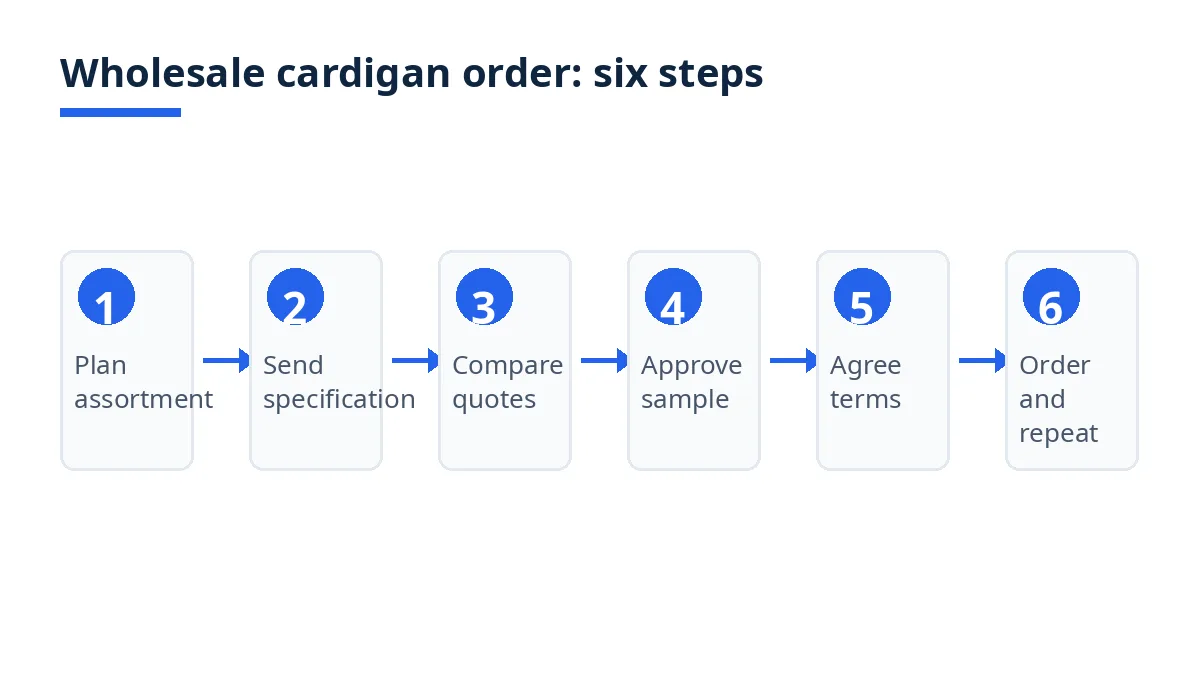
Plan the assortment. Fix styles, gauges, yarn tiers, colors and the size curve, mark stock versus made-to-order lines, and make a one-page assortment sheet.
Send one specification to every candidate. Send the same tech pack, assortment sheet, button and trim specification, label and packing requirements and delivery term.
Compare quotations line by line. Check per-style and per-color minimums, yarn specification, button count, finishing route, packing spec and delivery term on the same basis.5
Approve the washed sample as a pair. Order a proto sample, then a pre-production sample in the actual yarn, colors, buttons and labels. Check the two fronts together for shade and measurements after finishing.4
Agree inspection and order terms. Write the inspection basis, acceptance standard, delivery term and payment schedule into the purchase order.
Order, inspect, then set the repeat. Inspect finished goods against the approved sample before shipment, and close the order with the repeat price and minimum confirmed.
For construction detail, read the cardigans manufacturers guide; for inspection points, see the cardigans quality control checklist.
Costs, timelines and documents
What are the typical costs and timelines?
There are no typical costs or timelines a guide can state as fact. Each factory prices your yarn, gauge, structure, button count, dye lots, finishing route, packing and delivery term,5 and each timeline depends on whether yarn is stocked or dyed, sampling correction rounds, and line capacity at confirmation.
Which documents are needed?
The order documents are the assortment sheet, tech pack, itemized quotation and purchase order. The shipping documents are the commercial invoice, the packing list per carton, and the transport document.
Why this matters for buyers and sellers
For the buyer, the assortment decision is a cash decision: stock sits in the sizes and colors ordered. For the seller, the minimum protects the run: yarn dyed for your colors and labels printed with your brand cannot be sold to another buyer.
Bangladesh-specific rules and tips
Classification. In the Harmonized System, heading 6110 covers jerseys, pullovers, cardigans, waistcoats and similar articles, knitted or crocheted.6 Use it as the starting point for the destination-market classification.
Association claims. If a supplier claims BKMEA membership, confirm it with the association itself. Membership signals an active knitwear business; it does not prove capacity for your order.
Substance testing. OEKO-TEX STANDARD 100 confirms through independent certification that textiles and accessories have been tested for risks associated with harmful substances, and all components must meet the criteria, including buttons.7 A certificate is valid for 12 months.7 Ask which products, components and product class it covers, and confirm it with the issuing body.
Fiber labeling. If you sell into the European Union, Regulation (EU) No 1007/2011 requires that a textile product be labelled or marked with the name and percentage by weight of all constituent fibres in descending order.8 State the fiber composition on the tech pack and label specification exactly as it will appear on the garment.
Export declaration. Goods may not be loaded for export unless an export declaration, the Bill of Export or Shipping Bill, is submitted to Customs and approved.9 Enclosed documents include the export contract or purchase order where there is no export letter of credit, the commercial invoice, the packing list, the EXP form certified by an authorized dealer, and a certificate of origin issued by the EPB or a Chamber of Commerce and Industry.9
Imported inputs. Buttons, certain yarns and some trims may be bought in for your specification, and an imported button can set both the minimum and the earliest production date. Agree the button source, color match and delivery date before confirming.
Mistakes and red flags
What are the most common mistakes?
Ordering colors before checking the per-color minimum. The total clears the factory floor while one color fails. Check the per-color line for the smallest color first.
Comparing quotations with different button counts or finishing routes. A lower price on fewer buttons, an unwashed finish or stock labels is a different garment.
Approving an unwashed panel. Shade, measurements and button-band shape are decided after washing and finishing.4
Treating a profile, membership claim or badge as proof of capacity. Badge checks record documents and photos reviewed, not knitting capability.
Accepting a verbal repeat promise. Record the repeat minimum, repeat price basis and set-up ownership on the first purchase order.
Skipping inspection to meet a shipment date. Inspection against the approved sample is the last control before the goods become your stock. Red flags follow the same pattern: a quote without asking for the split per color, a sample that arrives unwashed, a certificate with no valid-until date or issuing body, or a quotation whose company name differs from the proforma invoice. Pause and ask for the missing paper.
Checklist
Before you confirm, every line should be answered in writing.
Assortment sheet fixed: styles, gauges, yarn tiers, colors, size curve, stock versus made-to-order lines.
Quantities per style, per color and per size, with one size ratio per color.
Minimums per style and per color confirmed; binding line named.
Yarn specification on the quotation: composition, count or ply, stock or dyed per color.
Button count, button source and trim lines itemized apart from the unit price.
Finishing route agreed; washed sample approved as a pair, in writing.
Certificates checked: scope, components, issuing body, valid-until date.7
Quotations compared on the same specification and delivery term.5
Inspection basis, acceptance standard and payment schedule in the purchase order.
Export set agreed: Bill of Export, invoice, packing list, EXP form, certificate of origin.9
Repeat minimum, repeat price basis and paid set-ups recorded.
How Exportain helps
On Exportain, browse suppliers and post a request for quotation on the RFQ board with your assortment sheet, quantities per color and delivery term, so suppliers quote against the same specification. Ask each reply for its per-style and per-color minimums, yarn specification and button and trim lines.
Read the badges for what they record. Exportain Verified means Exportain has checked identity, phone, email and business registration, and Export Verified means it has checked the Export Registration Certificate (ERC).10 Factory Verified means it has reviewed photos of the manufacturer factory, while Trading Company Verified means it has reviewed photos of the trading company office or warehouse.10 Verification is a document and photo review by staff, free, and never granted by membership plans.10 It is not a factory inspection,10 so sample approval and inspection stay with you. See how supplier verification works on Exportain and the MOQ definition guide.
FAQs
What should I know first about cardigans?
A cardigan is a sweater that opens like a jacket and is fastened in the front with buttons.1 The front opening drives the wholesale order: two fronts must match in shade after washing, and buttons add parts with their own runs.
What are the typical costs and timelines?
There are no typical figures a buyer can rely on, because each factory sets its price, minimum and lead time for your specification. Yarn, gauge and structure, button count, dye lots, finishing, packing and the delivery term drive the price,5 and yarn availability, sampling rounds and line capacity drive the timeline.
Which documents are needed?
The order documents are the assortment sheet, tech pack, itemized quotation and purchase order. The export set is the Bill of Export, commercial invoice, packing list, EXP form certified by an authorized dealer, and a certificate of origin issued by the EPB or a Chamber of Commerce and Industry.9
What are the most common mistakes?
The most common mistakes are ordering colors before checking the per-color minimum, comparing quotations with different button counts or finishing routes,5 approving an unwashed sample, and accepting a repeat promise verbally.
Next steps on Exportain
Browse suppliers, then post your assortment sheet, quantities per color and delivery term on the RFQ board. Before you confirm, read how supplier verification works on Exportain and the cardigans manufacturers guide.
Sources
- Cardigan Definition & Meaning. Britannica Dictionary (accessed )
- BKMEA at a Glance. BKMEA (accessed )
- RMG exports rise 6.10pc to US$10.58b in July-Sept of FY27. The Financial Express, (accessed )
- Sweater Knitting Gauge Guide: 3GG-18GG. KnitSeek (accessed )
- Incoterms® 2020. International Chamber of Commerce (ICC) (accessed )
- Classification Detail — HS Code 6110. United Nations Statistics Division (accessed )
- OEKO-TEX STANDARD 100 for textiles tested for harmful substances. Hohenstein (accessed )
- Regulation (EU) No 1007/2011 on textile fibre names and related labelling and marking of the fibre composition of textile products. European Union, (accessed )
- Customs Clearance Procedures for Export. Bangladesh Customs, National Board of Revenue (accessed )
- How Supplier Verification Works on Exportain. Exportain, (accessed )
About the author
Sourcing from Bangladesh?
Post a request for quotation and suppliers on Exportain can send you their quotes directly.
Post an RFQ