Typical MOQ for Pajamas and Sleepwear in Bangladesh (and How to Negotiate It Down)
No single pajamas and sleepwear MOQ in Bangladesh: how set and piece splits, cloth lots, print placements and size runs set the minimum, and how to structure a smaller order.
Short answer
There is no single typical MOQ for pajamas and sleepwear from Bangladesh. Each factory sets its minimum per set, per piece and per colour for your specification, driven by cloth and dye lots, print and embroidery set-ups, relaxed-fit size runs, and trim and box runs. Ask for the minimum per set, per piece and per colour in writing, then negotiate the structure: fewer colours, one shared cloth across top and bottom, stocked cloth, and set-up paid as a separate line.
On this page
Key takeaways
There is no single typical MOQ for pajamas and sleepwear from Bangladesh, because each factory sets its minimum per set, per piece and per colour for your specification.
Cloth and dye lots, print and embroidery set-ups, relaxed-fit size runs, trim and piping lots, and printed box runs are the drivers that set the floor.
A set is two garments that must match, so state the quantity per set, per top and per bottom, and check the smallest line, not only the order total.
Negotiate the structure first: fewer colours and print placements, one cloth shared across top and bottom, stocked cloth and trims, and set-up paid as a separate line.
Exportain verification is a document and photo review, not a factory inspection, and a badge is not a guarantee.
A sleepwear order is governed by cloth before it is governed by garments. A factory buys fabric by the roll, dyes it in a vessel batch, prints it in a repeat length and cuts it from a layered marker. The smallest batch at each stage sets a floor, and the binding floor may be a dye batch, a print repeat or a box print run.
That logic matters for sleepwear because a set has to match. A top and a bottom worn together show any shade difference, print shift or difference in hand feel at once, so keeping a set inside one batch makes the batch size your minimum.
The knitwear base in Bangladesh is broad: the Bangladesh Knitwear Manufacturers and Exporters Association counts about 2,540 member factories.1 A broad base does not set a shared floor.
That point shows in export totals too. July to September 2026 knitwear exports totalled $5.963 billion, up 6.88 percent on the year, inside ready-made garment exports of $10.578 billion, per Export Promotion Bureau data.2
Fabric first: how cloth lots set a sleepwear minimum
Flannel and fleece: the raised-surface problem
Flannel and fleece both carry a raised surface, which makes them warm and soft and changes how they behave in cutting, sewing and washing. Brushed flannel can shed fibre across wash cycles, while fleece can pill where it rubs against itself in sleep and laundering. So agree the wash check in the tech pack before bulk cutting: wash method, measurements, and pass criteria for shrinkage, pilling and top-bottom match. Dyeing adds a second constraint: flannel dyed to your colour needs a full dye batch, fixed by the vessel, not by your order. Stocked flannel in a standard colour avoids that vessel, so it can run far below a dyed-to-order colour.
Satin: slip, snagging and the bias-cut trim
Satin looks simple and behaves awkwardly. Its smooth face slips under the presser foot, slides in the cutting lay and snags on rough surfaces, and seam slippage is a real risk on a loose satin bottom. Bias-cut piping consumes more cloth than a straight-cut trim. A satin top paired with a jersey bottom creates two cloth purchases, two dye or stock decisions and two cutting plans, and the smaller line can hold up the set.
Jersey and modal: stretch, twist and recovery
Cotton jersey and modal knits stretch, which suits sleepwear but creates a measurement problem: a jersey top measured flat can read differently from the same top on a body, and a knit tube can twist after washing so that a side seam spirals. Modal can shrink more than expected if finishing and wash method are not settled in advance. So measure the set after washing, on both pieces, relaxed.
Print and embroidery: the set-up sits outside the garment count
An all-over sleepwear print is a cloth problem, not a garment problem: the print repeats along a length of fabric, so the factory must run enough cloth to cover the repeat and set-up waste before a single set is cut. A placement print, such as a chest motif, needs a screen for each colour in the artwork, and an embroidered motif needs a digitised file for that placement and stitch density. Those set-ups cost the same for a short run as for a long one, so factories either fold them into a higher minimum or charge them as a separate line. Ask for print and embroidery set-up as a separate line first.
Children's sleepwear adds a fabric decision to make before sampling. In the United States, children's sleepwear that is not an infant garment or tight-fitting is subject to the flammability standards in 16 CFR part 1615 for sizes 0 through 6X or 16 CFR part 1616 for sizes 7 through 14.3 Flannel and fleece are raised surface fabrics under the general wearing apparel flammability standard.3 A tight-fitting children's style needs its own pattern block, so settle fit category and fabric treatment in the tech pack first.
Sets, separates and the size run
A set, a separate top, a separate bottom and a nightdress are four different products for minimum purposes, even when they share a print. A set pairs two garments that must match. A separate top sold on its own leaves bottoms without partners, and unmatched bottoms have to be priced in somewhere. State each unit separately, per colour: sets, separate tops, separate bottoms and nightdresses.
The size run then applies a second squeeze: sleepwear is cut loose, so demand concentrates in the middle sizes and thins toward the ends of the range. A small edge size can fall below the per-size cutting line even when the colour total looks healthy, because the factory cannot lay a marker for a handful of pieces without wasting cloth. Relaxed pieces use more cloth per garment, so that waste is protected in the minimum or the unit price. If edge sizes complete your range, say so early.
Woven sleepwear sits under Harmonized System headings 6207 for men's or boys' nightshirts, pyjamas and similar articles, and 6208 for women's or girls' nightdresses, pyjamas and similar articles, with subheadings by fibre.4 Regulation (EU) No 1007/2011 requires fibre names with percentage by weight in descending order.5 See the HS code for pajamas and sleepwear guide and the MOQ definition guide.
Sleepwear input | Why it creates a floor | What to put in the enquiry |
|---|---|---|
Dye batch | One colour per fixed vessel size | Sets per colour, per cloth, stocked or dyed |
Print repeat | All-over print runs as a cloth length | Method, repeat, placement, artwork colours |
Size curve | Relaxed fits concentrate in middle sizes | Size range, ratio per colour, edge quantities |
Trims and boxes | Piping, buttons, cords, printed boxes run separately | Trim spec per colour, gift-box artwork |
Example figures: a buyer orders 800 sets in five colours: 160 sets, 160 tops and 160 bottoms per colour. The same 800 sets in two colours give 400 sets per colour, more than doubling the quantity behind each dye batch and print placement at the same total. Example figures only, not a typical MOQ, price or lead time.
Negotiation levers: changing the structure behind the number
A smaller number usually follows a simpler structure. Each lever below removes a batch, a set-up or a separate lot.
Consolidate colours before cutting the set total. Every colour multiplies dye batches, print placements and trim lots. Removing one colour raises the quantity behind every remaining batch.
Put top and bottom on one cloth in one colour. A set cut from a single cloth in a single colour shares one dye batch across both pieces.
Use stocked cloth and stock trims where the range allows it. A standard colour in a stocked flannel or jersey, with stock buttons, elastic and drawcord, removes the dye vessel and several small lots at once.
Pay set-up apart from the unit price. Where the floor comes from screens, digitising or a printed-box run, ask for those costs as a separate line. A factory that has recovered its set-up cost directly can often accept a shorter run.
Phase the size range. If edge sizes are holding up the order, launch with the middle sizes and add them on the repeat, when colour and cloth are already running.
Stage the range, and protect the checks. Place a smaller first order in fewer colours and fewer sizes, with a written repeat price and minimum. Keep the wash check, set-match approval and inspection plan in place.
Mistakes and red flags
Ordering by a set total alone. A total hides the split inside it: if tops in one colour fall below their line, or an edge size falls below its cutting line, the set cannot run.
Treating a nightdress as a set. A nightdress is one garment, not a pair, with a different marker and packing plan.
Comparing a satin minimum with a flannel minimum. Different cloth families carry different dye batches, cutting allowances and wash behaviour, so a lower number on a different cloth is a different offer.
Approving the top without the bottom. A top and a bottom approved separately can still fail together on shade, placement or fit, so approve the pair together, after washing.
Assuming the gift box is included. A printed box and insert run separately, so an order can clear the garment minimum and still fall below it.
Leaving a concession in conversation only. When a factory agrees to a smaller run, a shared batch or a waived set-up, write it into the order papers against the exact colours and sizes it covers.
Treating a badge as a measure of factory capability. Listings and badges record checks the platform has done. They say nothing about whether a factory's dye vessels suit your flannel or its markers suit your relaxed sizes.6
Why this matters for buyers and sellers
For a buyer, a sleepwear minimum is a cash decision in pairs: every unsold set ties up two garments, and a colour that sells through on tops but not bottoms leaves unsellable stock.
For a seller, the minimum protects work that has no second buyer. Cloth dyed to a buyer's colour, piping cut for a buyer's set and boxes printed with a buyer's brand cannot be resold if the order shrinks.
Step-by-step: how it works
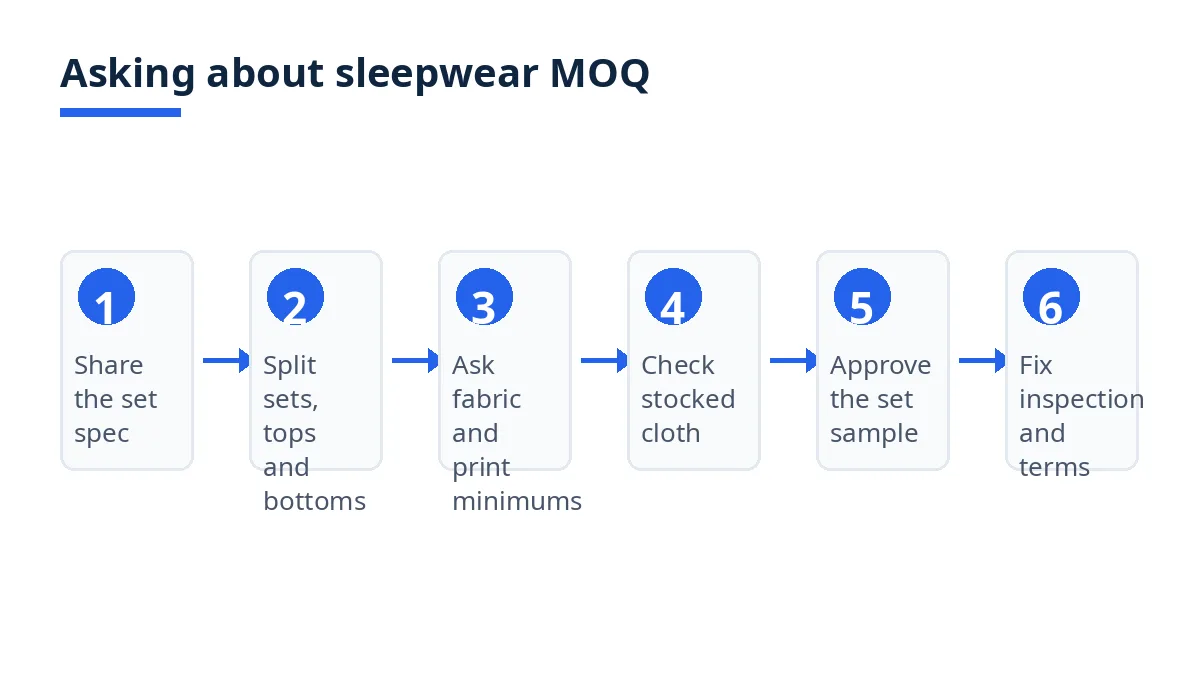
Fix the set definition first. State for each style whether it is a set, a separate top, a separate bottom or a nightdress, with cloth, construction and wash method.
Send one tech pack to every candidate. Include fit, the size chart with its size ratio, print method and placement, embroidery motif and placement, trim details, labels and packing.
State the split in full. Give the quantity per style, per colour, per size and, for sets, the tops and bottoms inside each colour.
Ask for the binding line. Ask for the minimum per set and per piece, per colour and dye batch, per print placement, embroidery file, trim and box run, and which line binds.
Ask what is already stocked. Record whether each fabric colour is stocked or dyed to order, and whether buttons, piping, elastic and labels are stock items.
Approve the washed pair, then agree the controls. Order a proto sample, then a pre-production sample in the actual cloth, colour, print and trims, with top and bottom together. Wash it, measure both pieces, check the match, then approve or list corrections. Before confirming, write inspection level and AQL values into the purchase order, following ISO 2859-1,7 and state one Incoterm and named place.8
A separate checklist for this product covers how to check a washed pair, artwork placement and trim lots: the pajamas and sleepwear quality control checklist.
Costs, timelines and documents
Costs and timelines in practice
Price and timing move with the specification, so this guide gives no standard figures. The factory's quote reflects cloth family, set structure, print placements, embroidery, trim and box runs, finishing, packing and delivery term.8 Sampling depends on cloth availability, wash testing and correction rounds; bulk production on dyeing, trim delivery and line capacity.
Documents for the order and for export
Your own paperwork is the tech pack, the itemised quote and the order, with the same split on the quote and the order. For the shipment, Customs needs the Bill of Export approved before loading, supported by invoice, packing list, EXP form and certificate of origin.9
Bangladesh-specific rules and tips
Check a claimed membership yourself. A supplier may say it belongs to BKMEA; ask the association to confirm. Membership shows the business operates in knitwear, not a low minimum for your set.1
Use one business name everywhere. Trade licence, quote, invoice and bank account should all carry the same exporter and buyer names, as Customs records those names.9
Find out which inputs arrive from abroad. Some satin, buttons, cords and yarns for a sleepwear specification are purchased overseas, and an overseas input can raise the floor and delay cutting.
Settle children's sleepwear rules before you price a children's range. The flammability standards and fit categories above apply before sampling: a tight-fitting style needs its own pattern block.3
Checklist
Run down this list and confirm every item in writing before you order.
Set definition fixed per style.
Split stated per style, per colour, per size and, for sets, per top and bottom.
Minimum confirmed per set, per piece and per colour, with the binding line named.
Cloth status per colour recorded.
Print minimums confirmed per placement and, for all-over print, as a cloth length.
Trim, piping, label and box minimums confirmed apart from the garment minimum.
Set-up costs itemized apart from the unit price.
Washed pair measured, match-checked and approved together.
Children's fit category settled in the tech pack.3
Inspection level and AQL values in the purchase order.7
Quotations compared on the same cloth family, set structure and term.8
Export set agreed: invoice, packing list, EXP form, origin certificate, Bill of Export.9
How Exportain helps
On Exportain, browse suppliers and post a request for quotation (RFQ) on the RFQ board with your tech pack summary, set and piece split, and delivery term. Read the seller verification guide first: verification is a document and photo review, not a factory inspection, and a badge is not a guarantee.6 10
FAQs
What should I know first about pajamas and sleepwear?
The minimum is set by cloth before it is set by garments: dye batches, print repeats, set pairing, size runs, wash sampling, trim lots and box runs each set a floor. Woven nightshirts and pyjamas sit under HS headings 6207 and 6208.4
What are the typical costs and timelines?
No standard price or lead time exists for this product, because each factory quotes for your cloth, set structure, artwork, split and delivery term.8 Sampling, wash testing, dyeing, trim delivery and line capacity set the timeline.
Which documents are needed?
Order papers come first: tech pack, itemised quotation and purchase order, all carrying the split figures. Shipment papers follow: Bill of Export, invoice, packing list, EXP form and origin certificate.9
What are the most common mistakes?
The most common mistakes are ordering by a set total alone, treating a nightdress as a set, comparing minimums across cloth families, and approving the top without the bottom. A badge is not a guarantee of capacity, quality or delivery.6
Next steps on Exportain
Browse suppliers, then post your tech pack summary, set and piece split, and delivery term on the RFQ board so suppliers state their minimum per set, per piece and colour. Before you confirm, read how to import pajamas and sleepwear from Bangladesh and the MOQ definition guide.
Sources
- BKMEA at a Glance. BKMEA (accessed )
- Exports up over 6% to $13.1bn in Q1 of current fiscal. United News of Bangladesh (accessed )
- Clothing Business Guidance. U.S. Consumer Product Safety Commission (accessed )
- HS Nomenclature 2017, Chapter 62: Articles of apparel, not knitted or crocheted. World Customs Organization (accessed )
- Regulation (EU) No 1007/2011 on textile fibre names and related labelling and marking of the fibre composition of textile products. European Union, (accessed )
- Trust & Safety Center. Exportain (accessed )
- ISO 2859-1:2026 - Sampling procedures for inspection by attributes — Part 1: Sampling schemes indexed by acceptance quality limit (AQL) for lot-by-lot inspection. ISO (accessed )
- Incoterms® 2020. International Chamber of Commerce (ICC) (accessed )
- Customs Clearance Procedures for Export. Bangladesh Customs, National Board of Revenue (accessed )
- Supplier verification: Earn trust badges buyers can see. Exportain (accessed )
- MOQ
- supplier verification
- knitwear
- buyer guide
- Bangladesh sourcing
- bangladesh garments
- Pajamas and sleepwear
About the author
Sourcing from Bangladesh?
Post a request for quotation and suppliers on Exportain can send you their quotes directly.
Post an RFQ