

Live Eels Lead Time From Bangladesh: Production and Shipping Timeline
No single live eels lead time from Bangladesh: the timeline is set by water quality. Fasting, conditioning, grading, oxygenated packing, certification and air freight, with live arrival checks at destination.
Short answer
There is no single typical lead time for live eels from Bangladesh. The timeline is set by water quality, not a production line: fasting and purging, shower conditioning, size grading, oxygenated packing, certification and air freight, with live arrival and acclimatisation at destination. Plan backward from the flight the eels can survive, with each stage dated separately.

On this page
Key takeaways
There is no single typical lead time for live eels from Bangladesh, because water quality, not a production line, sets the timeline.
Fasting and purging, then shower conditioning for three to four days for market-size eels, are what make the transport water survivable.
Only healthy and undamaged fish should be chosen for live storage and transportation, with no feeding during storage and transportation and none within the 24 hours preceding transportation.
Certify first and pack second: once eels are sealed in packing water, a pending certificate or a missed flight consumes the water-quality budget the flight needs.
Exportain verification is a document and photo review, not a factory inspection, and a badge is not a guarantee of live arrival.
A live eel order from Bangladesh has no factory line to speed up. The eels exist when the order is placed, and the timeline is spent making them shippable: emptying the gut, conditioning them to travel, sorting them into the grades the buyer ordered, packing them in water that will stay breathable, and getting the certificates and the flight ready. The clock that matters is the water in the container: oxygen falls and ammonia and carbon dioxide rise in transit, so every stage before the flight buys clean-water hours for the journey.
This guide follows that clock for buyers in the USA, the UK, the EU and the UAE: the sequence from order to live arrival, what sets the length of each stage, and which documents sit on the critical path. It states no typical number of days.
Why this matters for buyers and sellers
For the buyer, the risk is paying air freight on animals that arrive weak, mixed in grade or dead. For the seller, the risk is the mirror image: eels prepared correctly but held too long at the depot while a certificate or a flight is sorted out. A delay at any gate consumes the same water-quality budget the flight needs.
What should I know first about live eels?
Live fish are conditioned before transport, not simply caught and packed. The Food and Agriculture Organization describes live fish being conditioned in clean water, with damaged, sick and dead fish removed, then starved and, where possible, cooled so metabolic rates fall.1 Lower metabolic rates reduce fouling of the water with ammonia, nitrite and carbon dioxide, which are toxic to fish and impair their ability to extract oxygen.1 The transport method should be tailored to the species, and eel is named among the species kept alive and transported between countries.1
Eel preparation has its own conditioning step. Before shipment of live eels, they are starved for a few days and kept confined in a limited space, which reduces fat and off-flavour and conditions the eels to the lower oxygen levels required for safe shipment.2 The most common method described is stacking baskets of about 3 kg of eels each under a shower of water from above for three to four days.2 Elvers are acclimatised the same way in fine-mesh containers holding about 5 kg each, but for only half to one day.2
Only healthy animals enter the chain. The Codex code of practice states that only healthy and undamaged fish should be chosen for live storage and transportation, with damaged, sick and dead fish removed before introduction to holding tanks, and holding tanks checked regularly.3 Holding water should be well aerated before fish are transferred into it, and similar in properties and composition to the source water.3 No feeding should occur during storage and transportation, and in general fish should not be fed within the 24 hours preceding transportation.3
Grading decides whether the timeline holds together. Eels are sorted soon after harvest, with smaller fish kept for further rearing and larger sizes sorted to market preference: European markets prefer larger fish above 250 g, while eels of 120 to 150 g and 160 to 250 g are the preferred sizes in Japan, with preference varying by region.2 State the grade bands in weight in the purchase order, not a trade name alone. See the HS code for live eels guide and the live eels quality control checklist.
Step-by-step: how it works
The steps below follow the water, not the paperwork. Paperwork runs in parallel and must be ready before packing, because packed eels cannot wait for a certificate.
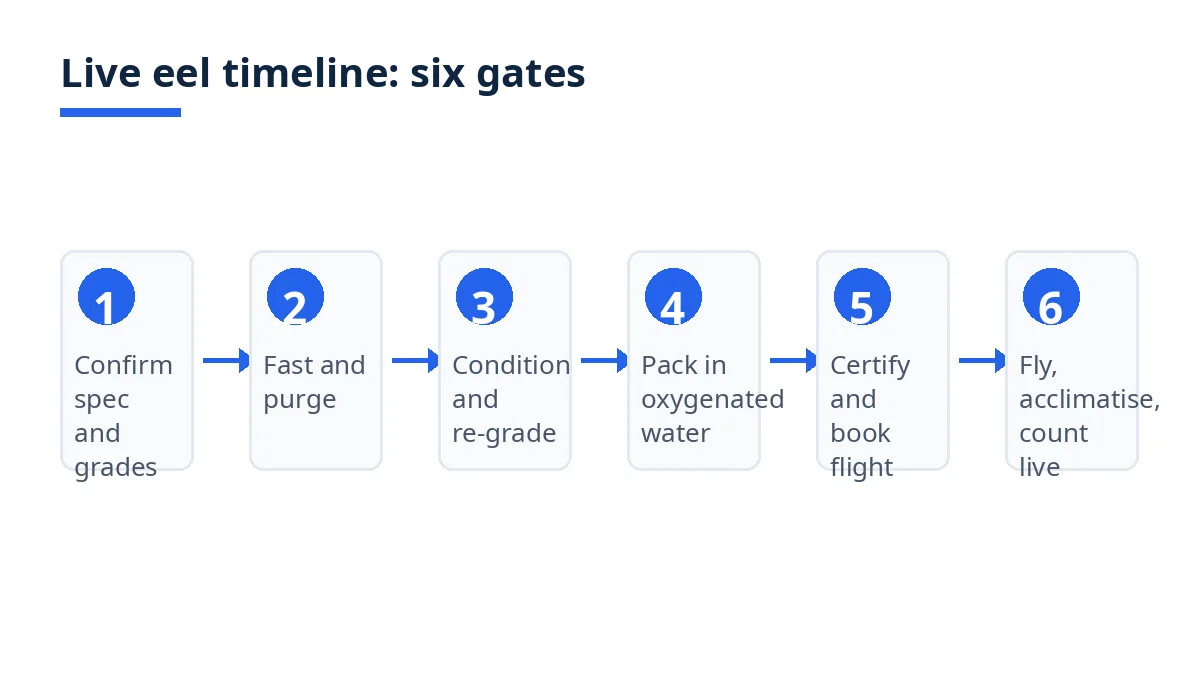
Confirm the live-arrival specification and the grade bands. State the species in full, the weight bands, the live-arrival count basis, the acceptable-loss threshold, the counting method at destination and the notification period for a claim, including what happens to weak and dead animals on arrival.
Fast and purge in clean, aerated water. Hold the eels without feeding so the gut empties and the transport water stays cleaner for longer. University of Florida guidance describes harvested fish held for several days to clear their digestive tracts, with fish ready to ship after one to three days to evacuate wastes and after evaluation and treatment for parasites or disease.4 Record the fasting start, the water exchanges and the removals at each check.
Condition under shower and re-grade. Condition the eels by the method named in the specification, using the shower-basket method described above where that is the agreed method, for three to four days for market-size eels.2 Re-grade after conditioning: remove weak, damaged and dead animals again, and pack short rather than filling a grade with animals that failed the second check.3
Pack in oxygenated water with temperature control. Pack only conditioned, re-graded eels, in clean water of similar composition to the holding water, with oxygen supplied for the full journey including ground time. The World Organisation for Animal Health requires transport containers to withstand the weight of the animals and water, and requires air-transport stocking densities to reflect both the space for each species and the oxygenation capacity available on the ground and during all stages of the flight.5 The International Air Transport Association's Live Animals Regulations cover container requirements, stocking density, marking, labeling, handling and documentation.6
Certify and book the live flight in parallel. Complete the export declaration, the destination health certificate and the airline acceptance while the eels are still in conditioning, so that no packed animal waits for paper. Confirm airline acceptance on the exact flight before the packing day.
Fly, land, acclimatise and count live on arrival. Load as late as the airline allows and keep the consignment out of sun and heat on the ground. On arrival, open cartons promptly, count live, weak and dead animals carton by carton, photograph the count, and notify the seller and the carrier within the contract period. Water quality in the bag degrades during shipment through accumulation of carbon dioxide, ammonia and other waste products,4 so the arrival count must be made before retail holding.
Costs, timelines and documents
What are the typical costs and timelines?
There are no typical costs or timelines a guide can state as fact for live eels, because each order prices its own grade mix, conditioning time, packing format, routing and delivery term. The Incoterms 2020 rules set out 11 rules with a clear allocation of cost, risk and obligations,7 so compare quotations only on the same rule and the same live-arrival basis. See the Incoterms for shipments from Bangladesh guide and the live eels price breakdown.
For timelines, ask for each stage as a separate date and time, not as a single delivery week: specification and grade agreement, fasting and purging, shower conditioning (three to four days for market-size eels in the method described2), re-grading, certification, flight and ground time, and destination clearance with the arrival count. Ground time counts against the same water budget as time in the air.
Example figures: consider two orders of the same grade bands. In the first, the eels fast and condition while the certificate is issued and the flight is held, are packed on the morning of departure, and are counted live on arrival the next day. In the second, eels are packed before the certificate is ready, wait a day for the document, and miss the direct flight. The difference is not one calendar day: it is a day of oxygen consumption and waste accumulation in sealed packing water. The example shows structure only, not a typical timeline, price or loss rate.
Which documents are needed?
For export clearance in Bangladesh, goods may not be loaded unless an export declaration, the Bill of Export or Shipping Bill, is submitted to Customs and approved.8 Enclosed documents include the export contract or purchase order where there is no export letter of credit, the commercial invoice, the packing list, the EXP form certified by an authorized dealer, and a certificate of origin issued by the EPB or a Chamber of Commerce and Industry.8 A quality control certificate by the Department of Fisheries is necessary as per the requirements of the destination country for the products it covers.8
On top of the export set, the live-eel order needs the destination health certificate, the airline acceptance documents and the species file. The IATA regulations cover shipper certification, the air waybill, captain notification and the acceptance checklist,6 and the species name in full must match across the purchase order, invoice, packing list and health certificate. Confirm in writing which certificate the destination requires, who issues it, and how long issuance takes, before the eels leave conditioning.
Bangladesh-specific rules and tips
Confirm the EU gate before you confirm the order. Commission Implementing Regulation (EU) 2021/405 lays down the lists of third countries from which entry of certain animals and goods intended for human consumption is permitted, and Bangladesh appears in the fishery-products list in Annex IX, with the footnote marking countries that can export all fishery products.9 That is a country-level gate, not approval of any supplier or consignment.
Treat China as a separate timeline, and verify the current protocol. Live crabs and eels exported to China require clinical compliance certification by the state veterinary office under the protocol communicated by the Chinese customs authority, and consignments without it are not allowed, according to a 2021 report of that protocol.10 The protocol places inspection, quarantine and health certificate issuance with the fisheries and livestock ministry, and requires examination by an official veterinarian before export.10 Book that examination before conditioning ends, and re-confirm the current protocol before contracting.
Use the e-certification channel, but do not assume it removes the wait. Bangladesh has automated licences and product test certificates for fish and seafood trade, including health certificates as required by the importing country, inspection, test reports and certificate issuance, connected directly to customs.11
Ask where the eels are conditioned, and how far conditioning is from the airport. Both decide how much of the water budget is spent before the flight. Keep one species name across every paper: the export declaration names the exporter and the foreign buyer,8 and the species file must carry the same full name on all documents.
Mistakes and red flags
What are the most common mistakes?
Packing before certification is ready. Once eels are sealed in packing water, the clock is running on oxygen and waste. Certify first, pack second.
Treating conditioning as wasted time. The fasting and shower-conditioning days are what make the transport water survivable. Cutting them leaves gut contents and unconditioned animals in the box, and the water degrades faster.1 2 4
Filling a grade with weak animals. A short grade packed with weak animals looks complete on departure and arrives as deaths spread across cartons. Pack short instead.3
Overpacking to cover expected losses. Adding more eels to absorb losses increases crowding, oxygen demand and waste. Stocking density must reflect space and oxygenation capacity at every stage of the flight.5
Accepting a routing with a long ground wait. A cheaper routing with a long layover, a change of aircraft or a hot tarmac wait can cost more in dead eels than it saves in freight.
Counting late or counting boxes. A destination count made after retail holding, or a count of cartons rather than live animals, cannot settle a loss claim. Agree the count method and time in the purchase order, and photograph the count carton by carton.
Treating a profile or a badge as a survival guarantee. A badge records a document and photo review, not a conditioning facility inspection or a flight outcome. See the live eels quality control checklist.
Checklist
Before you confirm, every line should be answered in writing.
Species, weight bands, live-arrival count basis and loss threshold agreed.
Fasting start, purge period and water-exchange log recorded.
Conditioning method and duration named in the specification.2
Re-grading after conditioning, with weak animals held out.3
Packing density set for space and oxygenation.5
Flight routing confirmed with ground time and earliest workable arrival.
Export declaration, invoice, packing list, EXP form, certificate of origin agreed.8
Destination health certificate confirmed: issuer and issuance time.
Species name matched across all documents.
One Incoterm and named place on every quotation.7
Arrival inspection plan agreed: who counts, when, and acclimatisation before retail holding.
How Exportain helps
On Exportain, browse suppliers and post a request for quotation (RFQ) on the RFQ board with your species in full, weight bands, live-arrival specification, destination market and delivery term, so suppliers quote against the same water-quality basis. Ask each reply for its conditioning method, water-exchange log, packing density, flight routing with ground time and certificate timing. When you accept a quotation, Exportain creates one order and issues one proforma invoice from the accepted terms.12
Read the badges for what they record. Exportain Verified means Exportain has checked identity, phone, email and business registration, and Export Verified means it has checked the Export Registration Certificate (ERC).12 Verification is a document review by staff, free, and never granted by membership plans.13 It is not a factory inspection,12 13 so conditioning and packing stay with you and the supplier.
FAQs
What should I know first about live eels?
Know that the timeline is governed by water quality, not calendar days. Eels are starved for a few days and conditioned, commonly under a shower of water for three to four days, so they travel with clean water and lower oxygen demand.2 Only healthy and undamaged fish should be chosen for live storage and transportation, with no feeding during storage and transportation and none within the 24 hours preceding transportation.3
What are the typical costs and timelines?
There are no typical figures a buyer can rely on, because each supplier prices your grade mix, conditioning method, packing format, routing and delivery term.7 Ask for each stage as a separate date, and compare quotations only on the same Incoterm and the same live-arrival basis.
Which documents are needed?
The order documents are the live-arrival specification, itemized quotation and purchase order, with the grade bands and counting method. The export set is the Bill of Export, commercial invoice, packing list, EXP form certified by an authorized dealer, and certificate of origin,8 plus the destination health certificate and airline acceptance documents.6
What are the most common mistakes?
The most common mistakes are packing before certification is ready, cutting conditioning to catch an earlier flight, filling a grade with weak animals, overpacking to cover expected losses, accepting a routing with a long ground wait, and counting late or counting cartons. Each spends the water-quality budget the flight needs.
Next steps on Exportain
Browse suppliers, then post your species in full, weight bands, live-arrival specification and destination market on the RFQ board so suppliers state their conditioning method, routing and certificate timing. Before you confirm, read the live eels quality control checklist.
Sources
- Quality and quality changes in fresh fish - 7. Improved fresh fish handling methods. Food and Agriculture Organization of the United Nations (accessed )
- Harvesting and marketing of Eels. BrainKart (accessed )
- Code of Practice for Fish and Fishery Products (CAC/RCP 52-2003). Codex Alimentarius Commission (accessed )
- Preparation of Ornamental Fish for Shipping (FA120). University of Florida IFAS Extension (accessed )
- Recommendations for safe transport of aquatic animals and aquatic animal products. World Organisation for Animal Health (accessed )
- Live Animals Regulations (LAR). International Air Transport Association (IATA) (accessed )
- Incoterms® 2020. International Chamber of Commerce (ICC) (accessed )
- Customs Clearance Procedures for Export. Bangladesh Customs, National Board of Revenue (accessed )
- Commission Implementing Regulation (EU) 2021/405 — list of third countries authorised for fishery products. European Union (accessed )
- Compliance certificate for exporting crab, eel mandatory under Chinese protocol. The Financial Express (accessed )
- Bangladesh rolls out online certification system to simplify fish and seafood trade. International Collective in Support of Fishworkers (ICSF) (accessed )
- Trust & Safety Center. Exportain (accessed )
- Supplier verification: Earn trust badges buyers can see. Exportain (accessed )
About the author
Sourcing from Bangladesh?
Post a request for quotation and suppliers on Exportain can send you their quotes directly.
Post an RFQ


