Live Eels Price in Bangladesh: FOB Cost Breakdown for Buyers
A live-eel FOB quotation from Bangladesh only compares fairly when live weight, size grade, holding and packing, freight basis, validity and live-arrival terms are read on the same basis. This guide shows how to read each line.
Short answer
Live eels price in Bangladesh has no single typical figure. Compare quotations only on the same basis: species and size band, live weight at loading or on arrival, holding and packing for the stated transit time, freight basis, quotation validity, and live-arrival terms. Rework each FOB quotation to a cost per kilogram of live animals received before ranking suppliers.
On this page
Key takeaways
A live-eel FOB quotation compares fairly only on the same weight basis, so rework every quotation to a cost per kilogram of live animals received.
Species and size band must be stated per price line, because a blended price for mixed sizes hides the mix that changes shipment value.
Holding, packing for the stated transit time, and charges past the loading window are cost lines, not extras, and a quotation that omits them is incomplete.
Under FOB the buyer contracts and pays main carriage and takes risk once goods are on board, so freight basis and live-arrival terms sit outside the FOB price.
Exportain verification is a document and photo review, not a factory inspection, and a badge is not a guarantee of grading, packing, or loading capacity.
A live-eel quotation from Bangladesh is a set of linked lines, not a single price per kilogram. Two quotations can show the same headline figure and still land at very different costs, because one prices loaded live weight, the other prices weight on arrival, one includes holding and live-transport packing, and the other leaves those lines out. Comparing quotations is reading work: find the weight basis, the size band, the holding and packing lines, the freight basis, the validity date, and the live-arrival terms, then compare every quotation on the same basis.
Under FOB, the seller delivers the goods loaded on board the vessel nominated by the buyer at the port of shipment, and risk transfers to the buyer at that point.1 The seller handles transport to the port, loading, and export formalities, while the buyer contracts the carrier and pays freight.1 That split matters for live eels: the buyer takes risk while the animals are still in transit, and freight and arrival terms sit outside the FOB price.
For customs purposes, live eels sit under heading 0301, live fish, with subheading 0301.92 covering eels of the genus Anguilla.2 The tariff presentation splits that subheading by length: under 12 cm, from 12 cm to under 20 cm, and 20 cm or more.2 A quotation that says only "live eels" has not specified the animals; species, band, and condition on arrival must appear in writing first.
Why this matters for buyers and sellers
For the buyer, the quotation structure decides the landed cost per kilogram of live animals received, the only cost that matters for resale or onward processing. A loaded-weight price looks cheaper than the same animals priced on arrival weight, because arrival weight is lower after any loss in transit. The cheaper-looking quotation may be the more expensive one once losses are counted.
For the seller, the structure protects the holding operation. Live eels must be held, graded, packed for the transit time, and moved to the port inside a loading window. Each step costs time and labor, and each changes the weight leaving the holding facility. A bare per-kilogram figure, without a weight basis, packing included, and loading window, invites a dispute at arrival, when the buyer counts fewer live kilograms than were loaded.
The structure also decides who carries the risk of a delayed vessel. Under FOB, if the buyer fails to nominate the vessel and loading point in time, or the vessel is delayed, risk and storage cost can pass to the buyer even though the goods have not been loaded.1 For live animals, a delay also extends holding, changes packing condition, and may require regrading or repacking, so state the loading window, the holding period included, and the price if loading slips past that window.
Step-by-step: how it works
Read a quotation in the order below, and do not accept one that leaves any line blank. Ask for the missing line in writing, and keep the reply with the quotation.
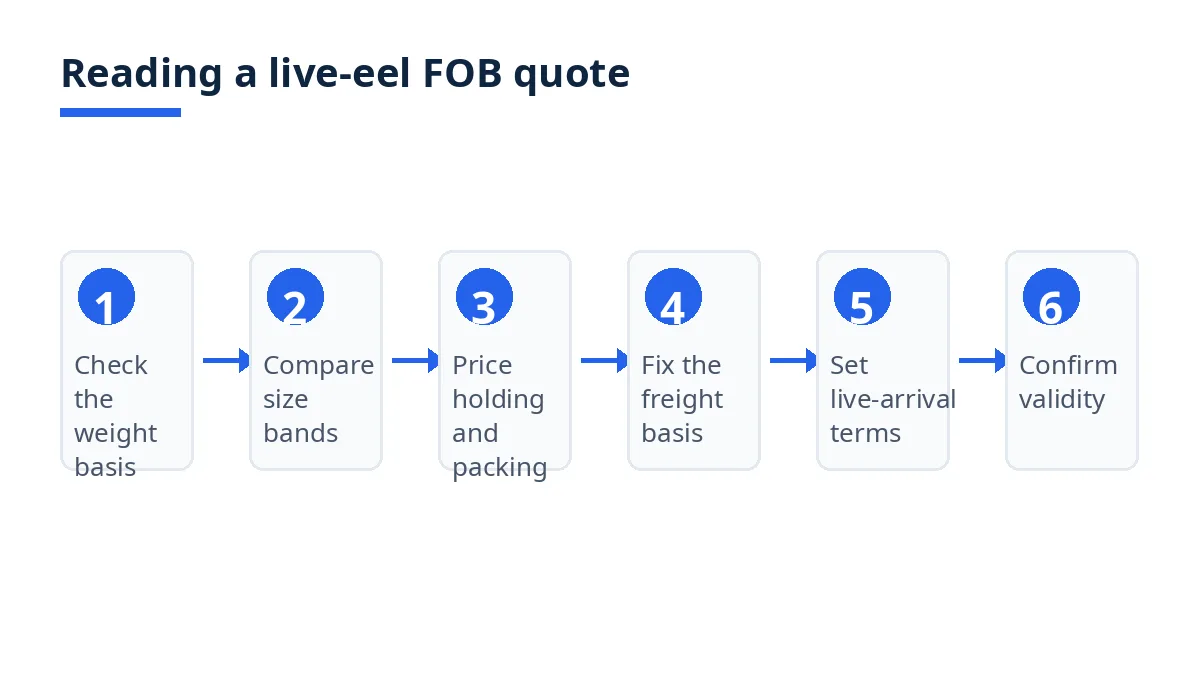
Confirm the animals first. Ask for species, life stage, and the length or weight band for every line. One price for mixed sizes hides the band that drives value, so ask for a price per band, not a blended average.
Fix the weight basis. Ask whether the price applies to live weight at loading, live weight at arrival, or a mortality-adjusted weight, and how payable weight is measured. Ask who weighs the shipment, at which point, and what record proves the weight.
Read the size and grade bands. Ask for band boundaries, the share of the shipment in each band, and the tolerance for animals outside a band. A band defined only as "medium" cannot be checked at arrival.
Price holding and packing as lines. Ask for the holding period included, the packing method for the stated transit time, the weight or count per pack, and whether packing is in the per-kilogram price or charged apart.
Fix the freight basis. Under FOB the buyer pays main carriage, so ask for the freight basis separately: mode, route, transit time assumed, and who bears cost if routing changes. Compare freight lines on the same transit time.
Set the live-arrival terms. Agree the arrival condition, the counting and weighing point, the mortality threshold, the evidence required, and the remedy for loss above that threshold, before confirming the order.
Confirm validity and documents. Ask for the validity date, currency, payment terms, and document set, and check each document against the export set below.
Costs, timelines and documents
What are the typical costs and timelines?
There is no typical live-eel price or timeline a guide can state as fact, because each quotation prices a specific species, size band, holding routine, packing method, loading window, and delivery term. The lines below are the structure to ask for, and every figure in them is an example only. Example figures: a quotation might show a per-kilogram price for loaded live weight, plus separate lines for holding beyond the included period, packing materials and labor, and freight for a stated transit time. Add those lines on the same weight basis before comparing quotations.
The weight-basis adjustment is where most comparisons go wrong, so work it in numbers. Example figures: suppose a shipment loads 1,000 kg live weight, and 5 percent do not arrive alive, leaving 950 kg live on arrival. A price of 20 currency units per kilogram on loaded weight gives 20,000 units, which is 21.05 units per kilogram of live animals actually received. A second quotation at 21 units per kilogram on arrival weight gives 19,950 units for the same 950 kg received. The second quotation looks dearer on paper and costs less for the live animals received. Repeat the arithmetic with the actual quoted figures, mortality threshold, and weighing point in each quotation.
Size bands change the same arithmetic. Example figures: a quotation might price three length bands separately, with the middle band carrying the largest share of shipment weight, and a tolerance of 5 percent outside the stated band. If the delivered mix shifts toward a lower-priced band, shipment value falls even when total loaded weight is unchanged. Ask for the band mix, the tolerance, and the price adjustment when the mix falls outside tolerance.
Timelines for live eels are loading windows and transit times, not single delivery dates. Ask for the holding period included, the packing date, the loading window, and the transit time the packing and freight lines assume. If the vessel is delayed past the window, ask in advance what holding charge applies, whether the animals are regraded or repacked, and who pays.
Which documents are needed?
For export clearance in Bangladesh, goods may not be loaded unless an export declaration, the Bill of Export or Shipping Bill, is submitted to Customs and approved.3 The enclosed documents for all export consignments include the export letter of credit or, where there is none, the export contract, purchase order, or export guarantee approved by the negotiating bank, the commercial invoice, the packing list, the EXP form certified by an authorized dealer, the certificate of origin issued by the Export Promotion Bureau or a Chamber of Commerce and Industry, the VAT registration certificate, and the taxpayer identification number.3 Product-wise additional documents may also be required, and the Customs page notes a Department of Fisheries quality control certificate where the destination country requires one, as for frozen fish.3 For live eels, ask the seller and the destination authority which additional certificates the destination requires.
The purchase order should carry the species and band, weight basis and weighing point, packing method and transit time, loading window, live-arrival terms, validity date, and adjustment for mix or mortality outside tolerance. A line missing from the purchase order is missing from the contract.
Bangladesh-specific rules and tips
Confirm the species before discussing price. Different species and life stages are different goods for classification, destination rules, and price. The European eel, Anguilla anguilla, was listed in Appendix II of CITES in 2007, regulating its international trade, and import and export from the European Union has been prohibited since 2010.4 That rule is specific to the European eel and the European Union, and does not by itself describe the rules for other species or destinations. State the species in the enquiry, and check destination rules for that species before confirming a price.
Use the classification to check the quotation. Heading 0301 covers live fish, and subheading 0301.92 covers eels of the genus Anguilla, split by length bands.2 Ask the seller to state the classification on the export declaration, and check that the declared band matches the quoted band. A mismatch is a warning sign, because the buyer may face a different duty or entry treatment at destination than the quotation assumed.
Ask where holding and loading happen, and get it in writing. No public source consulted for this article states the location or capacity of live-eel holding facilities in Bangladesh, so this guide states no such figures. Ask each seller, in writing, for holding location, holding capacity for the stated band, loading point, and transit time to the port. A seller that cannot state holding capacity for the quoted band cannot credibly promise the quoted loading window.
Mistakes and red flags
What are the most common mistakes?
Comparing prices on different weight bases. Comparing a loaded-weight price with an arrival-weight price, or a price with a mortality allowance against one without, as if they were the same figure, is the most common mistake. Rework every quotation to a cost per kilogram of live animals received before ranking quotations.
Accepting a single blended price for mixed sizes. A blended price hides the band mix, and the delivered mix can shift shipment value without changing total weight. Ask for a price per band, the band mix, and the tolerance and adjustment for mix outside tolerance.
Leaving holding and packing out of the comparison. Holding beyond the included period, packing materials, and repacking after a delay are real lines. A quotation omitting them is not cheaper; it is incomplete. Ask for each line, and for the charge when loading slips past the window.
Comparing FOB with CFR or CIF as if they were the same term. Under FOB the buyer contracts and pays main carriage, while under CFR or CIF the seller arranges carriage, and under CIF also insurance, with risk still transferring on board.1 A CFR or CIF price close to an FOB price is not comparable until freight, insurance, transit time, and the risk point are separated out.
Agreeing live-arrival terms after loading. Mortality thresholds, counting points, evidence, and remedies must be agreed before loading, because after arrival the evidence is harder to gather and the animals cannot be reloaded. A seller that will not put live-arrival terms in writing before loading is a seller to question.
Checklist
Before confirming a quotation, every line below should be answered in writing.
Species, life stage, and length or weight band for every price line.
Weight basis: loaded live weight, arrival live weight, or mortality-adjusted weight, with weighing point and proof.
Price per size band, band mix, tolerance, and adjustment for mix outside tolerance.
Holding period included, packing method for the stated transit time, weight or count per pack, and packing charges.
Freight basis: mode, route, transit time assumed, and cost if routing changes.
Loading window, holding charge past the window, and regrading or repacking terms.
Live-arrival terms: arrival condition, counting point, mortality threshold, evidence, and remedy.
Validity date, currency, and payment terms.
Export set: Bill of Export, commercial invoice, packing list, EXP form, certificate of origin, and any destination certificate.3
Classification on the declaration matches the band in the quotation.2
How Exportain helps
On Exportain, browse suppliers and post a request for quotation (RFQ) on the RFQ board with the species, band, weight basis, packing and transit time, loading window, and live-arrival terms you require, so suppliers quote against the same specification. Compare replies only after reworking each one to a cost per kilogram of live animals received. When you accept a quotation, Exportain creates one order and issues one proforma invoice from the accepted terms.5
Read the badges for what they record. Exportain Verified means Exportain has checked identity, phone, email, and business registration, and Export Verified means it has checked the Export Registration Certificate.5 Factory Verified means it has reviewed photos of the factory, while Trading Company Verified means it has reviewed photos of the office or warehouse.5 Verification is a document review by staff, free, and never granted by membership plans.6 It is not a factory inspection,5 6 so grading, packing, and loading checks stay with you. See how supplier verification works on Exportain.
FAQs
What should I know first about live eels?
Know the animals before the price. State the species and the length or weight band, because live eels sit under heading 0301, with subheading 0301.92 covering eels of the genus Anguilla, split by length bands.2 Then fix the weight basis, packing, and live-arrival terms, because those lines decide the cost per kilogram received. For the European eel, check destination rules first: it was listed in CITES Appendix II in 2007, and import and export from the European Union has been prohibited since 2010.4
What are the typical costs and timelines?
There are no typical figures a buyer can rely on, because each quotation prices a specific species, band, holding routine, packing method, loading window, and delivery term. Cost is the per-kilogram price on a stated weight basis, plus holding, packing, and freight. Timelines are the holding period, loading window, and transit time, with a stated rule if loading slips past the window.
Which documents are needed?
The order documents are the enquiry, the quotation, and the purchase order carrying every agreed line. The Bangladesh export set is the Bill of Export, commercial invoice, packing list, EXP form certified by an authorized dealer, certificate of origin, VAT registration certificate, and taxpayer identification number, with product-wise additional documents where the destination requires them.3 Ask separately which destination certificate applies to live eels for your market.
What are the most common mistakes?
The most common mistakes are comparing prices on different weight bases, accepting a blended price for mixed sizes, leaving holding and packing out, comparing FOB with CFR or CIF as if they were the same term,1 and agreeing live-arrival terms only after loading. Avoid each one the same way: get the weight basis, band mix, packing, freight basis, validity, and live-arrival terms in writing before confirming.
Next steps on Exportain
Browse suppliers, then post your species, band, weight basis, and live-arrival terms on the RFQ board so suppliers state their FOB lines on the same basis. Before you confirm, read how supplier verification works on Exportain and the MOQ definition guide.
Sources
- FOB & FAS Incoterms® 2020 explained: Key differences. ICC Academy (accessed )
- Live fish - UK Integrated Online Tariff, Heading 0301. GOV.UK (accessed )
- Customs Clearance Procedures for Export. Bangladesh Customs, National Board of Revenue (accessed )
- European Eel: a Slippery Mystery. IUCN (accessed )
- Trust & Safety Center. Exportain (accessed )
- Supplier verification: Earn trust badges buyers can see. Exportain (accessed )
About the author
Sourcing from Bangladesh?
Post a request for quotation and suppliers on Exportain can send you their quotes directly.
Post an RFQ