

Top LED Bulbs Manufacturers in Bangladesh: How to Find and Verify Them
Eight LED-bulb-specific checks for shortlisting manufacturers in Bangladesh: lumen and wattage evidence, color quality, driver flicker, LM-80 lifetime support, standards evidence, cap and voltage fit, batch consistency, and warranty terms.
Short answer
LED bulbs manufacturers in Bangladesh should be shortlisted with eight product-specific checks, not a ranking: lumen and wattage evidence from test reports, color rendering and temperature consistency, driver quality and flicker figures, LM-80 data behind lifetime claims, standards and BSTI evidence, cap and voltage fit, batch consistency with burn-in sampling, and written warranty terms.
On this page
A bulb that looks right in a photograph can still fail on light output, color, flicker, or early failure, and those failures only show after installation. Shortlist suppliers with product-specific checks, then test samples against a written specification before paying for a full order. No ranking here names a factory, because a ranking would hide the checks that protect the buyer.
Key takeaways
Shortlist by checks, not claims. Ask every supplier for the same test evidence on the same specification.
Light output is a measured pair, lumens and watts, not a wattage-equivalence slogan. The exact-model test report is the evidence.
Color, flicker, and lifetime claims each need their own document. One general report does not prove all three.
Standards evidence must be checked by scope. A licence, certificate, or mark is only useful when the model, the standard, and the producing site match the order.
Batch quality is decided by sampling and burn-in, not by a single sample. Keep a sealed reference sample for the shipment check.
Price and minimum order quantity (MOQ) follow the specification. Chip, driver, housing, testing, and packing move the quote more than location does.
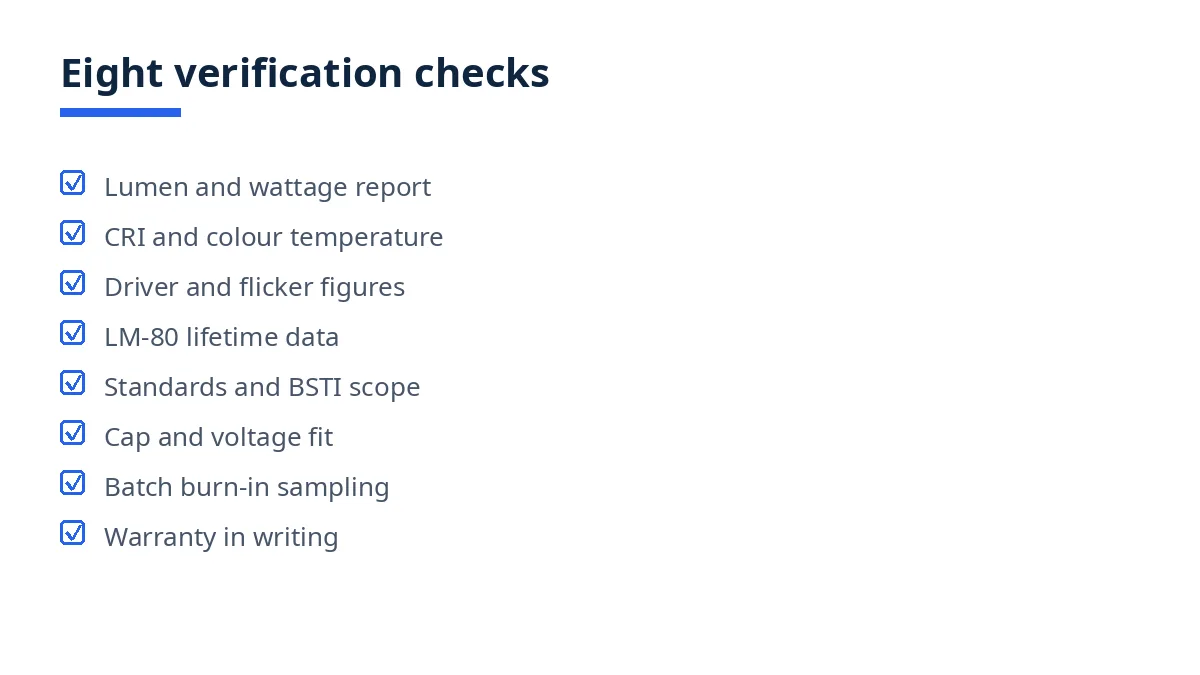
The list: eight verification checks before you shortlist a manufacturer
The eight checks below state what to ask for, why it matters, and how to fix a gap before it becomes a shipment problem. Keep every answer in the quotation or message thread.
1. Lumen and wattage evidence from a test report
What. Ask for the rated luminous flux in lumens, the rated power in watts, and the resulting efficacy in lumens per watt, for the exact model on offer, supported by a laboratory test report naming that model.
Why it matters. IEC 62612, the performance standard for self-ballasted LED lamps for general lighting, covers lamps with a rated power up to 60 W and a rated voltage above 50 V alternating current up to 250 V alternating current, with performance requirements and test methods.1 A wattage-equivalence claim alone gives the buyer no measured light output to check against.
How to fix it. Put lumens, watts, and efficacy in the specification, and ask for the report page showing them. Treat a report for a different model as unproven.
2. Color rendering and color temperature consistency
What. Ask for the color rendering index (CRI, Ra), the correlated color temperature (CCT) in kelvin, and the tolerance the supplier will hold across the batch, supported by the same model test report.
Why it matters. Two bulbs with the same lumen figure can render colors very differently, and a mixed batch will look inconsistent in one room. The ENERGY STAR specification for integral LED lamps sets a minimum CRI (Ra) of 80, with an R9 value above zero, and CCT targets with tolerances for nominal values such as 2700 K, 3000 K, 3500 K, and 4000 K.2
How to fix it. Name one CCT, one minimum CRI, and one R9 floor in the specification, and require the batch to stay inside an agreed tolerance. Test samples side by side, and reject a supplier promising only a CRI range without a report.
3. Driver quality and flicker figures
What. Ask for the driver type, the dimming behavior if the bulb is dimmable, and flicker figures: percent flicker, flicker index, and modulation frequency, measured at the operating conditions you will use.
Why it matters. An LED runs on direct current, so the driver must convert and stabilize the alternating-current supply. A basic rectified supply can let light output dip at each cycle valley, and most LED bulbs operate at a flicker frequency of 100 to 120 Hz, matching the input supply.3 At that frequency, the IEEE 1789 guidance described in that source advises a low-risk flicker percentage of 8 percent, with 3 percent needed to remove flicker effects entirely.3
How to fix it. Ask for a flicker test report, not the phrase flicker free on its own. State the dimming levels to be tested, because flicker at full brightness does not prove flicker at a dimmed level.
4. LM-80 data behind lifetime claims
What. Ask for the LM-80 test data for the LED package used in the bulb, including the test duration, the drive current, the case temperatures, and the TM-21 projection that follows from that data, if a lifetime figure is claimed.
Why it matters. LM-80 is a test method, not a lifetime promise. In the method of the Illuminating Engineering Society, batches of LEDs are tested at a specified drive current and temperature, with luminous flux and CCT measured at intervals, for a minimum of 6,000 hours, and the results are extrapolated using TM-21 to a lumen-maintenance projection, typically to 70 percent of initial output.4
How to fix it. Read the claim backwards: from claimed hours, to TM-21 projection, to LM-80 duration and temperatures. Revise in writing any claim exceeding what the test duration supports, or any finished-bulb claim based on data for a different LED package.
5. Standards and BSTI evidence, checked by scope
What. Ask for the exact standard and licence or certificate the supplier relies on for the model on offer, including the licence number, the scope, the producing site, and the expiry date, and check it with the issuing body where a register exists.
Why it matters. A published BSTI licence guide lists LED lamps under BDS 1851 among the products in its mandatory-product material, and it describes a licensing path running from application and factory inspection through sample collection, laboratory testing against the relevant Bangladesh Standard, and licence issuance.5 A mark on a carton is not enough on its own: the licence must cover the product, the standard, and the site.
How to fix it. Ask the supplier to state the BDS or IEC standard for the exact model, and to show the licence or certificate page naming it. If the document covers a different product, site, or expired period, treat the compliance claim as unproven, and add the destination market's own standard to the same check.
6. Cap, base, and voltage fit for the destination
What. Ask for the lamp cap type, such as E27 or B22, the rated voltage range, the frequency range, and the physical dimensions of the bulb, and confirm them against the sockets and supply in the destination market.
Why it matters. IEC 62612 applies to lamps with a lamp cap as listed in IEC 62560 and a rated voltage above 50 V alternating current up to 250 V alternating current.1 A bulb with the right light output and the wrong cap cannot be installed, and a bulb rated for a narrow voltage range can fail or behave badly on a different supply.
How to fix it. Put cap, voltage range, frequency range, and maximum dimensions in the specification, and test the sample in its actual socket type. Split mixed orders by cap and voltage.
7. Batch consistency and burn-in sampling
What. Ask how the supplier checks consistency across a production batch: the sample size, the burn-in period before testing, the measurements taken on the batch sample, and the action taken when a sample fails.
Why it matters. LED output, color, and driver behavior can vary between production runs, and a single sample approved months before production does not prove the shipped batch. Burn-in, running bulbs for a set period before measurement, catches early failures and unstable output before packing. Without an agreed sampling plan, the buyer has no rule for accepting or rejecting a shipment.
How to fix it. Agree the plan in writing before production: how many bulbs per batch are tested, how long burn-in runs, which measurements are recorded, and what happens to a failed lot. Keep one sealed approved-batch sample as the reference for the shipment inspection.
8. Warranty terms in writing, including failure handling
What. Ask for the warranty period, what it covers, what it excludes, who pays return freight, how failed bulbs are replaced or credited, and what evidence the buyer must supply for a claim.
Why it matters. A lifetime projection is not a warranty, and a warranty covering only the LED chip, or only defects found before installation, leaves the buyer carrying most failures. A supplier that will not put failure handling in writing asks the buyer to carry early-failure risk.
How to fix it. Write the warranty into the order terms, with the claim process, the response time, and the remedy for each failure type. Ask how batch failures are handled, since a batch problem needs a lot-level remedy.
Summary table
Check | What to ask for | Main gap it catches |
|---|---|---|
Lumen and wattage evidence | Exact-model report: lumens, watts, efficacy | Equivalence slogans, no measured output |
Color rendering and temperature | CRI, CCT, batch tolerance from the report | Mixed whites, poor color rendering |
Driver quality and flicker | Driver type, percent flicker, index, frequency | Visible flicker, poor dimming |
LM-80 lifetime support | LM-80 duration, temperatures, current, TM-21 projection | Lifetime claims with no test chain |
Standards and BSTI evidence | Licence or certificate: scope, site, expiry | Marks not covering the model ordered |
Cap, base, and voltage fit | Cap type, voltage range, frequency range, dimensions | Bulbs that cannot be installed or supplied |
Batch consistency and burn-in | Sample size, burn-in period, measurements, failed-lot action | Good samples, poor shipped batches |
Warranty terms | Period, cover, exclusions, freight, claim process | Failure costs left with the buyer |
Where LED bulb factories sit, and what sets capacity, MOQ and price
Do not accept a location claim without a producing site. A supplier may sell bulbs made in one factory, assembled elsewhere, or bought from a third party, and each arrangement changes what you can check. Ask for the name and address of the site that will make your order, whether assembly, driver fitting, and testing happen at that site, and which steps are subcontracted.
Capacity is a question about lines and shifts, not a headline number. Ask how many assembly and testing lines will run your order, how many shifts they run, and the daily output for your exact model, including burn-in and packing time. Put the line, the shift plan, and the delivery date for your model in the order terms.
MOQ is set per model and per variant, not per supplier. Each cap type, wattage, CCT, and packing style can carry its own MOQ, because the supplier must set up the line, source the LED package and driver for that variant, and run the batch test for it. The guide to MOQ in the supply chain explains how MOQ works as a supply-chain term. Ask for each variant's MOQ separately.
Price follows the same specification logic. The main drivers are the LED package and efficacy, the driver and flicker performance, the housing and heat sink, testing and burn-in time, and packing and carton marking. A lower quote usually reflects a change in one of those items. Example figures: when two bulbs share a lumen figure, ask which item differs before accepting the lower price. Compare quotes on the same lumens, CRI, CCT, cap, driver figures, warranty, and Incoterm, and question any line that is missing.
The guide to how to import LED bulbs from Bangladesh covers the ordering steps, and the LED bulbs quality control checklist turns these checks into inspection points.
How Exportain helps
Exportain is a B2B marketplace for sourcing from Bangladesh. Buyers search published products by keyword and category, filter by badge, sample availability, and OEM or ODM capability, and post an RFQ stating quantity, target price, destination, Incoterm, required certifications, and deadline.6 Each supplier profile shows its verification level, location, main products, and declared certifications.6
Use the badges as a starting filter, not a conclusion. On Exportain, supplier badges record document and photo checks reviewed by the Exportain team, and the guide to how supplier verification works on Exportain sets out what each badge does and does not cover.7 Run the eight checks above on your shortlist, and keep the exchange in the RFQ and message thread so the agreed specification and warranty terms are recorded in one place.
FAQs
What is the biggest mistake buyers make when sourcing LED bulbs from Bangladesh?
Choosing a supplier by unit price before checking the product evidence. A bulb quoted cheaply may carry a lower-efficacy LED, a simpler driver with higher flicker, or no burn-in testing, and none of those differences show in a photograph. Compare the same specification from each supplier, then verify the one you choose with test reports and a sample measured against that specification.
How can I avoid it?
Send one identical specification to every supplier you quote, covering lumens, watts, CRI, CCT, cap, voltage, flicker figures, lifetime evidence, batch sampling, and warranty. Name the producing site in the order terms, approve a sample from the production batch, and set the sampling and inspection plan in writing before production starts.
Who is responsible for quality, the factory or the buyer?
Both, at different points. The factory is responsible for making bulbs to the agreed specification and the approved sample. The buyer is responsible for making that specification complete and checkable, and for inspecting against it before shipment. In a dispute, the side with the written specification, sealed sample, test reports, and inspection record is the side whose version counts.
Where can I get help verifying a supplier?
Start with the records that exist: the issuing body for any licence or certificate, the test laboratory named on a report, and an inspection provider for the pre-shipment check.5 On Exportain, read what each profile badge covers before relying on it, and message the supplier through its profile so questions and answers stay in one thread.7
Next steps on Exportain
Browse Bangladeshi suppliers and filter the electrical listings by badge, MOQ, and OEM or ODM capability. Before you order, read how supplier verification works on Exportain so you know what each badge covers. Then post a free RFQ with your LED bulb specification, quantity, destination, and Incoterm, and compare the versioned quotations that come back.
Sources
- IEC 62612 Ed. 1.0 b:2013 — Self-ballasted LED lamps for general lighting services with supply voltages > 50 V - Performance requirements. International Electrotechnical Commission (IEC) via ANSI (accessed )
- ENERGY STAR Integral LED Lamp Specification V.1.4. U.S. Environmental Protection Agency (ENERGY STAR) (accessed )
- Identifying and Rectifying LED Flicker Problems. Shenzhen Benwei Lighting Technology Co., Ltd., (accessed )
- What is an LM-80 Report | Lighting Terminology Explained. Decrolux (accessed )
- How to Obtain BSTI License in Bangladesh. LegalSeba LLP, (accessed )
- How to source and buy from Bangladesh. Exportain (accessed )
- Supplier verification: Earn trust badges buyers can see. Exportain (accessed )
About the author
Sourcing from Bangladesh?
Post a request for quotation and suppliers on Exportain can send you their quotes directly.
Post an RFQ


