Quality Control Checklist for LED Bulbs From Bangladesh
A numbered QC checklist for LED bulbs from Bangladesh: flux and efficacy, colour temperature and rendering, E27 and B22 cap fit, flicker and dimming, burn-in, lamp marking, energy labels and packing, with fixes for common failures.
Short answer
Use this LED bulbs quality control checklist to check luminous flux and efficacy against the declared rating, colour temperature and rendering, cap fit for E27 and B22 holders, driver and flicker behaviour, burn-in results, lamp marking and energy-label data, and carton packing on bulbs from Bangladesh before shipment. Agree the sample, test methods and acceptance numbers in the purchase order.
On this page
Key takeaways
Agree the model specification, declared values, test methods and acceptance numbers before inspection, and draw the sample randomly across models, colour temperatures and cartons.
Measure flux and on-mode power on the same lamps and compute efficacy from those readings, then check colour temperature and consistency carton by carton, because a model can pass lamp by lamp and drift as a consignment.
For EU orders, Regulation (EU) 2019/2020 Annex II, Table 4 sets CRI of at least 80, colour consistency within a six-step MacAdam ellipse or less, Pst LM at or below 1.0 and SVM at or below 0.4 at full load, subject to stated exceptions.
Check the label file as carefully as the lamp: lamp marking and pack data under Regulation (EU) 2019/2020, the printed energy label and database entry under Regulation (EU) 2019/2015, and the BSTI document position confirmed for the exact model.
Use this LED bulbs quality control checklist to check a shipment before it leaves Bangladesh. A bulb is judged in the holder and on the meter: a lamp that fits poorly, reads below its declared flux or flickers fails in use. Use an agreed sampling plan rather than lamps the factory selects. ISO 2859-1:2026 defines acceptance sampling plans for inspection by attributes, using the acceptance quality limit (AQL) to determine sample sizes and acceptance and rejection thresholds.1
Why this checklist matters
LED bulbs concentrate risk in a small assembled product: the cap decides whether the lamp installs, the module and driver decide flux, colour and flicker, and the label decides whether the pack can be sold. A hidden fault, such as a substituted driver, shows only on powering and measuring.
A written checklist removes interpretation. Each point is checked against the approved sample and test file, and recorded as pass, fail or not applicable. Sampling and acceptance are set in the purchase order, not in this checklist: ISO 2859-1:2026 indexes its schemes by AQL for lot-by-lot inspection.1 See the AQL acceptance quality limit explainer.
Before you start
Do not begin until the references are complete: an approved pre-production sample per model, built with the production module and driver, the order documents, the test reports for the exact model, and the packing specification. The specification names each model separately: cap type such as E27 screw or B22 bayonet, shape, rated voltage, on-mode power, flux, colour temperature, colour rendering index, beam angle for directional lamps, dimming status and rated lifetime. Agree the sampling plan in advance,1 and draw the sample randomly across cartons.
Fix the market file before inspection. For the European Union, Commission Regulation (EU) 2019/2020 lays down ecodesign requirements for light sources and separate control gears, including light sources in a containing product.2 Commission Delegated Regulation (EU) 2019/2015 establishes labelling requirements for light sources on the same basis.3 Confirm the BSTI Certification Marks position for your exact model with the exporter before shipment and keep the copy with the order file. Read how to import LED bulbs from Bangladesh alongside this checklist.
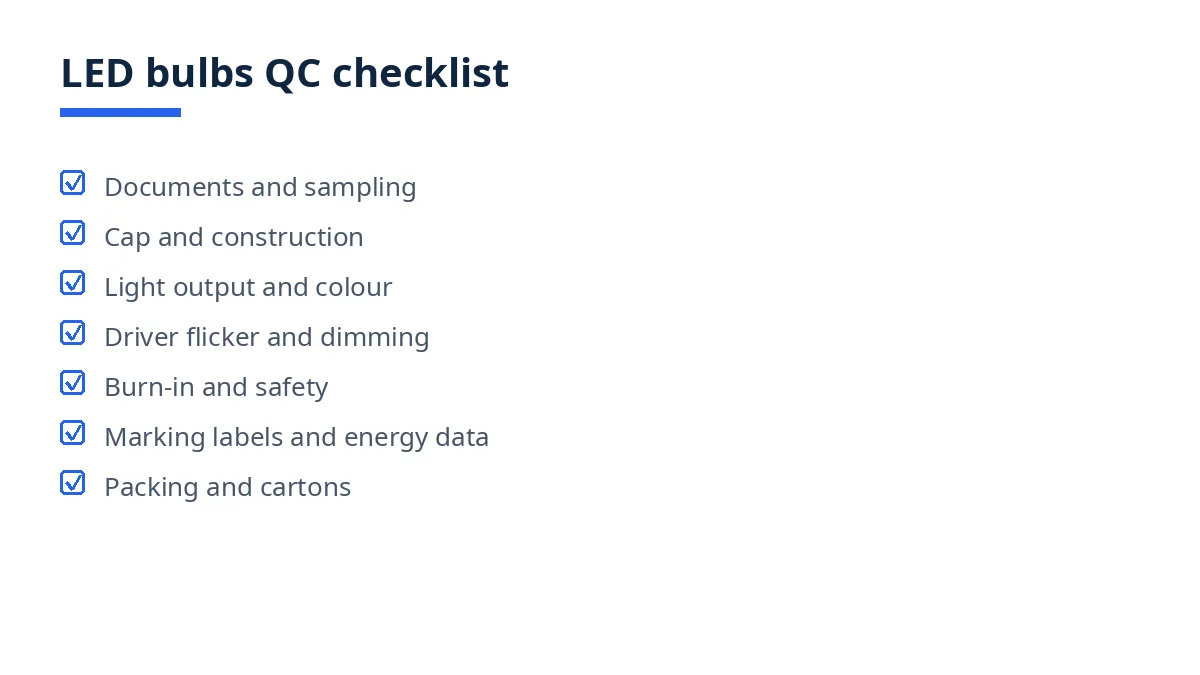
The full checklist (numbered, printable)
Specification, documents and sampling
Draw the sample randomly across models, colour temperatures and cartons under the agreed sampling plan, and record the lot size and cartons opened.
Check each sampled lamp against the specification and approved sample: model, cap type, shape, rated voltage and dimming status must agree.
Check the test file for the exact model: report identifiers, cap type and rated values must match the model in hand, not another wattage or a bare module.
Confirm the BSTI Certification Marks document position for the exact model with the exporter, and file the copy before shipment.
Cap, housing and construction
Fit each sampled lamp in a holder of the ordered cap type, E27 screw or B22 bayonet: it seats fully, makes contact and removes without forcing.
Check cap fixing and construction: no loose or rotating cap, cracks, exposed conductor or housing gap, and no dents, sharp edges or discoloration on housing or diffuser.
Check the lamp is complete and factory sealed, with no signs of opening or substituted parts. IEC 62612 covers performance requirements for self-ballasted LED lamps with integral means for stable operation,4 so a lamp rebuilt with another driver is not the tested product.
Power each sampled lamp at the rated voltage for the destination market and confirm it starts at once, with no delay, buzzing or instability.
Light output, power and colour
Measure useful luminous flux by the photometric method named in the inspection plan, and compare each result with the declared flux.
Measure on-mode power on the same lamps, compute efficacy as flux divided by power, and compare both with the declared rating.
For European Union orders, check declared power against Annex II, point 1 of Regulation (EU) 2019/2020: declared power shall not exceed a maximum allowed power calculated from declared flux and declared colour rendering index.2
Measure correlated colour temperature, compare each result with the declared value for that variant, and record values per carton.
Compare colour rendering evidence with the declared index. Annex II, Table 4 of Regulation (EU) 2019/2020 sets a colour rendering index of at least 80, subject to its stated exceptions.2
Check colour consistency across the sample and cartons. Annex II, Table 4 of Regulation (EU) 2019/2020 sets colour consistency for LED light sources as variation of chromaticity coordinates within a six-step MacAdam ellipse or less.2
For directional lamps, check measured beam angle against the declared angle, and confirm the flux figure states sphere or cone, as the packaging rule requires.2
Driver, flicker and dimming behaviour
Check flicker at full load with the meter named in the inspection plan. Annex II, Table 4 of Regulation (EU) 2019/2020 sets Pst LM at or below 1.0 and SVM at or below 0.4 at full load for LED mains light sources, subject to its stated exceptions.2
Operate dimmable models on the named dimmers: check for drop-out, shimmer, dead travel and noise, record the dimmers used, and confirm restart at full output after cycling.
Confirm non-dimmable models carry the required dimming warning, and that no dimmable claim appears on a model tested as non-dimmable.
Where a model has a standby mode, measure standby power. Annex II, point 1 of Regulation (EU) 2019/2020 provides that standby power shall not exceed 0.5 W, and networked standby power shall not exceed 0.5 W.2
Burn-in, ageing and safety checks
Run the burn-in or ageing run set in the inspection plan, record every early failure by model and carton, then re-measure flux and colour temperature against pre-run readings.
Confirm safety evidence covers the finished lamp, and check insulation and enclosure after burn-in: no cracking, softening or loosened cap. IEC 62560:2011 specifies safety and interchangeability requirements, with test methods and conditions to show compliance, for self-ballasted LED lamps for domestic and similar general lighting.5
Check the scope of the evidence against the model: IEC 62612 applies to lamps rated up to 60 W and above 50 V AC up to 250 V AC, with a cap as listed in IEC 62560,4 whose caps sit in Table 1 of that standard.5
Marking, labels and energy data
Check the marking on the lamp itself. Annex II, point 3(a) of Regulation (EU) 2019/2020 requires useful luminous flux and correlated colour temperature on the light source itself where space allows, and the beam angle for directional lamps.2
Check the retail packaging against Annex II, point 3(b) of Regulation (EU) 2019/2020: flux, colour temperature, beam angle for directional lamps, cap type, L70B50 lifetime in hours, on-mode power and colour rendering index.2
For European Union orders, check the energy label and product data. Article 3 of Regulation (EU) 2019/2015 requires each light source sold as an independent product to carry a label printed on the packaging, with product information sheet values entered into the public part of the product database.3
For United States packs, check the Lighting Facts information against the measured values: the Federal Trade Commission label lists brightness in lumens, estimated energy cost and life span, light appearance, wattage, and whether the bulb contains mercury.6
Packing and cartons
Confirm each retail pack contains the model, cap type and colour temperature its label states, and that barcode stickers scan and match the purchase order.
Check carton protection: lamps held so caps and diffusers cannot crush or abrade in transit, with the specified dividers or trays.
Weigh and measure sample cartons, and check markings, carton count and gross weight against the packing list.
Common failures and how to fix them
The most frequent failure is flux below the declared rating, usually from a module or driver substitution after sample approval. Stop, re-measure lamps built with the production module and driver, and hold the lot until the build matches the test file. Colour drift between cartons is next: re-sort by measured colour temperature and sample again.
Cap fit failures, where an E27 lamp binds or a B22 lamp sits loose, point to a cap batch fault: holder-test each batch and segregate the faulty batch. Flicker points to the driver: change the driver specification and re-test. Dead lamps after burn-in point to one production window: isolate it by carton marks and re-run burn-in.
Above the agreed acceptance level, options are re-inspection after sorting or rework, documented partial acceptance, or rejection.
Downloadable template / summary table
Copy the checklist into your inspection sheet, add the specification and acceptance numbers, and record a result per model.
Section | Checks | Evidence |
|---|---|---|
Documents and sampling | Sample, model, test file | Plan, reports |
Cap and construction | Holder fit, cap fixing | Fit checks |
Light and colour | Flux, efficacy, colour | Meter readings |
Driver behaviour | Flicker, dimming, standby | Readings |
Burn-in and safety | Ageing run, safety scope | Burn-in log |
Marking and labels | Lamp marking, energy label | Artwork, database |
Packing | Contents, protection, cartons | Packing list |
How Exportain helps
Exportain is a B2B marketplace connecting buyers with Bangladeshi suppliers of LED bulbs and electrical products, so the specification behind this checklist can be agreed at the enquiry stage. Browse suppliers, use inspection services when you plan the check, and plan the final check with the pre-shipment inspection guide. Supplier profiles show which document and photo checks have been recorded, not factory inspections. Exportain is not a party to the contract and does not inspect goods.
FAQs
When should this checklist be used?
Use it at final inspection, when lamps are finished and goods are largely packed. For larger and first orders, also use the photometric, cap-fit and burn-in points during production.
Who should complete it?
The buyer, a local agent or an independent inspector can complete it, using the approved sample, the specification and the test file.
What are the most common failures?
Flux below the declared rating, colour drift between cartons, loose or binding caps, flicker and early burn-in failures are the most common failures.
Can a third party do it?
Yes, if you share the approved references, declared values and acceptance levels first, and the inspector reports measured values per model.
Next steps on Exportain
Before production starts, agree your specification and label artwork, then read how to import LED bulbs from Bangladesh and the pre-shipment inspection guide, and plan the check with inspection services. You can also post a free RFQ via RFQs.
Sources
- ISO 2859-1:2026 - Sampling procedures for inspection by attributes — Part 1: Sampling schemes indexed by acceptance quality limit (AQL) for lot-by-lot inspection. International Organization for Standardization (accessed )
- Commission Regulation (EU) 2019/2020 laying down ecodesign requirements for light sources and separate control gears. European Union (accessed )
- Commission Delegated Regulation (EU) 2019/2015 with regard to energy labelling of light sources. European Union (accessed )
- IEC 62612:2013+AMD1:2015+AMD2:2018 CSV - Self-ballasted LED lamps for general lighting services with supply voltages > 50 V - Performance requirements. International Electrotechnical Commission (accessed )
- IEC 62560:2011 - Self-ballasted LED-lamps for general lighting services by voltage > 50 V - Safety specifications. International Electrotechnical Commission, (accessed )
- FTC Materials Will Help Shoppers Understand New Light Bulb Labels Coming in 2012. U.S. Federal Trade Commission (accessed )
About the author
Sourcing from Bangladesh?
Post a request for quotation and suppliers on Exportain can send you their quotes directly.
Post an RFQ