Top Kitchen Towels Manufacturers in Bangladesh: How to Find and Verify Them
Kitchen towel supply in Bangladesh is organised by maker type: five types, how to find each one, and the kitchen-specific checks on GSM, absorbency, lint and edging that catch a weak supplier before you order.
Short answer
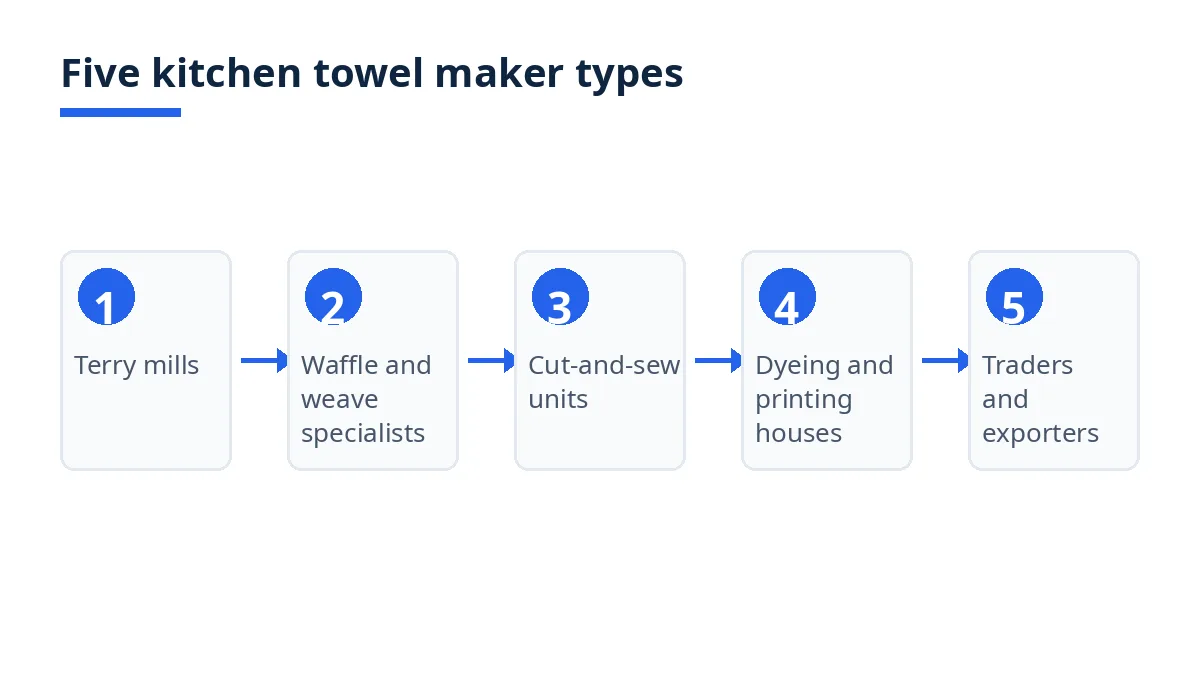
Kitchen towels manufacturers in Bangladesh fall into five types: terry mills, waffle and weave specialists, cut-and-sew units, dyeing and printing houses, and traders and exporters. Find the type that matches your towel first, then verify that maker with kitchen-specific checks on GSM, absorbency, lint, edging and wash durability before you pay.
On this page
Key takeaways
Kitchen towel supply in Bangladesh is organised by maker type: terry mills, waffle and weave specialists, cut-and-sew units, dyeing and printing houses, and traders and exporters.
Find the type first, then the company: a maker that weaves terry fabric and a unit that only cuts and sews bought fabric sell different offers at different risks.
Kitchen checks are GSM, absorbency, lint, edging and wash durability; published terry parameters list linting at 0.9 per cent or less, so agree kitchen-towel targets on your own sample.
Bangladesh home textile exports earned US$871.57 million in fiscal 2024-25, up 2.42 per cent, per Export Promotion Bureau data.
Exportain badges record document and photo checks reviewed by the Exportain team; they are not factory inspections or quality guarantees.
Buyers searching for kitchen towels manufacturers in Bangladesh face a practical problem, not a shortage of suppliers. The home textile sector that makes these towels earned US$871.57 million in exports in fiscal 2024-25, up 2.42 per cent on the previous year, according to Export Promotion Bureau (EPB) data, and its products include various types of terry towels sold mainly to the United States, Germany, France, the United Kingdom and Canada.1 With a sector that broad, a search result that names a factory tells you very little. The useful question is what kind of maker you are dealing with, how you find that kind of maker, and which kitchen-specific check proves it can make your towel.
A kitchen towel is not a small bath towel. Kitchen towels are used for wiping and drying dishes, and they are usually produced with a limited pile portion and a low pile height.2 A towel that feels thick in the hand can still leave lint on glassware, dry slowly between uses, or lose its shape after washing. The pile area is the main body of a terry towel and is responsible for absorption and cushioning, while hems and selvedges are separate structures joined into the same product.2 Judge a maker on the towel's working parts, not on catalogue photographs.
For each maker type this guide follows one sequence: what the type is, how to find it, and how to verify it before you order.
Key points to take away
Kitchen towel supply in Bangladesh is organised by maker type: terry mills, waffle and weave specialists, cut-and-sew units, dyeing and printing houses, and traders and exporters.
Find the type first, then the company. A maker that weaves terry fabric and a unit that only cuts and sews bought fabric sell different offers at different risks.
Kitchen checks are GSM, absorbency, lint, edging and wash durability. A published terry-towel parameter set lists linting at 0.9 per cent or less, and absorbency of 35 to 80 per cent for bath towels, so agree your kitchen-towel targets on your own sample rather than borrowing bath-towel figures.2
Terry towels are classified by end use, and kitchen towel is one of those end-use classes, alongside bath, hand and face towels.3 State the end use in every enquiry, because it decides the weave, the pile and the finish.
Exportain badges record document and photo checks reviewed by the Exportain team. They are not factory inspections or quality guarantees.4
The list: kitchen towels manufacturers in Bangladesh by type
The five types below cover how kitchen towels are actually made and sold from Bangladesh. One company can sit in more than one type, and a company can change type from one order to the next if it subcontracts a stage. Ask, for each order, which stages the named company controls itself. That answer, in writing, matters more than the company description on its profile page.
1. Terry mills
What they are. Mills that weave terry fabric on terry looms and then cut, hem and pack kitchen towels from it. Terry fabric is a pile fabric: loops on one or both sides of the fabric give the towel its absorbency, and pile manufacturers use yarns such as combed, compact and zero-twist yarns to control that absorbency and lint behaviour.3 A kitchen towel from a terry mill usually has a short, low pile, because a long bath-towel pile holds water, dries slowly and sheds more lint on glassware.
How to find them. Search for terry towel and kitchen towel production rather than for finished-goods trading, and ask directly whether the company weaves its own terry fabric. A terry mill answers with loom and fabric details: pick construction, pile height and the GSM range it runs. Towel making follows the same wet-processing sequence as other textiles, through desizing, bleaching, mercerizing, dyeing and finishing.3 If a supplier cannot describe that sequence for its own fabric, it is probably buying fabric in.
How to verify them, and fix a miss. Order the sample in the production fabric and at the production GSM, then wash it before approval. Weight and GSM should match the customer's requirement, and a manufacturer calculates pile height, pick density and ends to meet that requirement.3 For commercial kitchen terry, 300 to 450 GSM is presented as the balance between absorbency and drying speed.5 Check the sample after washing for four things: absorbency on a wet plate, lint left on a dark glass, open or skipped stitches at the hems, and size change. Dimensional stability is measured by the residual shrinkage percentage in a finished towel.3
2. Waffle and weave specialists
What they are. Weavers that make flat-weave kitchen towels, above all waffle-weave dish towels, rather than loop-pile terry. A waffle weave is a textured, recessed square weave pattern, also called honeycomb or lattice weave.6 These towels are durable but lightweight, and they are used for wiping spills, scrubbing grime and drying dishes.6 Their selling point for a buyer is different from terry: less bulk, faster drying and a surface that polishes glass without lint.
How to find them. Search for waffle weave and flat-weave dish towels as a separate product from terry towels, and ask the weaver to show the weave structure, not only a finished towel photograph.
How to verify them, and fix a miss. Test the towel on the job it will actually do. Waffle weave kitchen towels are more absorbent than terry cloth in part because the waffle pattern creates more surface area, and they dry more quickly because air circulates through the lightweight, breathable structure.6
3. Cut-and-sew units
What they are. Units that buy woven or dyed fabric and turn it into finished kitchen towels: cutting, hemming, adding hanging loops, labels and packing. After dyeing or printing, woven terry fabric is cut into individual towels along its length, the longer sides are hemmed, and then the end sides are cut and hemmed.2 A cut-and-sew unit's skill is in that finishing work. Its fabric quality, by contrast, is only as good as the fabric it buys.
How to find them. These units are the right search when your order is a defined towel design, a printed or embroidered tea towel, or a size and packing combination that a mill does not offer as standard. Ask which fabric mills the unit buys from and whether it holds fabric stock or buys per order.
How to verify them, and fix a miss. Inspect the fabric before cutting, and approve a pre-production sample made from the bulk fabric and trims. Stitching plays a central part in towel durability and appearance, and the factors behind stitch quality should be checked on the sample, not assumed from a photograph.2 In the European Union, textile fibre names and labelling are harmonised, and labelling of fibre composition is compulsory so that consumers receive correct and uniform information.7
4. Dyeing and printing houses
What they are. Processors that dye, print and finish kitchen towel fabric, either as a service to mills and cut-and-sew units or as the seller of finished printed towels. Towel making passes through desizing, bleaching, mercerizing, dyeing and finishing, and each of those stages affects the towel's hand feel, colour and absorbency.3
How to find them. Search for dyeing and printing capacity separately from weaving, and ask whether dyeing and printing are in-house or sent to another unit. That answer decides who controls shade, lead time and rework.
How to verify them, and fix a miss. Approve a struck-off sample of the exact colour or print on the production fabric, wash it, and compare it with the approved shade under the same light. Check colour fastness after washing, check that printed areas have not stiffened the towel or reduced its absorbency, and check that the care label matches the wash the towel will actually receive. Lint is measured by the weight of fibre collected from the washing machine and tumble dryer during testing.3
5. Traders and exporters
What they are. Export-licensed companies that sell kitchen towels made in partner factories rather than on their own looms or sewing lines. They aggregate capacity across several makers, handle export documentation, and give the buyer one contract and one contact.
How to find them. Search for kitchen towel exporters and trading companies when your order mixes towel types, when your quantity is too small or too mixed for one maker, or when you want one shipment rather than several. Ask at the first enquiry which factory will make each towel type, and whether the trader can show that factory's fabric and sample.
How to verify them, and fix a miss. Get the producing factory named in the order terms, then run the checks for that factory's type from sections 1 to 4 on its sample. For inspection, agree the sampling plan before production: a sampling plan should represent the whole population of the order and cover all its variables, and for inspection an acceptance quality limit (AQL) sampling plan is used to evaluate the defect rate and decide whether the merchandise meets the acceptable norm.2 The guide to how to import kitchen towels from Bangladesh covers the ordering and shipping steps that follow once the maker is confirmed.
Summary table
Type | Find it by | Verify it by |
|---|---|---|
Terry mills | Terry loom and fabric details, pick construction, GSM range | Washed sample in production fabric, GSM, absorbency, lint, hems, shrinkage |
Waffle and weave specialists | Weave structure, cell size, yarn count, flat-weave range | Glass-polishing test, wash test, snagging and loft check |
Cut-and-sew units | Named fabric source, fabric shown before cutting | Fabric inspection before cutting, sample from bulk fabric, hem and label check |
Dyeing and printing houses | In-house or named dyeing and printing unit, dye lots | Struck-off sample on production fabric, wash and colour-fastness check |
Traders and exporters | Export record plus a named producing factory per towel type | Factory named in order terms, type checks on that factory's sample, agreed AQL plan |
Example figures: a buyer writing one specification for all five types might state a 350 GSM terry dish towel, a waffle glass cloth in the same order, a washed sample for each type, and an AQL inspection level agreed before production. Those figures are an example only. Replace them with your own towel's GSM, size, fibre content and inspection level before you send the specification to any supplier.
How Exportain helps
Exportain is a B2B marketplace for sourcing from Bangladesh. Buyers search published products by keyword and category, and can filter to suppliers holding the Exportain Verified badge, sample availability and OEM or ODM capability, and sort by MOQ or lead time.8 Each supplier profile shows its verification level, location, main products and the certifications the supplier has declared.8 Buyers then post a request for quotation (RFQ) stating quantity, target price, destination, Incoterm, required certifications and deadline, and suppliers in that category quote against it.8
Use the platform as the finding step, then run the verification step yourself. A quotation on Exportain is versioned and states unit price, MOQ, lead time, Incoterm, payment terms and validity for each version, so you can compare two makers on the same fields instead of on email text.8 Verification on Exportain is a document and photo review by the Exportain team, not a factory inspection, and membership plans are a separate product that never grants a trust badge.4 The kitchen towels quality control checklist turns these checks into inspection points, and the HS code guide for kitchen towels covers classification for the same order.
FAQs
What is the biggest mistake buyers make when sourcing kitchen towels from Bangladesh?
Choosing a supplier by the quoted price before checking the maker type. A terry mill quoting its own fabric, a cut-and-sew unit quoting bought fabric, and a trader quoting another factory's capacity are three different offers at three different prices. Compare the same specification from the same type of maker, then verify the one you choose.
How can I avoid it?
Write one specification covering weave and pile, GSM, size, fibre content, colour or print, edging, labels and packing, and send the identical document to every supplier you quote. Name the producing factory in the order terms, approve a washed sample from the production fabric, and set the inspection plan in writing before production starts.
Who is responsible for kitchen towel quality, the factory or the buyer?
Both, at different points. The factory is responsible for making towels to the agreed specification and the approved sample. The buyer is responsible for making that specification complete and checkable, and for inspecting against it before shipment.
Where can I get help verifying a kitchen towel supplier?
Start with the records that exist: the trade body's sector information for registration, the test method behind any absorbency or lint claim, and an inspection provider for the pre-shipment check.1
Next steps on Exportain
Browse Bangladeshi suppliers and filter the kitchen towel listings by badge, MOQ and sample availability. Before you order, read how supplier verification works on Exportain so you know what each badge covers. Then post a free RFQ with your kitchen towel specification, quantity, destination and Incoterm, and compare the versioned quotations that come back. For a wider search, see finding suppliers in Bangladesh, and for quantities, the MOQ guide.
Sources
- Home textile sector rebounds after a two-year slump. TOB News, (accessed )
- Terry Towel - an overview. ScienceDirect (accessed )
- Towel Manufacturing - An Introduction. Online Clothing Study (accessed )
- Supplier verification: Earn trust badges buyers can see. Exportain (accessed )
- Terry Cloth Towels for Your Commercial Kitchen. Towel Depot (accessed )
- The 1 Dish Towel Design That's Better At Drying Dishes. Southern Living (accessed )
- Regulation (EU) No 1007/2011 on textile fibre names and related labelling and marking of the fibre composition of textile products. European Union, (accessed )
- How to source and buy from Bangladesh. Exportain (accessed )
About the author
Sourcing from Bangladesh?
Post a request for quotation and suppliers on Exportain can send you their quotes directly.
Post an RFQ