HS Code for Kitchen Towels: Classification Guide for Importers
Cotton terry kitchen towels sit at 6302.60 in heading 6302, flat cotton tea towels at 6302.91, with fibre splits at 6302.93 and 6302.99 and cleaning cloths at 6307.10.
Short answer
Kitchen towels are kitchen linen in heading 6302 of the Harmonized System. A cotton kitchen towel of terry toweling sits at subheading 6302.60, a flat cotton tea towel at 6302.91, a man-made fibre towel at 6302.93 and a towel of another material at 6302.99. A cloth sold for cleaning takes 6307.10 instead. Confirm the full 8- to 10-digit national code before filing.
On this page
Key takeaways
A cotton kitchen towel of terry toweling sits at subheading 6302.60 in heading 6302, toilet linen and kitchen linen, of terry toweling or similar terry fabrics, of cotton.
The 6302.60 line is cotton and terry only: a flat or waffle cotton tea towel takes 6302.91, a man-made fibre towel takes 6302.93 and a towel of another material takes 6302.99.
A cloth made and sold for washing or cleaning takes 6307.10, floorcloths, dishcloths, dusters and similar cleaning cloths, not a 6302 linen line.
For blends, the textile material that predominates by weight decides the line, so a polyester-predominant towel leaves the cotton lines.
Only the first six digits are shared worldwide: the EU extends to eight digits and the United States and United Kingdom to ten, so confirm the full national code per towel type.
If you import kitchen towels, the hs code for kitchen towels is the line your customs entry, duty calculation and origin claim depend on. The Harmonized System is a multipurpose international product nomenclature developed by the World Customs Organization (WCO), comprising more than 5,000 commodity groups, each identified by a six-digit code, and used by more than 200 countries and economies as a basis for their customs tariffs.1 For kitchen towels, the code turns on construction, fibre and intended use, not on the product name: a flat tea towel and a terry towel in the same order can take different lines. This guide covers classification method only; the ordering steps are in how to import kitchen towels from Bangladesh and the inspection points in the kitchen towels quality control checklist.
Quick answer: indicative HS heading (with verify note)
The HS organizes its approximately 5,000 six-digit product categories by sections, chapters (2 digits), headings (4 digits) and sub-headings (6 digits).2 Kitchen towels sit in Chapter 63 under heading 6302, bed linen, table linen, toilet linen and kitchen linen.3 Inside that heading, the first split is by construction: terry or not terry. The second split is by fibre.
Kitchen towel | Indicative code territory | Why |
|---|---|---|
Cotton kitchen towel of terry toweling or similar terry fabric | Subheading 6302.60 | Toilet linen and kitchen linen, of terry toweling, of cotton |
Flat-woven cotton tea towel, including waffle weave | Subheading 6302.91, other, of cotton | No terry fabric, so the cotton line in the other block |
Kitchen towel of man-made fibres, terry or flat | Subheading 6302.93, other, of man-made fibres | Fibre decides the line inside the other block |
Kitchen towel of another textile material, such as flax | Subheading 6302.99, other, of other textile materials | Residual line for materials that are neither cotton nor man-made fibres |
Cloth made and sold for washing or cleaning, not for drying | Subheading 6307.10, in heading 6307 | Floorcloths, dishcloths, dusters and similar cleaning cloths |
Verify the construction, the fibre and the use, not the label. The UK tariff lists the 6302.60 line exactly as toilet linen and kitchen linen, of terry toweling or similar terry fabrics, of cotton, and lists 6302.91, 6302.93 and 6302.99 in the other block.3 The United States schedule writes the same terry line at 6302.60.00 and gives dish towels their own statistical suffix inside it.4 Treat the six-digit line as indicative and confirm the full national code before filing. For toilet linen in the same heading, read the HS code for bath towels separately.
How HS codes are structured (2-4-6 digits)
Each pair of digits narrows the category: chapter 63 for other made up textile articles, heading 6302 for bed, table, toilet and kitchen linen, then a six-digit subheading by construction and fibre, for example 6302.60 for cotton terry kitchen linen, and a national extension of 8 to 10 digits.2
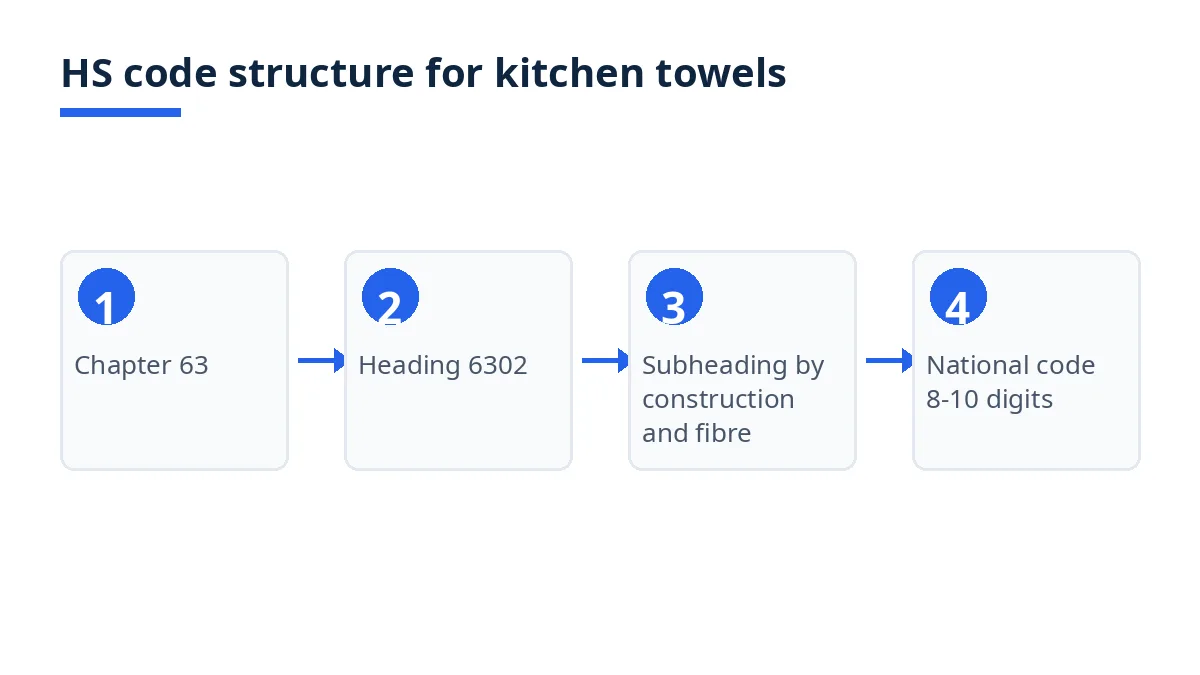
Countries subdivide the six-digit categories into national subheadings for their tariffs and statistics.2 The current version is HS 2022.2 Read the 6-digit HS code guide and the harmonized system explainer for more on the structure.
Factors that decide the code for kitchen towels
Work through the factors in order: use, construction, fibre, then presentation. The European Commission guidance makes the general point directly: check the attributes of the goods, because a small feature or point of difference can mean a different classification code than you would otherwise assume.5
Use as kitchen linen. Heading 6302 covers four linen groups in one heading: bed linen, table linen, toilet linen and kitchen linen.3 A kitchen towel is made for drying dishes, glassware and hands. That use places the towel in kitchen linen. The same cotton cloth made and sold for washing up is tested against a different heading, covered below.
Terry construction comes first inside heading 6302. The 6302.60 line is limited to terry toweling or similar terry fabrics, of cotton.3 A looped-pile cotton kitchen towel is tested against that line first. A cotton towel with no terry pile moves to the other block, at 6302.91.3 Waffle weave is the trap: a waffle tea towel has a textured woven surface but no terry loop pile, so it takes 6302.91, not 6302.60. Record the construction for every style.
Fibre composition and blends. Inside the other block, the split runs by textile material: 6302.91 cotton, 6302.93 man-made fibres and 6302.99 other textile materials.3 A terry towel that is not of cotton does not take 6302.60, because that line is written for cotton only; a polyester terry towel is tested against 6302.93 instead.3 For a blend, the textile section notes classify a mixture as the single textile material that predominates by weight over any other single material, and where no material predominates, as the material covered by the heading that occurs last in numerical order.3 Record the fibre percentages by weight for every style.
The drying and cleaning boundary with heading 6307. Heading 6307 covers other made up articles, and subheading 6307.10 covers floorcloths, dishcloths, dusters and similar cleaning cloths.6 The UK tariff splits 6307.10 by construction at ten digits: knitted or crocheted goods, nonwovens, and other goods.6 The boundary turns on what the cloth is for and how it is presented: a towel presented for drying is kitchen linen in heading 6302, while a cloth presented for washing or scouring is a cleaning cloth in 6307.10. The naming overlap is real: the United States schedule names dish towels inside the 6302 lines,4 while 6307.10 names dishcloths.6 Describe the product by its actual use, and keep the two product types on separate descriptions and codes.
Knitted or crocheted construction changes the national line, not the heading. The UK tariff splits the 6302.60 line by construction at ten digits: knitted or crocheted goods at 6302 6000 10 and other goods at 6302 6000 90.3 Most export kitchen towels are woven, but a knitted terry towel still starts from 6302.60 at six digits.
Sets and mixed packs do not average out. A retail set that combines a terry towel, a flat tea towel and a cleaning cloth contains pieces on different lines. Classify and invoice each piece on its own line: the terry and flat pieces on their 6302 lines, and the cleaning cloth against 6307.10.6
National codes: US HTS, EU CN/TARIC, UK commodity code
United States: HTS, ten digits. A cotton terry kitchen towel sits at 6302.60.00, with a statistical suffix that names dish towels separately from other towels inside that line.4 A flat cotton tea towel sits at 6302.91.00, where the suffixes separate pile or tufted construction from other construction and name dish towels inside each group.4 A man-made fibre towel splits by construction: 6302.93.10 for pile or tufted construction and 6302.93.20 for other construction.4 A flax towel sits at 6302.99.15, of flax.4 Read the full ten-digit line for each towel type before filing.
European Union: CN at eight digits, TARIC for measures. The Combined Nomenclature integrates the HS and adds EU subdivisions, producing eight-digit codes.2 The cotton terry line stays at 6302 60 00 at eight digits, because the EU splits this line only at the ten-digit TARIC level, by construction.3 Read the confirmed line in TARIC for the entry date and for origin Bangladesh, and check the origin rules behind any preference claim.
United Kingdom: commodity code. The UK builds its commodity code on the same first six digits, with its own extension after them.2 The UK tariff lists 6302 6000 10 for knitted or crocheted terry cotton goods and 6302 6000 90 for other goods, where a woven cotton terry kitchen towel sits; 6302 9100 90 in the flat cotton line; 6302 9310 00 for nonwovens and 6302 9390 00 for other goods in the man-made fibre line; and 6302 9910 00 for flax.3 Take the full code from the UK Trade Tariff for your towel and entry date. The general method is set out in how to classify your product.
How to confirm the code officially
Write a precise description for each towel type: terry, flat or waffle construction, woven or knitted make, fibre percentages by weight, intended use, and dimensions.
Start from the official tariff for the destination: the USITC HTS, TARIC or the UK Trade Tariff, and read the heading text and notes.
Check published rulings for similar towels and cloths. For the United States, the USITC advises traders to use the Customs Rulings Online Search Service (CROSS), because the correct classification of many items can be found there.7
For a borderline product, such as a waffle-weave towel or a cloth sold for both drying and cleaning, apply for a binding decision before you ship. In the EU, a Binding Tariff Information (BTI) application needs a separate application for each type of product and a detailed description.8 In the United Kingdom, a legally binding decision is generally valid for 3 years, through an Advance Tariff Ruling.9 In the United States, if the merchandise is not described in any ruling on CROSS, you may request a binding ruling from U.S. Customs and Border Protection.7
Give your broker the description and the confirmed code for each towel type, and use the same codes throughout the entry.
Common classification mistakes
Filing every kitchen towel at 6302.60. That line covers kitchen linen of terry toweling, of cotton only.3 A flat tea towel, a waffle tea towel and a polyester terry towel all sit elsewhere.
Filing a waffle tea towel as terry. Waffle weave has no terry loop pile, and 6302.60 requires terry toweling or similar terry fabrics,3 so a cotton waffle towel takes 6302.91.
Filing drying towels and cleaning cloths on one line. Heading 6302 is a linen heading and 6307.10 covers dishcloths and similar cleaning cloths.6 A cloth for washing up belongs against 6307.10.
Filing a blend on the cotton line without weighing the fibres. A mixture is classified as the material that predominates by weight.3 If polyester outweighs cotton, the cotton lines do not apply.
Copying a code from another country. The EU extends the six digits to eight,2 and the UK splits the 6302 lines further, for example at 6302 6000 10 and 6302 6000 90.3
Related duties and documents
This guide states no duty rates: the code decides which duty line customs applies, and a rate read beside the cotton terry line does not carry to the flat cotton, man-made fibre or cleaning-cloth lines. Read the rate beside your confirmed code for your origin and entry date, and check what proof of origin a preference claim requires.
Keep the classification file with the shipment documents: the product description with construction and fibre percentages, the confirmed national code for each towel type, any binding decision, and the origin evidence, with each towel type as a separate invoice line where the codes differ. The fibre composition on the product label must match the file.
FAQs
What is the HS code for kitchen towels?
Kitchen towels are classified in heading 6302.3 A cotton towel of terry toweling sits at 6302.60, a flat cotton tea towel at 6302.91, a man-made fibre towel at 6302.93 and a towel of another material, such as flax, at 6302.99.3 A cloth for cleaning takes 6307.10 instead.6
Is the HS code the same in every country?
Only the first six digits are harmonized. Beyond six digits, each country adds its own lines: eight digits in the EU Combined Nomenclature,2 and ten in the United Kingdom,3 and in the United States, where dish towels take their own statistical suffixes.4
How do I confirm the correct code?
Describe each towel precisely, with construction, fibre percentages and intended use, read the heading text and notes in the destination tariff, and check published rulings, such as CROSS for the United States.7 For a borderline product, apply for a binding decision before shipping: a BTI in the EU,8 an Advance Tariff Ruling in the United Kingdom,9 or a CBP binding ruling in the United States.7
What happens if I use the wrong code?
Duty, licensing and quota treatment are worked out from the code on the declaration, so a wrong code brings the wrong treatment. Taking a binding decision in advance helps you calculate the duties and restrictions that will apply.9
Next steps on Exportain
Browse Bangladeshi suppliers on Exportain, a B2B marketplace where supplier profiles carry document and photo review badges, and post a free RFQ at Exportain RFQs with the confirmed code stated per towel type. The harmonized system tariff code explainer is the background read. Exportain is not a party to the goods contract and does not inspect goods, book freight or clear customs, so keep your broker and your binding decision at the center of the entry.
Sources
- What is the Harmonized System (HS)?. World Customs Organization (accessed )
- Harmonised System. European Commission (accessed )
- Bed linen, table linen, toilet linen and kitchen linen - UK Integrated Online Tariff, Heading 6302. GOV.UK (accessed )
- Harmonized Tariff Schedule of the United States, Chapter 63: Other made up textile articles; sets; worn clothing and worn textile articles; rags (Revision 17, 2026). United States International Trade Commission (accessed )
- Classifying textiles. European Commission, Access2Markets (accessed )
- Other made-up articles, including dress patterns: UK Integrated Online Tariff, heading 6307. GOV.UK, HM Revenue and Customs (accessed )
- MTB 2019: Get Out Ahead of the Pack with a Binding Ruling from CBP. U.S. International Trade Commission (accessed )
- European Binding Tariff Information (EBTI). European Commission, Taxation and Customs Union, (accessed )
- Check what you'll need to get a legally binding decision on a commodity code. GOV.UK, HM Revenue and Customs (accessed )
About the author
Sourcing from Bangladesh?
Post a request for quotation and suppliers on Exportain can send you their quotes directly.
Post an RFQ