

Germany Sportswear Imports From Bangladesh: Hamburg Entry, EBA Duty and Buyer Checklist
Germany sportswear imports from Bangladesh: Hamburg entry, EBA duty at 0% with origin evidence, 19% German import VAT, labelling, shipping and landed cost for German buyers.
Short answer
For a German buyer, importing sportswear and activewear from Bangladesh means fixing one specification per style, shortlisting knitwear factories that already make that style, approving a sample in production fabric, and clearing the shipment at Hamburg under EU tariff and German import VAT rules, with duty-free EBA access depending on origin evidence.
On this page
Key takeaways
Knitted sportswear lines in headings 6112, 6114 and 6110 carry a third-country duty of 12 percent, and the EBA rate is 0 percent only where the goods meet the origin rules and the origin evidence is in order.
German import VAT applies at 19 percent on the customs value plus any duty plus transport and insurance to the first inland destination, and a VAT-registered business can generally deduct it as input tax.
Labels for the German market must be in German, easily legible, visible and clear, and durable and securely attached, with fibre composition matching the fabric actually bought.
Under FOB and CIF, risk passes once goods are loaded on board, while under DAP risk passes at the named destination and under DDP the seller also clears import customs and pays duty and taxes.
On the Example figures in this guide, losing the EBA claim on a 10,000 euro CIF shipment adds 1,200 euro in duty and a further 228 euro in VAT, because VAT is charged on the duty-inclusive base.
For a German buyer, importing sportswear and activewear from Bangladesh means fixing one specification per style, shortlisting knitwear factories that already make that style, approving a sample in production fabric, and then clearing the shipment at Hamburg under the European Union tariff and German import VAT rules. Bangladesh ships to the European Union duty-free under the Everything But Arms arrangement, but the zero rate depends on origin evidence, and German import VAT still applies at 19 percent.
This guide is written for German brands, retailers, clubs, gyms, wholesalers and importers buying knitted sportswear from Bangladesh for sale in Germany. It follows the Hamburg entry route: the order, the checks, the duty and tax treatment, the documents, and a landed-cost example with figures labelled as examples throughout.
Why source sportswear and activewear from Bangladesh
Bangladesh has a large knitwear sector, and sportswear sits inside it: knitted tracksuits, training tops and bottoms, hoodies and sweatshirts, leggings, shorts and other knitted athletic garments. The practical reason to look there is range depth rather than any single product claim. A factory that already cuts and sews knitted fleece and jersey, works with elastane blends, and runs sublimation or screen printing can usually handle a full training set, while a factory set up only for woven shirts cannot, even if its prices look lower.
Start from the end use, not from a catalogue. A running tight, a training tracksuit and a cotton fleece hoodie are three different buying problems: different fabrics, stretch and seam requirements, and tariff lines. Shortlist only factories whose current production already includes that style.
Find and verify suppliers
Where should you start the search?
Start with a specification, not with factory names. For each style, write down the garment type, fabric composition and weight, stretch requirement, construction details such as flatlock or overlock seams, print or embroidery method, colour range, size range with a full size chart, labelling and packing. Then shortlist factories whose current range already includes that style. Browse suppliers on Exportain and read finding suppliers in Bangladesh for the search approach.
Send every candidate the identical specification and ask for the same reply format: fabric assumed, price inclusions, validity, minimum per style and per colour, sample lead time and production capacity. Identical specifications are what make quotes comparable. Two quotes can differ because one assumes a lighter fleece, a lower elastane content, a simpler print or a different packing standard, and only a shared specification exposes that.
How do you verify a supplier before you pay?
Verification has three layers. The first is company documents: trade licence, export registration and association membership where applicable, checked so that name, address and bank account name agree across every document. The second is capability: monthly knitted-garment capacity, whether knitting, dyeing and printing are in-house or bought in, fabric sources, and which recent sportswear styles the factory can show from current production. A finished tracksuit or legging from current production shows more than a catalogue photograph: seam finish, print durability, waistband recovery and size consistency across the range.
The third layer is payment discipline. Keep payments to the company account named in the documents, never to a personal account, and verify any change of bank details separately. Read how supplier verification works on Exportain for what document and photo checks cover. On Exportain, supplier profiles carry document and photo review badges. A badge is a review of documents and photos, not a factory inspection or a guarantee, and Exportain is not a party to the goods contract.
MOQ, pricing and samples
What is the typical MOQ for sportswear and activewear from Bangladesh?
There is no single typical minimum order quantity for sportswear and activewear from Bangladesh. The minimum is set per style and usually per colour, because fabric is knitted, dyed or printed in batches and a cutting plan is set up per size range. A plain cotton fleece hoodie and a sublimated polyester training set with several colours will not carry the same minimum. Ask each supplier how its minimum splits by style, colour, print method and size range, and get the answer in writing before you approve a sample.
How is the price built, and how should you compare quotes?
Fabric is usually the largest cost element in knitted sportswear, followed by cutting and sewing, dyeing or printing, trims such as zips, drawcords and waistband elastic, testing, packing and the factory margin. Elastane content, fleece weight, print coverage and seam type each move the price. A quote that looks cheaper may assume a lighter fabric, less elastane, a smaller print area or simpler packing.
Compare quotes on the same basis: same style, sizes, fabric, print method, delivery term and packing. Ask each supplier to state what is excluded, for example print screens, special packing, testing or labels. A price that excludes testing is not comparable with one that includes it, and a price quoted on different delivery terms is not comparable at all. Settle the delivery term before you compare, and keep it in every quote request.
Which samples do you need, and how do you approve them?
Work in stages. A development sample shows whether the factory can construct the garment, hold the stretch, print cleanly and finish seams to your standard. A pre-production sample, made in the actual production fabric, colour, print and trims, is the sample you approve for bulk. Stretch, colour and print adhesion cannot be approved from a sample in substitute fabric, because dyeing, finishing and elastane content change hand feel, shade and recovery.
Test the samples as your customers will use them: stretch and recover the waistband and cuffs repeatedly, wash the garment following your care label and measure it again, check print adhesion after washing, and check that sizes across the range match your chart. Approve in writing and keep one sealed counter-sample of each style. The sealed sample is the reference if a bulk shipment is disputed.
Quality control and certifications needed
Which quality checks are specific to sportswear?
Against the approved sample and chart, check fabric composition and finished weight, measurements across the full size range within your agreed tolerances, and consistency from the smallest to the largest size. Then check construction style by style: seam type and stitch density, flatlock finish where specified, waistband and cuff recovery, zip function, drawcord length and finishing, print placement and coverage, and colour matching across the set. A tracksuit top and bottom can each pass alone and still fail as a set if the shades differ.
Agree the inspection method and defect limits before production. Inspect in stages: an inline check during sewing and printing catches a drift while correction is still possible, and a final random inspection on packed goods checks quantity, workmanship, measurements, labels and packing. See the acceptance quality limit and pre-shipment inspection guides.
Which label rules apply in Germany?
Fibre labelling applies to every textile garment, and to linings and trims where the rules require it. For the German market, labels must be in German: the regulation requires labelling or marking in the official language or languages of the member state where the textile products are made available to the consumer, and the information must be easily legible, visible and clear.1 Labels and markings must also be durable, easily legible, visible and accessible, and securely attached where a label is used.2 Agree the wording at sampling stage and check that the percentages match the fabric you bought, because the labelled composition is also the composition your classification is built on.
Add care, size and origin marking as your market requires, and check the finished label before bulk label sewing begins. ### Which certifications do you actually need?
Ask for test evidence tied to your specification, not a general certificate file. For sportswear, the tests that usually matter are fabric composition, colour fastness to washing and rubbing, dimensional stability after washing, and, for printed or dyed synthetics, chemical compliance with EU rules. Under REACH, substances of very high concern in textile products sold in the EU must be no more than 0.1 percent of the total product weight, and restricted substances such as certain azo dyes are controlled through Annex XVII.3 Ask the supplier which dyes and finishes it uses, and request test reports for the actual production fabric, not for a different fabric from an earlier season.
Do not accept a certificate as a substitute for a test on your own goods. A certificate can cover a different fabric, a different dye lot or a different factory. Name the tests in the purchase order, name the laboratory standard you accept, and state what happens if a test fails. That clause is what turns a certificate request into a working control.
Incoterms, shipping and transit time
Which delivery term should you choose?
The delivery term decides who pays for freight and insurance, who clears customs, and where risk passes from seller to buyer. Under FOB, the seller loads the goods on board the vessel nominated by the buyer, and risk passes once the goods are on board. Under CIF, the seller pays cost, insurance and freight to the destination port, but risk still passes once the goods are loaded on board. Under DAP, the seller delivers to the named destination ready for unloading, and under DDP the seller also clears import customs and pays duty and taxes.4
For a first Hamburg order, FOB or CIF through a forwarder you control is often the clearest choice, because you keep control of the German customs declaration and the origin claim. DAP can suit a repeat order where the seller already handles the route, but confirm in writing who holds the EORI number, who files the declaration and who pays German import VAT. DDP shifts duty and VAT to the seller, which only works if the seller is set up to act as importer in Germany, so confirm that before agreeing it.
How does the Hamburg entry work?
Hamburg is the usual German sea entry for Bangladesh container shipments, and the customs work starts before the vessel arrives. The entry summary declaration is lodged at the customs office of first entry using the electronic ATLAS-EAS procedure before the goods are brought into the customs territory of the Union.5 Your forwarder or customs representative files the import declaration, and the EORI numbers of the declarant, the customs representative and the consignee on import must be quoted in written and electronic customs declarations.6
How long does shipping take?
Import duty, taxes and documents
What duty applies to sportswear from Bangladesh?
Bangladesh is a least developed country beneficiary of the European Union's Everything But Arms arrangement, which gives duty-free, quota-free access to the EU market for all products except arms and ammunition.7 The tariff schedule shows the same result line by line: for the Northern Ireland tariff lines shown, the third-country duty is 12.00 percent and the GSP-EBA tariff preference is 0.00 percent.8 The schedule page for ski suits in heading 6112 shows a third-country duty of 12.000 percent with a general GSP rate of 9.600 percent, confirming that the 12 percent rate is the fallback when no preference applies.9
The duty table below uses the third-country rate of 12 percent and the EBA rate of 0 percent. The EBA rate applies only where the goods meet the origin rules and the origin evidence is in order. If origin is not proven, the 12 percent rate applies, so the origin file is part of the price, not an administrative afterthought. Confirm each 10-digit TARIC line with your customs broker before the shipment sails, because the line follows the exact garment and fibre, not the general product name.
Tariff line | Garment | Third-country duty | EBA duty with origin evidence |
|---|---|---|---|
6112.11 | Tracksuits, of cotton, knitted or crocheted | 12% | 0% |
6112.12 | Tracksuits, of synthetic fibres, knitted or crocheted | 12% | 0% |
6112.19 | Tracksuits, of other textile materials, knitted or crocheted | 12% | 0% |
6114.20 | Other garments, of cotton, knitted or crocheted | 12% | 0% |
6114.30 | Other garments, of man-made fibres, knitted or crocheted | 12% | 0% |
6114.90 | Other garments, of other textile materials, knitted or crocheted | 12% | 0% |
6110.20 | Jerseys and similar articles, of cotton, knitted or crocheted, including fleece hoodies and sweatshirts | 12% | 0% |
The hoodie line is included because many sportswear programmes mix fleece hoodies with tracksuits: the schedule page for a cotton hoodie shows a 12 percent third-country duty.10 Classify hoodies, sweatshirts, leggings and training sets line by line, because a set with a hoodie top and a tracksuit bottom can carry two lines. The classification follows the garment, the knit and the fibre, so give your broker the full specification, not just the word sportswear.
What German import VAT applies?
German import VAT, Einfuhrumsatzsteuer, applies at the standard rate of 19 percent on imports into Germany, as shown for a commercial import into Germany in the tariff calculation.10 The tax base is the customs value plus any duties plus transport and insurance costs to the first inland destination, following the German VAT Act rules for importation.11 A business that is entitled to deduct input tax can generally deduct the import VAT paid against its own VAT liability, which makes import VAT a cash-flow item rather than a final cost for most registered importers.11
Under FOB, CIF and DAP, the buyer normally bears import VAT; under DDP, the seller bears it.
Which documents does the Hamburg clearance need?
Prepare one consistent document set: commercial invoice, packing list, bill of lading, origin evidence for the EBA claim, and the import declaration data. The invoice, packing list and bill of lading must agree on parties, quantities, values, tariff lines, delivery term and route. Any mismatch between the invoice value and the packing list quantities, or between the consignee on the bill of lading and the declarant, will slow clearance.
Landed cost example (table)
All figures in this section are Example figures. They illustrate the Hamburg calculation for one shipment; they are not a quote, and your own figures will differ by style, fabric, quantity and route.
Cost element | EBA case, Example figures | Without proven origin, Example figures |
|---|---|---|
Goods value, FOB Chittagong | €8,500 | €8,500 |
International freight and insurance to Hamburg | €1,500 | €1,500 |
CIF customs value at Hamburg | €10,000 | €10,000 |
Customs duty | €0 at 0% EBA rate | €1,200 at 12% |
VAT base (CIF value plus duty) | €10,000 | €11,200 |
German import VAT at 19% | €1,900 | €2,128 |
Total border charges in these Example figures | €1,900 | €3,328 |
The table shows why the origin file matters in money terms. On these Example figures, losing the EBA claim adds €1,200 in duty and a further €228 in VAT, because VAT is charged on the duty-inclusive base. Add your own inland delivery, customs broker fee, inspection cost and any warehousing to the border total to reach a full landed cost, and compare that total with your selling price before confirming the order. See the landed cost imports from Bangladesh guide for the full build-up.
Step-by-step import checklist
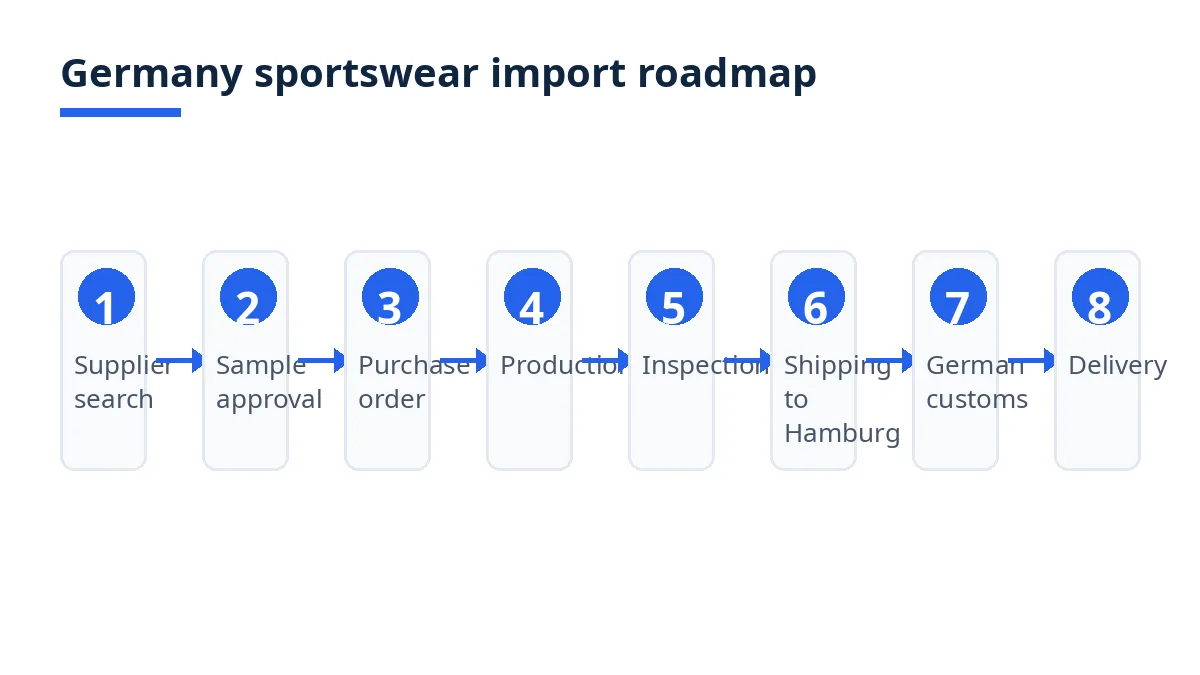
Write one specification per style: garment type, fabric, stretch, construction, print, colours, size chart, labels and packing.
Shortlist factories whose current production already includes that style, and send every candidate the identical specification.
Check documents, capability and bank details, and confirm the minimum per style and per colour in writing.
Approve a development sample, then a pre-production sample in production fabric, colour, print and trims.
Agree the delivery term, the tariff lines, the EBA origin evidence and the Hamburg customs roles before bulk production.
Name the tests in the purchase order, agree inspection stages and defect limits, and set the document dates.
Confirm the sailing, the Hamburg entry and the onward delivery, and build a buffer before any launch date.
File the Hamburg declaration with matching invoice, packing list, bill of lading and origin evidence, and pay the 19 percent import VAT at the border.
Check the delivered goods against the sealed sample and size chart, and keep the full shipment file for later queries.
Review the first order before repeating it: which styles sold, which sizes ran out, and what changes for the next drop.
How Exportain helps
Exportain connects German buyers with Bangladeshi suppliers, and the platform carries supplier profiles, product listings and a request-for-quote route for buyers who want comparable quotes. Use the platform to shortlist, to send the identical specification to several factories, and to compare replies on the same basis. The document and photo review badges on a profile describe what was reviewed, and they do not replace your own sample approval, inspection and customs checks.
FAQs
What is the typical MOQ for sportswear and activewear from Bangladesh?
There is no single typical minimum. The minimum is set per style and usually per colour, because fabric is knitted, dyed or printed in batches and cutting is planned per size range. Ask each supplier how its minimum splits by style, colour, print method and size range, and confirm the answer in writing before approving a sample.
How long does shipping take?
There is no single transit figure for every order. Confirm the sailing schedule, port pair, transhipment route and Hamburg clearance steps with your forwarder for your exact shipment date, and build a buffer before any launch date.
What import duty applies?
Knitted sportswear lines in headings 6112, 6114 and 6110 carry a third-country duty of 12 percent, and the EBA rate is 0 percent where the goods meet the origin rules and the origin evidence is in order.8 9 10 If origin is not proven, the 12 percent rate applies. Confirm each 10-digit TARIC line with your customs broker before the shipment sails.
How do I verify a supplier?
Check company documents so that name, address and bank account name agree, check capability against your exact style from current production, and keep payments to the company account named in the documents. Approve a development sample and then a pre-production sample in production fabric, and agree inspection stages and defect limits before bulk production. Read how supplier verification works on Exportain for what document and photo checks cover.
Next steps on Exportain
Start with the general import route in how to import from Bangladesh, then shortlist factories through suppliers and compare your landed cost with the landed cost imports from Bangladesh guide. When your specification is ready, post a free request for quote and ask each factory to reply on the identical specification, delivery term and document set described above.
Sources
- Regulation (EU) No 1007/2011 on textile fibre names and related labelling and marking of the fibre composition of textile products, Article 16. European Union, (accessed )
- Regulation (EU) No 1007/2011 on textile fibre names and related labelling and marking of the fibre composition of textile products, Article 14. legislation.gov.uk (accessed )
- REACH Compliance in Textiles: A Guide. QIMA (accessed )
- Incoterms 2020 Guide for Importers. Importivity (accessed )
- Lodging the entry summary declaration and notification of arrival. German Federal Customs Administration (Zoll) (accessed )
- Using the EORI number. German Customs (Zoll) (accessed )
- Trade and sustainability: Commission proposes new EU Generalised Scheme of Preferences to promote sustainable development in low-income countries. European External Action Service (accessed )
- Commodity code 6206909000: Of other textile materials - Northern Ireland Online Tariff. GOV.UK (accessed )
- HS Code 61122000. Tariffnumber (accessed )
- Importing cotton hoodie into the EU: duty and VAT. Tarific (accessed )
- A Guide to the German Import VAT. Consultinghouse (accessed )
About the author
Sourcing from Bangladesh?
Post a request for quotation and suppliers on Exportain can send you their quotes directly.
Post an RFQ


