

France Sportswear Imports From Bangladesh: Le Havre Entry, EBA Duty and VAT Guide
France sportswear imports from Bangladesh: Le Havre entry, EBA duty at 0% with origin evidence, 20% French TVA, French-language labeling, shipping and landed cost for French buyers.
Short answer
To import sportswear and activewear from Bangladesh to France, write one tech pack per garment, shortlist factories already making that garment type, and verify company documents and capability before paying. Approve a pre-production sample, classify every garment line, and clear French customs at Le Havre or Marseille-Fos with origin evidence for the EBA zero duty, French-language labels, and import TVA declared through your VAT return.
On this page
Key takeaways
France-bound sportswear from Bangladesh enters the EU duty-free under Everything But Arms where origin is proven; without origin evidence the third-country rate applies, so the origin file is part of the price.
The schedule pages opened for this guide show 12.000 percent third-country duty for 6112.20 ski suits and 12 percent for cotton jersey line 6110.20.91; confirm every other 10-digit line with your broker.
French TVA runs at 20 percent and, for VAT-registered importers, is declared and deducted through the VAT return under the reverse-charge mechanism in place since 1 January 2022, not paid in cash at the border.
Consumer labels for France must be in French under Regulation (EU) No 1007/2011 Article 16(3): fiber names and percentages in French, agreed at sampling stage.
There is no single typical MOQ, price or transit time for sportswear from Bangladesh; confirm each one in writing for your exact garment, fabric, size range and shipment date.
This guide explains how to import sportswear and activewear from Bangladesh to France, from supplier search in Bangladesh to customs clearance at Le Havre and delivery to your warehouse in France. It is written for French buyers: brands, retailers, clubs, gyms, wholesalers and importers buying training sets, leggings, jerseys, hoodies, shorts and swimwear.
France is where several decisions meet: EU duty treatment, French TVA, French consumer labels, and a French port and declaration route. Get those four right, and the rest is ordinary buying discipline. This guide states no typical minimum order, price or transit time.
Why source sportswear and activewear from Bangladesh
Bangladesh sells into the European Union under a preference that directly changes the duty line. The Everything But Arms scheme is a special arrangement for least developed countries, granting full duty-free and quota-free access to the EU Single Market for all products except arms and ammunition.1 The zero rate still depends on meeting the origin rules and having the origin evidence in order at entry.
The commercial case is breadth: one program can combine tracksuits, jerseys, fleece hoodies, leggings, shorts and swimwear, each with its own fabric, fit and tariff line. Nearly half of Bangladesh's merchandise exports are shipped to the EU under duty-free and quota-free access through Everything But Arms.2 Start with factories whose current range already includes your garment types.
There is also a time horizon to plan around. Bangladesh is scheduled to graduate from least developed country status, and its government is pursuing both a free trade agreement and GSP Plus qualification to retain duty-free access afterwards; under the current timeline, regular tariffs would come into effect from 2029 even with the agreed three-year continuation of preferences.2 That horizon does not change a 2026 or 2027 order, but it is a reason to price multi-season programs with the fallback duty in mind.
Find and verify suppliers
Where should you start the search?
Start with a tech pack, not with factory names. Write down every garment first: garment type, knit, fiber composition, fabric weight, fit and size range, colorways, print or embroidery, trims, labels and packing. Then shortlist factories whose current range already includes that garment type. A factory making woven shirts is not a close substitute for a leggings program, because stretch handling, elastic insertion, flatlock seaming and fit testing use different operations.
Send every candidate the identical tech pack and ask for the same reply format: fabric assumed, sizes covered, price inclusions, validity and minimum per style and per colorway. Browse suppliers on Exportain and read finding suppliers in Bangladesh before you narrow the list.
How do you verify a supplier before you pay?
Verification has three layers. The first is company documents: trade license, export registration and association membership where applicable, checked so that name, address and bank account name agree across every document. The second is capability: monthly capacity for your garment type, whether knitting or fabric sourcing is in-house, dyeing and printing route, stretch testing method, and recent sportswear styles the factory can show. A finished tracksuit from current production shows seam strength, elastic recovery, print adhesion and size consistency.
The third layer is payment discipline. Keep payments to the company account named in the documents, never to a personal account, and verify any change of bank details separately. On Exportain, supplier profiles carry document and photo review badges: a review of documents and photos, not a factory inspection or a guarantee, and Exportain is not a party to the goods contract. For a first order, add a video or in-person factory check.
MOQ, pricing and samples
What is the typical MOQ for sportswear and activewear from Bangladesh?
There is no single typical minimum order quantity for sportswear and activewear from Bangladesh. The minimum is set per style and usually per colorway, because fabric is knitted, dyed or printed in batches, cutting is planned per size range, and trims are ordered per style. A plain cotton jersey and a sublimated polyester training set will not carry the same minimum, and a program with ten sizes and four colorways will not carry the same minimum as a single-size, single-color order. Ask each supplier how its minimum splits by style, colorway, size range and fabric, in writing, before you compare quotes.
How is the price built, and how should you compare quotes?
Fabric is usually the largest cost element in sportswear, followed by cutting and sewing, dyeing or printing, trims, testing, packing and the factory margin. Stretch fabric costs more to handle than a stable jersey, and print adds its own variables: sublimation, screen print and embroidery differ in setup cost, durability and minimum, and several print positions cost more than a single chest print.
Compare quotes on the same basis only: same garment, sizes, fabric, print, term and packing. Ask each supplier to state what is excluded, for example testing, special packing, French labels, or hangtags. Two quotes can differ because one assumes a lighter fabric, fewer sizes or a simpler print, so ask what each price is based on, in writing, before treating a lower quote as a saving.
Which samples do you need, and how do you approve them?
Work in stages. A development sample shows whether the factory can construct the garment, sew stretch seams cleanly, place prints correctly and hold the fit. A pre-production sample, made in the actual production fabric, colorway, print and trims, is the sample you approve for bulk. Fit and stretch cannot be approved from substitute fabric, because dyeing, finishing and washing change dimensions and elastic recovery.
Test the samples as your customers will use them: wear-test through movement and washing, measure every size, check legging recovery after stretch, print survival after washing, and color matching across batches. Approve in writing and keep one sealed counter-sample of each style, since inspection is judged against it.
Quality control and certifications needed
Which quality checks are specific to sportswear?
Against the approved sample and size chart, check fabric composition and weight, measurements for every size, and consistency across the range. Then check construction garment by garment: seam type and stitch density, flatlock coverage, elastic insertion, drawcord and zip function, print placement and adhesion, and color matching across panels and sizes. A tracksuit top can pass alone and still fail as a set if the top and bottom come from different shade batches.
Agree the inspection method and defect limits before production. ISO 2859-1:2026 defines a system of acceptance sampling plans for inspection by attributes, and AQL stands for acceptance quality limit, the maximum average percentage of defective items considered acceptable during random sampling, used to determine sample sizes and acceptance and rejection thresholds.3 Inspect in stages: an inline check during sewing and finishing catches a drift while correction is still possible, and a final random inspection on packed goods checks quantity, workmanship, measurements, labels and packing. See the acceptance quality limit and pre-shipment inspection guides.
Which label rules apply in France?
Fiber labeling applies to every garment in the program, and for France the language question is settled by the regulation itself. Article 16 of Regulation (EU) No 1007/2011 states that the labeling or marking shall be provided in the official language or languages of the Member State on the territory of which the textile products are made available to the consumer, unless the Member State concerned provides otherwise.4 For goods sold in France, that means French: fiber names and percentages in French, legible and visible before purchase, including online. Agree the French wording at sampling stage and check that the percentages match the fabric you bought.
Add care, size and origin marking as your market requires, and check the finished label before bulk label sewing begins, when a fix is still cheap.
Which certifications do you actually need?
No single certificate covers every sportswear order. What you need follows your market and your customer: a retailer or club buyer may name a specific test or scheme in its own supplier manual, and the chemical rules apply regardless of who asks. Under REACH Annex XVII entry 43, azo dyes which may release listed aromatic amines above 30 mg/kg in textile articles that may come into direct and prolonged contact with the skin shall not be used in those articles, and such articles shall not be placed on the market unless they conform.5 Name any such requirement in the specification, ask for the matching test report, and check its scope, product, issuing body and date. A report for a different fabric or an unprinted version does not cover your printed set.
Incoterms, shipping and transit time
Which delivery term should a first order use?
The Incoterms 2020 rules define, for each rule, the delivery point and the transfer of risk from seller to buyer.6 FAS and FOB both apply only to sea or inland waterway transport, both require the seller to complete export formalities, and in both the buyer contracts the carrier, pays the port-to-port costs and handles import formalities.6 The difference is the delivery point: under FAS the seller delivers alongside the vessel, while under FOB the seller loads the goods on board.6
For a first order shipped in containers, weigh FOB at the Bangladeshi port against FCA at the named terminal. The ICC Academy notes that when goods are containerized, sellers typically deliver them to a container terminal rather than alongside the ship, and containers may remain at the terminal for days before loading, in which case the FCA rule is more appropriate.6 Under FOB, the factory delivers the goods on board and your forwarder handles the sea leg. Under FCA, delivery happens when the goods are handed to your carrier, which matches how containerized cargo moves. Settle the term in writing before sampling.
How long does shipping take, and which French port should you use?
There is no single typical transit time for sportswear from Bangladesh. Sea freight is the standard route for bulk orders and it takes weeks rather than days, varying by port, routing and season. Plan from your forwarder's current sailing schedule, and add clearance and delivery. Keep production time separate: an order is ready only when sewing, printing, inspection and packing are finished.
For the French port, Le Havre is the usual container gateway for northern France and Paris-region deliveries: it ranks as France's largest container port by volume.7 Marseille-Fos is the Mediterranean alternative, worth pricing when final delivery is in southern France. Name the port of discharge in the order and the forwarder's booking, and confirm carton counts, dimensions and weight in the specification, because sportswear is light for its volume.
Import duty, taxes and documents
How are sportswear garments classified for duty?
Duty follows the classification of each garment in the destination tariff, not the supplier's product name. Tracksuits, ski suits and swimwear, knitted or crocheted, sit in heading 6112; other knitted garments sit in heading 6114; and jerseys, pullovers and similar articles, including fleece hoodies and sweatshirts, sit in heading 6110. A training set with a tracksuit top and a jersey-style hoodie can therefore carry two lines. Classify every garment line by line, and give your broker the full specification, not just the word sportswear.
What import duty applies in France?
Your rate depends on each garment's line, the origin, and the preference in force on the entry date. The schedule page opened for this guide shows, for 6112.20 ski suits, a third-country duty of 12.000 percent.8 The cotton jersey line 6110.20.91 shows the same third-country figure of 12 percent on the opened calculator page.9 Everything But Arms then changes the result for Bangladesh: it grants full duty-free and quota-free access to the EU Single Market for all products except arms and ammunition.1 The EBA rate of 0 percent therefore applies where the goods meet the origin rules and the origin evidence is in order. If origin is not proven, the third-country rate applies.
Tariff line | Garment | Third-country duty | EBA duty with origin evidence |
|---|---|---|---|
6112.20 | Ski suits, knitted or crocheted | 12% | 0% |
6110.20.91 | Cotton jerseys, men's or boys', knitted or crocheted | 12% | 0% |
6112.11, 6112.12, 6112.19 | Tracksuits, knitted or crocheted | Confirm line with broker | 0% with origin evidence |
6114.20, 6114.30 | Other garments, knitted or crocheted | Confirm line with broker | 0% with origin evidence |
Confirm each 10-digit TARIC line with your broker before the shipment sails, because the line follows the exact garment and fiber, not the general product name. The preference also requires valid proof of origin: without it the third-country duty applies.9
What French TVA applies, and how is it paid?
France applies TVA at the standard rate of 20 percent on most imported goods, calculated on the customs value plus duties and charges.10 For a VAT-registered French importer, the picture changed on 1 January 2022: import VAT is now declared and deducted through the VAT return rather than paid in cash at the border, under the generalized reverse-charge mechanism.10 The import VAT base is pre-filled on the return, and the importer must check it and correct it where needed.11
That makes TVA a declaration and cash-flow item for most registered importers rather than a final cost, but the return must still show the import, and a buyer without a French VAT number cannot use the mechanism. Under FOB, CIF and DAP, the buyer normally bears import VAT; under DDP, the seller bears it.
Which documents does the French clearance need?
Prepare one consistent document set: commercial invoice, packing list, bill of lading, origin evidence for the EBA claim, and import declaration data. Every business that imports needs an EORI number, issued by the customs authority of the country where it is established.9 The invoice, packing list and bill of lading must agree on parties, quantities, values, tariff lines, delivery term and route. Any mismatch will slow clearance.
Your broker files the import declaration with French Customs (Direction générale des douanes et droits indirects). Commercial container shipments use the standard import declaration, so build declaration time into the delivery plan and keep the origin evidence with the declaration file.
Landed cost example (table)
A landed cost is the full cost of one garment set, ready to sell. Every number below is an example figure only, not a quote.
Example figures: 4,000 training sets, FOB Chattogram, sea freight to Le Havre, EBA duty at 0 percent with origin evidence, TVA excluded because a VAT-registered importer declares and deducts it.
Cost element | Example figures (per set) | How to obtain your figure |
|---|---|---|
Product price, FOB | €9.80 | Pro forma invoice |
International freight | €0.85 | Forwarder quote per set |
Insurance | €0.07 | Policy or forwarder quote |
Duty at EBA 0% | €0.00 | Broker calculation with origin evidence |
Port, clearance and broker fees | €0.42 | Broker invoices per set |
Local delivery to warehouse | €0.31 | Carrier quote per set |
Total landed cost | €11.45 | Sum of all lines above |
If origin evidence failed, duty at the 12 percent third-country rate on the example customs value of €10.72 would add €1.29 per set, taking the example total to €12.74. Import TVA at 20 percent is not included, because its treatment depends on your VAT position. Work the calculation twice: at quote stage, style by style, and again after shipment with the actual invoices. See landed cost for imports from Bangladesh for the full method.
Step-by-step import checklist
Write the tech pack garment by garment: type, knit, fiber, weight, fit, size range, colorways, print, trims, French labels and packing.
Classify every garment from headings 6112, 6114 and 6110, and confirm each 10-digit line and duty with your broker.
Shortlist factories whose range includes your garment types, and request comparable quotes on the identical tech pack and term.
Verify the supplier: company documents, sportswear capacity, fabric source, dyeing and printing route, and a video or in-person check for a first order.
Order samples in stages, wear-test and measure them, then approve a pre-production sample of each style in production fabric and print.
Confirm the order in writing: purchase order, pro forma invoice, delivery and payment terms, inspection plan with AQL limits, French labeling, packing and shipment date.
Inspect during production and again on packed goods against the approved samples, checking measurements, shade, print adhesion and set matching.
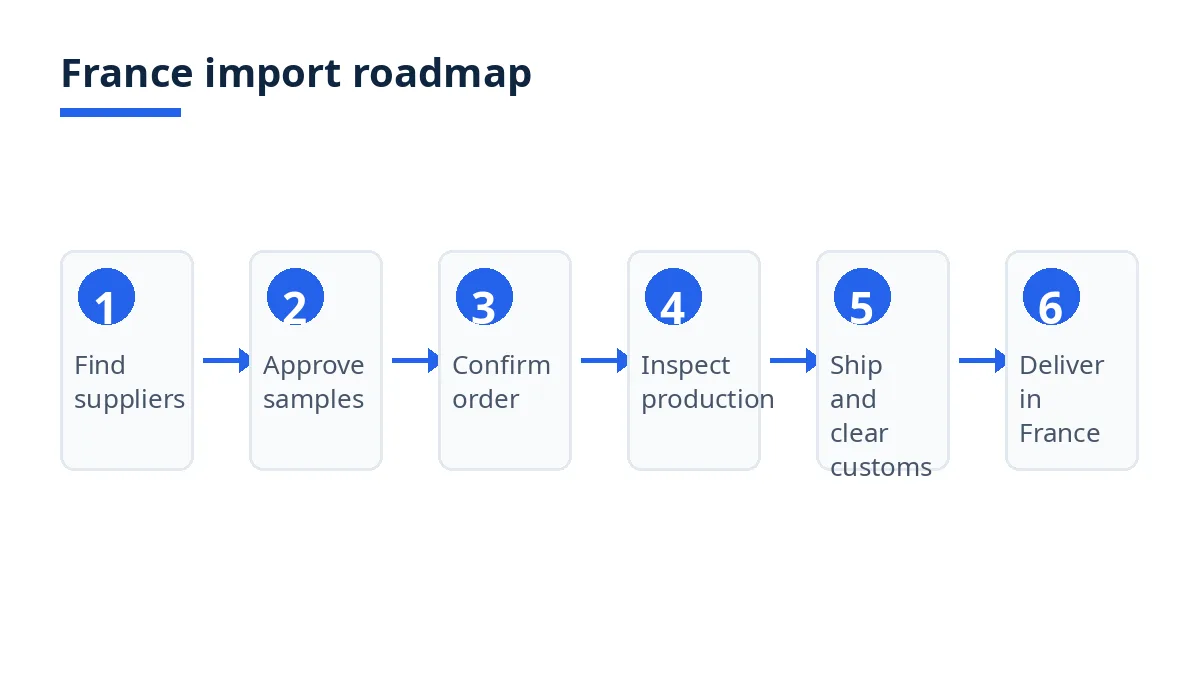
Ship to Le Havre or Marseille-Fos, clear French customs with the confirmed code and origin evidence, declare import TVA through the return, and reconcile the actual landed cost.
How Exportain helps
Browse suppliers for Bangladeshi sportswear exporters and compare their ranges against your list. Then post your tech pack and target quantity as an RFQ and compare replies on the same terms before you choose a factory for sampling. Exportain is a B2B marketplace where buyers post RFQs, receive quotations and message suppliers. It does not inspect goods, book freight or clear customs. Read how to buy before you post, so the RFQ carries a specification a factory can quote against.
FAQs
What is the typical MOQ for sportswear and activewear from Bangladesh?
There is no single typical minimum. It is set per style and usually per colorway, because fabric is knitted, dyed or printed in batches and cutting is planned per size range.
How long does shipping take?
Production time and transit time are separate, and neither has a single typical figure. Sea transit takes weeks rather than days and varies by port, routing and season. Plan from your forwarder's current schedule, and add French clearance and delivery.
What import duty applies?
Duty follows the confirmed classification of each garment, the origin and the preference in force on the entry date. Tracksuits sit in heading 6112, other knitted garments in 6114 and jerseys in 6110. The schedule page opened for this guide shows 12.000 percent third-country duty for 6112.20,8 and the cotton jersey line 6110.20.91 shows 12 percent.9 For Bangladesh, Everything But Arms grants full duty-free and quota-free access to the EU Single Market for all products except arms and ammunition, so the EBA rate is 0 percent where origin is proven.1 Without origin evidence, the third-country rate applies.
How do I verify a supplier?
Check company documents first, so that name, address and bank account agree across the trade license, export registration and invoices. Then check capability: sportswear capacity, fabric source, dyeing and printing route and recent production. Keep payments to the company account named in the documents, and approve a pre-production sample of each style before bulk production.
Next steps on Exportain
Read how to import from Bangladesh for the full process, then work through landed cost for imports from Bangladesh with your own figures. When ready, browse suppliers and post your tech pack as an RFQ.
Sources
- Trade arrangements. European Commission, Access2Markets (accessed )
- Govt takes twin-track approach to retain EU duty-free access. The Daily Star (accessed )
- ISO 2859-1:2026 - Sampling procedures for inspection by attributes — Part 1: Sampling schemes indexed by acceptance quality limit (AQL) for lot-by-lot inspection. International Organization for Standardization (accessed )
- Regulation (EU) No 1007/2011 on textile fibre names and related labelling and marking of the fibre composition of textile products, Article 16. European Union, (accessed )
- REACH, Annex XVII, Restrictions on the manufacture, placing on the market and use of certain dangerous substances, mixtures and articles. ReachOnline (accessed )
- FOB & FAS Incoterms® 2020 explained: Key differences. ICC Academy (accessed )
- Major French Ports: The Busiest Ports in France. GB Freight (accessed )
- HS Code 61122000. Tariffnumber (accessed )
- Importing cotton hoodie into the EU: duty and VAT. Tarific (accessed )
- Importing into France: EORI, VAT & Reverse Charge Guide. Eurofiscalis (accessed )
- Imports by a micro-entrepreneur: what are the rules?. Service Public Entreprendre (accessed )
About the author
Sourcing from Bangladesh?
Post a request for quotation and suppliers on Exportain can send you their quotes directly.
Post an RFQ


