Importing Socks From Bangladesh to UK: Costs, Duties and Suppliers
UK sock import guide: heading 6115 classification, DCTS duty position, import VAT and labelling for buyers importing socks from Bangladesh to the UK, with a landed cost example.
Short answer
To import socks from Bangladesh to the UK, fix each style in terms: length, fiber mix by weight, UK size range, heel and toe construction, and packing. Shortlist knitters making that style, verify documents and capability, and approve a pre-production sample in production yarn. Classify each style in heading 6115, confirm the DCTS duty position, import VAT treatment and fiber label with your broker, agree the inspection plan before production, and build the landed cost from quotes.
On this page
Key takeaways
Socks sit in heading 6115: 6115 9400 00 for wool, 6115 9500 00 for cotton, the 6115 96 group for synthetic fibers and 6115 9900 00 for other textile materials, with the supplementary unit in pairs; treat every code as indicative and verify it on the official tariff.
The schedule lines read for this guide show 12.00 percent third country duty on the main sock lines and 8.00 percent on graduated compression hosiery of synthetic fibers in 6115 1010 00; Bangladesh is listed under DCTS Comprehensive Preferences, subject to the origin rules.
There is no single typical MOQ, price or transit time for socks; confirm the minimum split by style, color and size run, compare quotes on the identical specification, and confirm sailing dates with your forwarder.
For multi-fiber products, Regulation (EU) No 1007/2011 requires the name and percentage by weight of all constituent fibers in descending order, and the percentages must match the production yarn.
Import VAT at the UK standard rate of 20 percent is separate from duty; VAT-registered importers can account for it through postponed VAT accounting on the VAT return.
If you plan to import socks from Bangladesh to UK customers, settle the details before the goods sail. A failed sock order usually fails on a detail agreed too late: a heel in the wrong place, a toe seam that presses, a fiber mix on the label that does not match the yarn knitted, or a tariff line chosen from a product name instead of fiber and construction.
The UK tariff treats socks by heading, fiber and construction rather than by brand or retail name. The UK Integrated Online Tariff places pantyhose, tights, stockings, socks and other hosiery, knitted or crocheted, in heading 6115, with the sock lines split by fiber and the supplementary unit given in pairs.1 Confirm the classification, the origin position under the Developing Countries Trading Scheme (DCTS), and the fiber label before treating any price as a landed cost. This guide is for UK buyers purchasing socks for retail, wholesale, private label or distribution.
Import socks from Bangladesh to UK: the short version
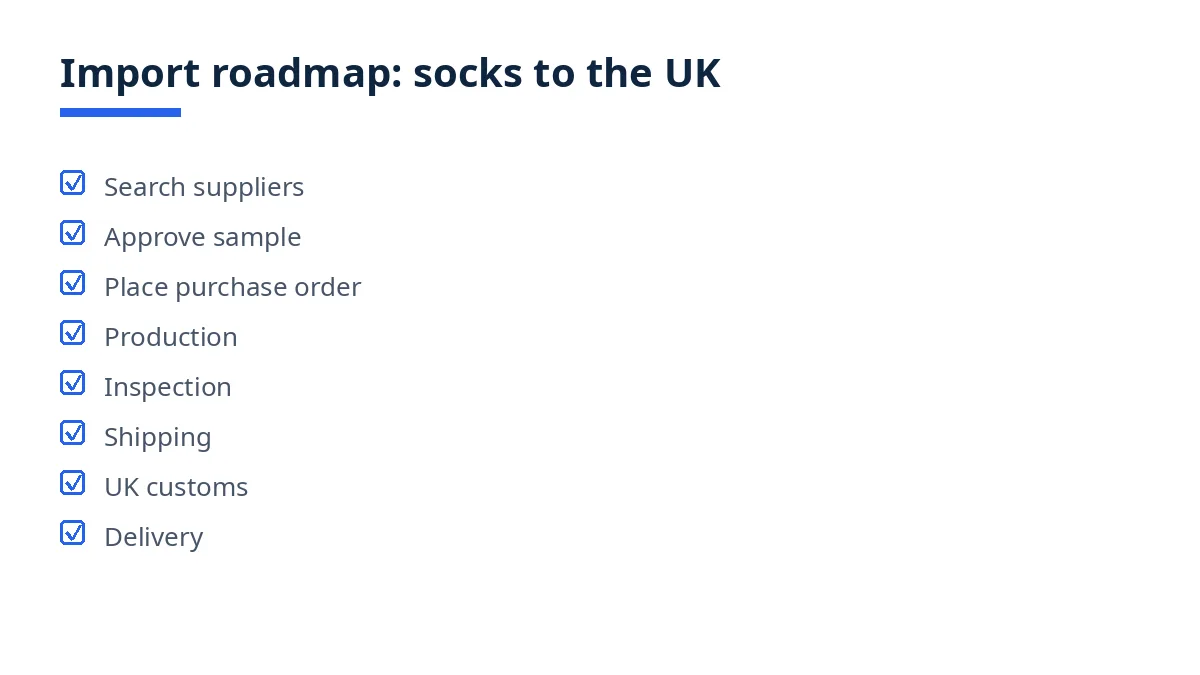
Fix one style at a time in measurable terms: length, fiber mix by weight, size range in UK shoe sizes, heel and toe construction, welt type and packing. Shortlist knitters whose current range already includes that style, check company documents and knitting capability, and approve a pre-production sample made in the production yarn and finish. Classify each style in heading 6115, confirm the UK duty and VAT treatment with your broker, agree the inspection plan before production, and build the landed cost from confirmed quotes.
Why source socks from Bangladesh
A sock order is a knitting order, and the first test of a supplier is whether the factory already knits the sock you want to buy. A mill that knits fine dress socks does not prove, by that fact alone, that it can knit a cushioned athletic sock with a shaped heel. Ask what the factory knits now, and ask to see finished pairs from current production.
Each variant changes the specification. Crew, ankle, knee-length, dress, athletic and work socks differ in length, cushioning and wear, and one order often mixes several of them. The fiber mix sets feel, wash behavior and the tariff line at the same time: cotton gives a familiar hand, synthetic fibers add durability, wool adds warmth, and a small share of elastane holds the sock in place. Name the mix for each style, and treat any substitution as a change needing your written approval before bulk knitting.
Sizing is part of the same specification. Give the supplier your own size chart with UK shoe sizes and foot-length ranges, state the tolerance on finished length and leg length, and check the sample on a foot form as well as laid flat. State the pairs per retail unit, pairs per carton and size mix per carton.
Find and verify suppliers
Where should you start the search?
Start with a specification sheet, not with factory names. Write one sheet per style: style and length, fiber mix by weight, size range, heel and toe construction, welt type, color range, pattern or logo placement, cushioning or grip detail, labels and packing. Send every candidate the same sheet and ask for the same reply format: yarn assumed, pairs per retail unit, price inclusions, validity, and the minimum per style, per color and per size run.
Browse suppliers on Exportain, and read how to import from Bangladesh for the wider import process before you shortlist.
Ask for the gauge range they knit, the toe-closing method, and recent production in the same fiber family.
How do you verify a supplier before you pay?
Verification has three layers. The first is company documents: trade licence, export registration and association membership where applicable, checked so that the business name, address and bank account name agree across every document. The second is capability: knitting capacity for your gauge and construction, yarn sourcing, dyeing route, toe-closing capacity, boarding and finishing capacity, and packing capacity for your retail format. The third is payment discipline: keep payments to the company account named in the documents, never to a personal account, and verify any change of bank details separately through a channel you already trust.
On Exportain, supplier profiles may carry document and photo review badges. A badge is a review of documents and photos, not a factory inspection or a guarantee, and Exportain is not a party to the goods contract. For a first order, add a video walkthrough of the knitting floor and finishing area.
MOQ, pricing and samples
What is the typical MOQ for socks from Bangladesh?
There is no single typical minimum order quantity for socks from Bangladesh. The minimum is set per style and usually per color and size run, because yarn is dyed in batches, machines are set up per construction, and a size run must cover the full curve. Ask each supplier how its minimum splits by style, color, size and construction, and get the split in writing before you compare offers.
How is the price built, and how should you compare quotes?
Yarn is often the main cost element in a sock, followed by knitting, dyeing, toe closing, boarding, pairing, labelling and packing. The fiber mix changes the yarn cost, the gauge changes knitting time, and detail adds operations: a hand-linked toe, a shaped heel, cushioning, a jacquard pattern or grip dots each cost more than a plain tube. Compare quotes only on the same basis: the same style, fiber mix, size curve, color count, construction, pairs per retail unit, delivery term and packing. Confirm the pricing unit first, and ask what is excluded, such as testing, special packing, labels or freight.
Which samples do you need, and how do you approve them?
Work in stages. A development sample shows whether the factory can knit the construction, close the toe cleanly, shape the heel and hold the size. A pre-production sample, made in the actual production yarn, colors and finish, is the sample you approve for bulk. Fit, color and hand feel cannot be approved from a sample in substitute yarn, because dyeing, finishing and boarding change dimensions, shade and stretch. Wear a pair from each size, wash the pair following your care label, measure finished length and leg length against your chart, and check that both socks in a pair match. Approve in writing, and keep one sealed counter-sample of each style and color.
Quality control and certifications needed
Which quality checks are specific to socks?
Check each style against the approved sample and your size chart: finished length, leg length, foot length and width within your agreed tolerances, and consistency across the size curve. Then check construction pair by pair: heel shape and position, toe seam type and comfort, welt tension and recovery, pattern alignment between the two socks, and any cushioning or logo detail you specified. Check pairing and packing: socks must match in length, shade and pattern, and a carton must contain the size mix you ordered.
Agree the inspection method and defect limits before production. ISO 2859-1 defines the acceptance quality limit (AQL) as the worst tolerable process average for acceptance sampling.2 Agree the lot size, inspection level, AQL and defect classes, and let the tables in the standard set the sample size and the accept and reject numbers. Set separate limits for critical, major and minor defects, and name the sock defects in each class in writing. Inspect in stages: an inline check during knitting and finishing, and a final random inspection on packed goods. See the socks quality control checklist for a fuller check sequence for this product.
Which label rules apply to socks sold in the UK?
Fiber labelling, care labelling and origin marking should all be agreed at sample stage. For multi-fiber textile products, Regulation (EU) No 1007/2011, which continues as part of the law of Great Britain, states that a textile product shall be labelled or marked with the name and percentage by weight of all constituent fibers in descending order.3 The same regulation allows a fiber of up to 5 percent of total weight, or fibers collectively up to 15 percent, to be designated as other fibers with their total percentage, where they cannot easily be stated at manufacture.3 UK trading-standards guidance states that the Textile Products (Labelling and Fibre Composition) Regulations 2012 require all textile products to carry a label indicating the fiber content, that products with two or more components of different fiber content must show the content of each, and that the guidance is for England, Scotland and Wales.4 If your socks will be sold in Northern Ireland, confirm the labelling position for that market separately with your broker.
Which certifications do you actually need?
No single certificate covers every sock order. What you need follows your market and your customer: a retailer or distributor may name a specific test or scheme in its own supplier manual, including chemical testing for a named list of substances or a fiber scheme for a named fiber. Name any such requirement in the specification, and check the matching report or certificate for scope, product covered, issuing body and date. A report for a different yarn, a different color or an untested style does not cover your order.
Incoterms, shipping and transit time
Which delivery term should a first order use?
Incoterms 2020 is the set of rules buyers and sellers use to fix where delivery happens and where risk passes. Under the ICC Academy summary of the rules, Free On Board (FOB) delivery and risk transfer occur when the goods are on board the vessel nominated by the buyer at the named port of shipment, and the same summary notes that for goods in containers, Free Carrier (FCA) is typically a better choice, even for maritime transport.5 For a first order shipped in containers, weigh FOB at the Bangladeshi port against FCA at the named terminal, and state the named place in full in the contract. Under either term, agree who handles export formalities, carriage, insurance and UK clearance.
How long does shipping take?
There is no single typical transit time for socks from Bangladesh to the UK. Sea freight is the usual route for bulk sock orders and it takes weeks rather than days, varying by port, routing, transshipment and season. Keep production time separate from transit time. Ask your forwarder for the current sailing schedule and the discharge port named in the quote, and compare Felixstowe and Southampton on the same delivery term if both are offered for your shipment. Confirm carton counts, dimensions and weight in the specification.
Import duty, taxes and documents
How are socks classified for duty in the UK?
Duty follows the classification of each style in the UK tariff, not the supplier's product name. Heading 6115 covers pantyhose, tights, stockings, socks and other hosiery, knitted or crocheted, and the sock lines split by fiber: wool or fine animal hair in 6115 9400 00, cotton in 6115 9500 00, synthetic fibers in the 6115 96 group, and other textile materials in 6115 9900 00, with the supplementary unit in pairs.1 Confirm the full ten-digit code for each style before you price or ship. See the HS code guide for socks, and treat every code in this guide as indicative: verify the code on the official tariff for your entry date.
What import duty applies?
The rate depends on the style's commodity code, the origin, and any preference in force on the entry date, so there is no single duty rate for a whole sock order. The UK Integrated Online Tariff lines read for this guide show a third country duty of 12.00 percent on the main sock lines, and 8.00 percent on graduated compression hosiery of synthetic fibers in 6115 1010 00.1
Bangladesh's position under the DCTS is separate from the third country duty. The UK Government guidance lists Bangladesh in the Comprehensive Preferences tier, and states that exporters in countries entitled to Comprehensive Preferences receive 0 percent import tariffs on 99.8 percent of products, all products except arms and ammunition.6 The same guidance states that when a country graduates from least developed country status, its transition period before moving to Enhanced Preferences is 3 years.6 Agree the proof of origin at order stage, and confirm with your broker whether your sock lines qualify on your entry date.
What about VAT, and how is it accounted for?
Import VAT is separate from duty, and it is a cash cost at clearance unless you account for it through postponed VAT accounting (PVA). The UK standard VAT rate is 20 percent and applies to most goods and services, and the UK tariff lines for heading 6115 show VAT at 20 percent or 0 percent.7 1 Confirm the VAT treatment style by style with your broker.7 For a VAT-registered importer, PVA allows the importer to account for the relevant import VAT on the VAT return rather than paying it immediately, with the amount appearing on a Monthly Postponed Import VAT Statement and entered in box 1 of the VAT return and, where appropriate, in box 4 to be reclaimed as input tax.8
Which documents do you need for clearance?
The standard import set is the commercial invoice, packing list, bill of lading or air waybill, and proof of origin where a preference is claimed. The invoice should name each style plainly, with fiber composition, sizes, quantities, unit prices and the delivery term, on its own line. Where a DCTS preference is claimed, the exporter must make an origin declaration for the consignment, which can be made on a commercial document with enough detail to identify the origin of the goods, such as an invoice, packing list or delivery note, and must contain the essential elements the scheme guidance lists.9 Ask your broker to confirm the full document set and the declaration wording before the goods sail.
Landed cost example
A landed cost is the full cost of one pair of socks, ready for the UK warehouse, with every figure labelled as an example figure. The table below uses example figures only, not a quote, for 12,000 pairs of cotton crew socks, FOB Chattogram, sea freight to Felixstowe, with duty shown at an example rate of 0 percent that your broker must confirm for your codes and entry date.
Cost element | Example figures (per pair) | How to obtain your figure |
|---|---|---|
Product price, FOB | £0.55 | Confirmed pro forma invoice |
International freight | £0.09 | Forwarder quote divided by pairs shipped |
Insurance | £0.01 | Policy or forwarder quote |
Duty | £0.00 | Broker calculation from confirmed codes and rates |
Port, clearance and broker fees | £0.05 | Broker invoices divided by pairs |
Local delivery to warehouse | £0.04 | Local carrier quote divided by pairs |
Total landed cost | £0.74 | Sum of all lines above |
Import VAT is not included in the total, because its treatment depends on your VAT position. At the example figures, import VAT at 20 percent would be £0.13 per pair on a VAT base of £0.65, before any PVA recovery. See landed cost for imports from Bangladesh for the full method.
Step-by-step import checklist
Write the specification style by style: style and length, fiber mix by weight, size range in UK shoe sizes, heel and toe construction, welt type, colors, pattern or logo, cushioning or grip detail, labels and packing.
Classify every style from heading 6115, confirm each code, duty and VAT treatment with your broker.
Shortlist knitters whose range includes your sock type, and request comparable quotes on the identical specification, pricing unit and delivery term.
Verify the chosen supplier: company documents, knitting capacity, yarn and dyeing route, toe-closing capacity, and a video or in-person factory check for a first order.
Order samples in stages, wear and wash them, measure them on a foot form, and approve a pre-production sample of each style in production yarn and finish.
Confirm the order in writing: purchase order, pro forma invoice, delivery and payment terms, inspection plan with AQL and defect limits, labelling, packing, origin declaration and shipment date.
Inspect during production and again on packed goods against the approved samples, checking pair matching, heel and toe finish, size mix and shade consistency.
Ship, clear customs with the confirmed code for each style and the DCTS declaration where a preference is claimed, and reconcile the actual landed cost.
How Exportain helps
Browse suppliers for Bangladeshi exporters and compare their ranges against your style list, then read how to buy on Exportain for the steps from enquiry to order. Post your specification and target quantity as an RFQ and compare replies before you choose a factory for sampling. Exportain is a B2B marketplace where buyers post RFQs, receive quotations and message suppliers. It does not inspect goods, book freight or clear customs, and a document and photo review badge is not a factory inspection or a guarantee.
FAQs
What is the typical MOQ for socks from Bangladesh?
There is no single typical minimum. It is set per style and usually per color and size run, because yarn is dyed in batches, machines are set up per construction, and a size run must cover the full curve. Ask each supplier how its minimum splits by style, color, size and construction, and get the split in writing.
How long does shipping take?
Production time and transit time are separate, and neither has a single typical figure for socks. Sea transit from Bangladesh to the UK takes weeks rather than days and varies by port, routing, transshipment and season. Confirm the sailing schedule, discharge port and clearance time with your forwarder and broker.
What import duty applies?
Duty follows the confirmed classification of each style, the origin and any preference in force on the entry date. The schedule lines read for this guide show 12.00 percent third country duty on the main sock lines and 8.00 percent on graduated compression hosiery of synthetic fibers in 6115 1010 00.1 Bangladesh is listed under DCTS Comprehensive Preferences, with 0 percent tariffs on 99.8 percent of products, all except arms and ammunition, subject to the origin rules.6 Confirm the rate for each code with your broker before you price.
How do I verify a supplier?
Check company documents first, so that the business name, address and bank account agree across the trade licence, export registration and invoices. Then check capability: knitting capacity, yarn sourcing, dyeing route, toe-closing capacity and recent production. Keep payments to the company account named in the documents, and approve a pre-production sample of each style before bulk production.
Next steps on Exportain
Read how to import from Bangladesh for the full process, then use how to write an RFQ to set out your style list and size curve. When ready, post an RFQ on Exportain and compare quotes on the same specification, pricing unit and delivery term.
Sources
- Pantyhose, tights, stockings, socks and other hosiery, including graduated compression hosiery and footwear without applied soles, knitted or crocheted - UK Integrated Online Tariff. UK Government (accessed )
- SIST ISO 2859-1:2003 - Sampling procedures for inspection by attributes, Part 1: Sampling schemes indexed by acceptance quality limit (AQL). International Organization for Standardization, (accessed )
- Regulation (EU) No 1007/2011 on textile fibre names and related labelling and marking of the fibre composition of textile products, Article 9: Multi-fibre textile products. legislation.gov.uk (accessed )
- Labelling of textiles. Business Companion (accessed )
- Place of delivery & risk transfer in trade contracts. ICC Academy (accessed )
- Preference tiers under the Developing Countries Trading Scheme. GOV.UK (Department for Business and Trade), (accessed )
- How VAT works. GOV.UK (accessed )
- IMPS02350 - Background information and policy objectives: postponed VAT accounting. UK Government, HM Revenue and Customs (accessed )
- How to claim preferences under the Developing Countries Trading Scheme. UK Government (Department for Business and Trade) (accessed )
About the author
Sourcing from Bangladesh?
Post a request for quotation and suppliers on Exportain can send you their quotes directly.
Post an RFQ