Socks From Bangladesh to Germany: A Buyer's Import Checklist
Import socks from Bangladesh to Germany: sock specification, supplier checks, samples, HS 6115 duty under EBA, Hamburg shipping, import VAT, and landed cost for German buyers.
Short answer
To import socks from Bangladesh to Germany, fix the sock specification first — fiber mix, length, size range, and packing — then shortlist sock makers, approve a pre-production sample, and agree inspection, labelling, and the delivery term in writing. Classify each style in heading 6115, confirm the EBA preference and origin proof with your broker, clear customs in Hamburg, and build the landed cost per style before bulk production.
On this page
Key takeaways
Socks sit in heading 6115, with everyday socks in 6115.94 to 6115.99 by fiber; confirm the full 10-digit code for each style with your broker, since the code decides the duty line.
Under Everything But Arms, Bangladesh has duty-free, quota-free access to the EU for all products except arms and ammunition, so the preferential duty is 0 percent when origin rules are met and the statement on origin is in order, subject to TARIC confirmation.
The third-country duty shown on the tariff lines opened for this guide is 12 percent, and German import VAT is planned at 19 percent, separate from duty and generally deductible as input tax for VAT-registered buyers.
There is no single typical MOQ, price, or transit time for socks: confirm each one in writing for your exact fiber mix, size range, color range, and shipment date, and approve a pre-production sample before bulk production.
To import socks from Bangladesh to Germany, start with the sock, not with a supplier list. A sock order is a set of small decisions that each change the price, the tariff line, and the way the sock is checked: fiber mix, length, size range, heel and toe construction, grip or cushioning, color range, and packing. Fix those decisions in writing first, then ask suppliers to quote the same sock. This guide follows that order, from specification and supplier checks through samples, quality control, shipping, duty, import VAT, and landed cost.
Germany is inside the European Union, so the import regime is the EU regime applied in Germany: the EU Common Customs Tariff, the TARIC database, EU textile labelling rules, and German import VAT collected by German customs. Bangladesh, as a least developed country, benefits from the most favorable regime under the EU Generalised Scheme of Preferences, the Everything But Arms arrangement, which grants duty-free, quota-free access for all products except arms and ammunition.1
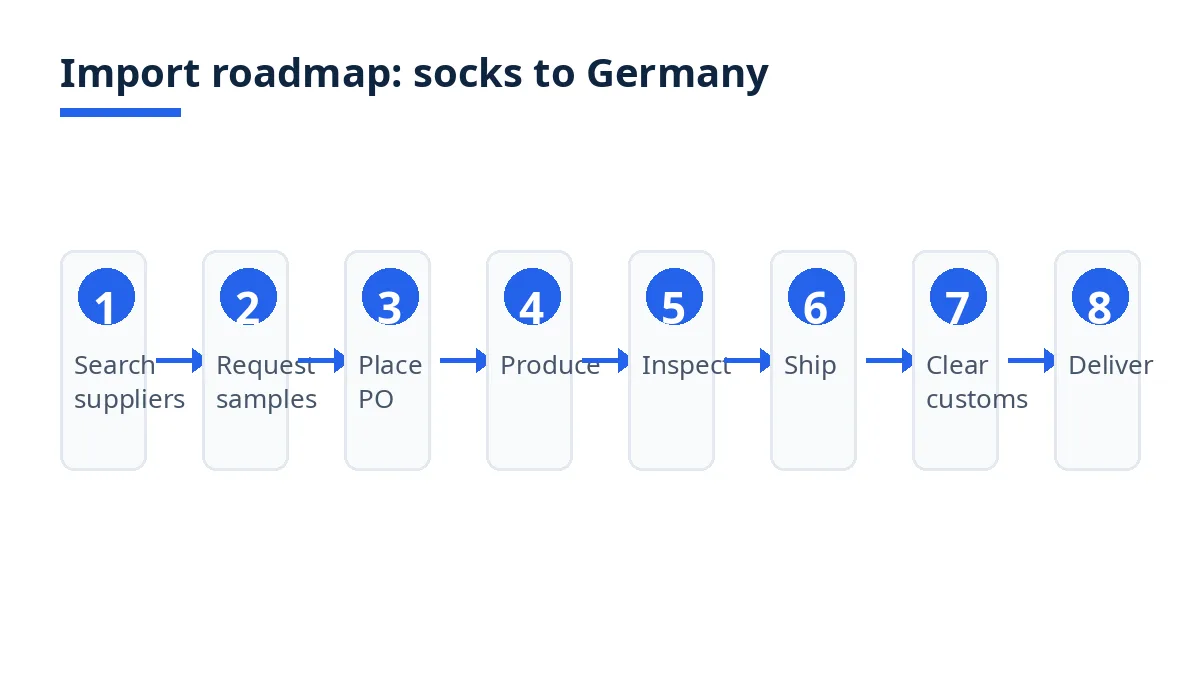
At a glance: what this checklist covers
This checklist is for buyers in Germany who buy socks for retail, wholesale, workwear, sport, or private label programs. It covers one product family, socks and other hosiery in heading 6115, and one destination regime, Germany in the EU. It sets no typical price, minimum order, or transit time. Cost numbers here are example figures.
Why source socks from Bangladesh
Socks are knitted hosiery, and the buying question is a knitting question. A sock is knitted in the round, with the heel and toe shaped during knitting or closed afterward, and with elastic in the welt and often in the leg. The details that decide whether a sock fits and lasts are the fiber mix, yarn count, stitch density, heel and toe construction, size grading, and finishing. Ask for the knitting terms in the first exchange.
The fiber mix sets the feel, the wash behavior, and the tariff line. Cotton gives softness and absorbency for everyday and work socks. Wool and wool blends give warmth for winter and outdoor socks. Synthetic fibers, including polyamide and polyester, add strength and quick drying for sport socks. Elastane, usually a small share, gives stretch and recovery in the welt and leg.
Size, length, and packing are specification decisions, not defaults. Ankle, quarter, crew, and knee-length socks differ in yarn use and fit risk, and a size range needs grading. Ask what finished measurements the supplier will hold after washing. Socks ship as pairs, usually banded, hooked, or bagged, then packed in cartons by size and color. The pair is the supplementary unit used in the tariff lines opened for this guide, where quantities are recorded in pairs.2
Find and verify suppliers
Where should you start the search?
Start with a written sock specification, one page per style, before you contact any supplier. Each page should state the style name, length, fiber mix with percentages, size and color range, heel and toe construction, any cushioning or grip, welt type, label and packing, and the delivery term you want quoted. Send the same pages to every candidate and ask for the same reply format: fiber mix assumed, price per pair, minimum per style and per color, and lead times. Quotes in different formats cannot be compared.
Shortlist makers whose current range already includes socks in your length and fiber mix. A factory that knits socks daily will have the machines, the toe-closing setup, and the packing line for socks. Ask whether knitting is in-house and where dyeing and finishing are done. Browse suppliers on Exportain and compare the ranges shown against your style pages.
How do you verify a supplier before you pay?
Verification has three layers. The first is company documents: trade licence, export registration, and tax documents where applicable, checked so that the company name, address, and bank account name agree across every document. The second is capability: knitting capacity, machine gauge, dyeing and finishing route, and recent sock styles from current production.
The third layer is payment discipline. Keep payments to the company account named in the documents, never to a personal account, and verify any change of bank details through another channel. On Exportain, supplier profiles carry document and photo review badges: a review of documents and photos, not a factory inspection or a guarantee.
MOQ, pricing and samples
What is the typical MOQ for socks from Bangladesh?
There is no single typical minimum order quantity for socks from Bangladesh. The minimum is set per style and usually per color, because yarn is dyed in batches and machines are set up per style and size. A plain cotton crew sock and a multi-color patterned sport sock will not carry the same minimum. Ask how the minimum splits by style, color, and size.
How is the price built, and how should you compare quotes?
Yarn is usually the largest cost element in a sock, followed by knitting, dyeing, finishing, toe closing, pairing, labelling, and packing. Yarn use per pair rises with length, stitch density, cushioning, and size, and each additional color needs yarn and machine setup. Two quotes can differ because one assumed a lighter yarn or simpler packing. Ask what each price is based on, in writing, and compare quotes on the same basis: same style pages, fiber mix, size range, pair packing, delivery term, and payment terms.
Which samples do you need, and how do you approve them?
Work in stages. A development sample shows whether the factory can knit the style, shape the heel and toe, hold the size, and finish the sock cleanly. A pre-production sample, made in the actual production yarn, colors, and finish, is the sample you approve for bulk. Test the samples as your customers will use them: wear them, wash them following the care label, and measure before and after washing. Check pair matching and toe closure, approve in writing, and keep one sealed counter-sample of each style and color.
Quality control and certifications needed
Which quality checks are specific to socks?
Check against the approved sample and size chart first: fiber mix, finished measurements before and after washing, and consistency across the size range. Then check construction pair by pair: welt elasticity, heel and toe shaping, toe closure smoothness, and stitch evenness. Check the pair as a pair, because an order can pass sock by sock and still fail when the two socks differ in length, shade, or heel position.
Agree the inspection method and defect limits before production. ISO 2859-1 defines the acceptance quality limit, AQL, as the quality level that is the worst tolerable process average when a continuing series of lots is submitted for acceptance sampling.3 In practice, many importers use AQL 0 for critical defects, 2.5 for major defects, and 4.0 for minor defects at General Inspection Level II.4 Set your own levels in writing and inspect inline and again on packed cartons. See the socks quality control checklist for a list to adapt to your styles.
Which label rules apply in Germany and the EU?
Fiber labelling is the first label rule to settle. Article 9 of Regulation (EU) No 1007/2011 states that a textile product shall be labelled or marked with the name and percentage by weight of all constituent fibers in descending order.5 Agree the wording at sampling stage and check that the percentages match the yarn you bought. The regulation allows limited derogations, for example where a fiber accounts for up to 5 percent of total weight and cannot easily be stated at manufacture.5 Add care, size, and origin marking as your market and customer require, and plan the consumer-facing text in German for German retail.
Which certifications and test reports do you actually need?
No single certificate covers every sock order. What you need follows your market, your customer, and the end user: name any required scheme or test in the specification, ask for the matching report or certificate, and check its scope and dates.
One scheme buyers often ask about is STANDARD 100 by OEKO-TEX, whose laboratory tests for harmful substances are based on the intended use of the textile, with stricter requirements the more intensive the skin contact.6 Its product classes run from Class 1 for babies and children up to 3 years, through Class 2 for direct skin contact, to Class 3 and Class 4 for products without direct skin contact and home textiles.6 Socks sit in the direct-contact class for most adult styles, and baby socks sit in the strictest class. Check the certificate number, product class, articles listed, and validity dates, and confirm it covers your exact sock.
Incoterms, shipping and transit time
Which delivery term should a first order use?
The Incoterms 2020 rules allocate delivery, risk, and costs between seller and buyer, and the choice matters most at the handover point. The ICC Academy summary of FCA and FOB states the key difference plainly: FCA is the appropriate rule when goods are transported in containers or pallets and multiple modes of transport are used, while FOB is the appropriate rule when goods are transported in bulk between ports.7 For socks in cartons inside containers, that points to FCA at the named terminal for a first order. Under FCA, the seller delivers to the carrier named by the buyer and risk passes at that handover. Under FOB, risk passes when the goods are loaded on board, a point the seller does not control for container cargo handed to a terminal first.7
Many Bangladesh sock orders are still quoted FOB Chattogram. If you accept FOB, agree in writing who bears the risk and cost while the container waits at the terminal, and make sure your insurance covers that period. If you choose FCA, name the place precisely, for example FCA Chattogram container terminal. CPT and CIP move the freight cost to the seller, DAP moves delivery to the named place in Germany, and DDP puts import clearance, duty, and import VAT on the seller. Name the Incoterms rule and year in the contract.
How long does shipping take, and which port should you use?
There is no single typical transit time for socks from Bangladesh to Germany. Sea freight is the standard route for bulk orders and takes weeks rather than days, varying by port pair, routing, transshipment, and season. Agree pairs per carton, carton dimensions, and carton weight in the specification. Keep production time separate from transit time.
Hamburg is the natural entry point for most Germany-bound sock orders. The Port of Hamburg is described by its port authority as Germany's largest seaport, with rail and road links onward across Germany and into Central and Eastern Europe.8 Compare the door cost through Hamburg with the door cost through an alternative EU port. Agree where clearance happens before the vessel sails, and plan backward from the retail date.
Import duty, taxes and documents
How are socks classified for duty?
Duty follows the classification of each style in the EU tariff, not the supplier's product name. Heading 6115 covers pantyhose, tights, stockings, socks and other hosiery, including graduated compression hosiery and footwear without applied soles, knitted or crocheted.2 Inside the heading, graduated compression hosiery sits in 6115.10, other pantyhose and tights in 6115.21 to 6115.29, other women's hosiery in 6115.30, and the other group splits by fiber into 6115.94 for wool, 6115.95 for cotton, 6115.96 for synthetic fibers, and 6115.99 for other textile materials.2 Everyday socks sit in 6115.94 to 6115.99 by fiber. Confirm the full 10-digit code for each style, and treat every code here as indicative. See the HS code guide for socks for the heading structure.
What import duty applies?
On the tariff lines opened for this guide, the third-country duty shown is 12 percent, for example on the synthetic-fiber lines in 6115.96 and on the cotton line 6115.95.2 9 Read 12 percent as the rate without a preference, indicative for your entry date, and confirm the current TARIC line for your exact code before you commit to a selling price. Bangladesh benefits under Everything But Arms from duty-free, quota-free access to the EU for all products except arms and ammunition,1 so the preferential duty is 0 percent when the origin rules are met and the proof of origin is in order, subject to confirmation in TARIC. Confirm that position with your broker, because a new Generalised Scheme of Preferences framework is scheduled to take effect on 1 January 2027.10
Under the EU Registered Exporter system, known as REX, exporters self-certify origin by issuing a statement on origin, and to do so they must be registered in the REX database through the Export Promotion Bureau in Bangladesh.11 Ask the supplier at order stage whether it holds a REX registration.
What about German import VAT?
Import VAT is separate from duty, and it applies even when duty is 0 percent under preference. Germany applies a standard VAT rate of 19 percent, with a reduced rate of 7 percent for goods listed in Annex 2 to the VAT Act, and the import VAT rate follows the same rates.12 Socks are not listed goods for the reduced rate in the sources opened for this guide, so plan on 19 percent and confirm the rate with your tax adviser. The VAT base is built from the customs value, plus any import duties levied, plus the cost of transport to the first inland destination.12 Import VAT is collected by the Federal Customs Administration, and a business importing by or on behalf of itself can generally deduct it as input tax.12
Which documents do you need for clearance?
The standard import set is the commercial invoice, packing list, bill of lading, and proof of origin where a preference is claimed. The invoice should name each style plainly, with length, size range, pair count, unit price, and delivery term, and quantities, weights, and carton counts must agree across every document. Settle who is the importer of record in the EU before the vessel sails, and make sure the EORI number is in order: it is a unique number issued by the competent authorities in the European Union that allows customs to identify economic operators, and economic operators must quote it on customs declarations.13 The European Commission's import guide states that as an EU importer you need to apply for an EORI number, valid throughout the EU.14
Landed cost example
A landed cost is the full cost of one pair of socks, ready in your warehouse, excluding import VAT where that VAT is recoverable. Every number below is an example figure only, not a quote, and the duty line assumes the Everything But Arms preference at 0 percent with valid origin proof. If the preference does not apply, rebuild the table with the 12 percent rate shown on the lines opened for this guide,9 confirmed in TARIC.
Cost element | Example figures (per pair) | How to obtain your figure |
|---|---|---|
Product price, FCA | 0.85 EUR | Pro forma invoice |
International freight to Hamburg | 0.12 EUR | Forwarder quote / pairs |
Insurance | 0.01 EUR | Policy or quote |
Duty at 0 percent under preference | 0.00 EUR | Broker calculation |
Port, clearance, and broker fees | 0.06 EUR | Broker invoices / pairs |
Local delivery to warehouse | 0.05 EUR | Carrier quote / pairs |
Total landed cost, excluding import VAT | 1.09 EUR | Sum of lines above |
Import VAT at 19 percent, separate | 0.19 EUR | 19% of 0.98 EUR base |
Work the calculation twice: at quote stage, style by style, and again after shipment with the invoices. See the landed cost method for imports from Bangladesh for the full method.
Step-by-step import checklist: how to import socks from Bangladesh to Germany
Write the specification style by style: length, fiber mix, size and color range, heel and toe, welt, label, and packing.
Classify every style from heading 6115 and confirm each code and duty with your broker in TARIC.
Shortlist sock makers in your length and fiber mix and request quotes on the identical specification. Read how to import from Bangladesh.
Verify the supplier: documents, knitting capacity, dyeing and finishing route, and a video or in-person check for a first order.
Order samples in stages, wear and wash them, then approve a pre-production sample of each style and color.
Confirm the order in writing: purchase order, pro forma invoice, delivery and payment terms, inspection plan, labelling, packing, origin proof, and shipment date.
Confirm the preference position, check the REX registration, and agree the statement on origin before shipment.
Inspect during production and again on packed cartons against the approved samples.
Ship, clear customs in Hamburg with the confirmed codes, EORI number, and origin proof, and settle duty and import VAT.
Reconcile the actual landed cost per style, file the reports and origin proof, and record what to change next time.
How Exportain helps
Exportain is a B2B marketplace where buyers find Bangladeshi suppliers, post requests for quotation, receive quotations, and message suppliers. Compare sock makers against the same specification pages. Exportain is not a party to the contract for goods: it does not inspect goods, book freight, or clear customs, and supplier badges are document and photo reviews, not factory inspections or guarantees.
FAQs
What is the typical MOQ for socks from Bangladesh?
There is no single typical minimum. It is set per style and usually per color, because yarn is dyed in batches and machines are set up per style and size. Ask how the minimum splits by style, color, and size for your exact sock.
How long does shipping take?
Production and transit times are separate, and neither has a single typical figure. Sea freight from Bangladesh to Hamburg takes weeks rather than days and varies by routing and season, so confirm the sailing schedule with your forwarder and add clearance and delivery time.
What import duty applies?
Duty follows the confirmed classification of each style, the destination, and the origin. Everyday socks sit in 6115.94 to 6115.99 by fiber.2 The third-country duty shown on the lines opened for this guide is 12 percent,2 9 while the Everything But Arms preferential duty is 0 percent when the origin rules are met, subject to confirmation in TARIC.1 Confirm the rate with your broker before you price.
How do I verify a supplier?
Check company documents first, so the name, address, and bank account agree across the trade licence, export registration, and invoices. Then check knitting capacity, dyeing and finishing route, and recent sock production. Keep payments to the company account named in the documents, and approve a pre-production sample before bulk production.
Next steps on Exportain
Read how to buy on Exportain, then use how to write an RFQ to set out your sock specification pages. When ready, post an RFQ on Exportain and compare quotes on the same terms before you choose a supplier for sampling.
Sources
- EU trade relations with Bangladesh. European Commission, (accessed )
- Pantyhose, tights, stockings, socks and other hosiery, including graduated compression hosiery and footwear without applied soles, knitted or crocheted - UK Integrated Online Tariff. UK Government (accessed )
- SIST ISO 2859-1:2003 - Sampling procedures for inspection by attributes, Part 1: Sampling schemes indexed by acceptance quality limit (AQL). International Organization for Standardization, (accessed )
- AQL Chart & Calculator: Acceptable Quality Limit Guide. Asia Quality Focus (accessed )
- Regulation (EU) No 1007/2011 on textile fibre names and related labelling and marking of the fibre composition of textile products, Article 9: Multi-fibre textile products. legislation.gov.uk (accessed )
- OEKO-TEX Standard 100. OEKO-TEX (accessed )
- FCA & FOB Incoterms 2020 explained: Key differences. ICC Academy (accessed )
- Port of Hamburg: Throughput figures for 2025 at a glance. AJOT, (accessed )
- Commodity code 6115969100: Women's stockings - Northern Ireland Online Tariff. GOV.UK (accessed )
- EU invites Bangladesh to share success story in preferential market access. The Financial Express (accessed )
- EPB starts registering local exporters with EU database. The Financial Express (accessed )
- A Guide to the German Import VAT. Consultinghouse (accessed )
- Using the EORI number. German Customs (Zoll) (accessed )
- Guide to import goods. European Commission, Access2Markets (accessed )
About the author
Sourcing from Bangladesh?
Post a request for quotation and suppliers on Exportain can send you their quotes directly.
Post an RFQ