

How to Import Men's Woven Shirts From Bangladesh to USA: Step-by-Step Guide
A USA-focused guide to importing men's woven shirts from Bangladesh: 6205 classification and duty, supplier checks, samples, FTC labels, CBP entry documents, shipping terms, and a worked landed-cost example.
Short answer
To import men's woven shirts from Bangladesh to the USA, classify each shirt in heading 6205 by fibre, confirm the General duty rate in the current US schedule, and agree the specification, labels, and delivery term before bulk production. Approve a pre-production sample, inspect against it, and clear the shipment through a US customs broker with the commercial invoice, packing list, transport document, and entry filings. Build the landed cost from the confirmed duty rate, not from a quoted unit price alone.
On this page
Key takeaways
Men's woven shirts sit in heading 6205: 6205.20 for cotton, 6205.30 for man-made fibres, and 6205.90 for other textile materials, with further lines for wool and silk.
In Revision 17 (2026), General rates include 19.7 percent on other cotton shirts (6205.20.20) and a compound 30.9 cents per kilogram plus 25.9 percent on other man-made fibre shirts (6205.30.20); confirm the current rate per style with a broker.
There is no single typical MOQ, price, or transit time for woven shirts: confirm each one in writing for your exact style, colour, size range, route, and shipment date.
United States labels answer to two systems: FTC fibre-content, origin, identity, and care labelling, and separate CBP country-of-origin marking.
For ocean cargo, file the Importer Security Filing no later than 24 hours before loading, file the entry summary within 10 working days of release, and keep entry records for five years.
For a United States buyer, importing men's woven shirts from Bangladesh starts with three decisions made before bulk production: the tariff line for each shirt, the label set for the United States market, and the entry documents your customs broker will file. Get those three right and the rest of the order has a fixed reference point. Get one wrong and a shipment can arrive with the wrong duty, the wrong label, or documents that do not match the goods.
A woven shirt is cut and sewn from woven fabric, rather than knitted. That construction point places it in Chapter 62 of the United States schedule, which applies to made up articles of textile fabric other than wadding and excludes knitted or crocheted articles.1 Heading 6205 covers men's or boys' shirts, and the chapter notes add two tests: heading 6205 does not cover sleeveless garments, and a shirt is a garment designed to cover the upper part of the body, with long or short sleeves and a full or partial opening starting at the neckline, which may also have a collar.1 A garment designed for left over right closure at the front is regarded as a men's or boys' garment under the same notes.1
Why source men's woven shirts from Bangladesh
Bangladesh offers a deep woven-garment supply base, with choice across cotton and cotton-blend shirting, man-made fibre shirting, structured dress shirts, and softer casual shirts. The decision is not about finding any shirt factory, but a supplier whose current production already matches your shirt type, because collar and cuff work, placket construction, and size-ratio cutting differ from knit-shirt production.
Write the shirt before you search: fabric and fibre, weave and weight, collar and cuff, placket, buttons, pocket, sleeve, size range and measurements, labels, and packing. Two suppliers quoting different versions of that list are not quoting the same shirt.
Find and verify suppliers
Where should you start the search?
Start from the specification, not from a list of factory names. Shortlist suppliers whose current range already includes men's woven shirts in your fibre and construction, and send every candidate the identical specification with the same reply format: fabric assumed, price inclusions, validity, minimum per style and per colour, and delivery term with a named place. Browse suppliers on Exportain and read how to import from Bangladesh for the full process.
How do you verify a supplier before you pay?
Verification has three layers. The first is company documents: trade licence, tax and VAT registration where applicable, export registration, and association membership where relevant. Check that the legal name, address, and bank account name agree across every document, the quotation, and the invoice. The second layer is capability: woven fabric source, cutting capacity by size ratio, collar and cuff lines, button and buttonhole equipment, washing and finishing route where you specify a wash, and recent woven-shirt production inspectable as finished goods.
The third layer is payment discipline. Keep payments to the company account named in the documents, never to a personal account, and verify any change of bank details separately through a channel you already trust. On Exportain, supplier profiles may carry trust badges recording which document and photo checks have been reviewed. A badge is not a factory inspection, not an inspection of your goods, and not a guarantee of capacity, quality, or delivery.
MOQ, pricing and samples
What is the typical MOQ for men's woven shirts from Bangladesh?
There is no single typical minimum order quantity for men's woven shirts from Bangladesh. The minimum is normally set per style and per colour, because fabric is bought or dyed in batches, a cutting plan is set up per size range, and trims are ordered per style. A plain white dress shirt and a yarn-dyed check shirt in a wide size range will not carry the same minimum. Ask each supplier how its minimum splits by style, colour, and size range.
How is the price built, and how should you compare quotes?
A woven-shirt price is built from fabric, trims such as buttons and interlining, cutting and sewing, washing or finishing where specified, testing, labels and packing, and the factory margin. Detail adds operations: a fused collar, matched checks across a placket, or a special wash each change the work involved. Two quotes can differ because one assumes a lighter fabric, a simpler collar, fewer sizes, or a different delivery term.
Compare quotes only on the same basis: the same specification, size range, delivery term with a named place, and packing. Ask each supplier to state what is excluded, for example testing or special packing. Convert every quote to an estimated landed cost before you choose.
Which samples do you need, and how do you approve them?
Work in stages. A development sample shows whether the factory understood the specification: collar shape and symmetry, cuff fit, placket alignment, button placement, and measurements against your chart. A pre-production sample, made in the actual production fabric, trims, labels, and finish, is the sample you approve for bulk. Measurements, shade, and wash behaviour cannot be approved from a sample in substitute fabric, because finishing and washing change dimensions and shade.
Test the sample as your customer will use it: measure every size against your chart, check collar-point match, even cuff closure, button seating without strain, and check or stripe matching across the placket and pocket where specified. Wash the sample following your care label and re-measure it. Approve in writing and keep one sealed counter-sample of each style.
Quality control and certifications needed
Which quality checks are specific to woven shirts?
Check against the approved sample and your size chart first: measurements within agreed tolerances, collar shape and point symmetry, cuff size and closure, placket straightness and button spacing, button attachment, seam quality, shade consistency, and check or stripe matching where specified. A shirt can pass size by size and still fail as a range if one size drifts.
Agree the inspection method and defect limits before production. ISO 2859-1:2026 defines a system of acceptance sampling plans for inspection by attributes, and its summary states that AQL stands for acceptance quality limit, the maximum average percentage of defective items considered acceptable during random sampling, used to determine sample sizes and acceptance and rejection thresholds.2 Inspect in stages: an inline check during cutting and sewing catches drift while correction is still possible, and a final random inspection on packed goods checks quantity, workmanship, measurements, labels, and packing. See the acceptance quality limit and pre-shipment inspection guides.
Which label rules apply in the United States?
United States shirt labels answer to two separate systems, and meeting one does not meet the other. Most textile and wool products sold in the United States must carry a label disclosing fibre content, country of origin, and the identity of the manufacturer or marketer, under the Textile Fiber Products Identification Act and, for wool, the Wool Products Labeling Act, with fibre content listed by generic name and percentage by weight in descending order.3 The Care Labeling Rule separately requires a care instruction, such as washing or dry-cleaning guidance, on most wearing apparel, and the responsible company can use its FTC-issued Registered Identification Number (RN) in place of its name.3
The RN route has a limit that matters for a Bangladesh order. Registered identification numbers are issued to persons or firms residing in the United States that import, manufacture, market, distribute, or otherwise handle the covered products, for display on labels in lieu of the full name.4 A Bangladeshi supplier therefore does not supply an RN. Your United States company uses its own name or its own RN, agreed at sampling stage, not after bulk labels are sewn.
Country-of-origin marking is a customs requirement distinct from the FTC label. Under 19 U.S.C. § 1304, every imported article or its container must be marked conspicuously, legibly, and permanently with the English name of its country of origin so the ultimate purchaser can see it, with marking rules in 19 CFR Part 134 and textile-specific origin rules in 19 CFR 102.21.3 Wearing apparel must also meet the clothing-textile flammability standard at 16 CFR Part 1610.3 Map cotton and fabric sourcing before shipping: the Uyghur Forced Labor Prevention Act presumes goods produced wholly or in part in the Xinjiang region of China, or by entities on the UFLPA Entity List, are made with forced labour and barred from entry, and cotton is a highest-risk input, so a detention requires supply-chain tracing documentation to rebut.3
Which certifications do you actually need?
No single certificate covers every woven-shirt order. What you need follows your market and your customer: a retailer may name a specific test or scheme in its supplier manual, so name it in the specification, ask for the matching report or certificate, and check its scope, product, issuing body, and date.
Incoterms, shipping and transit time
Which delivery term should a first order use?
Incoterms 2020 is the current set of 11 three-letter rules from the International Chamber of Commerce, in force since 1 January 2020: seven rules for any mode of transport and four for sea and inland waterway transport only.5 For a first container order, weigh FCA against FOB at the Bangladeshi port. FCA is an any-mode rule under which the seller delivers the goods, cleared for export, to a carrier the buyer names, with risk passing at that handover, and it is the container-friendly rule.5 FOB is a sea-only rule under which risk passes when the goods are on board the vessel at the port.5
The sea-only rules carry a trap for container cargo. Under CFR and CIF the seller pays freight to the destination port, yet risk still passes on board at the origin port, and a container is usually handed to the carrier at a terminal well before it is on board, so a sea-only rule mistimes the risk transfer; for containers, use FCA, CPT, or CIP instead.5 CIP also differs from CIF on insurance: CIP requires higher all-risks cover, while CIF requires only minimum cover.5 Incoterms move risk, not ownership or payment.5
How long does shipping take?
There is no single typical transit time for woven shirts from Bangladesh to the United States. Sea freight is the standard route for bulk orders and takes weeks rather than days, varying by port, routing, transshipment, and season. Plan from your forwarder's current sailing schedule, and keep production time separate from transit time: an order is ready only when every shirt has finished sewing, finishing, inspection, and packing. Confirm shirts per carton and carton dimensions in the specification.
Import duty, taxes and documents
How are men's woven shirts classified for duty?
Duty follows the classification of each shirt in the United States schedule, not the supplier's product name. Heading 6205 covers men's or boys' shirts, split by fibre: 6205.20 for cotton, 6205.30 for man-made fibres, and 6205.90 for other textile materials, with further lines for wool, silk, and other materials.1 One order can therefore span several lines. Confirm the full 10-digit code for each style before you price or ship. See the HS code guide for men's woven shirts for the classification structure.
What import duty applies?
Your rate depends on each style's subheading and the schedule in force on the entry date, so no single rate covers a whole shirt order. In the United States schedule opened for this guide, Revision 17 (2026), the General rates for heading 6205 include 8.7 percent on certified hand-loomed and folklore cotton shirts under 6205.20.10 and 19.7 percent on other cotton shirts under 6205.20.20.1 For man-made fibre shirts, certified hand-loomed and folklore products under 6205.30.10 carry 12.2 percent, while other man-made fibre shirts under 6205.30.20 carry a compound rate of 30.9 cents per kilogram plus 25.9 percent.1 For other textile materials, wool folklore shirts under 6205.90.05 carry 9.2 percent, other wool shirts under 6205.90.07 carry 52.9 cents per kilogram plus 17.5 percent, silk shirts with 70 percent or more silk under 6205.90.10 carry 1.1 percent, other silk shirts under 6205.90.30 carry 7.1 percent, and other textile material shirts under 6205.90.40 carry 2.8 percent.1
Confirm the current rate, any additional duties in force on the entry date, and any preference claim with your broker before you commit to a selling price. Do not build a margin plan on an unconfirmed preference. Import taxes beyond duty depend on your entry, so ask your broker to list every charge on the entry summary.
Which documents do you need for clearance?
The entry runs on a defined document set: a commercial invoice, packing list, and bill of lading or air waybill, plus the CBP entry (Form 3461) and entry summary (Form 7501) filed through the Automated Commercial Environment (ACE).6 For ocean cargo you also file an Importer Security Filing before the goods are loaded.6 The importer of record, not the broker, is legally responsible for the filing's accuracy and timeliness under the duty of reasonable care in 19 U.S.C. § 1484.6
Three deadlines bind the process. The Importer Security Filing, often called "10+2" for its ten importer data elements and two carrier elements, must be filed no later than 24 hours before cargo is laden aboard the vessel at the foreign port, for ocean shipments only.6 The entry and release filing is made at or before arrival, and the entry summary must be filed within 10 working days of release, with estimated duties deposited.6 Importers must retain entry records, including invoices, entry summaries, and valuation and classification support, for five years from the date of entry.6
The commercial invoice is the spine of the entry: CBP builds classification, valuation, and origin determinations from it, so describe each shirt style in plain, specific terms, for example cotton men's dress shirt with fused collar, with fibre composition, sizes, quantities, unit prices, and the delivery term on its own line.6 Keep fibre groups on separate lines matching their classifications, and make quantities, weights, and carton counts agree across every document. Ask your broker whether a customs bond is required for your entry.
Landed cost example
A landed cost is the full cost of one shirt, cleared and in your warehouse. Every number below is an example figure only, not a quote, and the duty line uses the schedule rate read for this guide.
Example figures: 5,000 men's cotton woven shirts, FOB Chattogram, sea freight to a United States port, duty at the 19.7 percent General rate for 6205.20.20 in Revision 17 (2026).1
Cost element | Example figures (per shirt) | How to obtain your figure |
|---|---|---|
Product price, FOB | $6.20 | Confirmed pro forma invoice |
International freight | $0.48 | Forwarder quote / shirts |
Insurance | $0.05 | Policy or forwarder quote |
Duty at 19.7 percent on the example product value | $1.22 | Broker calculation |
Broker and entry fees | $0.09 | Broker invoices / shirts |
Port, clearance, and delivery to warehouse | $0.23 | Carrier and broker invoices / shirts |
Inspection | $0.12 | Inspection quote / shirts |
Total landed cost | $8.39 | Sum of all lines above |
The example total is $41,967 for 5,000 shirts, or $8.39 per shirt. Import taxes beyond duty are not included, because their treatment depends on your entry and tax position. Work the calculation twice: at quote stage and again after shipment with the actual invoices. See landed cost for imports from Bangladesh for the full method.
Step-by-step import checklist
Write the specification style by style: fibre, fabric, weave and weight, collar and cuff, placket, buttons, pocket, sleeve, sizes and measurements, labels, and packing.
Classify every style in heading 6205 by fibre (6205.20 cotton, 6205.30 man-made fibres, 6205.90 other textile materials) and confirm each full code and duty with your broker.1
Shortlist suppliers whose current range includes men's woven shirts, and request comparable quotes on the identical specification and delivery term.
Verify the chosen supplier: company documents, woven-shirt capacity, fabric source, collar and cuff lines, and a factory check for a first order.
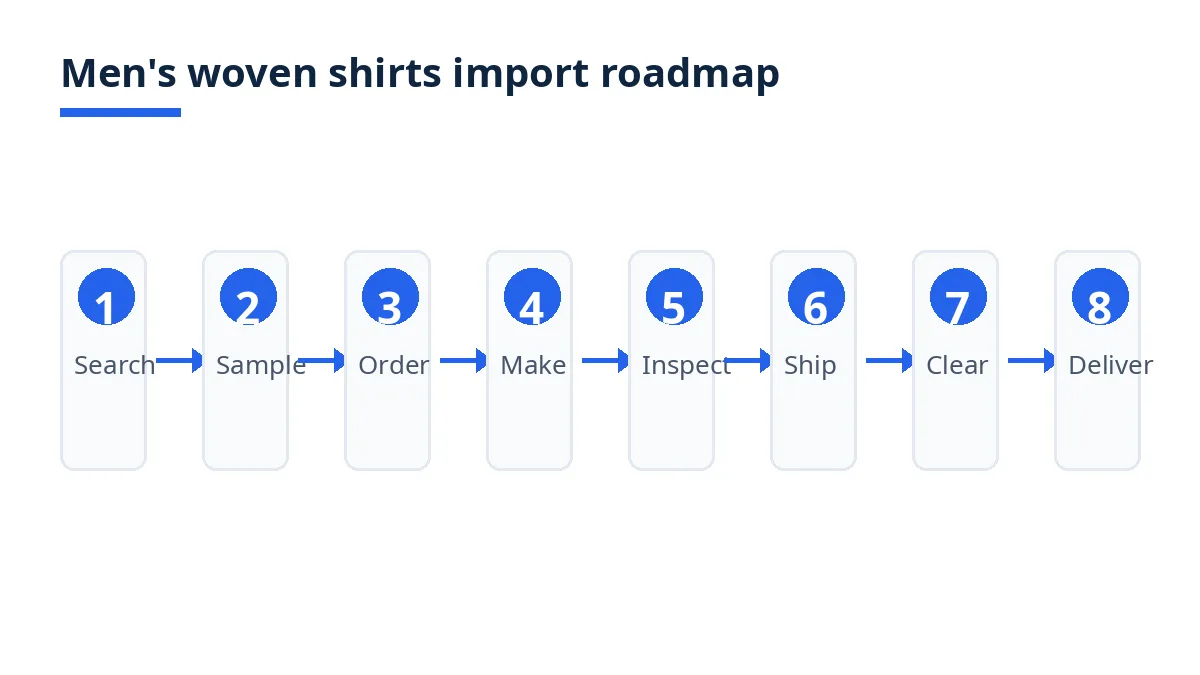
Order samples in stages, measure every size, test collar, cuff, placket, and wash behaviour, then approve a pre-production sample of each style in production fabric, trims, and labels.
Confirm the order in writing: purchase order, pro forma invoice, delivery and payment terms, inspection plan with AQL and defect limits, labelling, packing, and shipment date.
Inspect during production and again on packed goods against the approved samples, checking measurements, collar and cuff symmetry, shade, and carton counts.
Ship under the agreed delivery term, file the Importer Security Filing on time for ocean cargo, clear customs with the confirmed code for each style, and reconcile the actual landed cost.
How Exportain helps
Browse suppliers for Bangladeshi woven-shirt exporters and compare their ranges against your style list, then post your specification and target quantity as an RFQ and compare replies on the same terms before you choose a supplier for sampling. See how to buy for the buying steps. Exportain is a B2B marketplace where buyers post RFQs, receive quotations, and message suppliers. It does not inspect goods, book freight, or clear customs, and a trust badge is a document and photo review, not a factory inspection or a guarantee.
FAQs
What is the typical MOQ for men's woven shirts from Bangladesh?
There is no single typical minimum. It is normally set per style and per colour, because fabric is bought or dyed in batches and a cutting plan is set up per size range. Ask each supplier how its minimum splits by style, colour, and size range.
How long does shipping take?
Production time and transit time are separate, and neither has a single typical figure. Sea transit takes weeks rather than days and varies by port, routing, and season. Plan from your forwarder's current sailing schedule.
What import duty applies?
Duty follows the confirmed classification of each style in heading 6205 and the schedule in force on the entry date. In Revision 17 (2026), the General rates include 19.7 percent on other cotton shirts under 6205.20.20, 12.2 percent on certified hand-loomed and folklore man-made fibre shirts under 6205.30.10, and 30.9 cents per kilogram plus 25.9 percent on other man-made fibre shirts under 6205.30.20.1 Confirm the current rate for each style with your broker before pricing.
How do I verify a supplier?
Check company documents first, so that the legal name, address, and bank account agree across the trade licence, export registration, quotation, and invoices. Then check capability: fabric source, cutting capacity by size ratio, collar and cuff lines, and recent woven-shirt production. Keep payments to the company account named in the documents, and approve a pre-production sample of each style before bulk production.
Next steps on Exportain
Read how to import from Bangladesh for the full process, then use the landed cost guide to build your own per-shirt calculation. When ready, browse suppliers on Exportain and compare woven-shirt suppliers on the same specification and delivery term.
Sources
- Harmonized Tariff Schedule of the United States, Chapter 62: Articles of apparel and clothing accessories, not knitted or crocheted (Revision 17, 2026). United States International Trade Commission (accessed )
- ISO 2859-1:2026 - Sampling procedures for inspection by attributes — Part 1: Sampling schemes indexed by acceptance quality limit (AQL) for lot-by-lot inspection. International Organization for Standardization (accessed )
- How to Import Textiles into the U.S.. Reidel Law Firm (accessed )
- Wool Products Labeling; Fur Products Labeling; Textile Fiber Products Identification. Federal Trade Commission (accessed )
- Incoterms 2020 Explained: All 11 Rules, Chart & Meaning. Xflowpay (accessed )
- Import Documentation Requirements: A CBP Guide. Reidel Law Firm (accessed )
About the author
Sourcing from Bangladesh?
Post a request for quotation and suppliers on Exportain can send you their quotes directly.
Post an RFQ


