Importing Men's Woven Shirts From Bangladesh to UK: Costs, Duties and Suppliers
A UK-focused guide to importing men's woven shirts from Bangladesh: 6205 classification and 12 percent fallback duty, DCTS preference, import VAT and postponed VAT accounting, supplier checks, samples, UK labelling, shipping terms, and a worked landed-cost example.
Short answer
For a UK buyer, importing men's woven shirts from Bangladesh starts at the UK border: confirm each shirt's 6205 commodity code, evidence any DCTS preference claim, and agree how import VAT will be accounted for, before approving samples, production, and shipment.
On this page
Key takeaways
Men's woven shirts sit in UK heading 6205: 6205 20 for cotton, 6205 30 for man-made fibres, and 6205 90 for other textile materials, with the full commodity code confirmed per style before pricing or shipping.
In the UK tariff page opened for this guide, the third-country duty for every 6205 line is 12.00 percent; Bangladesh is listed in the DCTS Comprehensive Preferences tier, with 0 percent tariffs on 99.8 percent of products except arms and ammunition, subject to origin rules and a valid proof of origin.
There is no single typical MOQ, price, or transit time for men's woven shirts: confirm each one in writing for your exact style, colour, size range, route, and shipment date.
UK textile labels must be in English, durable, legible, visible, readily accessible and securely attached, use only approved fibre names, and accurately reflect the fibre content of each component.
For a VAT-registered UK importer, postponed VAT accounting allows import VAT to be accounted for on the VAT return rather than paid at the border, where it is chosen and notified on the customs declaration; it is not available to importers who are not VAT-registered.
For a buyer in the United Kingdom, a first shipment of men's woven shirts from Bangladesh usually meets its hardest questions at the UK border, not in the factory. The customs broker will ask for the commodity code for each shirt style, the proof that supports any preferential duty claim, and how import VAT is to be accounted for. Settle those three answers before production, or the same shipment can attract the wrong duty, a delayed release, or a VAT bill paid at the border that could have been accounted for on a return.
This guide is for UK-based buyers: menswear retailers, brands, wholesalers and importers bringing men's woven shirts from Bangladesh into Great Britain. It follows the UK tariff, the UK preference scheme for Bangladesh, and UK labelling practice. Where a figure is an illustration rather than a fact, it is labelled as an example figure.
Why source men's woven shirts from Bangladesh
Bangladesh has a deep woven-garment supply base, and men's shirts are a core product within it: cotton and cotton-blend shirting, man-made fibre shirting, structured dress shirts and softer casual shirts. The useful question is whether a shortlisted supplier already makes your shirt type at your size range, since collar and cuff work, placket construction and size-ratio cutting differ from knit-shirt production.
Write the shirt before you search. Record fabric and fibre, weave and weight, collar and cuff, placket, buttons, pocket, sleeve, size range and measurements, labels, and packing. Two suppliers quoting against different versions of that list are not quoting the same shirt.
Find and verify suppliers
Where should you start the search?
Start from the specification, not from a list of factory names. Shortlist suppliers whose current range already includes men's woven shirts in your fibre and construction, and send every candidate the identical specification with the same reply format: fabric assumed, price inclusions, validity, minimum per style and per colour, and delivery term with a named place. Browse suppliers on Exportain and read how to import from Bangladesh for the full process.
How do you verify a supplier before you pay?
Verification has three layers. The first is company documents: trade licence, tax and VAT registration where applicable, export registration, and association membership where relevant. Check that the legal name, address, and bank account name agree across every document, the quotation, and the invoice. The second layer is capability: woven fabric source, cutting capacity by size ratio, collar and cuff lines, button and buttonhole equipment, washing and finishing route where you specify a wash, and recent woven-shirt production examinable as finished goods.
The third layer is payment discipline. Keep payments to the company account named in the documents, never to a personal account, and verify any change of bank details separately through a channel you already trust. On Exportain, supplier profiles may carry trust badges recording which document and photo checks have been reviewed. A badge is a document and photo review, not a factory inspection or a guarantee.
MOQ, pricing and samples
What is the typical MOQ for men's woven shirts from Bangladesh?
There is no single typical minimum order quantity for men's woven shirts from Bangladesh. The minimum is normally set per style and per colour, because fabric is bought or dyed in batches, a cutting plan is set up per size range, and trims are ordered per style. A plain white dress shirt and a yarn-dyed check shirt in a wide size range will not carry the same minimum. Ask each supplier how its minimum splits by style, colour, and size range.
How is the price built, and how should you compare quotes?
A woven-shirt price is built from fabric, trims such as buttons and interlining, cutting and sewing, washing or finishing where specified, testing, labels and packing, and the factory margin. Detail adds operations: a fused collar, matched checks across a placket, or a special wash each change the work involved. Two quotes can differ because one assumes a lighter fabric, a simpler collar, or fewer sizes.
Compare quotes only on the same basis: the same specification, size range, delivery term with a named place, and packing. Ask each supplier to state what is excluded, for example testing or special packing. Convert every quote to an estimated landed cost before you choose. See landed cost for imports from Bangladesh for the full method.
Which samples do you need, and how do you approve them?
Work in stages. A development sample shows whether the factory understood the specification: collar shape and symmetry, cuff fit, placket alignment, button placement, and measurements against your chart. A pre-production sample, made in the actual production fabric, trims, labels, and finish, is the sample you approve for bulk. Measurements, shade, and wash behaviour cannot be approved from a sample in substitute fabric.
Test the sample as your UK customer will use it: measure every size against your chart, check collar-point match, cuff closure, button seating without strain, and check or stripe matching where specified. Wash the sample following your care wording and re-measure it. Approve in writing and keep one sealed counter-sample of each style.
Quality control and certifications needed
Which quality checks are specific to woven shirts?
Check against the approved sample and your size chart first: measurements within agreed tolerances, collar shape and point symmetry, cuff size and closure, placket straightness and button spacing, button attachment, seam quality, shade consistency, and check or stripe matching where specified. Check the full size range, not only the middle sizes, since one drifting size can fail a range.
Agree the inspection method and defect limits before production. ISO 2859-1:2026 defines a system of acceptance sampling plans for inspection by attributes, and its summary states that AQL stands for acceptance quality limit, the maximum average percentage of defective items considered acceptable during random sampling, used to determine sample sizes and acceptance and rejection thresholds.1 Inspect in stages: an inline check during cutting and sewing, and a final random inspection on packed goods. See the acceptance quality limit and pre-shipment inspection guides.
Which label rules apply in the United Kingdom?
UK textile labelling starts with fibre content. Textile labels must be in English, durable, legible, visible, readily accessible and securely attached, use only approved fibre names, accurately reflect the fibre content, and list the fibre content of each component where a product includes more than one material.2 Terms such as 100 percent, pure or all may be used only when the product contains only one fibre type, and small accessories such as buttons, buckles and slide fasteners do not require fibre labelling.2 Where a shirt includes non-textile parts of animal origin, the label must state that fact.2
Agree the fibre wording at sampling stage, from the actual bulk fabric composition, and check it again on the pre-production sample.
Which certifications do you actually need?
No single certificate covers every woven-shirt order. What you need follows your market and your customer: a retailer may name a specific test or scheme in its supplier manual, so name it in the specification, ask for the matching report or certificate, and check its scope, product, issuing body, and date. A report for a different fabric or an unwashed version does not cover your washed shirt.
Incoterms, shipping and transit time
Which delivery term should a first order use?
For a first container order to the UK, weigh FCA at a named container terminal against FOB at the Bangladeshi port, and write the named place into the contract either way. The distinction matters because containers are handed to the carrier at a terminal well before they are on board a vessel. Guidance drafted by the co-chairs and special adviser of the ICC Incoterms 2020 Drafting Group states that, where goods are shipped in containers through a port, FCA and CPT provide the best matching point to delineate freight cost and transfer of risk, while the traditional maritime rules FOB, CFR and CIF have an on-board point of delivery that is not suitable for containers.3
Under FCA, risk passes when the goods are handed to the buyer's carrier at the named place, which matches how container cargo actually moves. Under FOB, risk passes on board, leaving a gap between terminal handover and loading in which the seller no longer holds the goods but still carries the risk, and where terminal handling charges are most often disputed. The practical choice is usually FCA at the origin container terminal, CPT to a UK container terminal, or CIP where insurance cover is also agreed. Incoterms move risk and allocate costs; they do not transfer ownership and they do not clear UK customs for you.
How long does shipping take?
There is no single typical transit time for woven shirts from Bangladesh to the United Kingdom. Sea freight is the standard route for bulk orders and takes weeks rather than days, varying by port, routing, transshipment, and season. Plan from your forwarder's current sailing schedule, and keep production time separate from transit time. Confirm shirts per carton and carton dimensions in the specification, because carton volume and count drive the freight quotation and arrival handling.
On arrival, the UK process is a customs declaration through the Customs Declaration Service, made by you or by a customs agent acting for you. Get your GB EORI number and broker arrangement in place before the goods sail, not while the container waits for release.
Import duty, taxes and documents
How are men's woven shirts classified for duty in the United Kingdom?
Duty follows the classification of each shirt in the UK tariff, not the supplier's product name. Heading 6205 covers men's or boys' shirts, and the chapter notes add two tests: heading 6205 does not cover sleeveless garments, and a shirt is a garment designed to cover the upper part of the body, with long or short sleeves and a full or partial opening starting at the neckline, which may also have a collar.4 Garments designed for left over right closure at the front are regarded as men's or boys' garments under the same notes.4
Within heading 6205, the UK tariff splits by fibre. Cotton shirts sit at 6205 20, with 6205 2000 10 for shirts hand-printed by the batik method and 6205 2000 90 for other cotton shirts; man-made fibre shirts sit at 6205 3000 00; and other textile materials sit at 6205 90, with 6205 9010 for flax or ramie and 6205 9080 for other materials.4 Each style needs its own full commodity code before you price or ship. The supplementary unit is the number of items, so piece counts must agree across the invoice, packing list and declaration.4
What import duty applies?
Your rate depends on each style's commodity code, the tariff in force on the entry date, and whether a valid preference claim is made, so no single rate covers a whole shirt order. In the UK tariff page opened for this guide, the third-country duty shown for every 6205 line is 12.00 percent.4 That is the fallback figure to use in a margin plan until a preference is confirmed.
Bangladesh is listed by GOV.UK in the Comprehensive Preferences tier of the Developing Countries Trading Scheme, and exporters in countries entitled to Comprehensive Preferences receive 0 percent import tariffs on 99.8 percent of products, all products except arms and ammunition.5 A preference is not automatic: it depends on the goods meeting the origin rules and on a valid proof of origin, so agree the proof at order stage and have your broker confirm the claim before the goods sail. When a country graduates from least-developed-country status, its transition period before moving to Enhanced Preferences is 3 years, and Enhanced Preferences entitle exporters to 0 percent tariffs on 92 percent of product lines.5 Do not price a future programme on a post-transition rate until your broker confirms it.
The improved DCTS rules of origin applying to goods imported to the UK from 1 January 2026 make garment rules more flexible, including sourcing up to 100 percent of inputs from other countries depending on the garment, with only one significant manufacturing process, for example cutting and sewing, required in a DCTS country.6 Confirm the origin position for your exact fabric route with your broker, keep the records that support it, and treat any claim that cannot be evidenced as no claim at all.
What about import VAT?
Import VAT is separate from duty and is charged in addition to it. The UK tariff page lists VAT for the 6205 lines as 20 percent or 0 percent, depending on the goods and the VAT position, so your broker must confirm the VAT treatment for your styles rather than assuming a single figure.4 For a VAT-registered UK importer, postponed VAT accounting changes the cash timing rather than the VAT itself: it allows the importer to account for the relevant import VAT on the VAT return rather than paying it immediately, and where it is chosen and notified on the customs declaration, the VAT amount appears on a Monthly Postponed Import VAT Statement, which provides the amounts for box one of the VAT return and, where appropriate, box four to be reclaimed as input tax, subject to the normal rules.7 Importers who are not VAT-registered, or who could not treat the import VAT as input tax because they are not the owner of the goods, are not permitted to use it.7
If you cannot recover import VAT, it is a cost in full and must be added to the per-shirt total. Agree with your broker and accountant before the first shipment whether postponed VAT accounting will be used, because the choice is made on the declaration, not after clearance.
Which documents do you need for clearance?
The UK clearance set is the commercial invoice, packing list, and bill of lading or air waybill, plus the proof of origin where a preference is claimed. Describe each shirt style in plain, specific terms, for example men's cotton dress shirt with fused collar, with fibre composition, sizes, quantities, unit prices, and the delivery term on its own line. Keep fibre groups on separate lines matching their classifications, and make quantities, weights, and carton counts agree across every document.
Landed cost example
A landed cost is the full cost of one shirt, cleared and in your warehouse. Every number below is an example figure only, not a quote, and the duty line uses the preference position described above.
Example figures: 4,000 men's cotton woven shirts, FCA Chattogram container terminal, sea freight to a UK port, duty at 0 percent under a confirmed DCTS Comprehensive Preferences claim with valid proof of origin, import VAT tracked separately through postponed VAT accounting.
Cost element | Example figures (per shirt) | How to obtain your figure |
|---|---|---|
Product price, FCA | £6.00 | Confirmed pro forma invoice |
International freight | £0.55 | Forwarder quote / shirts |
Insurance | £0.06 | Policy or forwarder quote |
Duty at 0 percent under the example preference claim | £0.00 | Broker calculation |
UK port, clearance and broker fees | £0.42 | Broker invoices / shirts |
Local delivery to warehouse | £0.30 | Carrier quote / shirts |
Inspection | £0.15 | Inspection quote / shirts |
Total landed cost | £7.48 | Sum of all lines above |
The example total is £29,920 for 4,000 shirts, or £7.48 per shirt. Import VAT is not included, because its treatment depends on your VAT position.7 Work the calculation twice: at quote stage and again after shipment with the actual invoices. If the preference claim fails, the fallback third-country duty is 12.00 percent, which must be modelled before you commit to a retail price.4
Step-by-step import checklist
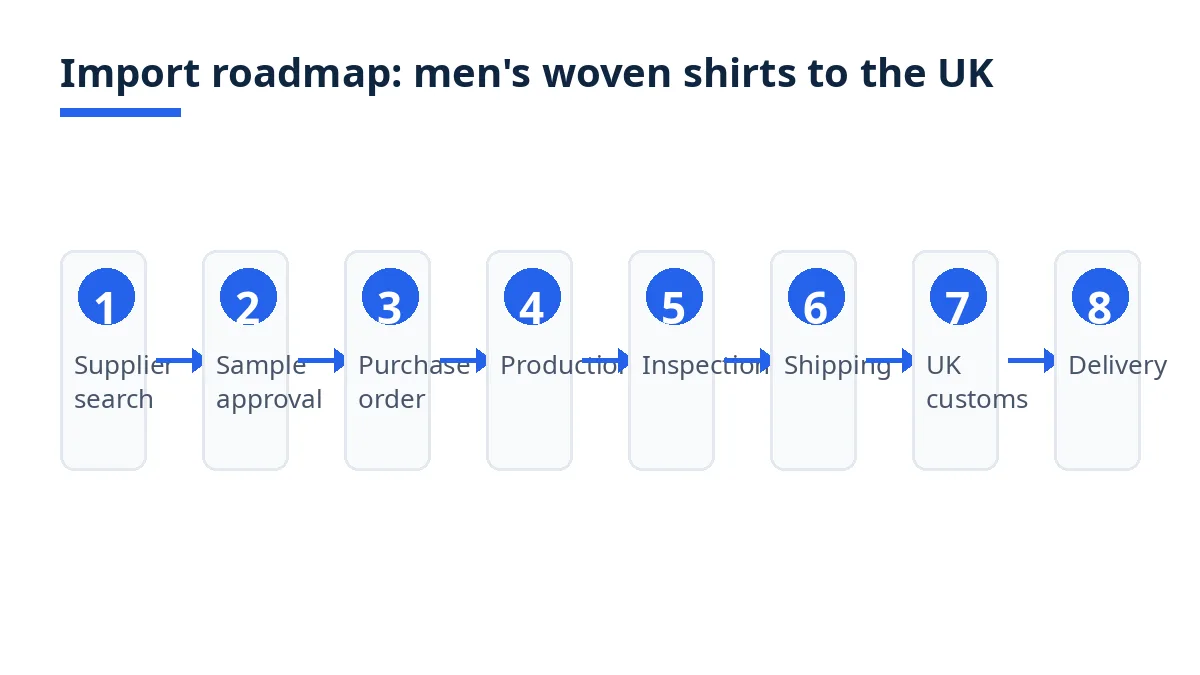
Write the specification style by style: fibre, fabric, collar and cuff, placket, buttons, sizes, UK label wording, and packing.
Classify every style in heading 6205 by fibre and confirm each full UK commodity code with your broker.4
Confirm the duty position for each style, including whether a DCTS preference claim is evidenced for your fabric route.5
Confirm the import VAT treatment and whether postponed VAT accounting will be used, before the goods sail.7
Shortlist suppliers whose current range includes men's woven shirts, and request comparable quotes on the identical specification.
Verify the chosen supplier: company documents, capacity, fabric source, and a factory check for a first order.
Order samples in stages, then approve a pre-production sample of each style in production fabric, trims, and labels.
Confirm the order in writing: purchase order, pro forma invoice, delivery and payment terms, inspection plan, labelling, packing, proof of origin, and shipment date.
Inspect during production and again on packed goods against the approved samples.
Ship under the agreed delivery term, clear UK customs with the confirmed code and preference claim, and reconcile the actual landed cost.
How Exportain helps
Browse suppliers for Bangladeshi woven-shirt exporters and compare their ranges against your style list, then post your specification and target quantity as an RFQ and compare replies on the same terms before you choose a supplier for sampling. See how to buy for the buying steps. Exportain is a B2B marketplace where buyers post RFQs, receive quotations, and message suppliers. It does not inspect goods, book freight, or clear customs.
FAQs
What is the typical MOQ for men's woven shirts from Bangladesh?
There is no single typical minimum. It is normally set per style and per colour, because fabric is bought or dyed in batches and a cutting plan is set up per size range. Ask each supplier how its minimum splits by style, colour, and size range.
How long does shipping take?
Production time and transit time are separate, and neither has a single typical figure. Sea transit takes weeks rather than days and varies by port, routing, and season. Plan from your forwarder's current sailing schedule.
What import duty applies?
Duty follows the confirmed classification of each style in heading 6205 and the tariff and preference position on the entry date. In the UK tariff page opened for this guide, the third-country duty for every 6205 line is 12.00 percent.4 Bangladesh is listed in the DCTS Comprehensive Preferences tier, with 0 percent tariffs on 99.8 percent of products except arms and ammunition, subject to the origin rules and a valid proof of origin.5
How do I verify a supplier?
Check company documents first, so that the legal name, address, and bank account agree across the trade licence, export registration, quotation, and invoices. Then check capability: fabric source, cutting capacity by size ratio, collar and cuff lines, and recent woven-shirt production. Keep payments to the company account named in the documents.
Next steps on Exportain
Read how to import from Bangladesh for the full process, then use the landed cost guide to build your own per-shirt calculation. When ready, browse suppliers on Exportain and compare woven-shirt suppliers on the same specification and delivery term.
Sources
- ISO 2859-1:2026 - Sampling procedures for inspection by attributes — Part 1: Sampling schemes indexed by acceptance quality limit (AQL) for lot-by-lot inspection. International Organization for Standardization (accessed )
- What a textile label must include. Invest Northern Ireland (accessed )
- Incoterms 2020 FCA and CPT - Best practice. ICC Incoterms 2020 Drafting Group (accessed )
- Heading 6205 - Men's or boys' shirts - UK Integrated Online Tariff. GOV.UK (accessed )
- Preference tiers under the Developing Countries Trading Scheme. GOV.UK (Department for Business and Trade), (accessed )
- Update: Improved Rules of Origin under the Developing Countries Trading (DCTS) are now in effect.. GOV.UK (accessed )
- IMPS02350 - Background information and policy objectives: postponed VAT accounting. UK Government, HM Revenue and Customs (accessed )
About the author
Sourcing from Bangladesh?
Post a request for quotation and suppliers on Exportain can send you their quotes directly.
Post an RFQ