

Hotel Linen From Bangladesh to Canada: A Buyer's Import Checklist
Hotel linen from Bangladesh to Canada: CARM registration, T2026 duty lines, LDCT proof of origin and bilingual labels, with a worked landed cost example.
Short answer
To import hotel linen from Bangladesh to Canada, register in the CARM portal and enrol for Release Prior to Payment before shipment, classify every piece in heading 6302 of the T2026 tariff schedule, and test the LDCT duty-free claim under the 20 percent origin rule with Form B255 proof of origin. Build the bilingual fibre label set before bulk sewing, approve wash-tested samples, and price from a landed cost worked piece by piece with your broker.
On this page
Key takeaways
Hotel linen is classified piece by piece in heading 6302: T2026 MFN rates are 17 percent on the cotton lines, 9 percent on the flax table linen line and 18 percent on the man-made fibre and knitted lines, with the LDCT column showing Free beside each line; confirm every rate with your broker.
The LDCT claim needs at least 20 percent least developed country or Canada content in the ex-factory price, plus the made-up articles fabric test, Form B255 proof of origin completed by the exporter, and direct shipment on a through bill of lading.
CARM registration and Release Prior to Payment enrolment are the importer's own steps: customs brokers cannot register a client's business, and the Commercial Accounting Declaration carries tariff treatment code 08 for LDCT, 09 for GPT or 02 for MFN.
Canadian textile labels must show each fibre at 5 percent or more by mass in English and French, with dealer identity or a CA Identification Number, on a label that remains legible through at least ten cleanings.
There is no single typical MOQ, price or transit time for hotel linen: set quantities by room count and par multiple, and treat every price and landed cost figure in this guide as an example figure only.
A hotel linen order for Canada is won or lost in the entry file before the first sheet is woven. The buyer who registers in the CARM portal, confirms the tariff line for every piece, and secures the right proof of origin can price with confidence. The buyer who leaves those points until the vessel sails pays for the delay instead. This guide to import hotel linen from Bangladesh to Canada puts the Canadian gates first, then works through specification, suppliers, samples, labels, shipping and landed cost.
It is written for Canadian hotel buyers, hospitality wholesalers, resort operators and brands importing bed, bath and table linen from Bangladesh. Every duty line comes from the Canadian tariff schedule in effect since January 1, 2026, and every one ends with the same instruction: confirm it with your broker for your entry date.
Set the Canadian entry file first: CARM, Release Prior to Payment and the tariff treatment code
Three registrations decide whether a first shipment clears without a hold. First, the business must be registered in the CARM Client Portal, the CBSA Assessment and Revenue Management system. Customs brokers cannot register a client's business on their behalf, and cannot enrol the business for programs either.1 Second, as a commercial import business you must enrol in the Importer Program; the first program account is numbered RM0001.1 Third, enrol for Release Prior to Payment (RPP) and post the required financial security, or the goods are not released until duties and taxes are paid in full. The security requirement is calculated from the highest accounts receivable in the 12 months before enrolment; a new importer without transaction history should see a system figure of $0.1 Enrol before the supplier books the vessel.
The Commercial Accounting Declaration (CAD) in the CARM portal carries the tariff treatment code. The CBSA guide to the Least Developed Country Tariff gives three codes: 08 for the Least Developed Country Tariff (LDCT), 09 for the General Preferential Tariff (GPT) and 02 for the Most-Favoured-Nation (MFN) tariff.2 Memorandum D11-4-4 states the same codes as Field No. 46, Tariff Treatment Code, with Code 009 for GPT and Code 008 for LDCT.3 Only claim a treatment whose proof of origin you hold.
Why source hotel linen from Bangladesh for a Canadian program
Bed, bath and table linen are made in the same Bangladeshi home-textile supply chain, so one program can cover sheets, towels and tablecloths with consistent white shade and finishing. Ask a shortlisted mill how it holds shade across repeat orders, and whether it has shipped to Canada before. Plan by opening, refurbishment or seasonal changeover, working backward from the date the linen must be in service, and get any brand standard in writing, naming the approver in the order plan.
Classify every piece in the T2026 schedule before you price
Hotel linen sits in heading 6302 of the Canadian Customs Tariff: bed linen, table linen, toilet linen and kitchen linen.4 The heading splits by linen group, construction, print and fibre, so a mixed order is coded piece by piece. Bed linen: knitted or crocheted at 6302.10.00, printed cotton at 6302.21.00, printed man-made fibres at 6302.22.00, other cotton at 6302.31.00.4 Table linen has no printed split: knitted or crocheted at 6302.40.00, other cotton at 6302.51.00, man-made fibres at 6302.53.00, flax inside 6302.59 at 6302.59.10.4 Cotton terry towels sit at 6302.60.00, with the bath towel line at 6302.60.00.10; other toilet and kitchen linen splits at 6302.91.00, 6302.93.00 and 6302.99.4 Bathrobes are garments, not linen, and leave heading 6302 entirely.
The schedule in effect since January 1, 2026 lists an MFN rate beside each 6302 line and lists the LDCT as Free beside the same lines.4 Treat every rate as indicative for your entry date: your broker confirms the current file and rate before you commit to a selling price.
Tariff item | Hotel piece | MFN rate, T2026 | LDCT column, T2026 |
|---|---|---|---|
6302.10.00 | Bed linen, knitted or crocheted | 18% | Free |
6302.21.00 | Other bed linen, printed, of cotton | 17% | Free |
6302.22.00 | Other bed linen, printed, of man-made fibres | 18% | Free |
6302.31.00 | Other bed linen, of cotton | 17% | Free |
6302.40.00 | Table linen, knitted or crocheted | 18% | Free |
6302.51.00 | Other table linen, of cotton | 17% | Free |
6302.53.00 | Other table linen, of man-made fibres | 18% | Free |
6302.59.10 | Other table linen, of flax | 9% | Free |
6302.60.00 | Terry cotton toilet and kitchen linen, including bath towels | 17% | Free |
6302.91.00 | Other toilet and kitchen linen, of cotton | 17% | Free |
6302.93.00 | Other toilet and kitchen linen, of man-made fibres | 18% | Free |
The LDCT column shows Free only where the treatment is claimed and the origin rules are met. Read the full HS code guide for hotel linen for the piece-by-piece split, including the bathrobe boundary and the blend rule.
Test the LDCT claim: the 20 percent rule, Form B255 and direct shipment
The Least Developed Country Tariff provides duty-free treatment for virtually all goods from least developed countries, and the Department of Finance states that the program was renewed in legislation to December 31, 2034, currently applies to 49 least developed countries, and lists Bangladesh as a beneficiary under both the LDCT and the GPT.5 The CBSA guide adds that almost all goods from a least developed country can enter duty-free, with supply-managed dairy, poultry and egg products the only exclusion.2 Hotel linen is not in that exclusion, so the question is whether your shipment meets the origin, proof and shipment tests.
The GPT is the fallback, not the first test: GPT preferences cover over 80 percent of tariff lines, with the exception of most apparel and textile products.5 Hotel linen sits in textile chapters 50 to 63, so test the LDCT first.
Memorandum D11-4-4, revised June 25, 2026, sets out the origin rules. The value of all materials, parts or products originating outside Canada or a least developed country, or in an undetermined location, must be no more than 80 percent of the ex-factory price of the goods as packed for shipment to Canada: at least 20 percent of the ex-factory price must originate in one or more least developed countries or Canada.3 Ex-factory price means materials, parts, factory overhead, labour, other reasonable manufacturing costs and a reasonable profit, excluding costs after the goods leave the factory such as freight.3 All least developed countries count as one single area, and Canadian content counts as content from the least developed country where the goods originate.3
Hotel linen has a second, stricter route. Made-up textile articles in Part B of the schedule to the Regulations must be cut, or knit to shape, and sewn or otherwise assembled in a least developed country, and the fabric used in assembling them must be produced in any least developed country or in Canada.3 When goods in Part B qualify under that route, Criteria D is quoted in Field 6 of Form B255.3 A sheet cut and sewn in Bangladesh from fabric woven elsewhere may satisfy the 20 percent test and still fail the fabric-origin test, so check both.
For originating textile and apparel goods of Harmonized System Chapters 50 to 63, Form B255, the Certificate of Origin for Textile and Apparel Goods Originating in a Least Developed Country, must be submitted as proof of origin.3 It must be completed by the exporter in the least developed country in which the goods were finished in the form they are imported into Canada.3 The importer declares possession of the proof when claiming the benefit and must present it to the CBSA on request; failure to present it results in the MFN treatment or another appropriate treatment, and may result in Administrative Monetary Penalty C152.3
Goods are entitled to the GPT or LDCT treatment only if shipped directly to Canada from a beneficiary country, which may include transhipment through intermediate, non-beneficiary countries.3 On request, the importer must provide the through bill of lading or documentation showing the shipping route and every transhipment point.3 Goods keep originating status outside the beneficiary country only if they remain under customs control, documentary evidence shows the route, and they undergo no further production beyond unloading, reloading, storing or another operation needed to transport or preserve them.3 Agree the routing and through bill of lading at booking stage.
The Finance page records that Bangladesh, Laos and Nepal were identified for prospective UN graduation in 2026, and that Canada intends to apply a standard transition policy allowing LDCT beneficiaries an additional three-year period to retain full tariff benefits following a formal change in status.5 Eligibility remains subject to the discretion of the Governor-in-Council on the recommendation of the Minister of Finance.5 Confirm the current beneficiary list and transition position with your broker at every reorder, and price the MFN fallback too.
Build the bilingual label set before bulk sewing
The Competition Bureau guide states the basic requirements: the disclosure label must bear the fibre content information expressed in percentages by mass, and the dealer identity information.6 The generic name of each fibre present in an amount of 5 percent or more must be stated as a percentage of the total fibre mass, generally in order of predominance.6 Dealer identity may be the name and full postal address under which the dealer normally carries on business, or, for a dealer in Canada, a CA Identification Number from the Competition Bureau.6 Settle the fibre wording at sampling stage and check that the percentages match the fabric bought, because the labelled composition is also the composition the classification is built on.
Except in areas where only one official language is used in consumer transactions, the required fibre content information must be bilingual in English and French.6 Dealer identity and country of origin, when required, need only be in one official language.6 Quebec has additional French-language requirements, so a program that will place linen in Quebec needs the Quebec position checked separately before labels are printed.6
Durability is a separate test. Articles in Schedule I of the Regulations, but not in Schedule III, require a label that can be expected to withstand and remain legible through at least ten cleanings.6 Wash-test a labelled piece under the property laundry program before bulk label sewing begins: a label that fades makes the program hard to sort, because item, size and property marks disappear with it.
Care information is voluntary in Canada; where provided, it must not be false or misleading and must accurately reflect an appropriate method of care.6 Add the sorting information the laundry needs, such as item type, size and any property or colour mark. Where different fibres are used in different parts of an item, both materials must be specified, in a sectional disclosure.6 Country of origin need not be identified unless a representation is made that the article, fabric or fibre is imported; when such a representation is made, the country of origin must be stated.6 Decide the origin wording once, in writing, and use it on every piece and invoice line.
A dealer may import incompletely labelled articles and label them in Canada, provided a Competition Bureau officer is notified at the time of, or in advance of, importation with the nature and quantity of the importation, the date and port of entry and the address of the premises where relabelling will be completed.6 Treat relabelling as a planned contingency with a named premises. The guide also records a basic minimum flammability standard under the Canada Consumer Product Safety Act for articles of bedding among other consumer textile articles.6 Confirm with your broker or counsel how it applies to linen bought for hotel use rather than resale.
Find and verify suppliers against a room-set specification
Write one specification document with one row per item: flat sheet, fitted sheet, pillowcase, duvet cover, bath towel, hand towel, washcloth, bath mat, tablecloth and napkin, each with its room use. State finished sizes with the tolerance you will accept after washing, fibre composition in the words you want on the label, weave, finished weight where it applies, colour or white shade, and construction details: hem width and stitching, fitted-sheet pocket depth including any mattress topper, elastic coverage, closures, and towel hems. Add logo treatment item by item and close with labels and packing by item. Then shortlist mills whose current range already includes hotel or institutional linen in bed, bath and table groups. A factory making only retail sheet sets is not a close substitute: a hotel program needs wide sheeting fabric, terry capacity, shade control across repeat orders and packing by room set.
Send every candidate the identical specification and ask for the same reply format: fabric assumed for each item, items per pack, price inclusions, validity and minimum per item and per colour. Ask the Canada questions at the same time: has the supplier shipped to Canada, can it supply the bilingual label set, and can it complete Form B255. Browse suppliers on Exportain and compare each profile against your specification before you send an inquiry.
Verification has three layers: company documents, checked so name, address and bank account agree; capability, from capacity by item group, fabric source and width, terry capacity and dyeing and bleaching route, plus a finished set from current production; and payment discipline, keeping payments to the company account named in the documents. On Exportain, supplier profiles carry document and photo review badges. The Trust and Safety Center states that verification is a document review by Exportain staff, not a factory inspection and not a check against any government database, and that a badge is not a guarantee of production capacity, product quality or delivery.7
Set quantity by room, not by carton: quantity needed per room, times rooms, times the par multiple set from occupancy, room turnover and laundry turnaround. Example figures: a 96-room property, one flat and one fitted sheet per room per par, two pillowcases and two bath towels per room per par, at a par multiple of 3, needs 288 flat sheets, 288 fitted sheets, 576 pillowcases and 576 bath towels. Record the par multiple item by item, so a reorder uses the same basis.
MOQ, pricing and samples
There is no single typical minimum order quantity for hotel linen from Bangladesh. The minimum is set per item and usually per colour, because sheeting and terry fabric are woven, bleached or dyed in batches and a cutting plan is set up per size. Ask how the minimum splits by item, size, colour and logo treatment, and whether it is counted in pieces, sets, dozens or cartons, and get the answer in writing before you compare quotes.
Fabric is usually the largest cost element, followed by cutting and sewing, bleaching or dyeing, finishing, hemming, logo work, testing, labelling and packing. Towel cost follows size and finished weight; sheet cost follows finished width and length. Compare quotes only on the same item list, sizes, fabric, towel weights, logo treatment, delivery term and packing, with exclusions such as logo work, testing, the Canadian label set or special packing stated.
Work in stages. A development sample shows whether the mill can construct each item and hold the finished size. A pre-production sample, made in the actual production fabric, colour or white shade and finish, is the sample you approve for bulk. Wash each item repeatedly under the property laundry program, measure finished sizes, check shrinkage, and confirm sheets and pillowcases still fit after washing. For towels, check absorbency, linting and pile after washing. Approve in writing, name the item, size, colour, label set and par basis, and keep one sealed counter-sample of each item.
Quality control and certifications needed
Check composition and finished weight, finished sizes within tolerance after washing, and construction item by item: hems, fitted-sheet corners and elastic, closures, towel hems and selvedges. Check shade across the program: a sheet, duvet cover and pillowcase can pass singly and still fail as a set if one piece comes from a different white or dye batch. Use the hotel linen quality control checklist as the inspection sheet, drawing pieces across items, sizes, colours and cartons. Agree the method and defect limits before production. ISO 2859-1:2026 defines a system of acceptance sampling plans indexed by acceptance quality limit (AQL), the maximum average percentage of defective items considered acceptable during random sampling.8 Inspect inline during cutting and sewing, and again on packed goods. No single certificate covers every order: name any test or scheme your customer requires in the specification, and check the report's scope, product, issuing body and date.
Incoterms, shipping and the Canadian gateway
The Incoterms 2020 rules are 11 rules with a clear allocation of cost, risk and obligations.9 Name the rule, version and named place in the contract, for example FCA Chattogram, Incoterms 2020. For containers, weigh FCA against FOB: FCA delivery happens when goods are handed to the carrier, matching container movement; FOB delivery happens once goods are loaded on board, so agree in writing who bears risk between terminal handover and loading. CIF adds seller-arranged carriage and insurance, with Institute Cargo Clauses (C) the default cover.9 DAP places delivery at a named place in Canada. Choose the gateway from the delivery province: Vancouver for the west, Montreal for Quebec and the east, Halifax for Atlantic Canada. There is no single typical transit time, and this guide states none: sea freight takes weeks, varying by sailing schedule, routing, transshipment and season. Confirm carton counts, dimensions and weight in the specification, and keep production time separate from transit time.
Import duty, GST and documents
Price the program twice: at the LDCT outcome, and at the MFN fallback in the table above, so a failed origin claim changes the margin by a known amount. Confirm the current rate on the current tariff file with your broker before you price. The federal Goods and Services Tax is 5 percent in Alberta, British Columbia, Manitoba, Northwest Territories, Nunavut, Quebec, Saskatchewan and Yukon, while the Harmonized Sales Tax is 13 percent in Ontario, 14 percent in Nova Scotia and 15 percent in New Brunswick, Newfoundland and Labrador and Prince Edward Island.10 The province of delivery decides which rate applies; confirm the tax base, recoverability and any additional provincial tax with your broker, and keep recoverable tax out of the landed cost total.
The Canadian entry set is the commercial invoice, packing list, bill of lading, and proof of origin where a preference is claimed, with the Commercial Accounting Declaration in CARM.2 On the Bangladesh side, section 131 of the Customs Act, 1969 requires an approved export declaration, the Bill of Export or Shipping Bill, before goods may be loaded.11 Its enclosed documents include the export letter of credit or contract, purchase order or guarantee, commercial invoice, packing list, EXP form, certificate of origin, VAT registration certificate and Taxpayer Identification Number.11 Confirm the two document sets describe the same goods, quantities and invoice numbers before the shipment date.
Document | Who prepares it | Must agree with |
|---|---|---|
Commercial invoice | Supplier | Specification, packing list, B255, CAD |
Packing list | Supplier | Invoice quantities, weights, carton count |
Through bill of lading | Carrier | Route, transhipment points, consignee |
Form B255 | Exporter in Bangladesh | Invoice numbers, criterion, description |
Commercial Accounting Declaration | Importer, in CARM | Tariff treatment code, invoice, B255 |
Bill of Export / Shipping Bill | Supplier, Bangladesh Customs | Export contract or letter of credit, invoice |
Landed cost example
Every number below is an example figure only, not a quote. Example figures: one room set (flat sheet, fitted sheet, two pillowcases, duvet cover, two bath towels, two hand towels), FCA Chattogram, sea freight to Vancouver, LDCT outcome assumed accepted for this example only.
Cost element | Example figures (per room set) | How to obtain your figure |
|---|---|---|
Product price, FCA Chattogram | $31.80 | Confirmed pro forma invoice |
International freight to Vancouver | $2.60 | Forwarder quote divided by room sets |
Insurance | $0.24 | Policy or forwarder quote |
Duty | $0.00 | Broker calculation; confirm whether the LDCT outcome applies |
Port, clearance and broker fees | $0.95 | Broker invoices divided by room sets |
Inland delivery to warehouse | $0.80 | Local carrier quote divided by room sets |
Total landed cost, excluding GST | $36.39 | Sum of all lines above |
On a value of $34.64 per room set, 5 percent GST is $1.73 as an example figure, for a cash cost of $38.12. If the LDCT claim is not accepted, duty is charged at the MFN treatment: confirm the current rate and fallback total with your broker. See landed cost for imports from Bangladesh for the full method.
Step-by-step import checklist: how to import hotel linen from Bangladesh to Canada
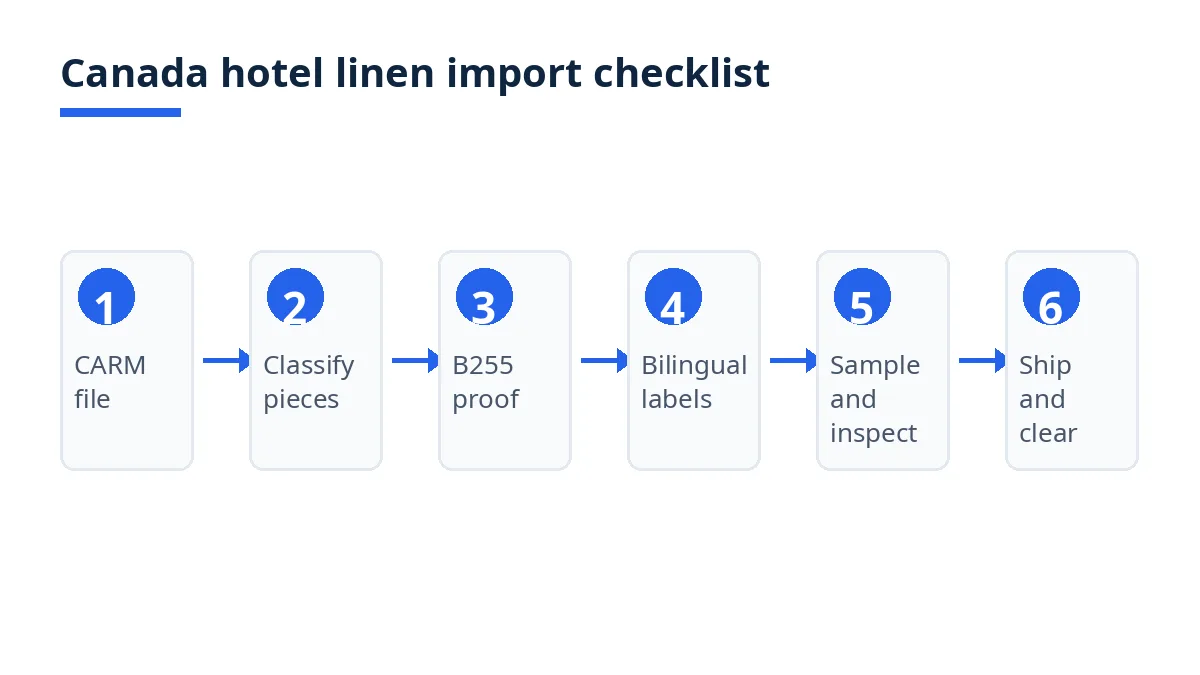
Register in CARM, enrol in the Importer Program and for Release Prior to Payment, before the vessel is booked.
Choose the gateway from the delivery province, with the through bill of lading route agreed at booking.
Write the room-set specification: fibre, weave, sizes and wash tolerances, towel weights, shade, logo treatment, bilingual labels, packing.
Classify every piece from heading 6302 in the T2026 schedule; confirm each line with your broker.
Test the preference position: the 20 percent rule, the made-up articles fabric test, Form B255, and direct shipment.
Shortlist mills whose range includes hotel linen; request quotes on the identical specification and label set.
Verify the supplier: documents, capacity, fabric source, dyeing and bleaching route, finished set from current production.
Sample in stages, wash-test under the property laundry program, and approve a pre-production sample of each item.
Confirm the order in writing: purchase order, pro forma invoice, delivery and payment terms, inspection plan, labelling, packing, shipment date.
Inspect during production and on packed goods, drawing pieces across items, sizes, colours and cartons.
Ship with the entry file complete: invoice, packing list, bill of lading, Form B255, and the CAD in CARM.
Clear customs with the confirmed code per piece, reconcile the actual landed cost, and run a housekeeping trial before full service.
How Exportain helps
Browse suppliers for Bangladeshi home-textile exporters and compare their ranges against your room-set specification, then post your specification, par basis and quantity as an RFQ and compare replies on the same terms. Exportain is a B2B marketplace where buyers post RFQs, receive quotations and message suppliers. It does not inspect goods, book freight or clear customs, and a profile badge records a document and photo review, not a factory inspection or a guarantee.7
What is the typical MOQ for hotel linen from Bangladesh?
There is no single typical minimum. It is set per item and usually per colour, because sheeting and terry fabric are woven, bleached or dyed in batches. Ask how it splits by item, size, colour and logo treatment, and work it out from your room count and par multiple.
How long does shipping take?
Production and transit times are separate, and neither has a single typical figure. Sea freight from Chattogram to Vancouver, Montreal or Halifax takes weeks rather than days, varying by sailing schedule, routing, transshipment and season. Confirm the shipment date only after sample, label and inspection approval.
What import duty applies?
Confirm every duty line with your broker before you price or ship. Hotel linen sits in heading 6302, with MFN rates of 17 percent on the cotton lines, 9 percent on the flax table linen line, and 18 percent on the man-made fibre and knitted lines in the T2026 schedule, and the LDCT column showing Free beside each line.4 A preference depends on the origin rules, including the 20 percent content rule and the made-up articles fabric test, and on Form B255.3 Bangladesh is listed as an LDCT beneficiary, renewed to December 31, 2034, but eligibility remains subject to the Governor-in-Council's discretion, with a prospective graduation and three-year transition policy recorded.5 Confirm the current position at every reorder.
How do I verify a supplier?
Check company documents first, so name, address and bank account agree across the trade licence, export registration and invoices. Then check capability: capacity by item group, fabric source and width, dyeing and bleaching route, current hotel production, and a finished set from current production. Keep payments to the company account named in the documents, approve a pre-production sample after the wash test, and confirm the label wording and tariff items with your broker before shipment. Treat any badge as a document and photo review, not a factory inspection or a guarantee.7
Next steps on Exportain
Read how to import from Bangladesh for the full process, then work through the landed cost method with your broker's confirmed duty line. When your specification is ready, read the bath towels import guide for Canada for the towel lines in the same tariff family, and see how to buy on Exportain. Post a free RFQ on Exportain and get quotes from Bangladeshi suppliers: post an RFQ.
Sources
- How to enrol. Canada Border Services Agency (accessed )
- Claim the least developed countries preferential tariff rate. Canada Border Services Agency (accessed )
- Memorandum D11-4-4: Rules of Origin Respecting the General Preferential Tariff and Least Developed Country Tariff. Canada Border Services Agency (accessed )
- Chapter 63 : T2026. Canada Border Services Agency (accessed )
- Canada's unilateral tariff preference programs for imports from developing countries. Department of Finance Canada (accessed )
- Guide to the Textile Labelling and Advertising Regulations. Competition Bureau Canada (accessed )
- Trust & Safety Center. Exportain (accessed )
- ISO 2859-1:2026 - Sampling procedures for inspection by attributes — Part 1: Sampling schemes indexed by acceptance quality limit (AQL) for lot-by-lot inspection. ISO (accessed )
- Incoterms® 2020. International Chamber of Commerce (ICC) (accessed )
- GST/HST for digital-economy businesses. Canada Revenue Agency (accessed )
- Customs Clearance Procedures for Export. Bangladesh Customs, National Board of Revenue (accessed )
About the author
Sourcing from Bangladesh?
Post a request for quotation and suppliers on Exportain can send you their quotes directly.
Post an RFQ


