

Bath Towels From Bangladesh to Canada: A Buyer's Import Checklist
Bath towels from Bangladesh to Canada: Vancouver, Montreal and Halifax routing, 6302 classification, LDCT proof of origin, CARM registration, bilingual labels, and a per-towel landed cost example.
Short answer
To import bath towels from Bangladesh to Canada, specify each towel by size, fiber content, GSM, and pile, classify it under tariff item 6302.60.00, and confirm the duty line with your broker before ordering. Test the Least Developed Country Tariff position with a Form B255 proof of origin, register in the CARM portal with a business number and import-export account, arrange bilingual fiber labels, and approve a pre-production sample before bulk production.
On this page
Key takeaways
Cotton terry bath towels fall under tariff item 6302.60.00, with the bath towel line 6302.60.00.10; confirm the full code for each towel type with your broker before pricing or shipping.
The Least Developed Country Tariff provides duty-free treatment for virtually all goods from least developed countries and was renewed to December 31, 2034, with Bangladesh listed as a beneficiary; a preference for your shipment depends on the origin rules and Form B255 proof of origin, and every duty line must be confirmed with your broker.
For textile and apparel goods of Harmonized System Chapters 50 to 63, Form B255 must be submitted as proof of origin, completed by the exporter where the goods were finished, with at least 20 percent of the ex-factory price originating in least developed countries or Canada.
CARM registration needs a 9-digit business number and a 6-digit import-export program account; brokers cannot register a client's business, and Release Prior to Payment enrolment and financial security should be reviewed before shipment.
Canadian towel labels must show fiber content in English and French for each fiber at 5 percent or more of total mass, with dealer identity or a CA Identification number, on a permanent label that stays legible through 10 cleanings.
A bath towel order for Canada is decided before the towel is woven. The landed cost turns on five Canadian points: the port of entry, the tariff line, the proof of origin, the import account, and the label. This guide is for Canadian retailers, hotel and hospitality buyers, wholesalers, and brands importing bath towels from Bangladesh. Every duty line in it ends with the same instruction: confirm it with your broker before you price or ship. Vancouver, Montreal, and Halifax cover most orders.
Why source bath towels from Bangladesh
Bangladesh offers terry weaving, dyeing, and finishing in one supply chain. A mill that controls the terry loom and the dye range can hold shade and pile consistency across a color range. Do not source bath towels from a garment factory that happens to offer towels. Shortlist mills whose current range already includes bath towels in terry, and ask to see current production.
Define the end use first. A hotel towel faces daily commercial washing, a retail towel faces a shopper comparing hand feel and price, and a private-label towel must carry your label set. Each use sets different priorities for GSM, pile density, and border construction. Ask whether the mill has shipped to Canada and can supply a Canadian label set and the textile proof of origin.
Find and verify suppliers
Where does a Canadian buyer begin the supplier search?
Start with a towel specification, not with supplier names. Write down the towel you want: type and size, fiber content, GSM as your own choice, pile construction, edge and hem finish, color or print, label set, and packing. Then shortlist suppliers whose ranges include terry bath towels, and compare them on that same specification. Browse suppliers on Exportain before you send an inquiry.
Send every candidate the identical specification and ask for the same reply format: GSM and pile assumed, towel size and weight, fiber content, price inclusions, validity, and the minimum per size and per color. Ask Canada-specific questions at the same time: has the supplier shipped to Canada, can it provide bilingual fiber labels, and can it complete the proof of origin for a textile shipment from a least developed country.
What checks come before any payment?
Verification has three layers. The first is company documents: trade license, export registration, and association membership where applicable, so name, address, and bank account agree. The second is capability: weaving and dyeing route, capacity, current towel sizes and GSM levels, and a finished towel from current production in your size and GSM.
The third layer is payment discipline. Keep payments to the company account named in the documents, never to a personal account, and verify any change of bank details through a separate channel. On Exportain, supplier profiles carry document and photo review badges. A badge is a review of documents and photos, not a factory inspection or a guarantee, and Exportain is not a party to the goods contract.
MOQ, pricing and samples
What does the minimum order mean for a towel range?
There is no single typical minimum order quantity for bath towels from Bangladesh. The minimum is set per towel size and usually per color or print, because terry fabric is woven and dyed in batches and a cutting and packing plan is set up per size range. Ask each supplier how its minimum splits by size, color, and print, and whether it is counted in towels, dozens, or cartons. A narrow range in few colors reaches a workable order sooner than a wide range in many colors.
How do you compare two towel quotes fairly?
Yarn and weaving form the main cost element, followed by dyeing, cutting, hemming, finishing, testing, labeling, and packing. GSM drives yarn use, so two towels of the same size at different GSM levels are different products. Compare quotes only on the same basis: same size, GSM, fiber content, pile construction, hem and border, color or print, delivery term, and packing. Ask what is excluded, including the Canadian label set and inspection cost.
Which samples prove the towel before bulk?
Work in stages. A development sample shows whether the mill can form the pile evenly, hold the size, and finish the hem and border cleanly. A pre-production sample, made in the actual production yarn, GSM, color or print, and finish, is the sample you approve for bulk. Shade, hand feel, and size after washing cannot be approved from a sample in substitute yarn or a lighter GSM.
Test the samples as a Canadian customer will use them: measure before and after washing following the care label, weigh the towel, check pile for shedding and loop pull, and wash a dark color with a white towel to check color transfer. Approve in writing, name the GSM, size, color, and label set, and keep one sealed counter-sample of each towel type.
Quality control and certifications needed
What should GSM, pile, and absorbency checks settle?
GSM is the weight of the towel fabric in grams per square meter, and it is a specification you set. Set the GSM in the specification and check it by weighing towels from different cartons. Pile checks cover even loops, dense pile, and loops that do not pull easily. Agree the inspection method, the sample size, and the defect limits before production. Inspect inline during production and again on packed goods.
What must a Canadian towel label carry?
The label must show the generic name of each fiber present in an amount of 5 percent or more of the total mass, with the amount expressed as a percentage of total mass, together with the dealer name and place of business or a CA Identification number.1 The information on the label must be factual, legible, and accessible to the prospective consumer at the time of purchase.1
The fiber information must appear in both French and English.2 Dealer identification and the country of origin, when required, do not have to be bilingual.2 A permanent label is required on towels: a permanent label is one that can remain attached and legible through 10 cleanings of the product.2 Care information is voluntary in Canada. If care information is included it cannot be false or misleading and must accurately reflect an appropriate method of care for the article.1 The Canadian care labelling standard is harmonized with the symbols used in North American and international standards.1 Country of origin is required on the label only if the dealer identifies the item as imported.1 Note that Quebec has additional French requirements.2
Which certificates should you ask for, and which should you not assume?
No single certificate covers every bath towel order for Canada. What you need follows your customer: a retailer or hotel group may name a specific test or scheme in its supplier manual. Name any such requirement in the specification, ask for the matching report or certificate, and check its scope, product covered, issuing body, and date. A report for a different fabric or a different GSM does not cover your towel. If your customer requires no certificate, say so in the specification rather than leaving the point open.
Incoterms, shipping and transit time
Which delivery term fits a first container order?
The delivery term fixes where the seller's delivery ends, who arranges the main carriage and insurance, and where your forwarder takes over. For a container shipment, compare FCA at the named terminal with FOB at Chattogram, and compare both with CIF and DAP before you sign. FCA matches how containerized cargo moves, because the container is handed to the carrier at a terminal before it is loaded on board. For FOB, agree in writing who bears risk and cost between terminal handover and loading. CIF adds seller-arranged carriage and insurance, while DAP places delivery at a named place in Canada. Put the term and named place in the purchase order and invoice.
How do you choose between Vancouver, Montreal, and Halifax?
Choose the port from the warehouse, not from the map. Vancouver suits a warehouse in western Canada. Montreal suits Quebec and eastern Canada. Halifax suits Atlantic Canada, and PSA Halifax operates two container terminals in Halifax, Atlantic Hub and Fairview Cove.3 There is no single typical transit time for bath towels from Bangladesh to Canada, and this guide states none. Sea freight takes weeks rather than days, varying by sailing schedule, routing, transshipment, and season. Work backward from the shelf date, and confirm carton count, dimensions, and weight in the specification, because towels are light for their size and carton volume can limit a shipment before weight does.
How long should you allow from order to warehouse?
Confirm production, sailing, clearance, and inland delivery separately. Production time is separate from transit time, and an order is ready only when every towel has finished weaving, dyeing, sewing, inspection, and packing. Clearance time depends on the entry file being complete before the vessel arrives, including the classification, the proof of origin, and the CARM account described below.
Import duty, taxes and documents
Which tariff line covers a cotton terry bath towel?
Duty follows the classification of each towel type in the Canadian tariff, not the supplier's product name. Heading 6302 covers bed linen, table linen, toilet linen and kitchen linen, and tariff item 6302.60.00 covers toilet linen and kitchen linen of terry towelling or similar terry fabrics of cotton.4 The commodity code list describes 6302.60.00.10 as toilet linen and kitchen linen of terry towelling or similar terry fabrics of cotton, towels and sheets, bath.5 Other fibres sit on 6302.91.00, 6302.93.00, and 6302.99.4 Confirm the full tariff item for each towel type with your broker before you price or ship.
What duty treatment can Bangladesh-origin towels claim, and what must you confirm with your broker?
At scheme level, the Least Developed Country Tariff provides duty-free treatment for virtually all goods imported from least developed countries, and it was renewed in legislation to December 31, 2034, with Bangladesh listed as a beneficiary.6 The separate General Preferential Tariff covers over 80 percent of tariff lines except most apparel and textile products.6 Towels fall in the textile chapters, so test the LDCT first and confirm the treatment with your broker.
The archived T2021 schedule line opened for this guide showed a Most-Favoured-Nation rate of 17 percent and LDCT listed as Free for tariff item 6302.60.00.4 Treat that line as archived only and confirm the current rate with your broker before you price. Current tariff files are in effect since January 1, 2026.7 Confirm the current file and rate with your broker.
How does proof of origin work for textiles from a least developed country?
For originating textile and apparel goods of Harmonized System Chapters 50 to 63, the Certificate of Origin for Textile and Apparel Goods Originating in a Least Developed Country, Form B255, must be submitted as proof of origin.8 The exporter in the least developed country where the goods were finished must complete it.8
The content rule for the LDCT requires at least 20 percent of the ex-factory price, as packed for shipment to Canada, to originate in least developed countries or Canada.8 Goods qualify only if shipped directly to Canada from the beneficiary country, including documented transshipment where the goods remain under customs control.8 The importer declares possession on the Commercial Accounting Declaration (code 008 for LDCT, 009 for GPT).8 If the proof of origin is not presented when the CBSA asks for it, the Most-Favoured-Nation treatment applies instead, and a penalty may follow.8 Confirm the B255 with your broker before shipment.
What does CARM change for a first-time Canadian importer?
CARM, the CBSA Assessment and Revenue Management system, is the official system of record for duties and taxes on commercial goods imported into Canada.9 Businesses need a 9-digit business number (BN9) from the Canada Revenue Agency and a 6-digit import-export program account (such as RM0001) to register.9 Importers must register themselves, because brokers cannot register a client's business, and consider Release Prior to Payment enrolment.9 Register before the goods ship, and confirm the account, delegation, and security with your broker.
What tax applies at the border, and what must you confirm with your broker?
The federal Goods and Services Tax rate is 5 percent in Alberta, British Columbia, Manitoba, Northwest Territories, Nunavut, Quebec, Saskatchewan, and Yukon, while the Harmonized Sales Tax applies at 13 percent in Ontario, 14 percent in Nova Scotia, and 15 percent in New Brunswick, Newfoundland and Labrador, and Prince Edward Island.10 The province of delivery decides which rate applies. Confirm with your broker the tax base for your entry, whether the tax is recoverable for your business. Confirm with your broker every tax line before you price.
Which documents complete a Canadian entry?
The standard import set is the commercial invoice, packing list, bill of lading, and proof of origin where a preference is claimed, together with the Commercial Accounting Declaration in the CARM portal. Name each towel type on its own invoice line, and keep quantities, weights, and carton counts in agreement across all documents. Keep the B255 with the file so it can be presented on request, and confirm with your broker that the document set matches the tariff item for each towel type before the vessel sails.
Landed cost example
A landed cost is the full cost of one towel, ready to sell from your Canadian warehouse, excluding Goods and Services Tax treatment. Every number below is an example figure only, not a quote. Confirm every line with your broker and forwarder before you price.
Example figures: 4,000 cotton terry bath towels, 70 by 140 centimeters, FCA Chattogram, sea freight to Vancouver, LDCT outcome assumed accepted for this example only.
Cost element | Example figures (per towel) | How to obtain your figure |
|---|---|---|
Product price, FCA Chattogram | $2.60 | Confirmed pro forma invoice |
International freight to Vancouver | $0.48 | Forwarder quote divided by towels shipped |
Insurance | $0.04 | Policy or forwarder quote |
Duty | $0.00 | Broker calculation from confirmed codes and rates; confirm with broker whether the LDCT outcome applies to your towels |
Port, clearance and broker fees, Vancouver | $0.22 | Broker invoices divided by towels |
Inland delivery to Canadian warehouse | $0.15 | Local carrier quote divided by towels |
Total landed cost, excluding GST | $3.49 | Sum of all lines above |
Goods and Services Tax is shown separately. On an assumed value of $3.08 per towel, 5 percent GST is $0.15 as an example figure, for a cash cost of $3.64 in this example. Confirm with your broker the tax base for your entry and whether the tax is recoverable, and confirm with your broker every tax line before you price.
If the LDCT claim is not accepted, duty is charged at the Most-Favoured-Nation treatment instead. Do not price the fallback from the archived line: the archived T2021 schedule line showed 17 percent for tariff item 6302.60.00, and that line is archived only.4 Confirm with your broker the current rate on the current tariff file, and confirm the fallback total with your broker. See the landed cost method for the full method.
Step-by-step import checklist
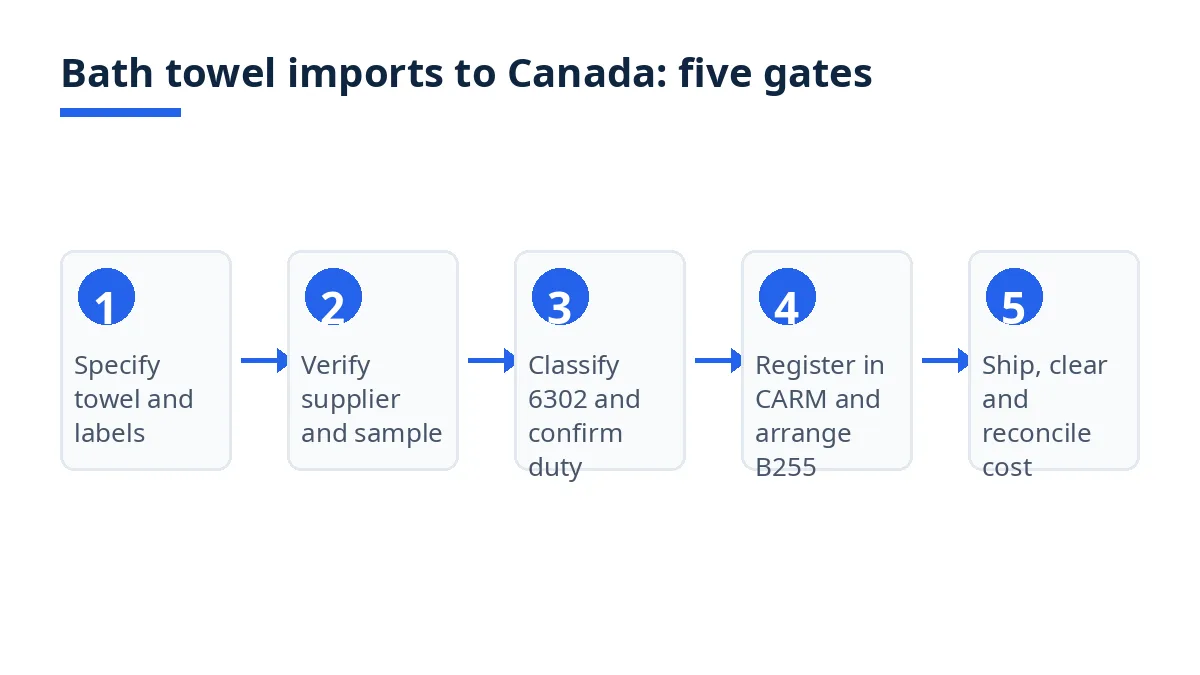
Choose the port and warehouse first: Vancouver, Montreal, or Halifax, with forwarder quotes for all three and the inland leg priced.
Write the towel specification: type, size, fiber content, GSM, pile, hem and border, color or print, label text, and packing.
Classify every towel type from heading 6302, starting from tariff item 6302.60.00, and confirm each code and duty line with your broker.
Test the preference position: LDCT scheme, Form B255 proof of origin, content rule, and direct shipment, confirmed with your broker.
Shortlist suppliers whose range includes terry bath towels, and request quotes on the identical specification and delivery term.
Verify the supplier: company documents, towel capacity, weaving and dyeing route, and a finished towel from current production.
Register in the CARM portal: business number, import-export program account, broker delegation, and financial security.
Order samples in stages, wash and measure them, check the bilingual label set, and approve a pre-production sample of each towel type.
Confirm the order in writing: purchase order, pro forma invoice, delivery and payment terms, inspection plan, labeling, and packing.
Ship, clear customs with the confirmed code and Form B255, and reconcile the actual landed cost against the example in this guide.
Next steps on Exportain
Read how to import from Bangladesh, then work through the landed cost method with your broker's confirmed duty line. When your towel specification is ready, see how to buy on Exportain and compare towel suppliers on the same size, GSM, and label set before you request samples. Post a free RFQ on Exportain and get quotes from Bangladeshi suppliers → https://exportain.com/rfqs. Exportain is a B2B marketplace where buyers post RFQs, receive quotations, and message suppliers.
What is the typical MOQ for bath towels from Bangladesh?
There is no single typical minimum. The minimum is set per towel size and usually per color or print, because terry fabric is woven and dyed in batches and a cutting and packing plan is set up per size range. Ask each supplier how its minimum splits by size, color, and print, and work it out from your own Canadian range plan.
How long does shipping take?
Production time and transit time are separate, and neither has a single typical figure. Sea freight from Chattogram to Vancouver, Montreal, or Halifax takes weeks rather than days and varies by sailing schedule, routing, transshipment, and season. Confirm the sailing schedule with your forwarder.
What import duty applies?
Confirm every duty line with your broker before you price or ship. Cotton terry bath towels fall under tariff item 6302.60.00, with the bath towel line described as 6302.60.00.10.4 5 At scheme level, the Least Developed Country Tariff provides duty-free treatment for virtually all goods from least developed countries and was renewed to December 31, 2034, with Bangladesh listed as a beneficiary, but a preference for your shipment depends on the origin rules and the Form B255 proof of origin.6 8 The archived T2021 schedule line showed 17 percent at the Most-Favoured-Nation rate for 6302.60.00; treat that line as archived only and confirm the current rate on the current tariff file with your broker.4 7
How do I verify a supplier?
Check company documents first, so that the name, address, and bank account agree across the trade license, export registration, and invoices. Then check capability: weaving and dyeing route, towel capacity, current towel production, and a finished towel from current production. Keep payments to the company account named in the documents, and approve a pre-production sample, with the bilingual Canadian label set, before bulk production.
Sources
- Textile labelling requirements. Competition Bureau Canada (accessed )
- Labelling textile requirements in a nutshell. Competition Bureau Canada (accessed )
- Company Info – PSA Halifax. PSA Halifax (accessed )
- Chapter 63 - T2021. Canada Border Services Agency (accessed )
- Chapter 63 – Import - Other made up textiles. Global Affairs Canada (accessed )
- Canada's unilateral tariff preference programs for imports from developing countries. Department of Finance Canada (accessed )
- Customs Tariff 2026. Canada Border Services Agency (accessed )
- Memorandum D11-4-4: Rules of Origin Respecting the General Preferential Tariff and Least Developed Country Tariff. Canada Border Services Agency (accessed )
- Get started with CARM. Canada Border Services Agency (accessed )
- GST/HST for digital-economy businesses. Canada Revenue Agency (accessed )
About the author
Sourcing from Bangladesh?
Post a request for quotation and suppliers on Exportain can send you their quotes directly.
Post an RFQ


