Quality Control Checklist for Hotel Linen From Bangladesh
A numbered QC checklist for hotel linen from Bangladesh: sizes and fitted fit, hems and stitching, counted thread count, sizing after wash, whiteness and shade across batches, sorting labels and packing, with fixes for common failures.
Short answer
Use this hotel linen quality control checklist to check finished sizes and fitted fit, hems and stitching, fabric defects and counted thread count, sizing and appearance after washing, whiteness and shade across batches, care and sorting labels, and packing on bed, bath and table linen from Bangladesh before shipment. Agree tolerances, test methods and the wash programme in the purchase order.
On this page
Key takeaways
Agree the sample, tolerances, test methods and wash programme before inspection, and draw the checked pieces across items, sizes, colors and cartons.
Verify a thread count claim by counting warp and weft threads per unit length with a counting glass, dissection or traversing counter, not by hand feel.
Wash a checked piece as your laundry will wash it, then re-measure it and re-check hems, shade and labels on that same piece.
Compare whiteness and shade within each piece, between pieces in a set and across batches under the same light, against the approved standard.
Check that care, fibre, size and laundry sorting labels stay legible after the wash check, so pieces can still be sorted in service.
This checklist gives you a practical way to check hotel linen before a shipment leaves Bangladesh. Hotel linen is judged in the laundry and on the bed, the bath and the table: a sheet that shrinks out of size, a white that drifts between batches, or a label that fades so pieces can no longer be sorted shows at once. Check pieces drawn from across the order, not pieces the factory selects.
Why this checklist matters
Hotel linen concentrates risk in repeated commercial laundering. Dimensions decide whether a sheet fits and tucks, hems decide whether an edge survives the wash, and whiteness and shade decide whether pieces from different batches can be mixed in the same room. A fault hidden on a folded piece, such as a wavy hem, shows as soon as the bed is made.
A written checklist removes interpretation: each point is recorded as pass, fail or not applicable against the approved sample, size chart and pack.
Before you start
Do not begin until the references are complete: an approved sample per item and color, the purchase order and pack, the size chart with tolerances, the wash programme your laundry will use, and the packing specification. Draw the checked pieces across items, sizes, colors and cartons.
Check the label plan before bulk labels are printed. ISO 3758 establishes a system of graphic symbols for care labelling, based on the most severe treatments that do not cause irreversible damage during care.1 Under Regulation (EU) No 1007/2011, a textile product shall be labelled with the name and share by weight of all constituent fibres in descending order.2 Add the sorting information your laundry needs, such as item and size, and check it stays legible after washing.
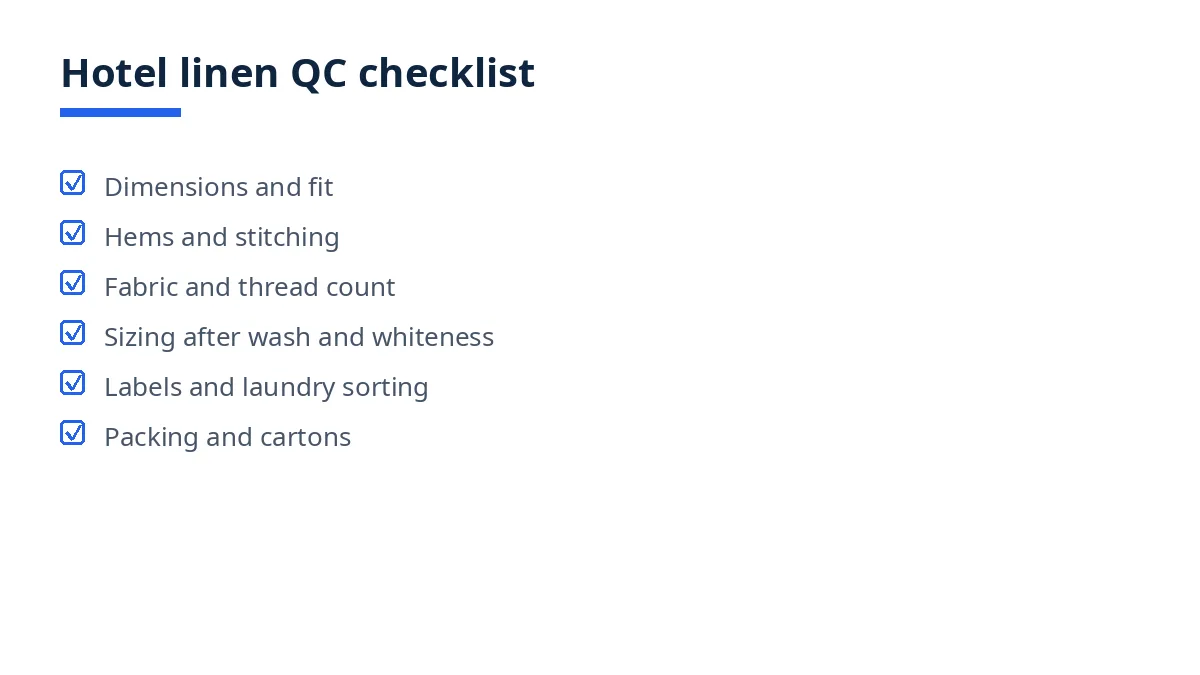
The full checklist (numbered, printable)
Dimensions and fit
Select pieces across all items, sizes and colors and measure length and width laid flat, smoothed without stretching, on sheets, duvet covers, towels and table linen alike.
Measure fitted sheets the same way, then fit each one to the mattress size named in the pack and check all four corners seat fully.
Measure fitted-sheet pocket depth at each corner and side, against the pack figure for the mattress depth it must cover.
Check pillowcases and duvet covers for length, width and opening.
Compare every measurement with the chart tolerance, record actual values, and check both sides for symmetry.
Confirm each size label matches the measured size and the set contents named in the pack.
Hems and stitching
Check hems on all edges for even width, straight stitching and secure finishing at the corners, with no wavy or rolled edges.
Check seams for skipped or broken stitches, opening and uneven stitch density, pulling each seam by hand.
Check corner construction: seams complete, joins neat, and no raw edges inside pockets or openings.
Check topstitching, embroidery and monograms named in the pack for straight lines and centered placement.
Where seam strength is tested, confirm the method and limit were agreed in advance. ISO 13935-1 specifies a strip test for maximum force to seam rupture, force applied perpendicularly to the seam, mainly for woven fabrics.3
Check that loose threads are trimmed inside and out, because a loose end will fray in the first commercial wash.
Fabric, weave and thread count
Check face and back for holes, slubs, broken yarns, weaving defects, snags, stains and oil marks, panel by panel against the sample.
Check the weave named in the pack, such as plain weave, sateen or terry, against the sample, and record any substitution as a failure.
Verify a thread count claim by counting, not by hand feel. ISO 7211-2 specifies three methods for determining the number of threads per centimetre in woven fabrics: dissection, a counting glass, and a traversing thread counter.4
Count warp and weft separately, in more than one place, convert to the basis named in the pack, and record the result beside the claimed figure. Record the claim as a failure when the count does not support it.
Check hand feel against the approved sample per item and color, and record any piece that feels harsh or thinner than the sample.
For towels, check loop pile for even height, pulled loops and bare patches, against the sample.
Sizing after wash and laundering durability
Review dimensional change evidence where required, for length, width and pocket depth. ISO 5077 specifies a method for determining dimensional change of textile articles in specified washing and drying procedures.5
Confirm the wash evidence used the programme your laundry will run. ISO 6330 specifies domestic washing and drying procedures for textile testing, including reference detergents and ballasts.6
Check appearance after washing: hem flatness, corner shape, twisting, seam puckering, edge curl and towel loop condition.
Review color fastness evidence for commercial laundering where required. ISO 105-C06 specifies methods for determining the resistance of textile colour to domestic or commercial laundering using a reference detergent.7
Wash a checked piece as your laundry will wash it, then re-measure it and re-check hems, shade and labels.
Confirm every wash report names the bulk fabric, color, wash programme and lot.
Whiteness and shade consistency
Check shade and whiteness within each piece, between pieces in a set, and across batches under the same light, against the approved standard.
Where whiteness is measured by instrument, confirm the method was agreed in advance. ISO 105-J02 specifies a method for quantifying the whiteness and tint of textiles, including fluorescent materials.8
Check for yellowing, greying and tint drift on white pieces after the wash check, and segregate any batch that no longer matches.
Review rubbing fastness evidence for dyed and printed pieces, such as colored table linen. ISO 105-X12 specifies a method for determining the resistance of textile colour to rubbing off and staining other materials, with one dry and one wet test.9
Labels, sorting marks and product claims
Verify that care, fibre, origin, size and brand labels are present, legible and correctly positioned. For the EU, check fibre names against Regulation No 1007/2011,2 and care symbols against ISO 3758.1
Check the laundry sorting information: item type, size and any property or color mark must match the pack and stay readable after the wash check.
Check that barcode and size stickers scan and match the purchase order.
Check elastic, thread and other trim for correct type and color match, with no substitution.
If a harmful-substances claim will appear on the product, check the certificate scope. Under OEKO-TEX STANDARD 100, the label is awarded only if all components meet the criteria, including fabric, threads and finishes.10
Check that any other claim in the pack matches the evidence agreed.
Packing and cartons
Confirm each piece and set is folded and packed as directed, and that set contents and ratios per carton match the specification.
Check that packaging carries the warnings and markings the pack requires.
Weigh and measure cartons from across the packing, and check markings and carton count against the packing list.
Common failures and how to fix them
The most frequent failure is a sheet or cover that measures correctly before washing and comes back short or narrow, which traces to cutting, or to shrinkage allowed for in the chart but not in the cutting plan. Stop, wash and re-measure a test piece, and only then restart cutting. Next is whiteness drift across batches, which points to more than one dye or bleach lot: re-sort complete sets before packing and hold the drifted batch apart.
Wavy hems usually start at sewing tension or uneven feeding: re-sew a test hem before the bulk is hemmed. An unsupported thread count claim points to a lighter fabric than the one approved: re-check the bulk fabric against the sample before more is cut. Labels that fade in the wash check make the program hard to sort: change the marking method and re-test before bulk labels are sewn in. Weaving defects clustered in one panel point to one fabric roll: segregate those pieces and re-inspect them as their own group.
Where failures repeat, the options are sorting and rework, documented partial acceptance, or rejection, as agreed in the purchase order.
Downloadable template / summary table
Copy the checklist into your inspection sheet, add the size chart and wash programme, and record a result per piece.
Section | Checks | Evidence |
|---|---|---|
Dimensions | Length, width, pocket, fit | Measurements, fit check |
Hems and stitching | Hem width, corners, seams | Pull checks, photos |
Fabric and thread count | Defects, weave, counted threads | Panel check, count record |
Sizing after wash | Length, width, pocket, appearance | Wash reports, re-measure |
Whiteness and shade | Batch match, tint, rubbing | Standard comparison |
Labels and sorting | Fibre, care, size, sorting marks | Label check after wash |
Packing | Folding, ratios, markings | Packing list |
How Exportain helps
Exportain is a B2B marketplace connecting buyers with Bangladeshi suppliers of hotel linen and home textiles, so the specifications behind this checklist can be agreed at the enquiry stage. The companion guide on how to import hotel linen from Bangladesh covers the buying steps around the inspection. Browse suppliers, see the home textiles category and use inspection services when you plan the check. Supplier profiles show which document and photo checks have been recorded, not factory inspections. Exportain is not a party to the goods contract and does not inspect goods.
FAQs
When should this checklist be used?
Use it at final inspection, when goods are finished and largely packed. For larger and first orders, also use it in production, while hems and cutting can still be corrected.
Who should complete it?
The buyer, a local agent or an independent inspector can complete it, using the approved sample, size chart and wash programme.
What are the most common failures?
Shrinkage out of size after washing, whiteness drift across batches, wavy hems, an unsupported thread count claim, and labels that fade in the wash are the failures buyers find most often.
Can a third party do it?
Yes, if you share the approved references, tolerances and wash programme first.
Next steps on Exportain
Before production starts, agree your size chart, tolerances, test methods, wash programme and label wording, then read the pre-shipment inspection guide and plan the check with inspection services. You can also post a free RFQ via RFQs and compare quotes.
Sources
- ISO 3758:2023 - Textiles — Care labelling code using symbols. International Organization for Standardization (accessed )
- Regulation (EU) No 1007/2011 on textile fibre names and related labelling and marking of the fibre composition of textile products. European Union, (accessed )
- ISO 13935-1:2014 - Textiles — Seam tensile properties of fabrics and made-up textile articles — Part 1: Determination of maximum force to seam rupture using the strip method. International Organization for Standardization (accessed )
- ISO 7211-2:2024 - Textiles — Methods for analysis of woven fabrics construction — Part 2: Determination of number of threads per unit length. International Organization for Standardization (accessed )
- ISO 5077:2007 - Textiles — Determination of dimensional change in washing and drying. International Organization for Standardization (accessed )
- ISO 6330:2021 - Textiles — Domestic washing and drying procedures for textile testing. International Organization for Standardization (accessed )
- ISO 105-C06:2010 Textiles — Tests for colour fastness — Part C06: Colour fastness to domestic and commercial laundering. International Organization for Standardization, (accessed )
- ISO 105-J02:1997 - Textiles — Tests for colour fastness — Part J02: Instrumental assessment of relative whiteness. International Organization for Standardization (accessed )
- ISO 105-X12:2016 - Textiles — Tests for colour fastness — Part X12: Colour fastness to rubbing. International Organization for Standardization (accessed )
- OEKO-TEX STANDARD 100 for textiles tested for harmful substances. Hohenstein (accessed )
About the author
Sourcing from Bangladesh?
Post a request for quotation and suppliers on Exportain can send you their quotes directly.
Post an RFQ