UAE Frozen Shrimp Imports From Bangladesh: Jebel Ali, Duty and VAT
Frozen shrimp from Bangladesh to the UAE through Jebel Ali: the MOCCAE/FIRS food-import file, the 0306.17 line and 5% duty, VAT on CIF plus duty, Arabic labeling, supplier checks, and a per-kilogram landed-cost example in dirhams.
Short answer
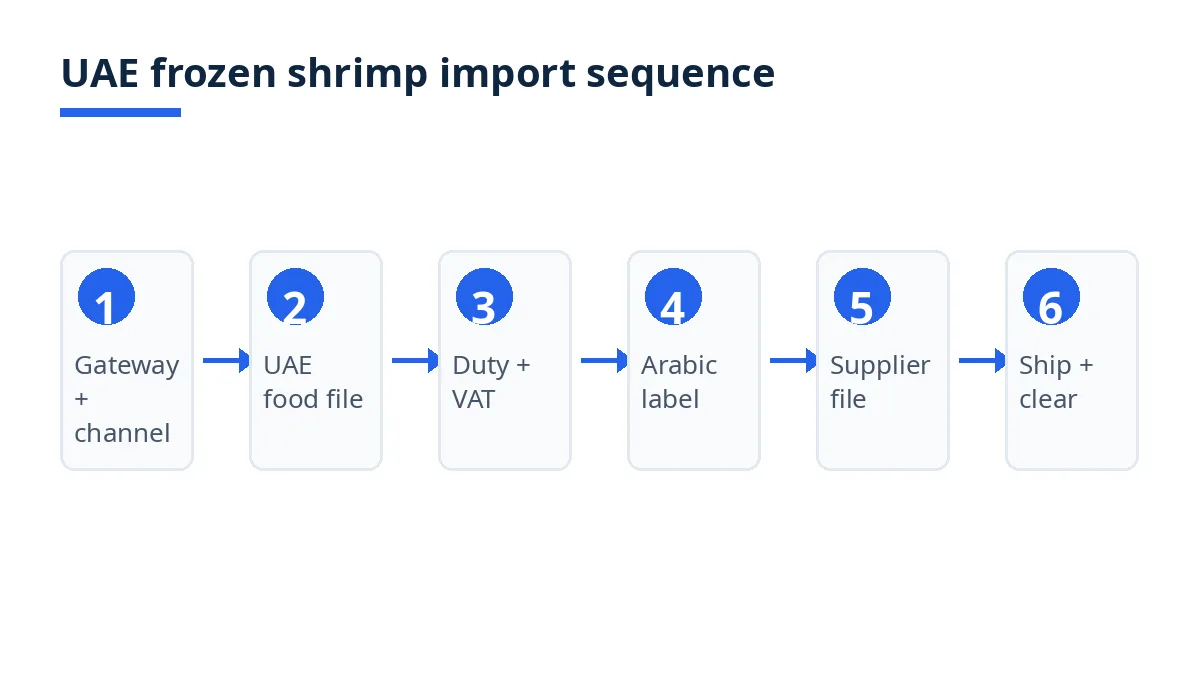
To import frozen shrimp from Bangladesh to the UAE, fix the Jebel Ali gateway and onward channel first, then the emirate food-import file, registration, and Arabic label. Classify on indicative heading 0306.17, price duty at 5 percent of the CIF value, add 5 percent VAT on CIF plus duty, check the supplier against the UAE file, and reconcile the landed cost in dirhams with actual invoices before you commit.

On this page
Key takeaways
Fix the Jebel Ali gateway and onward channel first: mainland, free zone, or designated zone entry changes the duty and VAT file.
Register company, supplier, and product in the emirate food system, agree the Arabic label artwork, and allow around 10 working days for Dubai approval.
Classify on indicative heading 0306.17 and price duty at 5 percent of the CIF value for mainland Dubai, confirmed by your broker on the exact GCC line.
Charge VAT at 5 percent on CIF plus duty, settle the halal position in writing, and never print a Halal mark before the answer is in the file.
Rework the AED 49.11 per kilogram example landed cost, duty and VAT included, at quote stage and after shipment with actual invoices.
A frozen shrimp order for the UAE is decided at the port of entry and in the food-import file before it is decided on price. The gateway, the food authority, and the onward channel, local sale, hotel and restaurant supply, processing, or re-export, each change the registration, the label, and the tax treatment. Fix those three points first.
This guide is for UAE-based buyers, distributors, hotel and restaurant suppliers, processors, and re-exporters importing frozen shrimp from Bangladesh. Every cost figure is an example figure; every duty and tax figure is a working figure for broker confirmation.
Start with the Jebel Ali gateway and the onward channel
Jebel Ali is the default gateway for a reefer container of frozen shrimp bound for Dubai and the northern emirates. DP World describes Jebel Ali Port as a man-made harbour serving as a gateway for over 80 weekly services connecting more than 150 ports.1 The UAE ranks first in the Arab world in re-exporting, and government tariffs range from 0 to 5 percent.2 Name the onward channel before you ask for a price: a container that will be split, repacked, or forwarded needs a different file from one sold locally.
The channel changes the specification: hotel and restaurant buyers judge size and presentation on the plate, retail buyers judge the pack and label, processors judge yield and glaze, and re-export buyers judge carton marks and lot identity. Fix the gateway, food authority, cold store, and onward route in writing, and confirm mainland versus free zone or designated zone entry, because duty and VAT treatment differs by route. For Abu Dhabi delivery, check the emirate's single-window food import system and pre-arrival release route with your broker at the same stage.3
Clear the UAE food-import file before the reefer sails
Food enters the UAE through a registration and release file, not through customs alone. The Ministry of Climate Change and Environment lists consignment release and veterinary health certificate services for animal and fish products.4 The importer, product, and supplier must be registered with the food authority of the entry emirate before the goods arrive.
In Dubai, that system is the Food Import and Re-export System, known as FIRS, run by Dubai Municipality. The supplier should first be registered at Dubai Municipality as an authorized foodstuff supplier through FIRS, and products new to the system need detailed registration, with a packaging description and a clear image of the label and food item.5 Approval normally takes around 10 working days when there are no issues.5 Build that lead time in before production.
Each consignment file starts with the customs declaration and the food authority's import request, supported by the bill of entry, delivery order, packing list, and the original health certificate from a governmental food health authority in the country of origin, or its number where issued electronically.5 Further certificates, such as residue and contaminant certificates, may be required for a particular product, origin, or risk.5 Ask the broker, in writing, which certificates apply to frozen shrimp from Bangladesh for your entry emirate and channel, and get the answer before the supplier packs.
Classify on 0306.17 and price the 5 percent duty on the CIF value
Classification comes before price, because duty follows the code, the species, the presentation, and the end use. The UAE uses the Harmonized System, developed by the World Customs Organization, with codes of up to six digits plus national or GCC extensions.2 Work on heading 0306.17, other shrimps and prawns, as an indicative heading, and have the broker confirm the full GCC line for the exact species, presentation, and entry date before any price is fixed.
The wording of the line matters. A tariff page for the same line family describes code 0306 17 92 20 as shrimps and prawns of Penaeus vannamei and Penaeus monodon, whether in shell or not, not cooked, for processing.6 That wording is from the United Kingdom tariff, shown only as an example of how species, shell, cooking, and end use are built into the line; the broker must confirm the UAE line. Code, species, presentation, and end use must match across the classification, invoice, packing list, health certificate, and declaration.
Duty in Dubai is 5 percent of the CIF value, cost plus freight plus insurance, except alcohol and cigarettes, which carry higher rates.2 Treat 5 percent of CIF as the working figure for mainland Dubai, and have the broker confirm the rate on the exact GCC line, including any exemption or preference route. This guide claims no preference, exemption, or reduced rate for shrimp from Bangladesh. Free-zone, designated-zone, or re-export suspension entries must be priced separately.
Work the 5 percent VAT line on CIF plus duty
VAT is charged on top of duty, not beside it. The rate of VAT in the UAE is 5 percent.7 For a non-registered importer, import VAT is calculated on the value inclusive of any customs duty and excise tax due, and is paid before clearing the goods.8 Registered importers account through returns; the FTA guide sets out separate scenarios for registered and non-registered importers, designated zones, and duty suspension.8 Confirm your scenario with your broker and tax adviser before fixing a delivered price.
The VAT base follows a fixed order: CIF value, then duty, then VAT, so the VAT line is 5 percent of CIF plus duty, not of the product price alone. A business must register for VAT if taxable supplies and imports exceed AED 375,000 per annum; registration is optional above AED 187,500.7 Registered businesses generally may reclaim VAT paid on business-related goods and must keep checkable records.7 Certain free zones are designated zones for VAT purposes, with special rules.7
Label in Arabic and settle the halal question in writing
The label is agreed before production, not after packing. Dubai Municipality regulates foodstuff importation and monitors labeling and testing, liaising with the Emirates Authority for Standardization and Metrology.5 Mandatory labeling includes the brand name, ingredients in descending order, production and expiration dates, manufacturer, packer, distributor or importer name, net weight, country of origin as the specific country, barcode, lot number, storage conditions, allergen information, and halal marking.5 Labels shall be in Arabic, the official language for verifying label information; mandatory information must always appear in Arabic.5
Agree the full Arabic and English label text with the buyer and broker before printing, and approve the finished artwork. Fix species name, designation, production method, origin wording, and scientific name; fix the net weight basis identically on label, invoice, and packing list; fix lot mark, dates, storage instruction, and establishment identification against the health certificate; and fix species, size, presentation, net weight, lot mark, and order number on every carton.
Get the halal answer in writing: this guide neither states that a certificate is required for frozen shrimp nor that one is not required. Published UAE certificate lists name halal certificates for meat, poultry, and derivatives.5 A Halal claim or mark on the pack must be supported by recognized certification. The Ministry of Industry and Advanced Technology publishes a list of approved accreditation bodies for halal, including the Emirates National Accreditation System and the Emirates International Accreditation Center.9 Ask the broker and food authority in writing whether a certificate is required and which body is recognized, and print no Halal mark until the answer is in the file.
Get the Bangladesh export file in order before loading
Goods shall not be loaded for export unless a Bill of Export is submitted and approved, specifying goods, value, exporter, buyer, and transport operator.10 Enclosed documents include the export letter of credit or, failing that, the approved export contract, purchase order, or export guarantee, the signed commercial invoice, packing list, EXP form certified by authorized dealers, certificate of origin from the Export Promotion Bureau or a chamber, the VAT registration certificate, and the taxpayer identification number.10
For frozen fish, the same list requires a quality control certificate where obligatory, giving the Department of Fisheries certificate for frozen fish as the example.10 Ask the supplier which fishery and quality certificates the UAE file requires and when each will be ready. Hold the shipment if any document cannot be confirmed before loading.
Why Bangladesh fits a UAE shrimp order
Bangladesh fits a UAE order when the buyer needs farmed shrimp in defined sizes and presentations, packed for a defined channel, from plants that already work to an export file. The fit is between the order's specification, glaze, file, and Arabic label, and what a plant can show before ordering: current production of the same species, size range, and pack format, with the certificate file the UAE authority will check.
The advantage is specification control at the plant, where size, count, glaze, peeling, deveining, and tail presentation each change yield, price, and label. A plant that can send the certificate file, the label artwork, and a sample carton before the order has shown the file discipline the UAE entry requires. For re-export buyers, carton marks and lot identity must survive splitting and forwarding. Judge the fit on documents and samples, lot by lot.
Specify the shrimp so the label, the carton and the file agree
One specification document carries the whole order: write it before requesting prices, send it identically to every supplier, and require replies in the same format.
Specification part | Fix in writing before quoting |
|---|---|
Species and origin | Species, scientific name, farmed or wild-caught, origin wording per broker |
Size and count | Size range or count, uniformity rule, out-of-range treatment |
Presentation | Shell, deveining, tail, cooked or uncooked, exact label presentation name |
Glaze and weight | Glaze and net weight basis, drained weight, weighing method |
Pack and carton | Pack and carton weights, marks, artwork approval |
File | Health and fishery certificates, halal position, registration data |
Shipment | Reefer, temperature range and record, sailing plan |
State size and glaze rules in the plant's words, and presentation in the label's words. Add a thawed yield check for hotel and restaurant supply, and the onward-market document set for re-export.
Find and check suppliers against the UAE file
Shortlist suppliers whose current range already includes the species, size range, and presentation needed, packed for export. Browse suppliers and read each profile against the UAE specification, not a headline price. Shortlist three or four suppliers, send each the identical specification, and ask for the same reply format: species, size range, glaze basis, pack format, price inclusions, validity, and minimum per size and presentation. Ask whether it has shipped to the UAE or another Gulf state and can supply the health and fishery certificates, certificate of origin, and Arabic artwork, with the halal position in writing.
Check three layers before any payment: documents, so name, address, and bank account agree across the trade license, export registration, and association membership; capability, meaning current production of the specified species and presentation and recent orders in the same presentation; and payment discipline, paying only the company account named in the documents and verifying any bank detail change through a different channel. On Exportain, document and photo review badges are a review of documents and photos, not a factory inspection or guarantee, and Exportain is not a party to the contract and does not inspect goods, book freight, or clear customs.
MOQ, pricing and samples
There is no single typical minimum, and this guide states none: it is set per species, size range, presentation, and pack format, because raw material is bought in lots and a packing run is set up per size and presentation. Ask how it splits, and get the split in writing.
Ask for the price on the identical specification, inclusions line by line: product, packing, labeling, inspection where agreed, and delivery term with named place. Ask what it excludes and how glaze, size, and weight basis affect it. For a UAE order, ask whether the quoted price is on a CIF basis to Jebel Ali or on another term, because duty is charged on the CIF value and the VAT base follows CIF plus duty, so the term changes the tax arithmetic as well as the freight.2 8 Sample in stages: a product sample tests capability, a pre-shipment sample tests the lot against the approved sample. Approve each in writing, keep one sealed counter-sample per presentation, and note size range, glaze basis, and lot mark.
Quality control, cold chain and the reefer leg
Quality control is agreed before production, not discovered at Jebel Ali. Agree inspection method, defect classes, acceptance limits, inspector, timing, and sample in writing; agree failure consequences, cost, and lot identity, so every carton traces to its production lot, raw material lot, and health certificate; and agree the frozen temperature range, pre-cooled reefer, and a temperature record traveling with the consignment. Read the frozen shrimp quality control checklist and the frozen shrimp MOQ guide before fixing the inspection plan and minimum.
A temperature break in transit shows up after clearance, when a claim is hardest to prove. Require the temperature record with the shipping documents, check it before the container leaves the port, record any excursion with the forwarder and insurer the same day, and confirm the cold store booking before arrival.
Delivery terms and the Chattogram to Jebel Ali leg
Sea freight in reefer containers is the standard route; build the sailing plan from the forwarder's current schedule. Plan in three blocks: production, sea transit, and UAE clearance and delivery.
State the delivery term in full: rule, named place, and version, with cost and risk positions confirmed for reefer cargo. The Incoterms 2020 rules deal with delivery, transfer of risk, mode of transport, cost, and customs obligations across 11 rules.11 Risk passes at the same point and time as delivery, and only CIP and CIF oblige the seller to provide the buyer with insurance.11 In the C and D rules the seller contracts freight to the destination; in the E and F rules the buyer arranges it; in all but EXW the seller handles export formalities, and in all but DDP the buyer handles import formalities.11 FAS, FOB, CFR, and CIF are only intended for port-to-port, bulk or break-bulk shipments, and are not suitable for containers in their current form.11 Ask the forwarder whether FCA, CPT, or CIP matches the handover better, and ask in writing who books the reefer, clears the import, pays duty and VAT, and bears delay costs.
Landed cost example in UAE dirhams
A landed cost is the full cost of one unit of shrimp at the UAE cold store or plant, duty and VAT included. Every number below is an example figure only, for in-shell uncooked shrimp shipped from Chattogram to Jebel Ali, at the working 5 percent duty and 5 percent VAT on CIF plus duty. Confirm the duty rate, GCC line, VAT base, and every fee line with your broker and tax adviser. The Dubai duty rule is 5 percent of CIF value,2 and import VAT is calculated on the value inclusive of customs duty.8
Example figures per kilogram, net weight basis.
Cost element | Example figures (per kilogram) | How to obtain your figure |
|---|---|---|
Product price, FOB Chattogram | AED 36.00 | Pro forma invoice |
Freight and insurance, per kilogram | AED 6.00 | Forwarder quote |
CIF value, per kilogram | AED 42.00 | Price plus freight and insurance |
Duty at 5% of CIF value | AED 2.10 | Broker calculation |
VAT at 5% of CIF plus duty | AED 2.21 | Broker and tax adviser calculation |
Port, cold-store and broker fees, per kilogram | AED 1.60 | Broker and port invoices |
Delivery to cold store or plant, per kilogram | AED 1.20 | Local carrier quote |
Total landed cost including duty and VAT, per kilogram | AED 49.11 | Sum of all lines above |
Work the calculation twice, at quote stage and after shipment. Rework duty and VAT for any free-zone, designated-zone, or re-export route.
UAE import sequence, step by step
Fix the gateway, entry emirate, and onward channel.
Name the broker, forwarder, and tax adviser, and confirm the entry scenario.
Register company, supplier, and product in the emirate food system; agree the Arabic artwork.
Settle the halal position in writing for the exact product and pack.
Confirm the GCC line and duty rate on indicative heading 0306.17.
Work the VAT line on CIF plus duty, and confirm who pays and when.
Check the Bangladesh export file and fishery certificates before loading.
Send one specification to every supplier, and compare quotes on the same delivery term.
Check the supplier on documents, capability, and payment discipline, with a plant check for a first order, and agree inspection, cold-chain range, and temperature recording.
Approve samples stage by stage.
Ship on the agreed term, clear the file and entry, and reconcile the actual landed cost.
What is the typical MOQ for frozen shrimp from Bangladesh?
There is no single typical minimum, and no figure is stated here. It is set per species, size range, presentation, and pack format; get the split in writing and compare minimums only on the identical specification and delivery term.
How long does shipping take?
Production, sea transit, and UAE clearance are separate blocks. Transit varies by port pair, routing, transshipment, and season; clearance varies by the food file, registration position, and cold store. Plan from the forwarder's current schedule, and add the Dubai registration lead time, around 10 working days where the file is clean, before production.5
What import duty applies?
Duty follows classification, species, presentation, end use, and entry route. The indicative heading is 0306.17; the broker must confirm the full GCC line. In Dubai, the customs tariff is 5 percent of the CIF value.2 Treat that as the working figure for a mainland Dubai entry, confirm it for the entry emirate and date, and claim no preference unless the broker confirms one in writing. VAT at 5 percent is then charged on the value inclusive of customs duty.8
How do I verify a supplier?
Check documents first, so name, address, and bank account agree across the trade license, export registration, and invoices, and payment goes to the named company account. Then check capability: current production of the specified species, size, and presentation, the certificate file, and the Arabic artwork. On Exportain, document and photo review badges are a review of documents and photos, not a factory inspection or a guarantee.
Next steps on Exportain
Read the general guide to importing from Bangladesh, the classification guide for frozen shrimp, and the landed cost guide for imports from Bangladesh before you price. When the gateway, channel, and specification are fixed, browse suppliers and read the how-to-buy guide.
Sources
- Jebel Ali Port | Port Operations. DP World (accessed )
- Customs duty and tariff. UAE Government (accessed )
- Abu Dhabi Agriculture and Food Safety Authority - Food Security. Abu Dhabi Agriculture and Food Safety Authority (accessed )
- UAE Ministry of Climate Change and Environment. Ministry of Climate Change and Environment (accessed )
- How do I register food products for import into the UAE under Dubai Municipality?. Pro Partner Group (accessed )
- Commodity code 0306179220: Shrimps and prawns of the species Penaeus vannamei and Penaeus monodon, whether in shell or not, not cooked, for processing. GOV.UK (accessed )
- Register for VAT. The Official Portal of the UAE Government (accessed )
- VAT Import Declaration User Guide. UAE Federal Tax Authority (accessed )
- Approved Accreditation Bodies for Halal. Ministry of Industry and Advanced Technology (accessed )
- Customs Clearance Procedures for Export. Bangladesh Customs, National Board of Revenue (accessed )
- Insider thoughts: Bob Ronai on Incoterms 2020 Rules; What are they about?. International Chamber of Commerce (accessed )
About the author
Sourcing from Bangladesh?
Post a request for quotation and suppliers on Exportain can send you their quotes directly.
Post an RFQ