Italy Frozen Shrimp Imports From Bangladesh: Step-by-Step Guide
Frozen shrimp from Bangladesh to Italy through Genoa or Livorno: the BCP and CHED border file, the 0306.17 line and duty routes, catch proof, Italian labelling, supplier checks, and a per-kilogram landed-cost example before VAT.
Short answer
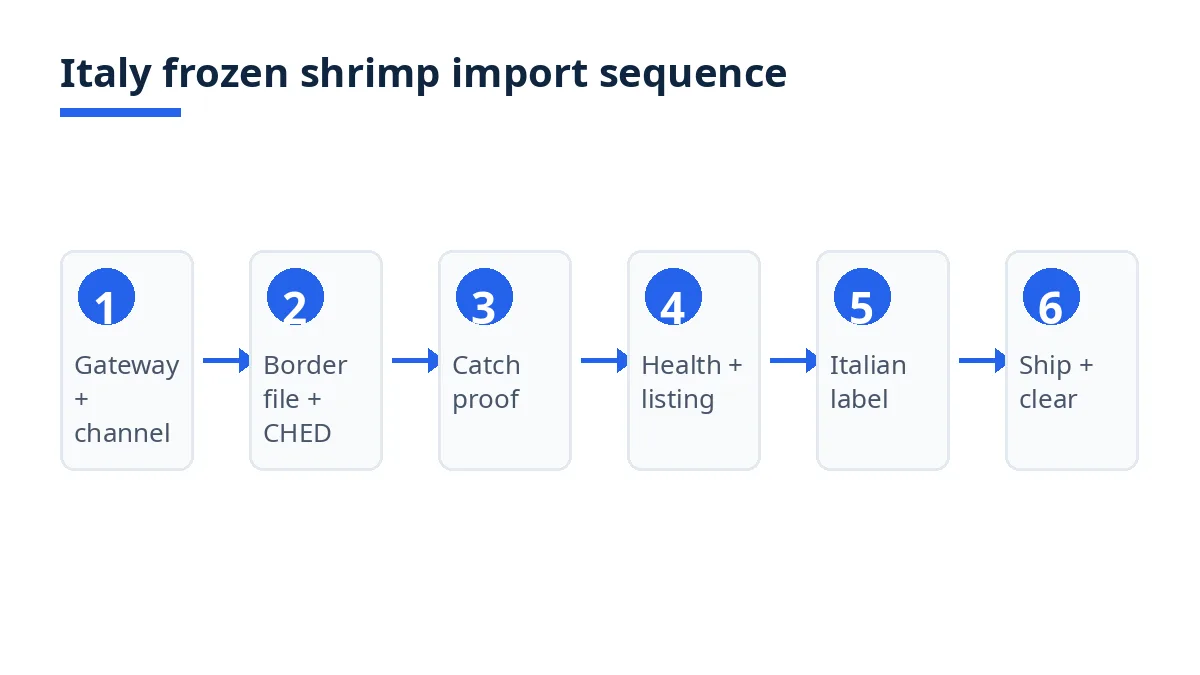
To import frozen shrimp from Bangladesh to Italy, fix the Italian gateway first: Genoa or Livorno, a designated border control post, and a CHED pre-notification in TRACES. Classify the lot on CN line 0306 17 92 20, confirm the indicative 12 percent duty and any Everything But Arms or quota route with your broker, check the establishment listing and catch documents, agree the Italian label before ordering, and confirm the Italian VAT rate and base before pricing.
On this page
Key takeaways
Fix the Italian gateway and channel first: Genoa or Livorno, the border control post, the cold store, and whether the lot goes to processing, wholesale, or retail-ready sale.
Classify on CN line 0306 17 92 20 for Penaeus vannamei and Penaeus monodon; treat the 12 percent third country duty as indicative and confirm the TARIC rate and any preference or quota route with your broker.
Wild-caught lots need a flag-State-validated catch certificate submitted at least three working days before arrival, and the certificate must match the invoice and packing list.
The processing establishment must appear on the current TRACES-NT list, and the health certificate must agree line by line with the invoice, packing list, and CHED before shipment.
Agree the full Italian label text before production, and rework the EUR 11.26 per kilogram example landed cost before VAT at quote stage and after shipment with actual invoices.
A frozen shrimp order for Italy is decided at the Italian border and in the Italian market before it is decided on price. The gateway, the border control post, and the buyer channel, processing, wholesale, or retail-ready sale, each change the documents, the label, and the duty route for the same container. Fix those three points first.
This guide is for Italian importers, wholesalers, processors, retailers, and food service buyers bringing frozen shrimp from Bangladesh into Italy. Every cost figure is an example figure, and every duty figure is indicative until your broker confirms it on the exact tariff line for the entry date.
Choose the Italian gateway and buyer channel first
Start with the port of entry and the onward channel, not with the supplier list. Genoa and Livorno are the two Tyrrhenian gateways named in this guide. The choice decides the border control post, the cold store, and the onward route. Fix the gateway, border control post, cold store, and onward route in writing before you ask for a price.
The channel changes the specification as much as the gateway changes the route: processing buyers judge yield and glaze, wholesale buyers judge carton count and size range, and retail-ready buyers judge the finished pack and label.
Pass the Italian border file: BCP, TRACES and the CHED
Frozen shrimp is a product of animal origin, and products of animal origin from third countries are admitted only from authorised countries, must be accompanied by official certificates, and are subject to documentary, identity, and physical checks at designated border control posts.1 The Italian border control post is therefore the first clearance the goods must pass, and the file presented there must agree with the goods in the container.
Documentary checks verify the certificates and other documentation. Identity checks ensure that the nature and labelling of the goods, including seals and means of transport, correspond to the documents. Physical checks involve direct examination, including sampling and laboratory testing if needed.1 Seafood is subject to systematic controls, with frequency and type depending on risk.1
Traceability is recorded in TRACES, which tracks and manages information on imports so affected products can be identified and traced back to their source.1 The Common Health Entry Document, known as the CHED, is the border entry document. Ask the border control post, through your broker, which CHED type applies, what pre-notification lead time it requires, and who files each part. If a consignment does not comply, it may be refused entry, and the authority may order destruction, re-dispatch outside the Union, special treatment, or another appropriate measure, with reinforced controls possible on future consignments from the same origin.1
Classify the shrimp and choose the duty route before you price
Classification comes before price, because the duty route follows the code, species, presentation, and end use. The line used in this guide is 0306 17 92 20, described as shrimps and prawns of the species Penaeus vannamei and Penaeus monodon, whether in shell or not, not cooked, for processing.2 The code, species, presentation, and end use must match in the classification, invoice, packing list, and health certificate.
The third country duty shown for that line is 12.00 percent.2 Treat 12 percent as indicative only, and have the broker confirm the rate on the exact line before any price is fixed. The same page shows import controls for illegal, unreported, and unregulated fishing and for veterinary control.2 Compare three duty routes. The first is the standard duty, with no preference or quota claimed. The second is the Everything But Arms arrangement, giving full tariff and quota-free imports for all goods from United Nations-defined least developed countries, except for arms.3 The third is a tariff quota: a non-preferential quota under authorised use, order number 052802, at 0.00 percent, open for 1 January 2026 to 31 December 2026.2 The landed-cost example uses the standard route only.
Prove the catch for wild-caught shrimp: certificate and the three-day rule
Wild-caught shrimp needs a catch file separate from the health file. The importation into the Community of fishery products obtained from illegal, unreported, and unregulated fishing is prohibited, and fishery products may only be imported when accompanied by a catch certificate in conformity with the catch certification scheme.4 The certificate must be validated by the flag State of the fishing vessel or vessels which made the catches, and it certifies that the catches were made in accordance with applicable laws, regulations, and international conservation and management measures.4
Timing is part of the file. The validated certificate must be submitted at least three working days before the estimated time of arrival at the place of entry, subject to adaptation for product type, distance, or transport means.4 For an Italian entry, it must reach the Italian authority at least three working days before the vessel reaches the Italian place of entry. If the lot is wild-caught, require the validated certificate and check species, quantities, and vessel details against the invoice and packing list. If the lot is farmed, ask the broker and supplier, in writing, which catch or origin file applies. Where a lot has been processed in a third country other than the flag State, the importer must submit a processing statement from the processing plant, endorsed by its competent authorities, with the original or a copy of the catch certificate as the regulation requires.4
Health certificate and the listed establishment
The health certificate is the second file, checked alongside the catch file. Only goods of animal origin from authorised countries are admitted, accompanied by official certificates issued by the competent authority of the exporting country.1 The exporting country must communicate its list of establishments to the Commission, which publishes it in TRACES-NT, guarantee traceability from origin to export, and operate a reliable certification procedure.1 Check that the establishment appears on the current list, and that its name, approval number, and address match the health certificate, invoice, and packing list, and that every certificate line agrees with the commercial documents and the CHED. Ask the supplier to send the certificate and listing before loading for broker confirmation. If any line cannot be confirmed before loading, hold the shipment.
Agree the Italian label before production
The label is agreed before production, not after packing. Identity checks ensure that the nature and labelling of the goods correspond to the information in the documents.1 A label naming a different species, presentation, or quantity fails that check. Agree the full label text, in Italian, with the buyer and broker before the first carton is printed, and approve the finished artwork, not a description of it.
Fix the species name and commercial designation in Italian, production method and origin wording, and scientific name, as the buyer and broker confirm them. Fix the net weight basis, drained weight or net weight including glaze, and use the same basis on the label, invoice, and packing list. Fix the lot mark, dates, storage instruction, and establishment identification, and check each against the health certificate. For cartons, fix species, size or count, presentation, net weight, lot mark, and purchase order number on every carton.
Why Bangladesh fits an Italian shrimp order
Bangladesh fits an Italian order when the buyer needs farmed shrimp in defined sizes and presentations, packed for a defined channel, from plants that already work to an export file. The fit is between what the order requires, a species and size specification, a glaze and presentation specification, a health and catch file, and an Italian label, and what a plant can show before the order is placed: current production of the same species, size range, and pack format, with the establishment listing and certificate file the border control post will check.
The advantage is specification control at the plant, where size, count, glaze, peeling, deveining, and tail presentation each change the yield, price, and label. A plant that can send the establishment listing, a sample health certificate, and the label artwork before the order has shown the file discipline the border control post requires.
Specify the shrimp so the file, the label and the carton agree
One specification document carries the whole order. Write it before requesting prices, send the identical document to every supplier, and require replies in the same format, so quotes can be compared line by line.
Specification part | Fix in writing before quoting |
|---|---|
Species and origin | Species, scientific name, farmed or wild-caught, catch or farming area wording as the broker confirms it |
Size and count | Size range or count per unit weight, uniformity rule, and how out-of-range pieces are treated |
Presentation | In shell or peeled, deveined or not, tail on or off, cooked or uncooked, and the exact presentation name for the label |
Glaze and weight | Glaze basis, net weight basis, drained weight where required, and the weighing method |
Pack and carton | Pack weight, packs per carton, carton weight, carton marks, and label artwork approval |
File | Health certificate, establishment listing, catch file where it applies, and the CHED data set |
Shipment | Reefer requirement, agreed temperature range, temperature record, and the loading and sailing plan |
State the size and glaze rules in the same words the plant will use, and the presentation in the same words that will appear on the Italian label.
Find and verify suppliers against the Italian file
Shortlist suppliers whose current range already includes frozen shrimp in the species, size range, and presentation the order needs, packed for export. Browse suppliers on Exportain and read each profile against the Italian specification, not a headline price. Shortlist three or four suppliers, send each the identical specification, and ask for the same reply format: species and presentation, size range and glaze basis, pack format, price inclusions, validity, and minimum per size and presentation. Ask whether the supplier has shipped to Italy or another European Union state, and whether it can supply the health certificate, establishment listing, catch file where it applies, and Italian label artwork.
Verification has three layers, all before any payment. First, company documents: trade licence, export registration, and association membership where applicable, checked so name, address, and bank account agree across every document. Second, capability: current production of the specified species and presentation, the packing line for the agreed pack format, and recent orders in the same presentation shown in finished goods. Third, payment discipline: pay only the company account named in the documents, never a personal account, and verify any bank detail change separately, through a different channel. On Exportain, supplier profiles carry document and photo review badges, a review of documents and photos, not a factory inspection or a guarantee, and Exportain is not a party to the contract, does not inspect goods, book freight, or clear customs.
MOQ, pricing and samples
There is no single typical minimum for frozen shrimp from Bangladesh, and this guide states none. The minimum is set per species, size range, presentation, and pack format, because raw material is bought and processed in lots, and a packing run is set up per size and presentation. Ask how it splits by size, presentation, and pack format, and get the split in writing.
Ask for the price on the identical specification, with inclusions stated line by line: product price, packing, labelling, inspection where agreed, and the delivery term with its named place. Ask what the price excludes, and how glaze, size, and weight basis affect it. Samples work in stages: a product sample shows whether the supplier can supply the specified species, size, and presentation, and a pre-shipment sample shows whether the production lot matches the approved sample. Approve each sample in writing, keep one sealed counter-sample per presentation, and note the size range, glaze basis, and lot mark on the approval.
Quality control, cold chain and the reefer leg
Quality control is agreed before production, not discovered at the Italian border. Agree the inspection method, defect classes, and acceptance limits in writing, and state who inspects, when, and on what sample. Agree what happens when inspection fails, and who bears the cost, and agree the lot identity system, so every carton can be traced to its production lot, raw material lot, and health certificate. Agree the frozen temperature range for storage, loading, transit, and delivery, that the reefer will be pre-cooled before loading, and that a temperature record will travel with the consignment. Read the frozen shrimp quality control checklist and the frozen shrimp MOQ guide before fixing the inspection plan and the minimum, and carry the agreed points into the purchase order.
Incoterms, shipping and the Chattogram to Italy leg
Sea freight in reefer containers is the standard route for bulk frozen shrimp, and the sailing plan must be built from the forwarder's current schedule, not from a general transit figure. Plan in three blocks: production time, sea transit, and Italian clearance and delivery. Production time depends on the plant and raw material lot, sea transit on the port pair, routing, transshipment, and season, and clearance and delivery on the border control post, cold store, and onward route.
The delivery term must be stated in full in every document: rule, named place, and version, with cost and risk positions confirmed by the forwarder and broker for containerised reefer cargo. Ask, in writing, who books the reefer, clears the Italian import, pays duty and Italian VAT, and bears the cost of a border delay or cold-store hold. Ask the supplier for the export file and as-shipped documents, check them against the purchase order before the vessel sails, and send the full set to the broker and border contact before arrival, so the CHED and customs entry can be prepared from agreed documents.
Landed cost example
A landed cost is the full cost of one unit of shrimp, ready at the Italian cold store or plant, before Italian VAT. Every number below is an example figure only, not a quote, for frozen shrimp in shell, uncooked, for processing, shipped by sea from Chattogram to Genoa and delivered to a cold store, with duty at the indicative 12 percent and no preference or quota claimed. Confirm the duty rate, customs value base, VAT rate and base, and every fee line with your broker and tax adviser. Italian VAT, known as IVA, is not included, because the applicable rate and base must be confirmed for the exact goods and entry, and this guide states no Italian VAT rate.
Example figures: per kilogram, net weight basis as agreed in the specification.
Cost element | Example figures (per kilogram) | How to obtain your figure |
|---|---|---|
Product price, FOB Chattogram | EUR 8.40 | Pro forma invoice |
Freight and insurance, per kilogram | EUR 1.05 | Forwarder quote |
Customs value, per kilogram | EUR 9.45 | Price plus freight and insurance |
Duty at indicative 12% of customs value | EUR 1.13 | Broker calculation |
Border, port, cold-store and broker fees, per kilogram | EUR 0.38 | Broker and port invoices |
Delivery to cold store or plant, per kilogram | EUR 0.30 | Local carrier quote |
Total landed cost before Italian VAT, per kilogram | EUR 11.26 | Sum of all lines above |
Work the calculation twice: at quote stage and again after shipment, with the actual invoices.
Step-by-step import checklist for Italy
Fix the gateway and channel, with the border control post, cold store, and onward route named.
Name the broker, forwarder, and border operator, and confirm what each needs.
Confirm the CHED type and lead time, and file the CHED from agreed documents.
Classify the shrimp, and confirm the duty rate on the exact line.
Compare the three duty routes, and record which route the price uses.
For wild-caught shrimp, submit the validated catch certificate at least three working days before arrival.4
Check the health certificate and establishment listing before loading.
Agree the Italian label, approve the artwork, and keep one proof in the file.
Send one specification to every supplier, and compare quotes on the same terms.
Verify the supplier, with a factory check for a first order.
Agree inspection, cold-chain range, and temperature recording, and approve samples stage by stage.
Ship on the agreed term, clear the border and customs entries, and reconcile the actual landed cost before VAT.
How Exportain helps
Browse suppliers on Exportain for Bangladeshi frozen shrimp exporters and compare their species, size ranges, and presentations against the Italian specification before you send an enquiry. Then post the specification, gateway, channel, and delivery date as an RFQ, and compare replies on the same terms. Exportain is a B2B marketplace where buyers post RFQs, receive quotations, and message suppliers. It does not inspect goods, book freight, or clear customs. Post a free RFQ and get quotes from Bangladeshi suppliers at post an RFQ.
What is the typical MOQ for frozen shrimp from Bangladesh?
There is no single typical minimum, and no figure is stated here. The minimum is set per species, size range, presentation, and pack format. Ask how it splits by size, presentation, and pack format, get the split in writing, and compare minimums only on the identical specification.
How long does shipping take?
Production time, sea transit, and Italian clearance and delivery are separate blocks. Sea transit varies by port pair, routing, transshipment, and season, and clearance varies by the border control post and the file. Plan from the forwarder's current sailing schedule, and keep production time separate from transit time.
What import duty applies?
Duty follows the classification, species, presentation, end use, and duty route. The line used here is 0306 17 92 20, for Penaeus vannamei and Penaeus monodon, whether in shell or not, not cooked, for processing, with a third country duty of 12.00 percent.2 Treat 12 percent as indicative, and compare the standard route with the Everything But Arms arrangement, full tariff and quota-free imports for all goods from United Nations-defined least developed countries, except for arms,3 and with the quota route at 0.00 percent under authorised use.2 Confirm the route with your broker before fixing a price, and price on the standard route until a preference or quota route is confirmed in writing.
How do I verify a supplier?
Check company documents first, so name, address, and bank account agree across the trade licence, export registration, and invoices, and payment goes to the company account named in them. Then check capability: current production of the specified species, size range, and presentation, the establishment listing, and the health and catch files the supplier can supply before shipment.
Next steps on Exportain
Read the general guide to importing from Bangladesh and the classification guide for frozen shrimp before you price. For the full cost picture, read the landed cost guide for imports from Bangladesh, and when the gateway, channel, and specification are fixed, post a free RFQ on Exportain with the Italian gateway and delivery date.
Sources
- Import controls of food and feed Q&As. European Commission (accessed )
- Commodity code 0306179220: Shrimps and prawns of the species Penaeus vannamei and Penaeus monodon, whether in shell or not, not cooked, for processing. GOV.UK (accessed )
- Preferential European Union import tariffs for developing countries. EUR-Lex (accessed )
- Council Regulation (EC) No 1005/2008, Chapter III: Catch certification scheme for importation and exportation of fishery products. legislation.gov.uk, (accessed )
About the author
Sourcing from Bangladesh?
Post a request for quotation and suppliers on Exportain can send you their quotes directly.
Post an RFQ