

Canada Frozen Shrimp Imports From Bangladesh: Licence-First Guide
Frozen shrimp from Bangladesh to Canada, licence-first: the SFC licence and AIRS check, the 0306.17 tariff line and Free duty position, bilingual labelling, GST, supplier checks, and a Canadian-dollar landed-cost example.
Short answer
To import frozen shrimp from Bangladesh to Canada, hold a Safe Food for Canadians licence for importing food before presenting the shipment, check the requirements in AIRS, and file the declaration through the Integrated Import Declaration system. Classify the lot on tariff line 0306.17.00, confirm the indicative Free duty rate with a broker on the current schedule, agree the bilingual English and French label before packing, and price GST at 5 percent on the value for duty plus any duty.
On this page
Key takeaways
Hold a valid Safe Food for Canadians licence for importing food before the shipment reaches the border: without it, a food shipment will be denied entry, and a licence cannot be obtained at the border.
Check the exact requirements in AIRS for the species and presentation, validate the AIRS codes with the broker, and file the declaration through the Integrated Import Declaration system up to 90 days in advance.
Classify on tariff line 0306.17.00 and treat the Free MFN and LDCT rates shown on the archived T2023 schedule as indicative only: confirm the rate on the current schedule for the exact 10-digit line and entry date.
Agree the full label in English and French before packing, with the common name, net quantity, lot code, and country of origin, and confirm the Quebec French position separately for sales in Quebec.
Price GST at 5 percent on the value for duty plus any duty, show it as a separate line, and rework the CAD 13.88 per kilogram example landed cost before GST at quote stage and after shipment with actual invoices.
A frozen shrimp order for Canada is settled on the Canadian side before it is settled on price. The Safe Food for Canadians licence, the Automated Import Reference System check, the tariff line, and the bilingual label decide whether the container is released, held, or refused.
This guide is for Canadian importers, wholesalers, processors, retailers, and food service buyers bringing frozen shrimp from Bangladesh into Canada. Every cost figure is an example figure in Canadian dollars, and every duty figure is indicative until a customs broker confirms it on the exact tariff line for the entry date.
Get the Canadian licence file right before you buy
Canada controls food imports through a licence held by the importer, not through a document supplied by the exporter alone. Commercial importers of fish and seafood have been required to hold a Safe Food for Canadians (SFC) licence since the Regulations came into force on January 15, 2019, with verification before import in place since March 2021.1 Without a valid SFC licence, a food shipment will be denied entry.2
Apply through My CFIA and confirm three points before the first order: the licence is active, it is issued for the activity "Importing food", and it covers the commodities being imported.2 SFC licences are valid for two years, so diary the renewal date when the licence is granted.2 Businesses must obtain the licence before presenting the shipment at the border, and applications can take up to 15 business days, longer for complex applications.1 The licence number must be declared exactly as issued, and an importer that does not declare a valid licence may have the shipment delayed or refused entry and may face enforcement action.1
Check the exact import requirements in AIRS before you order
The licence is the permission to import food. The Automated Import Reference System, known as AIRS, is where the shipment-specific requirements are checked. Importers are advised to consult AIRS for food import requirements, and finding the requirements for the shipment is the first step in the commercial importing process.1 2 Use AIRS for the exact species, presentation, and country of origin, and ask the broker to validate the AIRS codes before the declaration is submitted.2
File the declaration through the Integrated Import Declaration system, which gives an electronic admissibility decision, up to 90 days in advance.2 The Canada Border Services Agency (CBSA) makes the final decision to accept or reject a shipment.2 Re-check AIRS for every new species or presentation.
Settle the tariff line and the duty position on 0306.17
Classification drives the duty rate, so settle the code before fixing a price. A tariff classification number is a standardized code used to identify goods for customs purposes, the first six digits are common across countries using the Harmonized System, and the next four digits are unique to Canada and establish duty rates and statistics.3 The line used in this guide is 0306.17.00, described in the Canadian Customs Tariff as frozen other shrimps and prawns, with the unit of measure in kilograms.4 The statistical suffix splits in-shell shrimp by count per kilogram, from fewer than 33 to more than 154 per kilogram, with suffix 90 for other presentations.4 Cold-water shrimps and prawns, Pandalus species and Crangon crangon, sit on a separate line, 0306.16.00.4
On the tariff schedule opened for this guide, the Most-Favoured-Nation (MFN) tariff for 0306.17.00 is Free, and the Least Developed Country Tariff (LDCT) rate is also shown as Free.4 Treat Free as an indicative working figure only: that schedule is the archived T2023 edition, and the broker must confirm the rate on the current schedule for the exact 10-digit line and the entry date. Other crustacean lines on the same schedule do carry duty, for example 0306.19.00 at 5 percent MFN.4 If any line in the order does show duty, test the LDCT route for Bangladesh-origin goods: the program provides duty-free treatment for virtually all goods from least developed countries, Bangladesh is listed as a beneficiary, and it is renewed in legislation to December 31, 2034.5 A preferential claim still needs proof of origin and must meet the shipping requirements for that treatment.3 5 Where the position is unclear, request an advance ruling through the CARM Client Portal, which assigns a 10-digit number and is binding between the CBSA and the person who receives it.3 For 0306.17.00, where the MFN rate itself is shown as Free, no preference claim is needed to reach a zero duty result, but the value for duty still sets the tax base even when no duty is owed.3
Work the GST line into the price from the start
Duty is only one part of the border cost. Goods imported into Canada are generally subject to the 5 percent Goods and Services Tax (GST), and GST is calculated on the total value of the goods and applicable duties.3 The CBSA worked example shows the method: convert the invoice value to Canadian dollars at the exchange rate for the date of direct shipment, add any duty to reach the value for tax, and apply 5 percent GST to that value.3 With duty payable, GST is charged on the duty-inclusive value, so a duty change moves the GST figure as well.
Work in Canadian dollars from the first quotation, because the value for duty must be declared in Canadian currency only.3 Ask the broker to run the estimate in the Duties and Taxes Calculator in the CARM Client Portal before the goods ship, and to confirm which tax exemption code, if any, applies.3 Show GST as a separate line in every landed-cost comparison.
Choose the Canadian gateway by inland destination, not by headline freight
Canada has three main container gateways for a reefer shipment from Chattogram: Vancouver on the Pacific coast, Montreal on the St. Lawrence, and Halifax on the Atlantic coast. The right gateway follows the inland destination and the cold-store plan, not the lowest ocean freight quotation. Each gateway carries a different inland leg, cold-store handoff, and delivery window. Fix the gateway, the cold store, and the onward route in writing before asking for a price, and ask the forwarder to confirm the reefer routing, transshipment points, and the discharge port that matches the delivery address.
Label for Canada in English and French before packing
The label is agreed before production, not corrected after packing. Fish and fish products must be labelled with the information needed for public health and consumer protection, including the common name of the fish, net quantity, ingredients list, Nutrition Facts table, lot code or other unique identifier, and the principal place of business where the food was manufactured.6 For imported prepackaged fish, the country of origin must be clearly identified on the label, meaning the country where the fish product was last substantially transformed, for example filleted or frozen.6
Mandatory information on consumer prepackaged food must be shown in both official languages, French and English, including core labelling requirements such as the common name.7 Shipping containers sent to a commercial or industrial enterprise or an institution are generally exempt from bilingual labelling, provided they are not resold to consumers at retail and all mandatory information for shipping containers is provided in one official language.7 If the same container is offered for sale to consumers at retail, bilingual labelling applies.7 Quebec has additional requirements on the use of French for products marketed in Quebec, so confirm the Quebec position separately when any part of the order will be sold there.7 Agree the full label artwork in both languages before the first carton is printed, and confirm the allergen wording for crustaceans in both languages.
Traceability and records: what the importer must hold
Traceability is a condition of the Canadian import, not an optional extra. The traceability requirements in the Safe Food for Canadians Regulations require businesses to prepare, keep, and retain records, one step forward and one step back, so a food product can be followed through the supply chain, and so products can be tracked in a food safety investigation or recall.6 The importer must also hold preventive controls, and a written preventive control plan may be required. Build the record set into the purchase order: before loading, the supplier sends the lot identity for every carton, the production dates, and the establishment identification. Keep the declaration, AIRS result, licence number, and broker correspondence together.
Why Bangladesh fits a Canadian shrimp order
Bangladesh fits a Canadian order when the buyer needs farmed shrimp in defined sizes and presentations, packed for a defined channel, from plants that already work to a documented export file. Judge the plant on current production of the same species, size range, and pack format, and on the document file the Canadian entry will check. Two points help: the 0306.17.00 line is shown as Free on both the MFN and LDCT columns of the schedule opened for this guide, subject to broker confirmation,4 and specification control at the plant, where size, count, glaze, and presentation each change the yield, price, and label.
Specify the shrimp so the label, the carton and the declaration agree
One specification document carries the whole order. Write it before requesting prices, send the identical document to every supplier, and require replies in the same format, so quotes can be compared line by line and the declaration can be prepared from the same words.
Specification part | Fix in writing before quoting |
|---|---|
Species and origin | Species, scientific name, farmed or wild-caught, and origin wording as the broker confirms it for the label |
Size and count | Size range or count per kilogram, uniformity rule, and how out-of-range pieces are treated |
Presentation | In shell or peeled, deveined or not, tail on or off, cooked or uncooked, and the exact presentation name for the label |
Glaze and weight | Glaze basis, net weight basis, drained weight where required, and the weighing method |
Pack and carton | Pack weight, packs per carton, carton weight, carton marks, and bilingual label artwork approval |
File | Export documents, lot identity, catch or origin file where it applies, and the AIRS data set |
Shipment | Reefer requirement, agreed temperature range, temperature record, and the loading and sailing plan |
Use the same wording in the quotation, the label, and the declaration: a specification that changes wording between them creates three different products in the file.
Find and check suppliers against the Canadian file
Browse suppliers on Exportain and shortlist three or four whose current range already includes the species, size range, and presentation the order needs. Send each the identical specification and ask for the same reply format: species and presentation, size range and glaze basis, pack format, price inclusions, validity, and minimum per size and presentation.
On the Bangladesh side, the export file for shrimps and prawns includes a licence for export and a no objection certificate from the Department of Fisheries, a salubrity certificate for the consignment, and, for marine-caught fish, a certificate on illegal, unreported, and unregulated fishing, with fish-farm registration required for farmed fish intended for export.8 Ask the supplier to confirm which documents apply to the exact frozen line, since the Bangladesh schedule opened for this guide lists them against a different shrimp code. Verify in three layers before any payment: company documents, so name, address, and bank account agree across the trade licence, export registration, and invoices; capability, shown by current production of the specified species and presentation; and payment discipline, paying only the company account named in the documents, never a personal account. Exportain profiles carry document and photo review badges, not a factory inspection or guarantee, and Exportain is not a party to the contract.
MOQ, pricing and samples
There is no single typical minimum, and this guide states none. The minimum is set per species, size range, presentation, and pack format. Ask how it splits by size, presentation, and pack format, and get the split in writing. Read the frozen shrimp MOQ guide before fixing the minimum, and compare minimums only on the identical specification.
Ask for the price in Canadian dollars on the identical specification, with inclusions stated line by line. State the count basis, per kilogram, in the quotation, because the tariff statistical suffix for in-shell shrimp is set by count per kilogram.4 Approve each sample in writing and keep one sealed counter-sample per presentation.
Quality control, cold chain and the reefer leg
Quality control is agreed before production, not discovered at the Canadian border. Agree the inspection method, defect classes, acceptance limits, and what happens when inspection fails, in writing. Read the frozen shrimp quality control checklist before fixing the inspection plan, and carry the agreed points into the purchase order. Agree the frozen temperature range, pre-cooling of the reefer, and a temperature record travelling with the consignment. Do not accept a range stated only as "frozen": it must be a number in the specification, checked against the record on arrival. If the record shows a break, hold the lot.6
Delivery terms and the Chattogram to Canada leg
Sea freight in reefer containers is the standard route for bulk frozen shrimp. Plan in three blocks: production time, sea transit, and Canadian clearance and delivery. No transit figure is stated here, because no current sailing schedule was opened for it: ask the forwarder for the schedule for the exact port pair and sailing week. The Incoterms® 2020 rules allocate cost, risk, and obligations between seller and buyer, and the rules have been used globally in trade contracts since 1936, updated in 2020.9 State the delivery term in full in every document: rule, named place, and version. Under CIF, which is reserved for maritime trade, the default insurance level remains Institute Cargo Clauses (C), with the option to agree a higher level of cover.9 Under FCA for carriage by sea, the parties may agree that the buyer instructs the carrier to issue an on-board bill of lading to the seller once the goods are loaded.9
Landed cost example in Canadian dollars
Every number below is an example figure only, not a quote, for frozen shrimp in shell, uncooked, shipped by sea from Chattogram to Vancouver, with duty at the indicative Free rate on 0306.17.00. Confirm every line with the broker and tax adviser. Example figures: per kilogram, net weight basis.
Cost element | Example figures (per kilogram) | How to obtain your figure |
|---|---|---|
Product price, FOB Chattogram | CAD 11.50 | Pro forma invoice |
Freight and insurance, per kilogram | CAD 1.45 | Forwarder quote |
Value for duty, per kilogram | CAD 12.95 | Price plus freight and insurance |
Duty at indicative Free rate | CAD 0.00 | Broker calculation on the current schedule |
Border, port, cold-store and broker fees, per kilogram | CAD 0.52 | Broker and port invoices |
Delivery to cold store or plant, per kilogram | CAD 0.41 | Local carrier quote |
Total landed cost before GST, per kilogram | CAD 13.88 | Sum of all lines above |
GST at 5 percent of the value for tax | CAD 0.65 | Broker calculation |
Total landed cost including GST, per kilogram | CAD 14.53 | Before-GST total plus GST |
Work the calculation twice: at quote stage and again after shipment, with the actual invoices. The GST line follows the CBSA method, where GST is charged on the value for duty plus any duty.3 If the duty position changes, the GST figure changes with it.
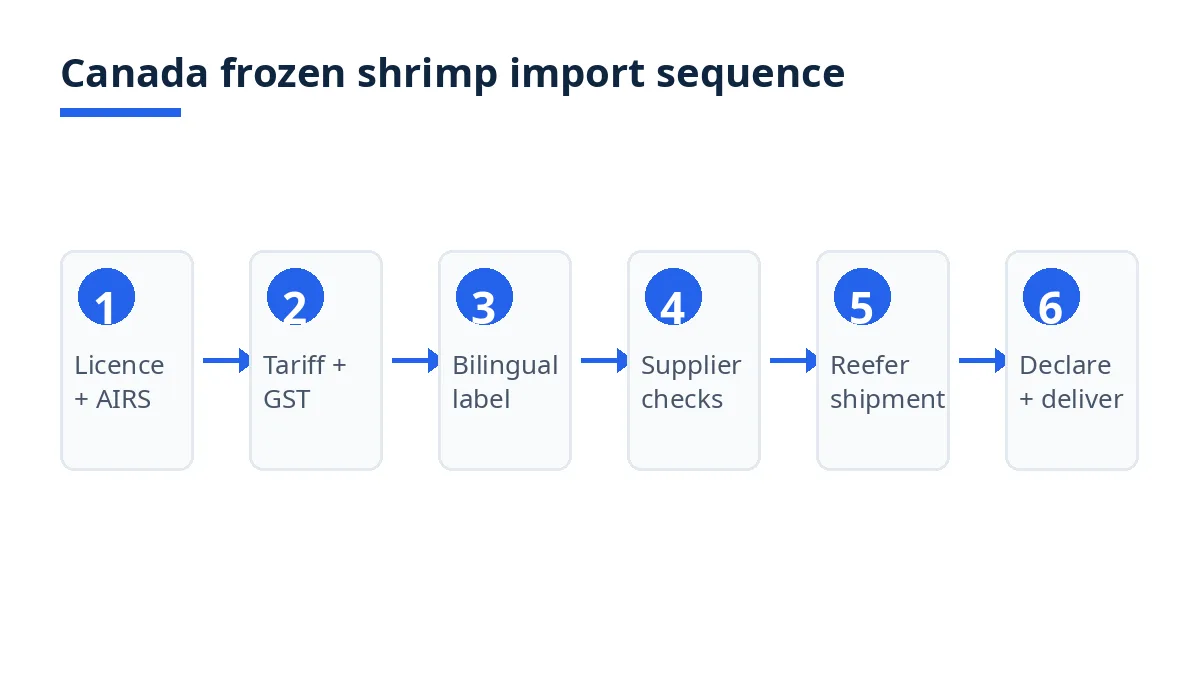
Your Canada import sequence, step by step
Apply for or renew the SFC licence, and confirm it covers importing food and the exact commodities.1 2
Check the shipment requirements in AIRS, and ask the broker to validate the AIRS codes.2
Fix the Canadian gateway, cold store, and onward route with the forwarder.
Classify the shrimp and confirm the duty rate with the broker.4 3
Confirm the GST calculation method and the CARM estimate before pricing.3
Send one specification to every supplier, and compare quotes on the same terms and in Canadian dollars.
Check the supplier documents and export file for the exact line.8
Approve samples stage by stage, and agree inspection, cold-chain range, and temperature recording.
Ship on the agreed Incoterms® 2020 term, with the document set sent to the broker before arrival.9
File the import declaration through the Integrated Import Declaration system, with the SFC licence number entered exactly as issued.1 2
Clear the entries, hold any lot with a cold-chain break, and reconcile the actual landed cost before the next order.
What is the typical MOQ for frozen shrimp from Bangladesh?
There is no single typical minimum, and no figure is stated here. The minimum is set per species, size range, presentation, and pack format. Ask how it splits by size, presentation, and pack format, get the split in writing, and compare minimums only on the identical specification.
How long does shipping take?
Production time, sea transit, and Canadian clearance and delivery are separate blocks, and no combined figure is stated here. Sea transit varies by port pair, routing, transshipment, and season, and clearance varies by gateway, cold store, and the import file. Plan from the forwarder's current sailing schedule for the exact port pair and sailing week.
What import duty applies?
Duty follows the classification, presentation, origin, and tariff treatment claimed.3 The line used here is 0306.17.00, and on the schedule opened for this guide the MFN tariff is Free and the LDCT rate is also shown as Free.4 Treat Free as indicative and confirm the rate on the current schedule for the exact line and entry date.3 GST is separate: 5 percent on the value for duty plus any duty.3
How do I verify a supplier?
Check company documents first, so name, address, and bank account agree across the trade licence, export registration, and invoices. Then check capability and the export document file, including the Department of Fisheries licence, no objection certificate, and salubrity certificate where they apply.8 Then check the Canadian file: lot identity, bilingual label artwork, and the documents the broker needs for AIRS and the declaration. Do not pay before all three layers are checked.
Next steps on Exportain
Read the general guide to importing from Bangladesh and the classification guide for frozen shrimp before you price, and use the landed cost guide for imports from Bangladesh to build the full cost picture. When the licence, gateway, and specification are fixed, post a free RFQ on Exportain with the Canadian gateway and delivery date, and compare replies on the same terms. For the buying journey itself, see how to buy on Exportain.
Sources
- Customs Notice 24-03: Safe Food for Canadians (SFC) licence to import food to Canada. Canada Border Services Agency, (accessed )
- Commercial importing process: at a glance. Canadian Food Inspection Agency, (accessed )
- Select the duties and taxes that apply. Canada Border Services Agency (accessed )
- Chapter 3: T2023 — Fish and crustaceans, molluscs and other aquatic invertebrates. Canada Border Services Agency (accessed )
- Canada's unilateral tariff preference programs for imports from developing countries. Department of Finance Canada (accessed )
- Fish and seafood labelling and traceability requirements. Canadian Food Inspection Agency, (accessed )
- Bilingual food labelling. Canadian Food Inspection Agency (accessed )
- Other shrimps and prawns: export requirements, HS Code 03063610. Bangladesh Customs, National Board of Revenue, (accessed )
- Incoterms® 2020. International Chamber of Commerce (ICC) (accessed )
About the author
Sourcing from Bangladesh?
Post a request for quotation and suppliers on Exportain can send you their quotes directly.
Post an RFQ


