

Australia Frozen Shrimp Imports From Bangladesh: Step-by-Step Guide
Frozen shrimp from Bangladesh to Australia through the BICON permit and certificate, WSSV and YHV1 testing, Free duty on line 0306.17.00, GST on the taxable value, Australian labelling, and a per-kilogram landed-cost example.
Short answer
To import frozen shrimp from Bangladesh to Australia, start with the BICON import permit for uncooked peeled prawns, then the government certificate with WSSV and YHV1 test results for each batch. Classify the shrimp on tariff line 0306.17.00, shown Free, confirm the 10 percent GST position on the value of the taxable importation with your broker, agree the biosecurity label and batch number, and hold the sealed container for inspection on arrival.
On this page
Key takeaways
Work the current BICON case and import permit first: uncooked peeled prawns need a valid permit before importation, and goods arriving without one are directed for export or destruction.
Order peeled, deveined, frozen prawns in the standard form: whole unpeeled uncooked prawns are accessible only from New Caledonia, and every batch needs WSSV and YHV1 freedom shown by pre-export and on-arrival testing.
Classify on line 0306.17.00, other shrimps and prawns, shown Free in the Australian tariff; confirm the line, statistical code, and GST treatment with your broker before pricing.
Label the primary pack 'For human consumption only - not to be used as bait or feed for aquatic animals', with a batch number matching the health certificate, on freezer-grade labels stable at minus 20 degrees Celsius.
Keep each batch to one container, keep seals intact until the approved arrangement inspection, and rework the AUD 18.11 per kilogram example landed cost including GST with actual invoices.
An Australian frozen shrimp order is decided by biosecurity before it is decided by price. The import permit, the government certificate, and the disease tests for white spot syndrome virus and yellow head virus genotype 1 decide whether uncooked prawns can enter at all.
This guide is for Australian buyers bringing frozen shrimp from Bangladesh into Australia. Every cost figure is an example figure. Every duty and tax figure must be confirmed by your broker and tax adviser for the exact goods and entry date.
Start with the Australian permit, not the price
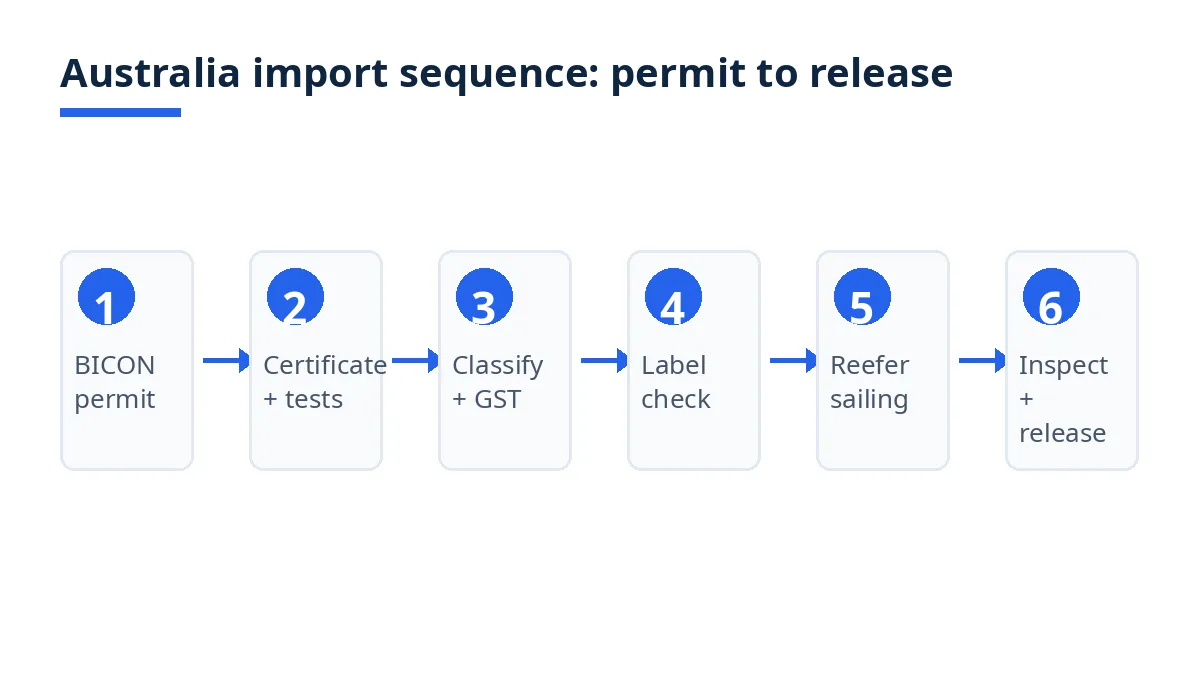
Australia administers two sets of requirements for imported food: biosecurity risks under the Biosecurity Act 2015, and food safety risks under the Imported Food Control Act 1992. All imported food must meet biosecurity import conditions to be allowed into the country.1 The Biosecurity Import Conditions system, known as BICON, shows whether a food is allowed, what conditions apply, what documentation it requires, and whether it needs an import permit.1 Work the current BICON case for prawns before you request a price, and keep a dated copy in the order file.
For uncooked peeled prawns from an approved country, BICON requires a valid import permit from the Department of Agriculture, Fisheries and Forestry before the goods are imported.2 Goods that require a permit but arrive without one, including cases where an application is still under consideration, will be directed for export or required to be destroyed in an approved manner.2 BICON requires the uncooked prawns questionnaire to accompany the application, and a manufacturer declaration must state that the method of manufacture has not been altered.2
The imported food legislation also establishes the Imported Food Inspection Scheme, known as IFIS, which checks public health and safety, Food Standards Code, and Country of Origin Food Labelling Information Standard 2016 compliance.1 Biosecurity requirements come first.
Choose the presentation: uncooked peeled, cooked, or another form
Under the standard conditions confirmed in October 2025, all uncooked prawns exported to Australia must be frozen, have had the head and shell removed, and be deveined, and must be disease tested before export and on arrival and be found free from white spot syndrome virus and yellow head virus genotype 1.3 Whole, unpeeled uncooked prawns are a separate case: New Caledonia is the only trading partner with access for imports of whole unpeeled uncooked prawns to Australia.3 A Bangladesh uncooked order must therefore be peeled and deveined, unless the current BICON case says otherwise.
BICON defines uncooked peeled prawns as goods that have been peeled, marinated, or breaded, battered, or crumbed without a par-cooking process.2 Cooked prawns sit under different conditions: cooking must leave all protein in the meat coagulated with no raw meat remaining, and every consignment must be accompanied by a health certificate from the competent authority confirming that point.4 Since September 2018, breaded, battered, and crumbed prawns must have undergone a par-cooking step after coating, and prawns without an acceptable par-cooking step must comply with the uncooked prawn conditions.4 The product must also stay in the form assessed: BICON requires prawns to be in the same form as that assessed at application, and to be sold only in their imported form, with no alteration, further processing, or repackaging without written approval.2
Classify the shrimp and work the duty and GST position
In the Australian tariff, heading 0306 covers crustaceans in the forms listed, subheading 0306.1 covers frozen crustaceans, and line 0306.17.00 covers other shrimps and prawns, at a rate shown as Free.5 The line carries statistical codes splitting the entry by form: cooked, and uncooked split into farmed and other.5 Have your broker confirm the Free rate on the exact line and statistical code for the entry date. A Free rate removes duty, not GST, biosecurity charges, inspection fees, or port and cold-store costs.
GST is payable on most goods imported into Australia, and the Department of Home Affairs collects GST on taxable importations at 10 percent of the value of the taxable importation.6 That value is the sum of the customs value, any customs duty payable, the amount paid or payable to transport the goods to their place of consignment in Australia, the insurance cost for that transport, and any wine tax payable.6 The Australian Border Force states the same formula as the value of the taxable importation, or VoTI, and confirms GST must be paid at clearance unless the importer is approved for GST deferral.7 Some importations are non-taxable, including goods that would have been GST-free if supplied within Australia, such as basic food, and goods qualifying for certain customs duty concessions.6 Whether a particular frozen shrimp consignment is non-taxable is a tax question for your broker and tax adviser, and this guide does not decide it. A GST-registered business may be able to claim a GST credit, and importers meeting the criteria may defer GST until the first activity statement lodged after importation.6
Label for Australia: biosecurity wording, Food Standards Code, and origin
Labeling has three layers. The first is the biosecurity label. The primary packaging, meaning the retail-ready packaging, must be clearly labeled "For human consumption only – not to be used as bait or feed for aquatic animals".4 It must also include the batch number, which may be the best-before date but must match the batch number on the health certificate, and labels must be freezer-grade, permanent, and stable at minus 20 degrees Celsius.4 The BICON certificate repeats the same wording.2
Under the Food Standards Code, Standard 1.2.1 sets out when a food for sale must bear a label and what information the label must state. For retail sales, packaged food must bear a label stating the name of the food, lot identification, supplier name and address, warnings and declarations, ingredients, date marking, and storage conditions, and the other information listed in the standard.8 Confirm with your broker and label adviser which division of the standard applies to each pack format, and agree the full label text before printing.
For origin, IFIS inspections check compliance with the Country of Origin Food Labelling Information Standard 2016.1 Agree the exact origin statement for each pack format with your broker and label adviser, and have the label adviser confirm the allergen declaration and origin statement together.1
Get the Bangladesh export file in order before loading
The Bangladesh and Australian files must agree. The Bangladesh Customs and National Board of Revenue hub lists export requirements for other shrimps and prawns under HS code 03063610 for the 2024–2025 fiscal year: a license for export from the Department of Fisheries, a no objection certificate for export for the lot, and a salubrity certificate for the consignment, each issued through the Deputy Director for Fish Inspection and Quality Control.9 Where the product is extracted from marine sources, a certificate for illegal, unreported, and unregulated fisheries is also listed.9 Ask the supplier to confirm the current document list for the exact HS code and lot.9 The hub also lists farm registration and a HACCP-based quality assurance program for the processing plant.9
BICON requires certification by a body listed in the list of overseas authorities approved for uncooked prawns of the country of export.2 Ask your broker to confirm, from the current BICON case, which list applies to Bangladesh, and require the supplier to name the certifying body and the approved processing company. The certificate must include the container and seal number, port of shipment, date of departure, species names, batch numbers, number of cartons and net weight, approved processing company details, health attestations required by the permit, post-processing testing laboratory details, number of cartons per batch, and the batch definition.2 Agree the template before loading.
Find and check suppliers against the Australian file
Shortlist suppliers already supplying the species, presentation, and pack format the order needs. Browse suppliers on Exportain and read each profile against the Australian specification, not against a headline price. Send each shortlisted supplier the identical specification and ask for replies in the same format. Ask whether the supplier can supply the BICON certificate and post-processing WSSV and YHV1 test results for each batch.
Verification has three layers, all before any payment. First, company documents: trade license, export registration, and association membership where applicable, checked so name, address, and bank account agree across every document. Second, capability: current production of the specified species and presentation and recent orders in the same presentation. Third, payment discipline: pay only the company account named in the documents, never a personal account, and verify any bank detail change separately, through a different channel. On Exportain, supplier profiles carry document and photo review badges, a review of documents and photos, not a factory inspection or a guarantee, and Exportain is not a party to the contract, does not inspect goods, book freight, or clear customs.
MOQ, pricing, and samples on one specification
There is no single typical minimum for frozen shrimp from Bangladesh, and this guide states none. The minimum is set per species, size range, presentation, and pack format, because raw material is bought and processed in lots and a packing run is set up per size and presentation. Read the frozen shrimp MOQ guide before you negotiate, and compare minimums only on the identical specification.
Send one identical specification document to every supplier, and require replies in the same format.
Part | Fix in writing before quoting |
|---|---|
Species and origin | Species, scientific name, farmed or wild-caught, origin wording |
Presentation | Peeled, deveined, tail on or off, cooked or uncooked, in BICON wording |
Size and count | Size range or count per unit weight, uniformity rule, out-of-range treatment |
Glaze and weight | Glaze basis, net weight basis, drained weight, weighing method |
Pack and label | Pack and carton weight, batch numbering, artwork, carton marks |
File | Permit position, certificate, testing laboratory, batch definition, export documents |
Ask for the price on the identical specification, with inclusions stated line by line: product price, packing, labeling, inspection where agreed, and the delivery term with its named place. Samples work in stages: a product sample shows whether the supplier can supply the specified species, size, and presentation, and a pre-shipment sample shows whether the production lot matches the approved sample. Approve each sample in writing and note the size range, glaze basis, and lot mark on the approval.
Quality control, residue testing, and the cold chain
Agree the inspection method, defect classes, and acceptance limits in writing, and state who inspects, when, and on what sample. Agree what happens when inspection fails and who bears the cost. Read the frozen shrimp quality control checklist and carry the agreed points into the purchase order.
Product from each batch must be found, after processing, to be free of white spot syndrome virus and yellow head virus genotype 1, based on a sampling and testing method recognized by the World Organisation for Animal Health.2 On arrival, samples are taken by biosecurity officers under secure seals intact conditions at approved arrangement locations: 65 prawns from 13 randomly selected cartons, five from each carton, from each importer-declared batch, and a batch cannot be greater than one shipping container.4 The regime is designed to give 95 percent confidence of detecting WSSV or YHV1 if present at 5 percent prevalence or greater.4 Keep batches to one container, keep the batch definition identical on certificate, packs, and invoice, and do not mix batches in a carton.
Consignments of crustaceans are referred for antimicrobial residue testing at the rate of 5 percent, and officers also conduct a visual and label assessment.10 The permitted result is no detectable amount, and Schedule 20 of the Food Standards Code lists permitted maximum residue limits.10 If a batch fails, it must, within a reasonable time period, usually 28 days, be exported, disposed of at an approved arrangement facility, or treated, meaning cooked, at an approved arrangement facility.4 Where a screening laboratory reports positive results, the importer may request confirmatory re-testing at the Australian Centre for Disease Preparedness within five working days, with all costs borne by the importer.4 All inspection and testing costs are borne by the importer under the BICON conditions.2 State in the purchase order who bears the cost of a failed batch, re-testing, cold storage during holding, and re-export or disposal.
Delivery terms and the Chattogram to Australia reefer leg
Build the sailing plan from the forwarder's current schedule, not from a general transit figure. This guide states no transit time, because transit depends on the port pair, routing, transshipment, and season. Ask your forwarder about routing via Singapore or Port Klang, and confirm the routing and onward sailing in writing. Agree any routing change with the broker before the vessel sails.
State the delivery term in full in every document: rule, named place, and version. Under the Incoterms 2020 rules, risk passes from seller to buyer at the same point and time as delivery, and in only two rules, CIP and CIF, must the seller provide the buyer with insurance for its risk.11 In the C rules and the D rules the seller must contract for freight to the destination place or port, while in the E and F rules the buyer arranges freight.11 Four rules, FAS, FOB, CFR, and CIF, are only intended for port-to-port shipments, meaning bulk or break-bulk, and are not suitable for container shipments in their current form.11
Containers must remain unopened with seals intact until inspection. Biosecurity officers must be present to verify the seal number, then supervise breaking the seal and opening the container; if the seals are not intact, the inspection will not proceed and the product will be deemed non-compliant.4 The importer bears all transport, handling, labour, and cold storage costs for inspection.4 Allow for a minimum four-hour inspection.4
Landed cost example in Australian dollars
Every number below is an example figure only, not a quote, for frozen uncooked peeled farmed shrimp shipped by sea in a reefer container from Chattogram to an Australian port and delivered to a cold store, with duty at the Free rate on line 0306.17.00 and GST on the GST-payable basis. GST is 10 percent of the value of the taxable importation where the importation is taxable, and some importations are non-taxable, including goods that would have been GST-free if supplied within Australia.6
Example figures: per kilogram, net weight basis, Australian dollars.
Cost element | Example figures (per kilogram) | How to obtain your figure |
|---|---|---|
Product price, FOB Chattogram | AUD 14.00 | Pro forma invoice |
Freight and insurance | AUD 1.60 | Forwarder quote |
Customs value, on the example FOB basis | AUD 14.00 | Broker calculation |
Duty at Free rate, line 0306.17.00 | AUD 0.00 | Broker confirmation 5 |
Value of the taxable importation | AUD 15.60 | Customs value plus duty plus freight and insurance |
GST at 10% of the taxable value | AUD 1.56 | Broker and tax adviser 6 |
Border, inspection, port, cold-store, broker fees | AUD 0.55 | Broker, port, cold-store invoices |
Delivery to cold store or plant | AUD 0.40 | Local carrier quote |
Total cash outlay including GST | AUD 18.11 | Sum of all lines above |
Total excluding GST | AUD 16.55 | Cash outlay less the GST line |
If the consignment is a non-taxable importation, the GST line is zero. Confirm the timing of any GST credit, including deferral, before pricing.6 Rework every line with your own quotes. Read the classification guide for frozen shrimp alongside the duty line, so the code, statistical code, and certificate describe the same goods.
Step-by-step import checklist for Australia
Work the current BICON case for prawns, and keep a dated copy in the order file.
Apply for the import permit before ordering.
Fix the presentation in BICON wording: uncooked peeled and deveined, cooked, or another assessed form.
Confirm the competent authority list position for Bangladesh and the certificate template with your broker.
Classify on line 0306.17.00 with the correct statistical code, and confirm the Free duty position.
Confirm the GST treatment, deferral, and credit position with your broker and tax adviser.
Agree the label: biosecurity wording, batch number, Code information, and origin statement.
Confirm the Bangladesh export file: license, no objection certificate, salubrity certificate, and any IUU certificate.
Send one specification to every supplier, and compare quotes on the same terms.
Check the supplier in three layers: documents, capability, and payment discipline.
Agree inspection, residue controls, cold-chain range, and temperature recording, and approve samples stage by stage.
Agree the certificate contents, testing laboratory, and batch definition before loading.
Ship on the agreed term, keep seals intact, and hold the goods at the approved arrangement site until directions are given.
Reconcile the landed cost from invoices, and file the permit, certificate, test results, and declarations together.
What is the typical MOQ for frozen shrimp from Bangladesh?
There is no single typical minimum, and no figure is stated here. The minimum is set per species, size range, presentation, and pack format, because raw material is bought and processed in lots and a packing run is set up per size and presentation. Compare minimums only on the identical specification.
How long does shipping take?
This guide states no combined transit figure. Sea transit varies by port pair, routing, transshipment, and season, and inspection varies by the approved arrangement site, the seals-intact appointment, and the test results. Plan from the forwarder's current sailing schedule, and add a hold allowance for biosecurity inspection and testing before promising a delivery date.
What import duty applies?
The line used here is 0306.17.00, other shrimps and prawns, frozen, shown in the Australian Border Force tariff schedule at a rate of Free.5 Treat Free as the indicative working position and have your broker confirm it on the exact line and statistical code for the entry date. Duty at zero does not remove GST where GST is payable, biosecurity charges, inspection and testing costs, or port and cold-store fees.
How do I verify a supplier?
Check company documents first, so name, address, and bank account agree across every document, and payment goes to the company account named in them. For Australia, add the decisive third check: whether the supplier's competent authority can issue the government certificate BICON requires, with the seven certificate statements and the eleven certificate contents, and whether the supplier can supply post-processing WSSV and YHV1 test results for each batch.2 A supplier that cannot produce the Australian certificate and test file cannot supply the order, however strong its production record.
Next steps on Exportain
Read the general guide to importing from Bangladesh and the classification guide for frozen shrimp before you price, and work the landed cost guide for imports from Bangladesh with your own quotes. When the permit position, presentation, and specification are fixed, read how to buy on Exportain, browse suppliers, and post a free RFQ with the presentation, certificate requirement, and delivery date.
Sources
- Imported food legislation. Department of Agriculture, Fisheries and Forestry (accessed )
- BICON - Import Conditions: Prawns - Uncooked peeled prawns from an approved country. Department of Agriculture, Fisheries and Forestry (accessed )
- 366-2025: Unchanged import conditions for prawns. Department of Agriculture, Fisheries and Forestry, (accessed )
- Uncooked prawns and other prawn products for human consumption. Department of Agriculture, Fisheries and Forestry (accessed )
- Chapter 3: Fish and crustaceans, molluscs and other aquatic invertebrates, Australian Customs Tariff. Australian Border Force (accessed )
- GST and imported goods. Australian Taxation Office (accessed )
- GST and other taxes when importing. Australian Border Force (accessed )
- Australia New Zealand Food Standards Code - Standard 1.2.1 Requirements to have labels or otherwise provide information. Food Standards Australia New Zealand (accessed )
- Other shrimps and prawns: export requirements, HS Code 03063610. Bangladesh Customs, National Board of Revenue, (accessed )
- Crustaceans. Department of Agriculture, Fisheries and Forestry (accessed )
- Insider thoughts: Bob Ronai on Incoterms 2020 Rules; What are they about?. International Chamber of Commerce (accessed )
About the author
Sourcing from Bangladesh?
Post a request for quotation and suppliers on Exportain can send you their quotes directly.
Post an RFQ


