HS Code for Industrial Lighting: Classification Guide for Importers
Industrial lighting has no single HS code: complete luminaires sit in heading 9405, separate LED modules and lamps in 8539, and parts in 9405.91, 9405.92 or 9405.99 by material, with national codes running to 8-10 digits.
Short answer
Industrial lighting has no single HS code. Complete luminaires sit in heading 9405, with 9405.42 for other electric luminaires designed for use solely with LED light sources, 9405.11 for LED ceiling or wall fittings and 9405.41 for photovoltaic LED fittings. Separate LED modules take 8539.51, separate LED lamps take 8539.52, and luminaire parts take 9405.91, 9405.92 or 9405.99 by material. Confirm the full national code before filing.
On this page
Key takeaways
Complete luminaires sit in heading 9405 and separate light sources in heading 8539: 9405.42 for other electric LED luminaires, 8539.51 for capless LED modules and 8539.52 for capped LED lamps.
The LED-only test is a design test: a fitting that can also take a filament or discharge lamp falls to the other line beside it, 9405.19, 9405.29 or 9405.49, not to an LED line.
Ceiling or wall fittings exclude fittings for public open spaces or thoroughfares, so a site-road light is tested in the other electric group, and photovoltaic fittings are tested at 9405.41 before 9405.42.
Luminaire parts split by material into 9405.91 for glass, 9405.92 for plastics and 9405.99 for other materials, but parts of general use of base metal are excluded from chapter 94.
Only the first six digits are shared worldwide: the EU extends to eight digits and the United States and United Kingdom to ten, so confirm the full national code per invoice line and seek a binding decision for borderline items.
An industrial lighting order rarely contains one product. One shipment can hold LED high-bay luminaires, workshop battens, yard floodlights and spare LED modules, each needing its own classification. The Harmonized System is a multipurpose international product nomenclature developed by the World Customs Organization (WCO), comprising more than 5,000 commodity groups, each identified by a six-digit code, and used by more than 200 countries and economies as a basis for their customs tariffs.1 This guide classifies the whole range for buyers importing into the United States, the United Kingdom, the European Union and the United Arab Emirates. It covers classification only; supplier selection is in how to import industrial lighting from Bangladesh, and factory inspection in the industrial lighting quality control checklist.
Quick answer: indicative HS heading (with verify note)
There is no single HS code for industrial lighting. Complete luminaires sit in heading 9405, separate light sources in heading 8539, and luminaire parts back in 9405. The United States schedule states heading 9405 as luminaires and lighting fittings including searchlights and spotlights and parts thereof, not elsewhere specified or included, together with illuminated signs and nameplates with a permanently fixed light source.2 Treat every line below as indicative; confirm the full national code before filing.
Item as shipped | Indicative line | Why |
|---|---|---|
Complete other electric LED luminaire (high-bay, batten, floodlight) | 9405.42 | |
Complete other electric luminaire that is not LED-only | 9405.49 | |
Photovoltaic other electric LED luminaire | 9405.41 | Photovoltaic LED line, ahead of 9405.423 |
LED ceiling or wall fitting, excluding public-space fittings | 9405.11 | LED line inside the ceiling or wall group4 |
Other ceiling or wall fitting in the same group | 9405.19 | The other line beside 9405.114 |
LED table, desk, bedside or floor-standing luminaire | 9405.21 | LED line inside the table and floor-standing group5 |
Other table, desk, bedside or floor-standing luminaire | 9405.29 | The other line beside 9405.215 |
Separate LED module, with no cap for a luminaire | 8539.51 | LED modules, United Kingdom tariff6 |
Separate LED lamp, with a cap for a luminaire | 8539.52 | LED lamps, per a United States ruling on screw-cap lamps7 |
Luminaire part of glass, plastics, or other material | 9405.91, 9405.92, 9405.99 | Parts lines of 9405, split by material2 |
The current version of the system is HS 2022.8 A code correct under an older revision, or copied from a catalogue, is not evidence for the entry date. Read the line in the destination tariff for the shipment date.
How HS codes are structured (2-4-6 digits)
The Harmonized System is organised in a hierarchical structure by sections, chapters (2 digits), headings (4 digits) and sub-headings (6 digits).8 For industrial lighting the path is chapter 94, heading 9405, then a six-digit subheading by form and light source. In 9405.42, 94 is the chapter, 9405 is the heading for luminaires and lighting fittings, and 42 is the subheading for other electric LED luminaires.2 3
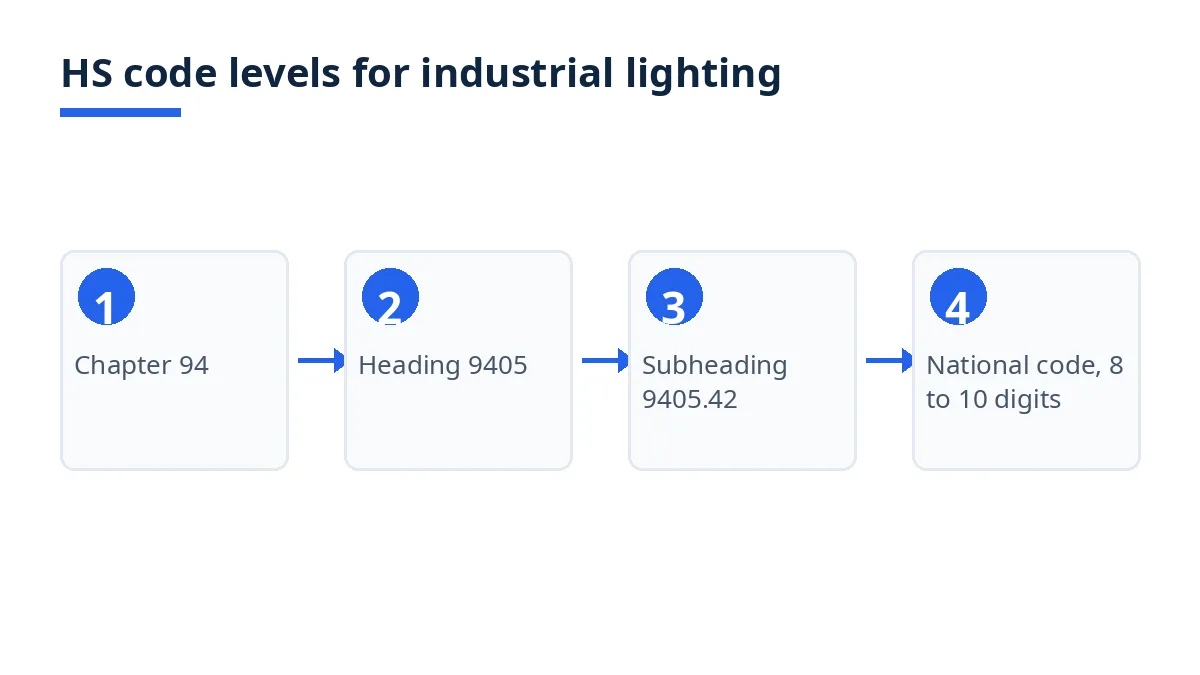
Beyond six digits, countries add their own lines. The Combined Nomenclature of the European Union uses eight-digit codes.8 The United States and the United Kingdom run to ten digits. The first six digits are the shared part, so a six-digit code alone is never a finished entry. For more on the structure, read the harmonized system tariff code explainer, the 6-digit HS code guide and how to classify your product.
Factors that decide the code for industrial lighting
Complete fitting or separate light source. This split is set by a chapter note, not by the product name. Chapter 94 does not cover lamps or light sources and parts thereof of chapter 85.2 A complete luminaire goes to 9405. A bare LED module or lamp shipped on its own goes to 8539.
Fitting form comes before wattage or mounting. The 9405 subheadings divide complete fittings first by form: ceiling or wall fittings, table, desk, bedside or floor-standing luminaires, and other electric luminaires.2 4 3 5 A high-bay luminaire and a workshop batten both sit in the other electric group. Wattage, lumen output and mounting bracket do not change the six-digit line.
Ceiling and wall fittings exclude public-space lighting. The ceiling or wall group expressly excludes fittings of a kind used for lighting public open spaces or thoroughfares.4 A street light for a site road therefore does not take 9405.11 even when LED, and is tested in the other electric group, at 9405.42 when LED-only.
The LED-only test is a design test. The LED lines read designed for use solely with light-emitting diode (LED) light sources.2 3 A fitting built only around an LED module or lamp meets that wording. A fitting that can also take a filament or discharge lamp falls to the other line beside it: 9405.19, 9405.29 or 9405.49. Inside other electric luminaires, the photovoltaic line 9405.41 comes before the general LED line 9405.42,3 so a solar-powered yard luminaire is tested at 9405.41 first. National lines separate searchlights and spotlights within 9405.42 and 9405.49,3 but a yard floodlight is not automatically a searchlight.
Parts follow material, with one exclusion. Parts split into 9405.91 for glass, 9405.92 for plastics and 9405.99 for other materials.2 A glass diffuser and a metal housing therefore take different parts lines. Chapter 94 does not cover parts of general use of base metal, as defined in the section XV note, or similar goods of plastics,2 so a generic screw or bracket does not become a 9405.99 part merely because it ships with a luminaire.
Module or lamp turns on the cap. For heading 8539, the chapter 85 notes draw the line by the cap: LED modules do not have a cap designed to allow easy installation or replacement in a luminaire and ensure mechanical and electrical contact, while LED lamps have such a cap.6 That cap test separates 8539.51 from 8539.52, as the United States ruling for E26 and E27 screw-cap LED lamps shows.7
The interpretation rules decide borderline cases. Classification follows the terms of the headings and any relative section or chapter notes, and only subheadings at the same level are comparable.3
National codes: US HTS, EU CN/TARIC, UK commodity code
United States: HTS, ten digits. The United States schedule carries the six-digit subheading into ten-digit lines. Inside 9405.42, for example, it lists 9405.42.84 with statistical suffixes separating lighting sets from other goods.2 Read the full ten-digit line for the exact fitting and material.2
European Union: CN at eight digits, TARIC for measures. The Combined Nomenclature uses eight-digit codes, comprising the HS codes with further EU subdivisions.8 Take the eight-digit CN code for the fitting, then confirm the measures that apply to it for the entry date and for origin Bangladesh. Do not carry a United States ten-digit suffix into an EU entry.
United Kingdom: commodity code, ten digits. The United Kingdom tariff lists commodity codes to ten digits: 9405 4239 90 for other fittings of other materials in the other electric LED group,3 and 9405 1140 90 for other fittings of plastics or ceramic materials in the ceiling or wall LED group.4 Take the full code for the fitting and entry date.
How to confirm the code officially
Write a precise description for each invoice line: complete fitting or separate source, fitting form, LED-only or not, photovoltaic or not, part material, and cap position for a separate source.
Start from the official tariff for the destination: the USITC schedule, the Combined Nomenclature and EU tariff, or the United Kingdom tariff. Read the heading, subheading and chapter notes, not a summary page.
Check published rulings for similar goods. For the United States, the USITC advises traders to use the Customs Rulings Online Search Service (CROSS), because the correct classification of many items can be found there.9
For a borderline item, apply for a binding decision before shipping. In the EU, a Binding Tariff Information application needs a separate application for each type of product and a detailed description.10 In the UK, a legally binding decision is generally valid for 3 years, through an Advance Tariff Ruling.11 In the US, if the merchandise is not described in any ruling on CROSS, you may request a binding ruling from United States Customs and Border Protection.9
Give your broker the description and confirmed code for each line, and use the same codes on the invoice, packing list and entry.
Common classification mistakes
Filing the whole order under 9405. Complete luminaires belong in 9405, but separate modules and lamps belong in 8539, and chapter 94 expressly excludes lamps and light sources of chapter 85.2
Filing a site street light as a ceiling or wall fitting. The ceiling or wall group excludes fittings for public open spaces or thoroughfares.4 A site-road light belongs in the other electric group, not at 9405.11.
Filing every LED fitting at 9405.42. Photovoltaic fittings are tested at 9405.41 first,3 and a fitting that can take a non-LED source falls to 9405.49, not 9405.42.
Filing a capless module as a lamp. The cap test separates 8539.51 from 8539.52: a module without a cap for easy installation in a luminaire is not a lamp.6
Copying a code from another country. Only the first six digits are shared. The European Union extends to eight digits,8 and the United States and the United Kingdom split the lines further.2 3
Related duties and documents
This guide states no duty rates. The code decides which duty line customs applies, and a rate on one national line does not carry to a neighbouring line or material. Read the rate beside your confirmed code for your origin and entry date, and check what proof of origin any preference claim requires.
The invoice should carry each fitting, light source and part on its own line with its confirmed code, and the packing list should match the invoice line by line. A mixed carton combining a luminaire with spare modules needs the split visible on both documents. Keep the specification sheet, tariff pages or ruling relied on, any binding decision and origin evidence in the shipment file.
FAQs
What is the HS code for industrial lighting?
There is no single code. Complete luminaires sit in heading 9405: 9405.42 for other electric LED luminaires, 9405.11 for LED ceiling or wall fittings outside the public-space exclusion, and 9405.41 for photovoltaic LED fittings.2 4 3 Separate modules take 8539.51, separate lamps take 8539.52,6 7 and parts take 9405.91, 9405.92 or 9405.99 by material.2
Is the HS code the same in every country?
Only the first six digits are harmonised. Beyond six digits, each country adds its own lines: eight digits in the EU Combined Nomenclature,8 and ten digits in the United States and United Kingdom schedules.2 3 Confirm the full national code for each destination.
How do I confirm the correct code?
Describe each item precisely, read the heading text and chapter notes in the destination tariff, and check published rulings, such as CROSS for the United States.9 For a borderline item, apply for a binding decision before shipping: a Binding Tariff Information decision in the EU,10 an Advance Tariff Ruling in the UK,11 or a Customs and Border Protection ruling in the US.9
What happens if I use the wrong code?
Duty, licensing and quota treatment are worked out from the code on the declaration, so a wrong code brings the wrong treatment. A legally binding decision helps you calculate the duties and restrictions in advance.11 Correct it with your broker before filing.
Next steps on Exportain
Read how to import industrial lighting from Bangladesh for the order process, then use the industrial lighting quality control checklist to plan inspection. Browse suppliers on Exportain and post an RFQ with the confirmed code per invoice line. Exportain is not a party to the goods contract and does not inspect goods, book freight or clear customs.
Sources
- What is the Harmonized System (HS)?. World Customs Organization (accessed )
- Harmonized Tariff Schedule of the United States, Chapter 94 (2026 Revision 18). U.S. International Trade Commission (accessed )
- Other electric luminaires and lighting fittings: Northern Ireland Online Tariff. GOV.UK, HM Revenue and Customs (accessed )
- Chandeliers and other electric ceiling or wall lighting fittings: UK Integrated Online Tariff, subheading 940511. GOV.UK, HM Revenue and Customs (accessed )
- Electric table, desk, bedside or floor-standing luminaires: Northern Ireland Online Tariff, subheading 940521. GOV.UK, HM Revenue and Customs (accessed )
- Commodity code 8539510000: Light-emitting diode (LED) modules – UK Integrated Online Tariff. GOV.UK, HM Revenue and Customs (accessed )
- Customs Ruling NY N349718: Tariff classification of LED lamps. U.S. Customs and Border Protection (accessed )
- Harmonised System. European Commission (accessed )
- MTB 2019: Get Out Ahead of the Pack with a Binding Ruling from CBP. U.S. International Trade Commission (accessed )
- European Binding Tariff Information (EBTI). European Commission, Taxation and Customs Union, (accessed )
- Check what you'll need to get a legally binding decision on a commodity code. GOV.UK, HM Revenue and Customs (accessed )
About the author
Sourcing from Bangladesh?
Post a request for quotation and suppliers on Exportain can send you their quotes directly.
Post an RFQ