Quality Control Checklist for Industrial Lighting From Bangladesh
A numbered QC checklist for industrial lighting from Bangladesh: documents, appearance, electrical safety, photometric and performance data, ingress protection, marking, labels and packing, with fixes for common failures.
Short answer
Use this industrial lighting quality control checklist to check documents, appearance, electrical safety and function, photometric and performance data, ingress protection, marking and packing on industrial lighting from Bangladesh before shipment. Agree the sample, specification limits, test methods and acceptance numbers in the purchase order, and draw the sample randomly across models, wattages and cartons.
On this page
Key takeaways
Agree the sample, specification limits, test methods and acceptance numbers before inspection, and draw the sample randomly across models, wattages and cartons.
Check safety and performance evidence against the exact model and configuration shipped, not a related model in the same family.
Work fitting by fitting on seals, drivers and markings, because a pinched gasket or a substituted driver is easy to miss inside a sealed carton.
Treat every test value and limit as a term of the contract and purchase specification, and record any missing or mismatched report as a finding.
If you buy industrial lighting from Bangladesh, this checklist gives you a practical way to check a shipment before it leaves the factory. Industrial luminaires fail in ways that show up late: a fitting that will not mount cleanly, a driver that hums or flickers, a seal that lets dust or water in, or a label that does not match the carton. Agree the sampling plan in advance, and draw the sample randomly across models, wattages and cartons rather than accepting pieces the factory selects. ISO 2859-1 specifies an acceptance sampling system for inspection by attributes, indexed in terms of the acceptance quality limit (AQL), for lot-by-lot inspection.1
Why this checklist matters
Industrial lighting is bought for a place of work: a warehouse, a factory floor, a yard or a workshop. The buyer checks not only how a fitting looks on a bench, but whether it mounts as specified, runs steadily under load, keeps its seals in dust and damp, and carries the markings the destination market requires. A fault hidden inside a sealed carton, such as a wrong driver or a missing gasket, shows only after installation.
A written checklist removes interpretation. Each point is checked against the approved sample, the purchase specification and the packing list, and recorded as pass, fail or not applicable. Test values and limits are those of the contract and purchase specification, and the acceptance numbers stay in the purchase order. See the AQL acceptance quality limit explainer.
Before you start
Do not begin until the references are complete: an approved sample, the purchase order and packing specification, the photometric and electrical data sheets, the test reports and certificates, and the label and carton artwork. Agree the sampling plan in advance,1 and confirm which checks rest on every sampled piece, which on a subsample, and which on a lab report.
Confirm the standards named in the order before bulk production. IEC 60598-1 specifies general requirements for luminaires, incorporating electric light sources for operation from supply voltages up to 1 000 V, covering classification, marking, mechanical construction, electrical construction and photobiological safety.2 IEC 62722-1 covers performance and environmental requirements for luminaires, incorporating electric light sources for operation from supply voltages up to 1 000 V, with performance data for luminaires in a condition representative of new manufacture.3 Check that every report names the exact model, wattage and configuration shipped, not a related model. For street-lighting orders, see the companion LED street lights quality control checklist.
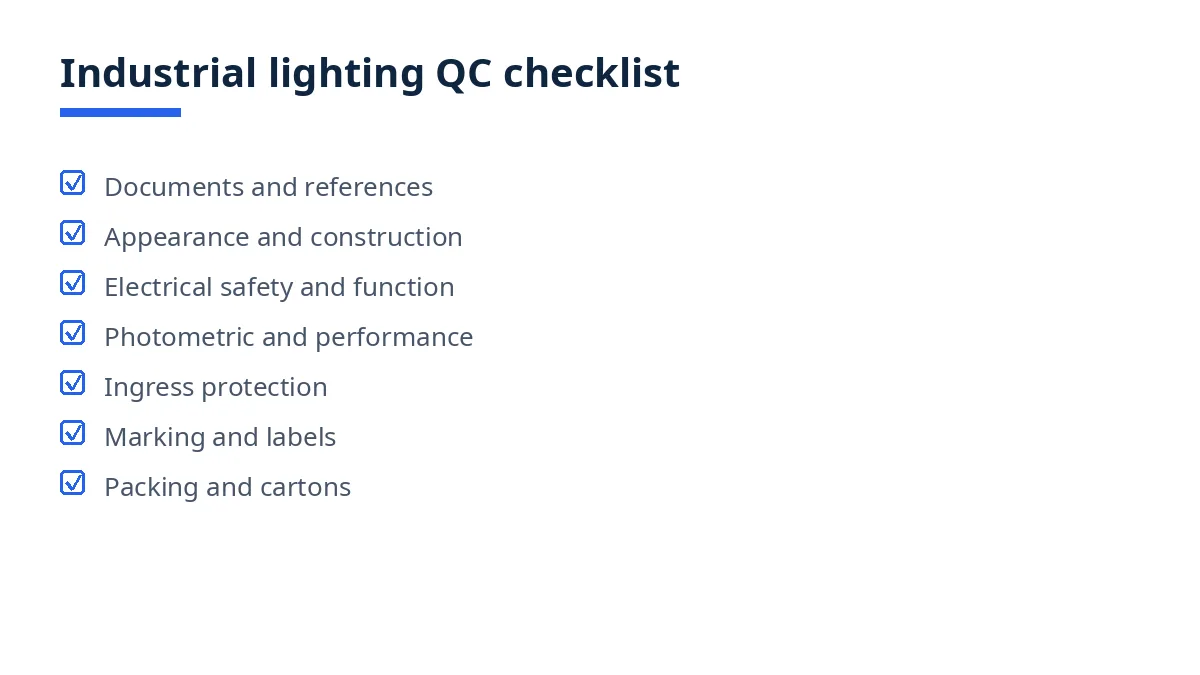
The full checklist (numbered, printable)
Documents and references
Confirm the approved sample, purchase specification, data sheets and packing list are at the inspection table, and that the sample matches the model, wattage, colour temperature and finish in the order.
Confirm the agreed sampling plan, draw the sample randomly across models, wattages and cartons, and record the carton numbers sampled.
Check that each test report and certificate names the exact model and configuration shipped, the test method used, and the contract limit applied.
Check that safety and performance reports cover the luminaire type in the order. IEC 60598-1 covers general requirements and tests for luminaires,2 and IEC 62722-1 covers performance and environmental requirements.3
Appearance and construction
Check each sampled fitting against the sample for dents, cracks, scratches, bent brackets, damaged fins and deformed housings.
Check the finish for even colour, peeling, blistering, rust spots and overspray, including inside brackets, mounting plates and heat-sink fins.
Check lenses, diffusers and covers for cracks, scratches, yellowing, trapped dust and fingerprints, and confirm they seat fully with no gaps or rocking.
Check that screws, clips, hinges and latches are present, of the specified type and tight, and that adjustable brackets move and lock as specified.
Check mounting parts against the specification: bracket type, hole positions, suspension points and included fixings. Fit one sampled fitting to its mounting arrangement where allowed.
Check cables, glands and connectors for cuts, nicks, pinching and loose strands, and confirm cable entry points are sealed as specified.
Check that internal wiring is neat, secured away from sharp edges and hot surfaces, with no loose wire ends or exposed conductors visible when covers are opened.
Electrical safety and function
Check the driver and control gear against the specification: model, input voltage range, output rating and dimming type, where named.
Check that the driver is firmly fixed, its wiring matches the wiring diagram, and no component touches the housing in a way the sample does not show.
Switch on each sampled fitting and check that it lights without extra delay, visible flicker, colour shift across the fitting, or audible buzz beyond what the sample shows.
Check dimming, sensor and emergency functions named in the order, including that the fitting returns to full output when the control is set back.
Check earthing where the luminaire class requires it: earth connections present, secure and correctly terminated, as the sample shows.
Check that live parts are not accessible when covers, lenses and diffusers are fitted as for normal use, and that no cover comes off without a tool where the sample requires one.
Photometric and performance data
Compare each data sheet against the purchase specification: rated power, luminous flux, colour temperature, colour rendering and beam distribution, where named.
Check light output across sampled fittings of the same model for even brightness, even colour and dark spots, comparing any suspect piece side by side with the sample.
Check that photometric, electrical and efficacy data name the model and configuration shipped, and that no data sheet from a different wattage or optic has been substituted.
Ingress protection and environment
Check the ingress protection rating on the label and data sheet against the purchase specification, and confirm a test report supports it for that exact model and configuration.
IEC 60529 classifies degrees of protection provided by enclosures: access to hazardous parts, ingress of solid foreign objects, and ingress of water, with designations, requirements and tests.4
Check gaskets and seals on sampled fittings: present, correctly seated, undamaged, of even thickness, and closing without pinching or gaps.
Check drainage, ventilation and breather features named in the specification, and confirm they are not blocked, painted over or fitted the wrong way round.
Check that outdoor and damp-location fittings show no trapped water, condensation or dust inside lenses or housings, and open one cover per model where allowed to check the seal seat.
Marking, labels and claims
Check that each fitting carries the required markings: model, rated voltage, rated power, manufacturer or brand marking, and any safety or performance marking named in the order, legible and in the sample position.
Check that labels match the carton and the purchase order for model, wattage, colour temperature, quantity and destination, and that barcode stickers scan and match the order.
Check that any claim on the label, carton or data sheet, such as a lifetime, efficacy or ingress protection claim, matches the evidence in the file, and record an unsupported claim as a failure.
Check installation and safety instructions are included where required, in the language and format named, with warnings matching the luminaire class.
Packing and cartons
Check that each fitting is packed as specified, with protective caps, separators or foam where required, so lenses, brackets and finishes cannot damage each other in transit.
Check that carton contents, model mix and quantities per carton match the packing list, and that fittings shipped with drivers, brackets or accessories are complete.
Check carton markings against the packing list: model, quantity, weight where marked, and handling marks required by the order.
Weigh and measure sample cartons, check the carton count against the packing list, and confirm cartons are strong, sealed and free of crushing or water damage.
Common failures and how to fix them
The most frequent failure is a seal or gasket fault: a gasket pinched, seated unevenly, or missing. Stop, open sampled covers, compare the seal seat against the sample, and rework affected fittings before packing continues. Next is a driver mismatch: segregate affected cartons, check drivers piece by piece, and do not accept a substitute without a revised specification.
Flicker or uneven colour across fittings of the same model usually traces to mixed drivers, mixed LED batches or a wrong optic. Compare suspect pieces side by side with the sample, then sort by batch before deciding on rework or rejection. Wrong markings are common on mixed-model cartons: re-check labels at the packing table, not after cartons are sealed. Above the agreed acceptance level, options are re-inspection after sorting or rework, documented partial acceptance, or rejection.
Downloadable template / summary table
Copy the checklist into your inspection sheet, add the specification limits, test methods and acceptance numbers, and record a result per fitting.
Section | Checks | Evidence |
|---|---|---|
Documents | Sample, specification, reports | Report file, carton list |
Appearance | Housing, finish, lens, brackets | Sample comparison |
Electrical | Driver, function, earthing, access | Switch-on checks |
Performance | Data sheet, output, colour | Lab reports |
Ingress protection | Rating, gaskets, seals | Seal check |
Marking | Labels, claims, instructions | Scan check |
Packing | Protection, contents, cartons | Packing list |
How Exportain helps
Exportain is a B2B marketplace connecting buyers with Bangladeshi suppliers of industrial lighting and industrial equipment, so the specifications behind this checklist can be agreed at the enquiry stage. Browse suppliers, see the industrial equipment category and use inspection services when you plan the check. Supplier profiles show which document and photo checks have been recorded, not factory inspections. You can also post an RFQ via RFQs. Exportain is not a party to the goods contract and does not inspect goods.
FAQs
When should this checklist be used?
Use it at final inspection, when goods are finished and largely packed. For larger and first orders, also use it during production.
Who should complete it?
The buyer, a local agent or an independent inspector can complete it, using the approved sample, the specification and a drawn sample.
What are the most common failures?
Seal and gasket faults, driver mismatches, flicker, uneven colour, wrong markings and damaged packing.
Can a third party do it?
Yes, if you share the approved sample, specification, test methods and acceptance levels first.
Next steps on Exportain
Before production, agree your specification, test methods, acceptance numbers and label wording, then read the AQL acceptance quality limit explainer and the how to import industrial lighting from Bangladesh guide, and plan the check with inspection services.
Sources
- ISO 2859-1:2026 - Sampling procedures for inspection by attributes — Part 1: Sampling schemes indexed by acceptance quality limit (AQL) for lot-by-lot inspection. ISO (accessed )
- IEC 60598-1:2020 - Luminaires, Part 1: General requirements and tests. International Electrotechnical Commission, (accessed )
- IEC 62722-1:2022 - Luminaire performance, Part 1: General requirements. International Electrotechnical Commission (accessed )
- Degrees of protection provided by enclosures (IP Code) - IEC 60529 adoption scope. Standards Council of Canada (accessed )
- pre-shipment inspection
- quality control
- aql inspection
- Industrial lighting
- Bangladesh industrial equipment
About the author
Sourcing from Bangladesh?
Post a request for quotation and suppliers on Exportain can send you their quotes directly.
Post an RFQ