Quality Control Checklist for LED Street Lights From Bangladesh
A numbered QC checklist for LED street lights from Bangladesh: housing, optics, mounting, driver, light output, colour, sealing, labels and packing, with fixes for common failures.
Short answer
Use this LED street lights quality control checklist to check housing, seals, optics, mounting, driver, light output, colour, protection rating, labels and packing on LED street lights from Bangladesh before shipment. Agree models, tolerances, test methods and acceptance numbers in the purchase order.
On this page
Key takeaways
Agree the sample, specification, tolerances, test methods and acceptance numbers before inspection, and draw the sample randomly across models, wattages, colour temperatures and cartons.
Check seals, housing, lens and bracket fit as a group, because an outdoor failure usually starts with a seal that looks closed but does not seal.
Compare driver markings, light output, colour and input power against the order model by model, and record the report reference for every model.
Check the enclosure protection rating against the certificate scope, not the marking alone, and record any mismatch as a failure.
If you buy LED street lights from Bangladesh, this checklist gives you a practical way to check a shipment before it leaves the factory. A street light is judged outdoors, in rain, dust, heat and vibration, and a fault missed on a bench shows at once on a pole. ISO 2859-1 defines a system of acceptance sampling plans for inspection by attributes, indexed by acceptance quality limit (AQL), for lot-by-lot inspection.1
Why this checklist matters
LED street lights combine housing, optics, driver electronics and mounting hardware in one outdoor unit, so one shipment can carry several failures at once: a housing that does not seal, a driver that does not match the order, a light output that does not match the datasheet, or a bracket that does not fit the pole. Switching the light on alone finds none of these.
A written checklist removes interpretation. Each point is checked against the approved sample, the purchase specification and the packing list, and recorded as pass, fail or not applicable. Agree defect classes, tolerances, test methods and acceptance numbers in the purchase order before inspection begins, and name the standard edition for each test.1 See the AQL acceptance quality limit explainer.
Before you start
Do not begin until the references are complete: an approved sample per model and wattage, the purchase order and specification, the datasheet and photometric file for each model, the test reports and certificates named in the order, the mounting and wiring instructions, and the packing specification. Confirm which items are checked on sampled units and which against reports only.
Confirm the scope of the standards named in the order. IEC 60598-2-3 specifies requirements for luminaires for road, street lighting and other public outdoor lighting applications, for tunnel lighting, and for column-integrated luminaires with a minimum total height above normal ground level of 2,5 m, for use with electrical lighting sources on supply voltages not exceeding 1 000 V, and it is to be read in conjunction with IEC 60598-1.2 IEC 62722-2-1 covers LED luminaire performance, including input power, photometric performance, chromaticity, colour temperature, colour rendering and luminaire life.3 Where the order names a protection rating, check it against the certificate and report scope, not the marking alone. IEC 60529 classifies enclosure protection, with the first characteristic numeral covering access to hazardous parts and solid foreign objects and the second covering ingress of water.4
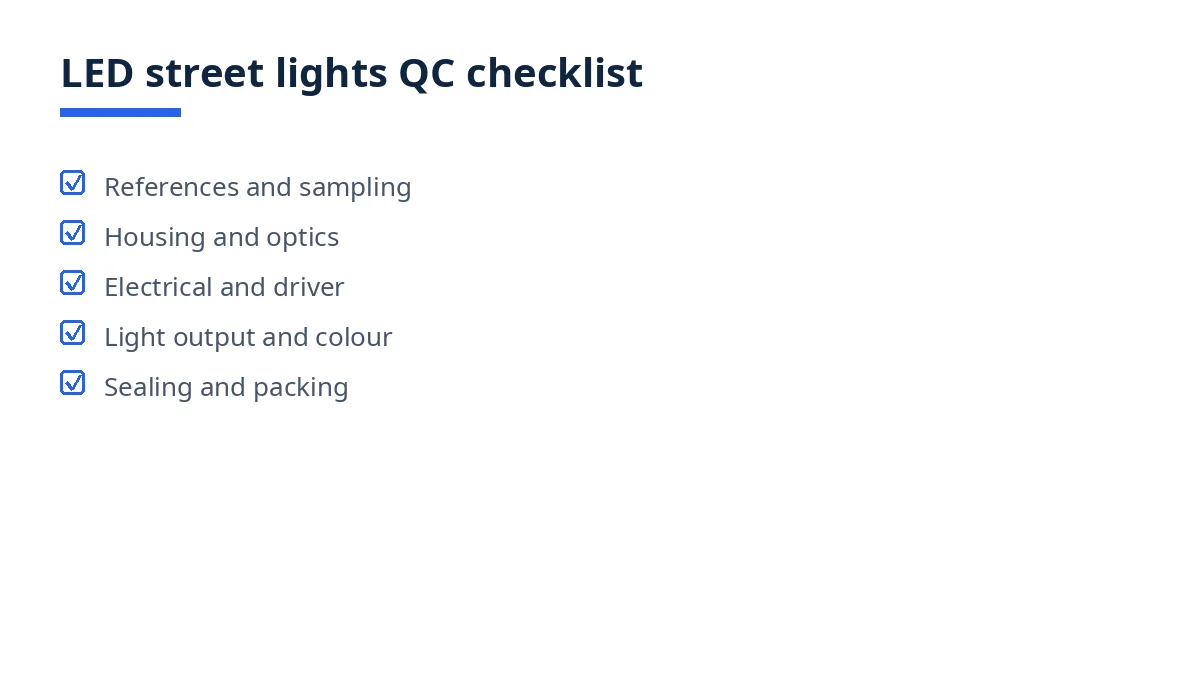
The full checklist (numbered, printable)
Documents, sample and sampling
Confirm the approved sample, datasheet, photometric file and specification match the model, wattage, colour temperature and mounting type in the order.
Confirm the sampling plan agreed in the order, and draw the sample randomly across models, wattages, colour temperatures and cartons.1
Confirm each test report and certificate names the model, the standard edition and the issuer, and covers the model shipped, not a related model only.
Housing, optics and mounting
Check the housing for cracks, dents, casting defects, sharp edges and damaged fins, and for an even finish with no bare metal or peeling.
Check the lens or cover for cracks, scratches, haze, yellowing and trapped dirt, and that it sits flat with no gap at any corner.
Check gaskets and seals for correct type and position, even compression, and no twisting, cuts or missing sections.
Check screws, bolts and fasteners for correct type and size, full seating, and no stripped threads or missing washers.
Check the mounting bracket or spigot against the specification and sample: fit, adjustment range, locking method and pole or arm size.
Fit a sampled unit to the mounting type named in the order where the factory can provide it, and check that it locks without forcing and holds its aim.
Check cable entries, glands and plugs for correct size, full seating and no damage to the cable sheath at the housing entry.
Electrical parts and driver
Check the driver marking against the order: model, input voltage range, output type and wattage class. Record any substitution as a failure.
Check internal wiring for correct routing, secure terminations, no pinched or bare conductors, no loose strands, and no wire on a sharp edge or hot surface.
Check terminal blocks and connectors for full seating, secure fixing, and no cracked housings or bent pins.
Check earthing parts, where the design requires them, for presence, connection and secure fixing, with no earth wire cut short or left loose.
Check surge protection, dimming, photocell and control parts named in the order for presence, correct type and secure connection.
Switch on each sampled unit and check that it starts without flicker, buzzing, repeated restarts or a dead section, and that any ordered control function responds as specified.
Light output and colour
Compare measured or reported light output for each model against the datasheet figure in the order, and record the report reference for every model.
Check luminous intensity distribution, peak intensity and beam angle evidence where the order requires it, because a wrong distribution lights the wrong part of the road even when total output matches.3
Check colour temperature and colour rendering evidence against the order for each colour temperature supplied, and check sampled units side by side for a visible colour shift within one model.3
Check for dark spots, dead LED sections, uneven brightness and colour patches on a lit sampled unit, viewed from the road side and from below.
Check rated input power evidence against the order, and confirm the figure is for the complete luminaire, not the LED module alone.3
Where the order names a lumen maintenance or life figure, check the report scope and measurement conditions, and record it as a report check, not a bench measurement.3
Sealing, ingress and outdoor durability
Check the enclosure protection rating marked on the unit against the rating named in the order and the certificate scope, and record any mismatch as a failure.4
Check seals after closing and reopening a sampled unit: the gasket must return to position without distortion, with no dust, water marks or insect debris inside.
Check corrosion protection on brackets, screws and exposed metal parts, including inside the bracket joint, for rust, white corrosion or coating damage.
Labels, markings and documents in the carton
Check the rating label on each sampled unit for model, input voltage, wattage class, protection rating and maker identification as named in the order.
Check that label, datasheet and carton marking agree on model, wattage and colour temperature, and that no carton mixes models or colour temperatures unless the packing list says so.
Check that installation, wiring and maintenance instructions in the carton match the model supplied, including mounting method and control wiring.
Packing and cartons
Check that each unit is packed as specified, with protection for lens, bracket and cable, and that no unit can move freely or bear another unit's weight inside the carton.
Check carton markings against the packing list: model, wattage, colour temperature, quantity, carton number and destination marking.
Weigh and measure sample cartons, and check carton count, pallet arrangement and strapping against the packing list.
Check that export markings, warnings and handling marks required by the order are present and legible, and that no carton is crushed, wet or torn at dispatch.
Common failures and how to fix them
The most frequent failure is a seal that looks closed but does not seal: a twisted or cut gasket, a lens frame that does not sit flat, or a cable gland never tightened. Stop, open a sampled unit, compare gasket and frame against the approved sample, and only then restart packing. Next is a driver or colour temperature substitution, where the unit lights but does not match the order: compare the driver marking and lit colour against the sample before more units are packed.
Uneven light or a dark LED section usually traces to one module or connection: segregate those units and re-inspect them as their own group. A bracket that does not fit the named pole size is a specification failure: check the fit against the sample mounting before the shipment is closed. Above the agreed acceptance level, options are re-inspection after sorting or rework, documented partial acceptance, or rejection.
Downloadable template / summary table
Copy the checklist into your inspection sheet, add the specification figures and acceptance numbers from the purchase order, and record a result for each unit.
Section | Checks | Evidence |
|---|---|---|
Documents and sampling | Sample, datasheet, reports, random draw | Report references |
Housing and mounting | Housing, lens, seals, bracket fit | Fit check |
Electrical and driver | Driver, wiring, earthing, controls | Marking check, switch-on test |
Light output and colour | Output, distribution, colour, power | Reports, side-by-side check |
Sealing and durability | Protection rating, seals, corrosion | Certificate scope, reopen check |
Labels and documents | Rating label, instructions, spares | Label check |
Packing | Protection, markings, carton count | Packing list |
How Exportain helps
Exportain is a B2B marketplace connecting buyers with Bangladeshi suppliers of LED street lights and industrial lighting, so the specifications behind this checklist can be agreed at enquiry stage. Browse suppliers, see the LED street lights import guide and the industrial lighting import guide, and use inspection services when you plan the check. Supplier profiles show which document and photo checks have been recorded, not factory inspections. Exportain is not a party to the goods contract and does not inspect goods.
FAQs
When should this checklist be used?
Use it at final inspection, when goods are finished, tested and packed. For larger and first orders, also use it in production, while seals, drivers and brackets can still be corrected.
Who should complete it?
The buyer, a local agent or an independent inspector can complete it, using the approved sample, specification and a randomly drawn sample.
What are the most common failures?
A seal that does not close, a substituted driver or colour temperature, uneven light or a dead LED section, and a bracket that does not fit the named pole size are the failures buyers find most often.
Can a third party do it?
Yes, if you share the approved references, tolerances and acceptance levels first.
Next steps on Exportain
Before production starts, agree your models, protection rating, photometric evidence and acceptance numbers, then read the AQL acceptance quality limit explainer and the pre-shipment inspection guide, and plan the check with inspection services. You can also post a free RFQ via RFQs and compare quotes from Bangladeshi suppliers.
Sources
- ISO 2859-1:2026 - Sampling procedures for inspection by attributes — Part 1: Sampling schemes indexed by acceptance quality limit (AQL) for lot-by-lot inspection. ISO (accessed )
- IEC 60598-2-3:2002+AMD1:2011 CSV - Luminaires - Part 2-3: Particular requirements - Luminaires for road and street lighting. International Electrotechnical Commission, (accessed )
- IEC 62722-2-1:2023 - Luminaire performance — Part 2-1: Particular requirements — LED luminaires. International Electrotechnical Commission (accessed )
- IEC 60529:1989 - Degrees of protection provided by enclosures (IP Code). International Electrotechnical Commission (accessed )
- pre-shipment inspection
- quality control
- aql inspection
- LED street lights
- Industrial lighting
- Bangladesh lighting
About the author
Sourcing from Bangladesh?
Post a request for quotation and suppliers on Exportain can send you their quotes directly.
Post an RFQ